












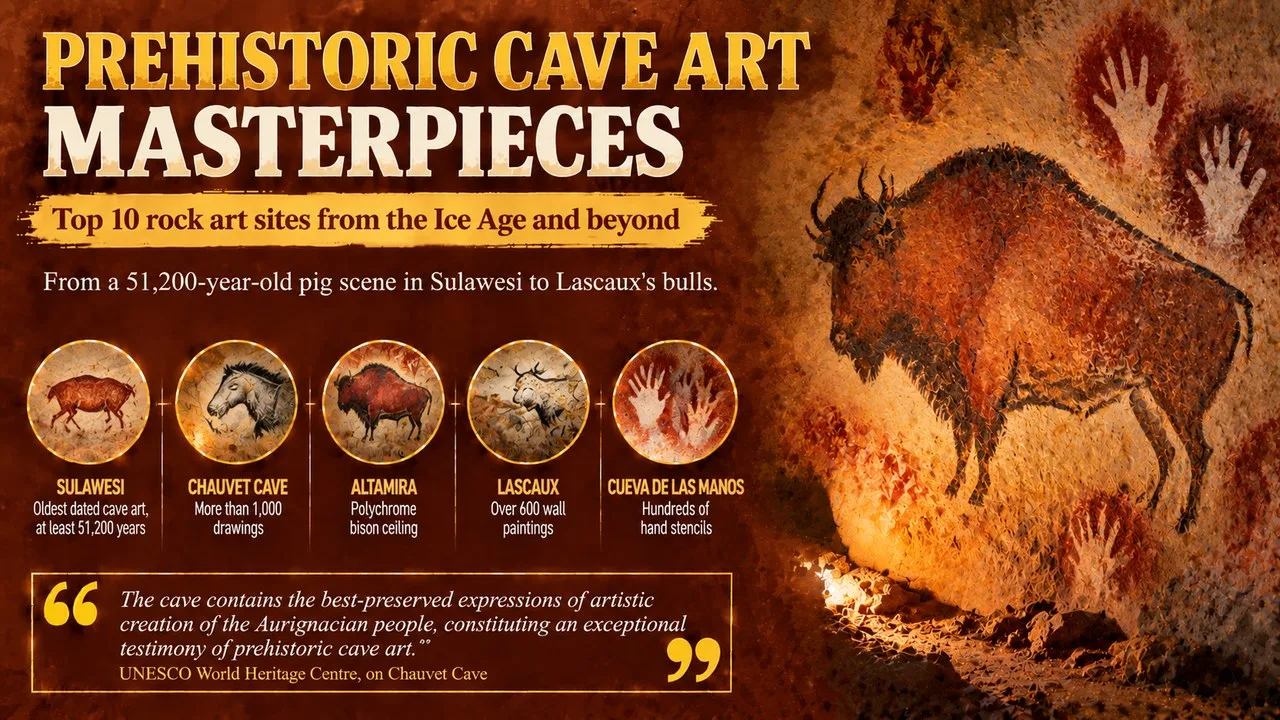
Prehistoric cave art masterpieces include a 51,200-year-old pig scene in Sulawesi, the lions of Chauvet, the bison of Altamira and the bulls of Lascaux.
This Finepedia guide, written in October 2026, looks at 10 of the most remarkable places where prehistoric people painted on rock, from Indonesia and Europe to Africa, India, Australia and South America. The facts come from UNESCO, published dating studies in Nature and Science Advances, and encyclopaedias. Dating ancient paint is difficult, and new results keep pushing ages back, so we give the most widely accepted figures and point out where experts still disagree. If you like hidden places underground, you may also enjoy Finepedia's guides to the most popular underground caves in the world and the oldest surviving buildings on Earth.
How We Chose These
We looked for rock art sites that are famous for their age, their beauty, the number of images they hold or what they reveal about early human life. Most are protected as UNESCO World Heritage Sites, and every inhabited continent except North America is represented. The list runs roughly from the oldest dated art to the youngest, though dates for several sites are still debated. For each site you will find a short profile, four key facts and one more note on why it matters or a surprising detail.
The 10 Cave Art Sites at a Glance
| No. | Site | Country | Approximate age of the art | Best known for |
|---|---|---|---|---|
| 1 | Maros-Pangkep and Muna caves | Indonesia | at least 51,200 to 67,800 years | oldest dated cave art |
| 2 | Chauvet Cave | France | about 37,000 to 28,000 years | lions, rhinos and horses |
| 3 | Cave of Altamira | Spain | earliest about 36,000 years | polychrome bison ceiling |
| 4 | Lascaux | France | 17,000–22,000 years | Hall of the Bulls |
| 5 | Ubirr, Kakadu | Australia | thousands of years, still repainted | X-ray style animals |
| 6 | Tadrart Acacus | Libya | from about 12,000 BC to AD 100 | a green Sahara |
| 7 | Bhimbetka rock shelters | India | earliest about 10,000 BC | India's oldest rock art |
| 8 | Serra da Capivara | Brazil | many thousands of years | densest cluster of sites in the Americas |
| 9 | Cueva de las Manos | Argentina | about 9,300 to 1,300 years ago | hundreds of hand stencils |
| 10 | Laas Geel | Somaliland (Somalia) | 5,500–4,500 years | decorated cattle |
1. Sulawesi Holds the Oldest Dated Cave Art
The limestone caves of the Indonesian island of Sulawesi now hold the oldest securely dated rock art known anywhere. In 2024, researchers reported that a ceiling panel at Leang Karampuang, in the Maros-Pangkep karst, showing three human-like figures beside a pig, was painted at least 51,200 years ago. In January 2026, a team announced an even older hand stencil from Liang Metanduno on the nearby island of Muna, with a minimum age of 67,800 years.
Key Facts
- Location: South and South-east Sulawesi, Indonesia
- Oldest scene: Leang Karampuang, at least 51,200 years old (Nature, 2024)
- Oldest stencil: Liang Metanduno, Muna, at least 67,800 years old (Nature, 2026)
- Method: uranium-series dating of mineral crusts that formed over the paint
Why It Matters
For a long time, Europe was seen as the birthplace of cave art. The Sulawesi finds turned that idea upside down. Scientists date tiny mineral growths, nicknamed cave popcorn, that formed on top of the pigment, so the results are minimum ages and the paint itself may be older still. An earlier find at Leang Tedongnge, a red pig 136 cm long dated to at least 45,500 years, was announced in 2021, before the new results beat it. The Muna stencil also has narrowed, pointed fingers, a style so far known only from Sulawesi.
2. Chauvet Cave Holds a Gallery of Ice Age Beasts
Chauvet Cave lies in a limestone cliff above the Ardèche River in southern France. Three cavers, including Jean-Marie Chauvet, after whom it is named, found it on 18 December 1994. Its walls hold more than 1,000 drawings, mostly of animals, and many show dangerous creatures, such as cave lions, bears and woolly rhinoceroses, that are rare in later art.
Key Facts
- Location: Vallon-Pont-d'Arc, Ardèche, France
- Age: two phases of use, about 37,000–33,500 years ago, then again 31,000–28,000 years ago
- Images: more than 1,000 drawings, according to UNESCO
- World Heritage: inscribed in 2014
Did You Know?
A rock fall sealed the entrance about 20,000 years ago. That kept the cave's climate stable and its art in near-perfect condition until 1994. To protect it, the real cave is closed to visitors. Instead, a full-size copy called the Caverne du Pont-d'Arc opened nearby in April 2015, and no bigger copy of a cave has ever been made. One famous panel shows two woolly rhinos clashing horns, an early attempt to show movement and action.
3. Altamira Was the First Cave Art Taken Seriously
The Cave of Altamira, near Santillana del Mar in Cantabria, northern Spain, is about 270 metres long. Its most famous feature is the Polychrome Ceiling, where red, black and ochre paint shows a herd of steppe bison, a species now extinct, standing and lying in many poses. The earliest marks in the cave are about 36,000 years old, while the famous bison belong to a much later phase, the Magdalenian.
Key Facts
- Location: Santillana del Mar, Cantabria, Spain
- Earliest art: about 36,000 years ago
- Discovered: by a local tiler, Modesto Cubillas, in 1868
- World Heritage: inscribed in 1985
Why It Matters
In 1879, María, aged just eight, led her father, the keen amateur scholar Marcelino Sanz de Sautuola, to the paintings, and he realised that the marks on the walls were paintings of animals. When he said the art was prehistoric, many experts mocked him and argued that early humans could not have painted so well. The argument lasted until 1902, when similar finds in France and Spain finally settled it. The cave has been closed to the general public since 2002, after green mould appeared on some paintings, and a replica stands nearby.
4. Lascaux Is Famous for Its Hall of the Bulls
Lascaux is a cave near Montignac in the Dordogne region of south-west France. It holds over 600 wall paintings of horses, deer, aurochs and other animals, along with many engravings. Most experts now place the art between 17,000 and 22,000 years ago. Its largest chamber, the Hall of the Bulls, contains some of the most famous images in prehistoric art.
Key Facts
- Location: Montignac, Dordogne, France
- Age: roughly 17,000–22,000 years old
- Found: on 12 September 1940 by Marcel Ravidat, then 18, and three friends
- World Heritage: inscribed in 1979, with other Vézère Valley sites
Did You Know?
Lascaux opened to the public in July 1948, but by 1955 the carbon dioxide, heat and moisture from about 1,200 visitors a day had visibly harmed the paint, and the cave was closed in 1963. Since then, visitors have seen copies instead. Lascaux II opened near the real cave in 1983, and Lascaux IV, a full-scale copy of almost the whole cave, opened in December 2016 inside a new centre devoted to cave wall art. A set of touring copies, called Lascaux III, has travelled the world since 2012.
5. Ubirr Shows Animals in X-Ray Style
Ubirr is a cluster of rocky hills rising beside a broad floodplain in Kakadu National Park, in Australia's Northern Territory. Its natural rock shelters are covered in Aboriginal paintings of fish, turtles, wallabies, goannas and other local animals. Many are painted in the X-ray style, which shows bones and inner organs as well as the outline of the animal.
Key Facts
- Location: Kakadu National Park, Northern Territory, Australia
- Style: X-ray art, Mimi spirit figures and creation ancestors
- Age: many layers, with most visible paintings about 2,000 years old
- World Heritage: Kakadu is listed for both natural and cultural value
Why It Matters
Ubirr is not a dead site. Aboriginal people have painted and repainted these walls over a very long period, and some images were renewed into modern times, so the art forms a living record of one of the oldest continuing cultures on Earth. One painting shows a thylacine, or Tasmanian tiger, an animal that disappeared from mainland Australia thousands of years ago, which proves how old some layers are. Indigenous rangers give talks to visitors at the main galleries.
6. Tadrart Acacus Remembers a Green Sahara
The Tadrart Acacus is a range of rocky mountains in the Sahara Desert of south-west Libya, near the border with Algeria and east of the town of Ghat. Thousands of paintings and carvings cover its cliffs and shelters. They show giraffes, elephants, ostriches and, later, cattle, horses and camels, along with people dancing, hunting and herding.
Key Facts
- Location: near Ghat, south-west Libya
- Age: from about 12,000 BC to AD 100
- Name: in Berber, adrar means mountain and Tadrart is its feminine form
- World Heritage: inscribed in 1985
Why It Matters
The animals painted here could never survive in today's Sahara. The art is a picture diary of climate change, showing how a land of lakes and grasslands slowly became desert, and how people moved from hunting wild game to herding animals. Sadly, UNESCO reports describe deliberate damage to at least ten rock art sites since 2009, including names carved beside ancient images and chemicals used to rub paintings away.
7. Bhimbetka Holds India's Oldest Rock Art
The Bhimbetka rock shelters lie in central India, some 45 km from the city of Bhopal in Madhya Pradesh. More than 750 shelters are spread over seven hills in the sandstone foothills of the Vindhya Range. People were living in some of them over 100,000 years ago, and the oldest paintings date to about 10,000 BC.
Key Facts
- Location: Raisen district, Madhya Pradesh, India
- Size: over 750 shelters spread across seven hills
- Earliest paintings: about 10,000 BC, in the Mesolithic
- World Heritage: inscribed in 2003
Did You Know?
The name means Bhima's resting place, after the strong hero of the Mahabharata, who is said to have rested here during his exile. The archaeologist V. S. Wakankar noticed the unusual rock formations, thought they resembled the painted caves of Spain and France, and reported the shelters in 1957. The paintings show hunting, dancing, music and animals, while later scenes add warriors on horseback, so the site records thousands of years of change in one place.
8. Serra da Capivara Is a Treasure House of the Americas
Serra da Capivara National Park lies in the dry north-east of Brazil, in the state of Piauí. The name means Capybara Hills. Its sandstone cliffs shelter hundreds of painted sites, with scenes of hunting, dancing, animals and daily life. It is home to the largest and oldest cluster of prehistoric sites known in the Americas.
Key Facts
- Location: Piauí, north-east Brazil
- Created: as a national park in 1979
- Best-known site: the Pedra Furada rock shelter
- World Heritage: inscribed in 1991
Why It Matters
The park is at the centre of a lively debate about when people first reached South America. The archaeologist Niède Guidon, who led work here for decades, argued that some finds were far older than the standard timeline allowed. Stone tools at one site, Toca da Tira Peia, may be up to 22,000 years old. Many scholars still question the oldest claims, but the sheer number of painted sites makes the park one of the most important places for studying early American life.
9. Cueva de las Manos Is Covered in Painted Hands
Known in English as the Cave of the Hands, Cueva de las Manos sits at the foot of a stepped cliff above the Pinturas River, in the Patagonian province of Santa Cruz, Argentina. It takes its name from the hundreds of hand stencils that cover the walls in overlapping clusters. The site also shows guanacos, a wild relative of the llama, and lively hunting scenes.
Key Facts
- Location: Pinturas River canyon, Santa Cruz, Argentina
- Age: about 9,300 to 1,300 years ago, according to UNESCO
- Pigments: red and purple iron oxides, white kaolin, yellow and black minerals
- World Heritage: inscribed in 1999
Did You Know?
The hands are negative stencils. A person pressed a hand to the rock and sprayed paint around it, leaving the outline behind. Researchers found remains of bone tubes that were used to blow the paint, and these helped to date the art. One count found 829 left hands and only 31 right hands, which suggests most painters held the tube in their right hand. The people who made them were hunter-gatherers, possibly ancestors of the Tehuelche people of Patagonia.
10. Laas Geel Shows Cattle Dressed for a Ceremony
Laas Geel is a set of rock shelters on the outskirts of Hargeisa, in the self-declared state of Somaliland, which most of the world regards as part of Somalia. Its bright red, white and yellow paintings show cattle with decorated necks, often wearing what look like ceremonial robes, beside human figures with raised arms. The art is usually dated to between about 5,500 and 4,500 years ago.
Key Facts
- Location: near Hargeisa, Somaliland, Horn of Africa
- Age: roughly 5,500–4,500 years old
- Brought to world attention: by a French survey team in late 2002
- Subjects: long-horned cattle, a dog, a giraffe and people
Why It Matters
Local people had known about the paintings for centuries, but the outside world only learned of them after the 2002 survey. Laas Geel gives rare evidence of early cattle herders in the Horn of Africa, and its paintings have survived in remarkably good condition. It is not a World Heritage Site, so careful local protection is vital for its future.
Frequently Asked Questions
What is the oldest cave painting in the world?
As of October 2026, the oldest securely dated rock art is a hand stencil in Liang Metanduno cave on Muna island, Indonesia, with a minimum age of 67,800 years. The oldest dated scene with figures is the pig and human-like figures at Leang Karampuang in Sulawesi, at least 51,200 years old.
Can you visit Lascaux and Chauvet?
The original caves are closed to protect the paintings, but you can visit detailed full-size copies. Lascaux IV stands near Montignac, and the Caverne du Pont-d'Arc reproduces Chauvet a few kilometres from the real cave.
Conclusion
From a pig scene in an Indonesian cave to painted cattle in the Horn of Africa, these ten sites show that people were making art on every continent long before writing existed. They record lost animals, changing climates and the beliefs of the very first artists. For more ancient wonders, read Finepedia's guides to the most popular underground caves in the world and the oldest surviving buildings on Earth.
- Nature, Narrative cave art in Indonesia by 51,200 years ago, 2024.
- Nature, Rock art from at least 67,800 years ago in Sulawesi, January 2026.
- Brumm, A. et al., Oldest cave art found in Sulawesi, Science Advances, 2021.
- UNESCO World Heritage Centre, Decorated Cave of Pont d'Arc, known as Grotte Chauvet-Pont d'Arc, Ardèche, whc.unesco.org/en/list/1426.
- UNESCO World Heritage Centre, Cueva de las Manos, Río Pinturas, whc.unesco.org/en/list/936.
- UNESCO World Heritage Centre, Serra da Capivara National Park, whc.unesco.org/en/list/606.
- Reuters, Hand stencil in Indonesian cave seen as the oldest-known rock art, 21 January 2026.
- Wikipedia (accessed October 2026), articles on Chauvet Cave, Lascaux, Cave of Altamira, Ubirr, Tadrart Acacus, Bhimbetka rock shelters, Serra da Capivara National Park, Cueva de las Manos and Laas Geel.
- 10 Most Today, 10 Mesmerizing Prehistoric Cave Paintings, 10mosttoday.com (topic reference).


















Log in with