




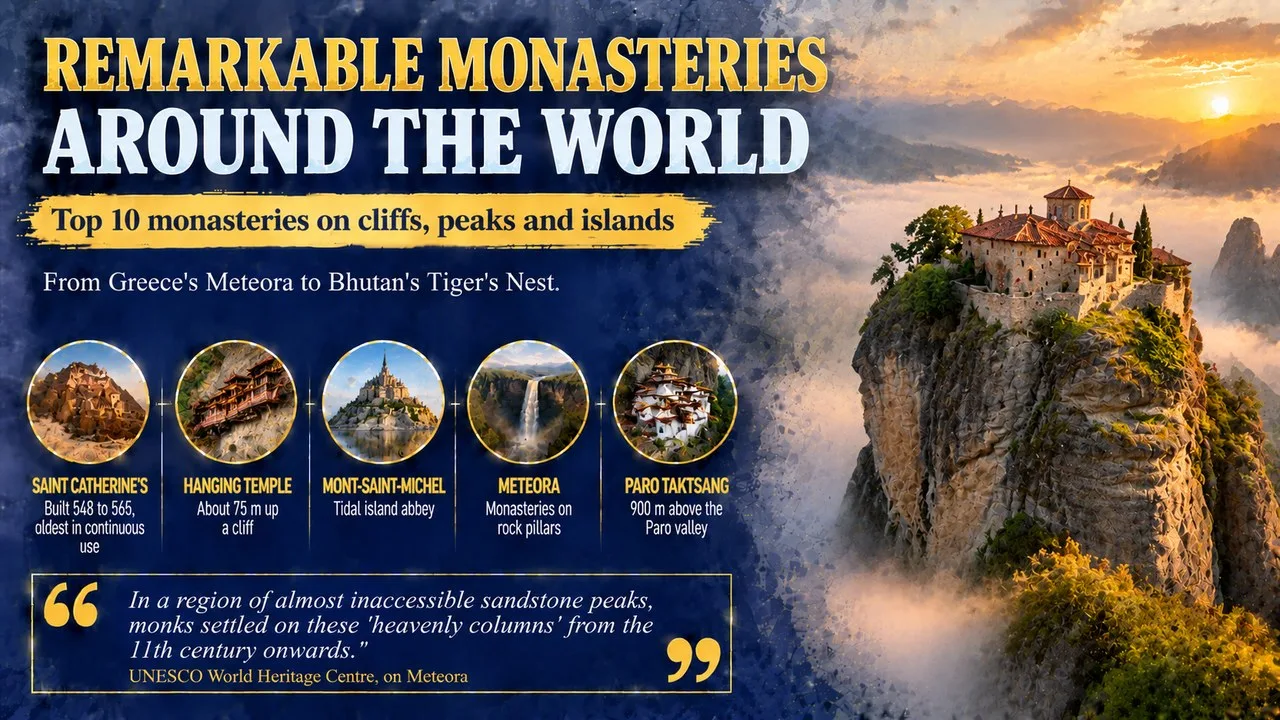
Remarkable monasteries around the world include Greece's rock-top Meteora, Bhutan's cliffside Tiger's Nest and Egypt's Saint Catherine's below Mount Sinai.
This Finepedia guide, written in October 2026, looks at 10 of the most striking monasteries on Earth, from desert valleys and tidal islands to sheer cliffs and mountain ridges. The facts come from UNESCO, the communities and authorities that care for these places, and encyclopaedias. Many founding dates come from tradition rather than written records, so we say where a date is a legend or still debated. If you enjoy historic places, you may also like Finepedia's guides to the best-preserved medieval towns in Europe and famous walls that shaped history.
How We Chose These
We picked ten monasteries that are famous for their setting, their age, their art or their importance to the faiths that built them. The list covers Christian and Buddhist communities across three continents, and most of the sites are protected by UNESCO. It runs roughly by founding date, from the earliest traditions to the youngest building. For each one you will find a short profile, four key facts and one more note on why it matters or a surprising detail.
The 10 Monasteries at a Glance
| No. | Monastery | Country | Founded | Best known for |
|---|---|---|---|---|
| 1 | Geghard | Armenia | 4th century by tradition, main church 1215 | churches carved into a cliff |
| 2 | Sümela | Turkey | about AD 386 by tradition | clinging to a cliff face |
| 3 | Hanging Temple | China | AD 491 by legend | held up on wooden beams |
| 4 | Saint Catherine's | Egypt | 548 to 565 | oldest continuously inhabited |
| 5 | Mont-Saint-Michel | France | 708 by legend, abbey from 966 | tidal island abbey |
| 6 | Rila | Bulgaria | 10th century | painted arcades |
| 7 | Montserrat | Spain | 1025 | saw-toothed mountain |
| 8 | Kyiv Pechersk Lavra | Ukraine | about 1051 | caves beneath the churches |
| 9 | Meteora | Greece | 14th century | monasteries on rock pillars |
| 10 | Paro Taktsang | Bhutan | 1692 | Tiger's Nest above a valley |
1. Geghard Is Carved Out of a Mountain
Geghard is a monastery from the Middle Ages in Armenia's Kotayk province, set in the gorge of the Azat River. Some of its churches stand as normal buildings, while others are hollowed straight out of the rock, with rooms and chapels cut deep into the cliff. Its name means spear, after a relic said to be the lance that pierced Jesus at the Crucifixion.
Key Facts
- Location: Azat River gorge, Kotayk province, Armenia
- Founded: traditionally by Gregory the Illuminator, in the 300s
- Main church: built in 1215
- World Heritage: inscribed in 2000, with the upper Azat Valley
Did You Know?
The site was first called Ayrivank, the Cave Monastery, because it grew up around a holy spring in a cave. The spear relic that later gave it the name Geghard is now kept in the treasury of Etchmiadzin, the mother church of Armenia. Many visitors combine a trip with the nearby Temple of Garni, a classical-style temple lower down the same valley.
2. Sümela Clings to a Cliff in Northern Turkey
Sümela is an old Greek Orthodox monastery, no longer in use, high in the Pontic range of Trabzon province, near Turkey's Black Sea coast. It is built into a steep rock face about 1,200 metres up, looking over the forested Altındere valley. Today it is a museum inside Altındere National Park and one of the region's best-known sights.
Key Facts
- Location: Maçka, Trabzon province, Turkey
- Founded: by tradition around AD 386, under Emperor Theodosius I
- Height: about 1,200 m above sea level
- Recent history: closed in 2015 because of falling rocks, reopened in 2019
Why It Matters
Its fame came from an icon of Mary, the Panagia, which legend says was painted by the Apostle Luke. It was restored by many rulers and took on the shape we see today in the 1200s, during the Empire of Trebizond. The monks left after the exchange of populations between Greece and Turkey in 1923. On 15 August 2010, an Orthodox service was allowed there for the first time in decades, and later services have drawn pilgrims from Greece and beyond.
3. The Hanging Temple Is Pinned to a Sheer Cliff
The Hanging Temple, also called Xuankong Temple, is fixed to a cliff face roughly 75 metres up, close to Mount Heng in Shanxi province, northern China. Its halls and walkways seem to float in mid-air, resting on wooden beams set into holes cut in the rock. The closest city is Datong, about 64 kilometres away.
Key Facts
- Location: near Mount Heng, Hunyuan County, Shanxi, China
- Founded: by legend in AD 491, by a monk named Liaoran
- Height: about 75 m above the ground
- Faiths: honours Buddhism, Taoism and Confucianism together
Did You Know?
The slender poles under the temple are not its main support. Its real support comes from oak crossbeams fixed deep into the cliff, with the main frame hidden inside the rock. The building sits under an overhang in a small canyon, which shields it from rain and harsh sunlight. It is one of very few temples to bring together all three of China's traditional teachings in one place.
4. Saint Catherine's Has Housed Monks for Almost 1,500 Years
Saint Catherine's Monastery stands beneath Mount Sinai in Egypt's Sinai Peninsula. It went up between the years 548 and 565 on the orders of Justinian I, the Byzantine emperor, and it is the oldest Christian monastery still in use without a break. Inside its walls grows a bush that the monks identify as the burning bush from the story of Moses.
Key Facts
- Location: foot of Mount Sinai, South Sinai, Egypt
- Built: 548 to 565, under Emperor Justinian I
- Church: Greek Orthodox, under the autonomous Church of Sinai
- World Heritage: inscribed in 2002, as part of the Saint Catherine Area
Why It Matters
The monastery is sacred to Jews, Christians and Muslims, and it even contains a small Fatimid mosque built in 1106. Its library is one of the most important in the world for early Christian books. It once held most of the Codex Sinaiticus, one of the oldest surviving handwritten copies of the Bible, and it still keeps a rare group of early icons, including the oldest known image of Christ Pantocrator. The monastery was later named after Catherine of Alexandria, whose relics are kept there.
5. Mont-Saint-Michel Rises From the Tides
Mont-Saint-Michel is a rocky tidal island about one kilometre off the coast of Normandy, France, crowned by a great medieval abbey. The tides in its bay are among the strongest in Europe, with a gap of about 14 metres between high and low water. Pilgrims once crossed the sands at low tide, and the sea also made the island hard to attack.
Key Facts
- Location: Normandy, north-west France
- Founded: by legend in 708, when the archangel Michael appeared to Bishop Aubert
- Visitors: more than three million a year
- World Heritage: inscribed in 1979, with its bay
Did You Know?
The island was never captured during the Hundred Years' War, and a small garrison beat off an English attack in 1433. Later, French kings used the abbey as a prison, and it stayed one until the 19th century. In 2014, a light footbridge replaced the old raised road, so that the tide can once again flow around the island and wash away the silt that had built up. Only about 23 people live on the island itself.
6. Rila Is Bulgaria's Painted Mountain Monastery
Rila Monastery sits in a deep valley of the Rila Mountains at about 1,147 metres above sea level, around 117 kilometres south of Sofia. No Orthodox monastery in Bulgaria is bigger or better known. Its striped arches, wooden balconies and brightly painted galleries make it one of the most photographed buildings in the Balkans.
Key Facts
- Location: Rila Mountains, south-west Bulgaria
- Founded: in the 10th century, by followers of Saint Ivan of Rila, a hermit
- Frescoes: completed in 1846 by masters including Zahari Zograf
- World Heritage: inscribed in 1983
Why It Matters
Saint Ivan lived as a hermit in a nearby cave, and his students built the first monastery around his memory. During the long period of Ottoman rule, Rila helped keep Bulgarian language, learning and identity alive, so it is seen as a national symbol. The present buildings mostly date from 1834 to 1862, after a fire in 1833, and are a leading example of the Bulgarian National Revival style. Its image was even printed on Bulgaria's one-lev note of 1999.
7. Montserrat Sits Among Jagged Peaks
Santa Maria de Montserrat is a Benedictine abbey high on the mountain of Montserrat, about 48 kilometres north-west of Barcelona in Catalonia, Spain. The name means saw-toothed mountain, after the strange rows of rocky pinnacles that rise around it. The abbey keeps the Virgin of Montserrat, a dark wooden statue of Mary that is the patron saint of Catalonia.
Key Facts
- Location: Monistrol de Montserrat, Catalonia, Spain
- Founded: 1025, rebuilt in the 19th and 20th centuries
- Community: around 70 to 80 monks
- Access: by road, a rack railway or a cable car
Did You Know?
The Escolania, the abbey's choir of boys, ranks among Europe's oldest and still sings in the basilica. The statue of Mary is known locally as La Moreneta, the little dark one, because of its dark face. Many young people from across Catalonia hike up the mountain overnight to watch the sunrise from its peaks, and in good weather you can see as far as Mallorca from the top of Sant Jeroni.
8. The Kyiv Pechersk Lavra Hides a World Underground
The Kyiv Pechersk Lavra, known in English as the Monastery of the Caves in Kyiv, is a large Orthodox monastery on the hills above the Dnipro River in Kyiv, Ukraine. It began in the 11th century as a cave monastery, when a monk named Anthony, who had lived on Mount Athos, settled in a cave and was soon joined by followers. Gold-domed churches now stand above the caves.
Key Facts
- Location: Pechersk district, Kyiv, Ukraine
- Founded: in 1051 or 1074, as recorded in the old Primary Chronicle
- Name: pechera means cave, and lavra means a senior monastery
- World Heritage: inscribed in 1990, together with Saint Sophia Cathedral
Why It Matters
For centuries the Lavra was the leading centre of Orthodox Christianity across Eastern Europe. The monks' press played a big part in the early history of printing in Ukraine. Beneath the churches run two networks of narrow passages, the Near Caves and the Far Caves, where the remains of many monks, including the chronicler Nestor, lie in their resting places. Pilgrims still walk through the caves by candlelight.
9. Meteora Floats on Pillars of Rock
Meteora is a group of giant rock pillars rising from the plain of Thessaly in central Greece, near the town of Kalabaka. Monks began building monasteries on their summits in the 14th century, and twenty-four were eventually founded. Six survive today, and the name means lofty or raised high.
Key Facts
- Location: Kalabaka, Thessaly, Greece
- Oldest major house: the Great Meteoron, founded in 1356
- Today: six monasteries survive, and four are still active, one of them a convent
- World Heritage: inscribed in 1988
Did You Know?
For centuries, the only way up some of the rocks was by long ladders or by being hauled up in a net on a rope, and the ladders could be pulled up whenever the monks felt threatened. Steps were finally cut into the rock in the 1920s, making the climb much easier. Geologists are still debating exactly how the pillars formed, since they are not volcanic plugs like many other tall rock towers.
10. Paro Taktsang Is Bhutan's Tiger's Nest
Paro Taktsang, known in English as the Tiger's Nest, clings to a cliff at about 3,120 metres, some 900 metres above the Paro valley in Bhutan. The main temple was built in 1692 around a cave where Guru Padmasambhava, who brought Vajrayana Buddhism to Bhutan, is said to have meditated in the early 800s, before he left Tibet.
Key Facts
- Location: upper Paro valley, Bhutan
- Built: 1692, around a sacred meditation cave
- Height: about 3,120 m, roughly 900 m above the valley floor
- Disaster: a fire in April 1998 badly damaged the main building, restored by 2005
Why It Matters
Legend says Padmasambhava arrived here riding through the air on a tigress, which gave the place its name. The monastery has become the best-known image of Bhutan and a symbol of the country. Most visitors reach it on foot along a steep mountain path that takes several hours. After the 1998 fire, the government and the then king, Jigme Singye Wangchuck, oversaw a careful rebuilding that restored it to its old form.
Frequently Asked Questions
What is the oldest monastery in the world still in use?
Saint Catherine's Monastery in Egypt, built between 548 and 565, is widely described as the oldest Christian monastery that has been lived in without a break. Some other religious communities claim older roots, but their buildings have not been used continuously.
Can you visit these monasteries?
Yes, all ten welcome visitors, though some have dress codes, set opening hours or parts that are closed to the public. At working monasteries, visitors are asked to respect the quiet and the daily prayers of the community.
Conclusion
From a cliffside nest in the Himalayas to a desert monastery at Mount Sinai, these ten places show how far people have gone to find quiet, safety and closeness to the sacred. Many are still home to living communities. For more history, read Finepedia's guides to the best-preserved medieval towns in Europe and famous walls that shaped history.
- UNESCO World Heritage Centre, Monastery of Geghard and the Upper Azat Valley, whc.unesco.org/en/list/960.
- UNESCO World Heritage Centre, Saint Catherine Area, whc.unesco.org/en/list/954.
- UNESCO World Heritage Centre, Mont-Saint-Michel and its Bay, whc.unesco.org/en/list/80.
- UNESCO World Heritage Centre, Rila Monastery, whc.unesco.org/en/list/216.
- UNESCO World Heritage Centre, Meteora, whc.unesco.org/en/list/455.
- UNESCO World Heritage Centre, Kyiv: Saint-Sophia Cathedral and Related Monastic Buildings, Kyiv-Pechersk Lavra, whc.unesco.org/en/list/527.
- Wikipedia (accessed October 2026), articles on Geghard, Sümela Monastery, Hanging Temple, Saint Catherine's Monastery, Mont-Saint-Michel, Rila Monastery, Montserrat Abbey, Kyiv Pechersk Lavra, Meteora and Paro Taktsang.
- 10 Most Today, 10 Most Breathtaking Monasteries in the World, 10mosttoday.com (topic reference).













Log in with