


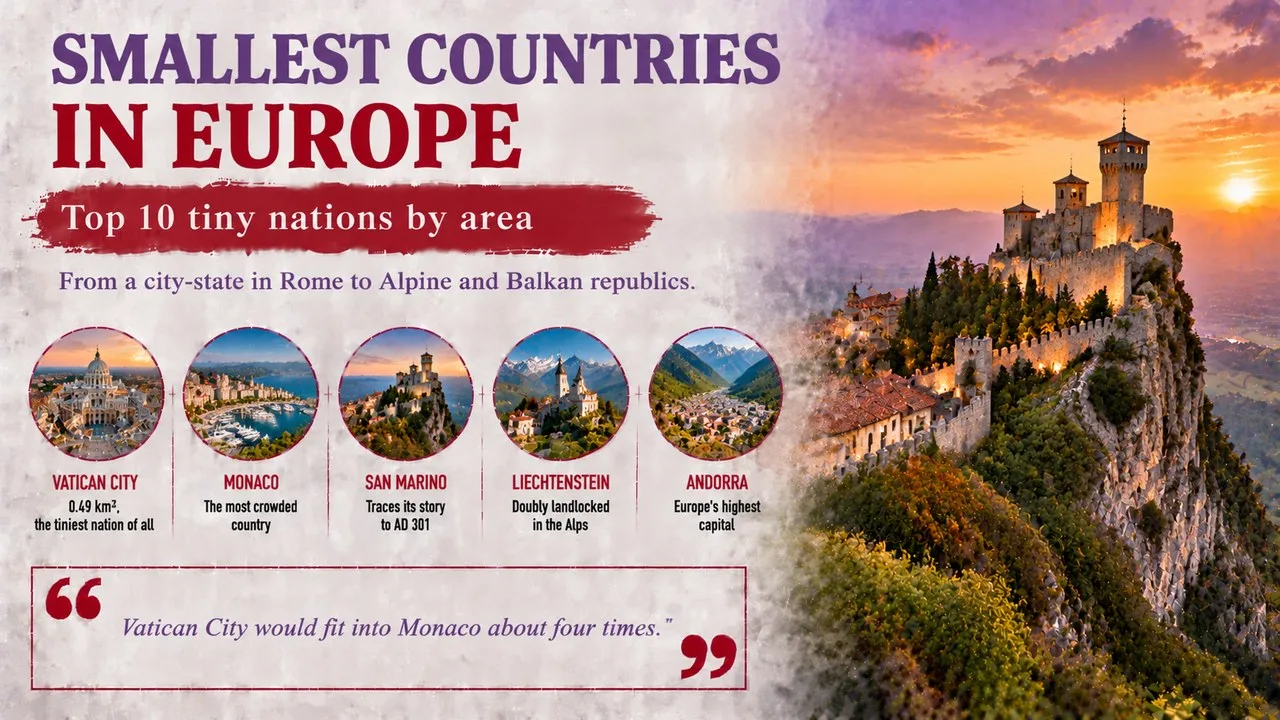
Smallest countries in Europe start with Vatican City, under half a square kilometre, then Monaco and San Marino, tiny states you can cross on foot.
This Finepedia guide, written in October 2026, ranks Europe's 10 smallest independent countries by area, from the pope's city-state in Rome to the Alpine and Balkan republics. Every entry lists its area, its population and what sets it apart. To explore more of Europe, see the Finepedia guides Largest Countries in Europe by Area: Top 10 and Best-Preserved Medieval Towns in Europe: Top 10.
How We Chose These
The ranking uses total area, including inland water, as published by the United Nations and national statistics offices, checked against Wikipedia's list of European countries by area. We counted only fully recognised sovereign states. Kosovo, at about 10,900 square kilometres, would sit between Cyprus and Montenegro, but it is not recognised by every country. Cyprus is included because it belongs to the EU and the Council of Europe, although geographically the island lies off the coast of West Asia. Population figures are the latest official estimates and change from year to year.
The 10 Smallest Countries in Europe at a Glance
| Rank | Country | Area (km²) | Population (about) | Capital |
|---|---|---|---|---|
| 1 | Vatican City | 0.49 | 880 | Vatican City |
| 2 | Monaco | 2.08 | 38,400 | Monaco |
| 3 | San Marino | 61 | 33,600 | City of San Marino |
| 4 | Liechtenstein | 160 | 41,400 | Vaduz |
| 5 | Malta | 316 | 588,000 | Valletta |
| 6 | Andorra | 468 | 90,000 | Andorra la Vella |
| 7 | Luxembourg | 2,586 | 696,000 | Luxembourg City |
| 8 | Cyprus | 9,251 | 918,000 (south) | Nicosia |
| 9 | Montenegro | 13,812 | 633,000 | Podgorica |
| 10 | Slovenia | 20,271 | 2,100,000 | Ljubljana |
1. Vatican City Is the Tiniest Nation of All
Vatican City is a walled enclave inside Rome and the home of the pope, who rules it as an absolute monarch. It covers just 0.49 square kilometres, making it both the smallest and the least populous country in the world.
Key Facts
- Area: 0.49 square kilometres
- Population: about 880
- Founded: 1929, by the Lateran Treaty with Italy
- Landmarks: the papal basilica, the Sistine Chapel and the Vatican Museums
Did You Know?
The pope's personal guard, the Swiss Guard, is the only part of the old papal armed forces that was kept when Pope Paul VI disbanded the rest in 1970. Its members are Swiss Catholic men and still wear their striped Renaissance-style uniforms.
2. Monaco Is the Most Crowded Country
Monaco sits on the French Riviera, wrapped by France on three sides and facing the Mediterranean on the fourth. With about 38,400 people on roughly 2 square kilometres, no country on Earth packs more people into each square kilometre.
Key Facts
- Area: about 2.08 square kilometres
- Rulers: the House of Grimaldi, with short breaks, since 1297
- Coastline: about 3.8 km, the shortest of any country with a coast
- Famous for: the Monte Carlo Casino and the Monaco Grand Prix
Why It Matters
Fewer than 10,000 of Monaco's residents are Monégasque citizens; most are foreigners drawn by its wealth and lifestyle. It joined the UN as a full member only in 1993, and its head of state, Prince Albert II, keeps real political power.
3. San Marino Traces Its Story to AD 301
Ringed on every side by Italian territory, San Marino clings to the flanks of Monte Titano, a short way inland from the Adriatic. It says it was founded in AD 301, which would make it the oldest surviving sovereign state and constitutional republic in the world.
Key Facts
- Area: about 61 square kilometres
- Population: about 33,600
- Capital: the hilltop town of San Marino on Monte Titano
- Heads of state: two Captains Regent, chosen every six months
Did You Know?
Its name honours Saint Marinus, a stonemason who, legend says, escaped the Roman emperor Diocletian's persecution of Christians. The two Captains Regent come from opposing parties and share power equally, a custom that guards against any one leader becoming too strong.
4. Liechtenstein Is Locked Between the Alps
Liechtenstein lies in the Alps between Switzerland and Austria. Only one other nation, Uzbekistan, shares its status as doubly landlocked, meaning that it is surrounded by countries that themselves have no coast.
Key Facts
- Area: about 160 square kilometres
- Population: about 41,400
- Formed: 1719, fully independent from 1866
- Currency: the Swiss franc
Why It Matters
Liechtenstein is the smallest country in the world to border two other countries. Although outside the EU, it belongs to the Schengen zone and the wider European single market area (EEA), and it is headed by Prince Hans-Adam II, who has reigned since 1989.
5. Malta's Temples Are Older Than the Pyramids
Malta is an island nation in the middle of the Mediterranean, south of Sicily, made up mainly of the islands of Malta, Gozo and Comino. It is the smallest member of the EU and ranks among the world's most crowded nations.
Key Facts
- Area: about 316 square kilometres
- Population: about 588,000 (2025 census)
- Independence: 1964, from the UK
- Languages: Maltese and English
Did You Know?
From around 3500 BC, early Maltese farmers raised huge stone temples, older than Stonehenge and the pyramids of Giza and among the earliest freestanding structures anywhere. UNESCO now protects several of them as a single World Heritage listing.
6. Andorra Has Europe's Highest Capital
Andorra sits high in the eastern Pyrenees between France and Spain. It is the largest of Europe's microstates and has an unusual pair of heads of state: the Catalan Bishop of Urgell and France's president, who serve together as co-princes.
Key Facts
- Area: about 468 square kilometres
- Population: about 90,000
- Capital: Andorra la Vella, at 1,023 metres, the highest in Europe
- Language: Catalan
Why It Matters
Andorra's shared rule goes back to a charter of 1278. Today the country lives largely from tourism, with about 8 million visitors a year coming to ski, hike and shop tax-free.
7. Luxembourg Is the Last Grand Duchy
Luxembourg lies between Belgium, Germany and France and is the world's only remaining grand duchy, now headed by Grand Duke Guillaume V. Its capital ranks among the EU's main institutional centres.
Key Facts
- Area: about 2,586 square kilometres
- Population: about 696,000, almost half of them foreign nationals
- Languages: Luxembourgish, French and German
- EU role: hosts the EU's highest court
Did You Know?
In 2020 the Grand Duchy made buses, trams and trains free for everyone, a world first for a whole country. Measured by income per person, it ranks among the wealthiest nations anywhere.
8. Cyprus Is a Divided Island
Only Sicily and Sardinia are bigger than Cyprus among Mediterranean islands; it lies south of Turkey and west of Syria. Since 1974 the island has been split, with the internationally recognised government in the south and a breakaway northern state recognised only by Turkey.
Key Facts
- Area: about 9,251 square kilometres, including the north
- Population: about 918,000 in the south (2021 census)
- Capital: Nicosia, split in two by a buffer zone
- EU membership: 2004, with the euro adopted in 2008
Why It Matters
A UN buffer zone, known as the Green Line, runs across the island and through the middle of Nicosia. In ancient times the island was famous for its copper, and the Latin word for the metal, cuprum, comes from the phrase "metal of Cyprus".
9. Montenegro Is Small but Mountainous
Montenegro is a Balkan country on the Adriatic coast, bordered by Croatia, Bosnia and Herzegovina, Serbia, Kosovo and Albania. Its name means "black mountain", and much of the land is rugged and forested.
Key Facts
- Area: about 13,800 square kilometres
- Population: about 633,000
- Independence: June 2006, after a referendum
- Currency: the euro, although it is not in the EU
Did You Know?
The country has two capitals of a sort: Podgorica is the seat of government, while Cetinje, the old royal capital, is still called the cultural centre. Its coast includes the dramatic Bay of Kotor, ringed by steep mountains.
10. Slovenia Has Just 47 km of Coast
Slovenia is a mostly mountainous and forested country in Central Europe, bordered by Italy, Austria, Hungary and Croatia. Its coast on the Adriatic Sea is only about 46.6 km long.
Key Facts
- Area: about 20,271 square kilometres
- Population: about 2.1 million
- Capital: Ljubljana
- EU membership: 2004, with the euro adopted in 2007
Why It Matters
Slovenia was the first former Yugoslav republic to join the EU and the first to use the euro. Its landscapes range from the Julian Alps to the caves of the Karst region, which gave the word karst to science.
Frequently Asked Questions
Which is the smallest country in Europe?
Vatican City is the smallest country in Europe and in the world, covering only 0.49 square kilometres inside Rome. Monaco, at about 2 square kilometres, is second.
What are the European microstates?
Europe's microstates are usually listed as Andorra, Liechtenstein, Malta, Monaco, San Marino and Vatican City. All six are very small in area and population, but each is a fully independent country.
Conclusion
From the pope's walled city to the Alpine valleys of Liechtenstein, Europe's smallest countries pack a great deal of history into very little space. Several are among the richest and best-loved places to visit on the continent. To explore more of Europe, read the Finepedia guides Largest Countries in Europe by Area: Top 10 and Best-Preserved Medieval Towns in Europe: Top 10.
- United Nations Statistics Division, Demographic Yearbook, area of countries.
- Eurostat, population and area statistics for EU members.
- UNESCO World Heritage Centre, Megalithic Temples of Malta.
- Government of Luxembourg, free public transport (2020).
- Wikipedia (accessed October 2026): List of European countries by area, European microstates, Vatican City, Monaco, San Marino, Liechtenstein, Malta, Andorra, Luxembourg, Cyprus, Montenegro and Slovenia.
- 10 Most Today, 10 Smallest Countries in Europe, 10mosttoday.com (topic reference).










Log in with