









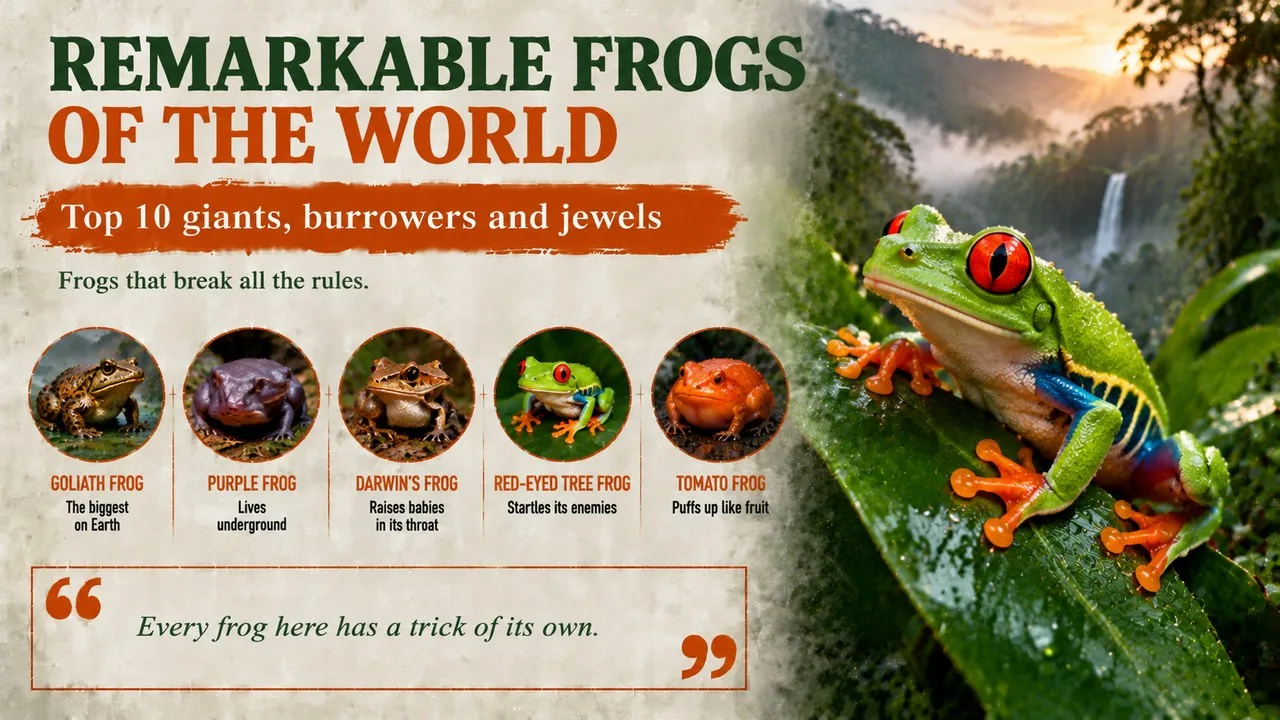
Remarkable frogs of the world include the goliath frog, which tops 3 kg, a purple frog that lives underground and a father that raises young in his throat.
This Finepedia guide, written in October 2026, introduces 10 of the most unusual frogs on Earth, from African giants and Indian burrowers to tiny jewel-coloured species from Madagascar. For every frog we describe its home, what makes it special and how it is doing in the wild. For more on amphibians and rainforest wildlife, see the Finepedia guides Top 10 Most Dangerous Amphibians and Amazing Animals of the Amazon Rainforest: Top 10.
How We Chose These
We picked frogs that are unusual in size, colour, shape or breeding habits, and that are well studied enough for their facts to be checked. The glass frog and the poison dart frogs are left out because they already feature in our Amazon and dangerous amphibians guides. Sizes are given as snout-to-vent length, the usual way scientists measure frogs, which leaves out the legs. Facts come from Wikipedia and the IUCN Red List, checked against zoo and research sources. The order is a guide to how striking each frog is, not a scientific ranking.
The 10 Remarkable Frogs at a Glance
| Rank | Frog | Where it lives | Size | Stand-out feature |
|---|---|---|---|---|
| 1 | Goliath frog | Cameroon and Equatorial Guinea | up to about 35 cm | the largest living frog |
| 2 | Purple frog | Western Ghats, India | about 7 cm | lives almost all its life underground |
| 3 | Darwin's frog | Chile and Argentina | 2 to 3 cm | males raise young in the vocal sac |
| 4 | Horned (Pacman) frogs | South America | varies by species | a huge mouth |
| 5 | Red-eyed tree frog | Central America | about 5 to 7.5 cm | bright red eyes |
| 6 | Panamanian golden frog | Panama | 3.5 to 6.3 cm | waves at other frogs |
| 7 | Vietnamese mossy frog | Vietnam, Laos and China | about 6 to 9 cm | looks like moss |
| 8 | Golden mantella | Madagascar | 2 to 2.6 cm | glowing orange skin |
| 9 | Malagasy rainbow frog | Madagascar | 2 to 4 cm | climbs canyon walls |
| 10 | Tomato frog | Madagascar | females to 10.5 cm | puffs up and oozes glue |
1. The Goliath Frog Is the Biggest on Earth
The goliath frog lives in fast-flowing rivers in the rainforests of Cameroon and Equatorial Guinea. It is the largest frog alive today, and with its legs stretched out the biggest individuals can measure more than 80 cm from nose to toe.
Key Facts
- Scientific name: Conraua goliath
- Heaviest confirmed: about 3.3 kg, a frog caught in 1960
- Body length: up to about 35 cm, not counting the legs
- Threats: hunting for food, forest loss and the pet trade
Did You Know?
Goliath frogs build their own nurseries. Adults clear out pools beside rivers, sometimes pushing aside heavy stones to dam them, and then guard the eggs at night. Scientists think their great size helps them shift rocks that smaller frogs could never move.
2. The Purple Frog Lives Underground
The purple frog, also called the pignose frog, has a bloated purple body, tiny eyes and a pointed snout. It lives in the Western Ghats mountains of southern India and spends most of the year buried in the soil, where it feeds on termites.
Key Facts
- Scientific name: Nasikabatrachus sahyadrensis
- Formally described: 2003, though its tadpole was recorded back in 1917
- Above ground: only about two weeks a year, during the monsoon, to breed
- Closest relatives: tiny frogs found only in the Seychelles
Why It Matters
Its nearest cousins live thousands of kilometres away in the Seychelles. That link dates back to when India and the Seychelles were joined in an ancient supercontinent, making the purple frog a living clue to how the continents drifted apart.
3. Darwin's Frog Raises Babies in Its Throat
This little, leaf-like frog comes from the cool forests of southern Chile and Argentina, with a fleshy point on the end of its nose. Charles Darwin found it during the voyage of HMS Beagle, and it was named after him in 1841.
Key Facts
- Scientific name: Rhinoderma darwinii
- Size: roughly 2 to 3 cm
- Parenting: the male keeps the developing tadpoles in his vocal sac
- Status: Endangered on the IUCN Red List
Did You Know?
When the eggs begin to wriggle, the father swallows them into his vocal sac, where the young grow until they hop out as tiny froglets. Its only close relative, the northern Darwin's frog, has not been seen since 1981 and is feared extinct.
4. Horned Frogs Are Living Pac-Men
South American horned frogs are nicknamed Pacman frogs because their round bodies and enormous mouths recall the video game character. They sit half-buried among leaves and ambush almost anything that fits in their jaws, from insects to mice and other frogs.
Key Facts
- Genus: Ceratophrys, with eight species
- Range: South America
- Hunting style: sit and wait, then lunge
- In the wild: usually live 1 to 4 years
Why It Matters
Horned frogs are among the most popular pet frogs in the world, and a captive-bred hybrid called the fantasy frog is widely sold. Their bold appetite has made them a favourite of keepers, but they need careful feeding to stay healthy.
5. The Red-Eyed Tree Frog Startles Its Enemies
Few frogs are photographed as often as the red-eyed tree frog, with a bright green body, blue and yellow flanks, orange feet and vivid red eyes. It lives in the rainforests of Central America and north-western South America.
Key Facts
- Scientific name: Agalychnis callidryas
- Habits: active at night and lives in trees
- Poison: none, despite its bright colours
- Eggs: laid on leaves that hang over water
Did You Know?
If a snake or wasp attacks a clutch, the embryos inside can sense the danger and hatch early, falling into the water below to escape. By day the frog tucks in its legs and closes its eyes, and then flashes its colours to startle any predator that disturbs it.
6. The Panamanian Golden Frog Waves Hello
The Panamanian golden frog is bright gold with black spots and is a national symbol of Panama. Despite its name it is really a toad, and it once lived along mountain streams in the cloud forests of the west-central part of the country.
Key Facts
- Scientific name: Atelopus zeteki
- Status: Critically Endangered, and possibly gone from the wild since 2007
- Poison: its skin holds zetekitoxin, a powerful nerve toxin
- Main threat: chytridiomycosis, a fungal disease
Why It Matters
Living beside noisy streams, these frogs talk with their hands. They wave their front feet at rivals and mates, a kind of semaphore. Zoos now keep breeding groups in the hope of one day returning the species to the wild.
7. The Vietnamese Mossy Frog Hides in Plain Sight
The Vietnamese mossy frog is covered in bumpy green and brown skin that looks exactly like moss on a wet rock. It lives in rainforest caves and cliffs in northern Vietnam, southern China and parts of Laos.
Key Facts
- Scientific name: Theloderma corticale
- Size: about 6 cm, with females reaching 8 to 9 cm
- Defence: curls into a ball and plays dead
- Altitude: found between about 470 and 1,500 metres
Did You Know?
Breeding takes place in water-filled tree holes and rock hollows, sometimes inside hollow logs that local villagers have set out. When frightened, the frog rolls up and lies still, so a predator sees only a lump of moss.
8. The Golden Mantella Glows Like a Flame
The golden mantella is a tiny orange, yellow or red frog from the forests of east-central Madagascar. Its fiery colour is a warning: like the poison dart frogs of South America, it stores toxins in its skin.
Key Facts
- Scientific name: Mantella aurantiaca
- Size: 20 to 26 mm
- Range: a few small areas around the town of Moramanga
- Habits: active by day, often in groups with more males than females
Why It Matters
Because it lives in such a small area, the golden mantella is among the most threatened frogs in Madagascar. Forest clearing and collection for the pet trade put it at risk, and it is bred in zoos around the world as a back-up population.
9. The Malagasy Rainbow Frog Climbs Canyon Walls
This Madagascan species wears a smooth coat of bold green, black, white and rusty orange patches, as if painted by hand. It lives only in the Isalo Massif, a sandstone region of south-central Madagascar with deep, narrow canyons.
Key Facts
- Scientific name: Scaphiophryne gottlebei
- Size: about 2 to 4 cm, with females larger
- Feet: claws for clinging to rock and spurs for digging
- Status: rated Endangered by the IUCN
Did You Know?
This little frog can both burrow and climb. Hard spurs on its back feet let it dig into the ground, while claws on its front feet help it scale the steep canyon walls of its rocky home.
10. The Tomato Frog Puffs Up Like Fruit
The tomato frog is a plump orange-red frog from north-eastern Madagascar, named for its colour and round shape. It lives in swamps, shallow pools and slow streams around Antongil Bay.
Key Facts
- Scientific name: Dyscophus antongilii
- Females: as long as 10.5 cm, weighing up to 230 g
- Males: far smaller, around 6.5 cm long and 41 g
- Status: Near Threatened, with trade controlled by CITES
Why It Matters
When threatened, the tomato frog puffs itself up and releases a sticky white substance from its skin that gums up the mouth of an attacking snake. In people it can cause an allergic reaction, so it is best admired rather than handled.
Frequently Asked Questions
What is the largest frog in the world?
The goliath frog of West Africa is the largest living frog. The heaviest confirmed specimen weighed about 3.3 kg, and its body can reach about 35 cm, or more than 80 cm with the legs stretched out.
Why are so many frogs endangered?
Frogs face habitat loss, pollution, collection for the pet trade and a deadly fungal disease called chytrid. Amphibians are now among the most threatened groups of animals on Earth, and several on this list depend on zoo breeding to survive.
Conclusion
From a rock-moving giant in Cameroon to a father that carries his young in his throat, these ten frogs show how inventive amphibians can be. Many are under threat, which makes protecting their forests and streams more urgent than ever. For more on amphibians and rainforest wildlife, read the Finepedia guides Top 10 Most Dangerous Amphibians and Amazing Animals of the Amazon Rainforest: Top 10.
- IUCN Red List of Threatened Species, assessments for the species listed.
- AmphibiaWeb, species accounts (University of California, Berkeley).
- Schäfer, M. and others, "Goliath frogs build nests for spawning", Journal of Natural History, 2019.
- Smithsonian's National Zoo and Conservation Biology Institute, Panamanian golden frog.
- Wikipedia (accessed October 2026): Goliath frog, Nasikabatrachus sahyadrensis, Darwin's frog, Ceratophrys, Agalychnis callidryas, Atelopus zeteki, Theloderma corticale, Mantella aurantiaca, Scaphiophryne gottlebei and Dyscophus antongilii.
- 10 Most Today, 10 Coolest Frogs in the World, 10mosttoday.com (topic reference).
















Log in with