











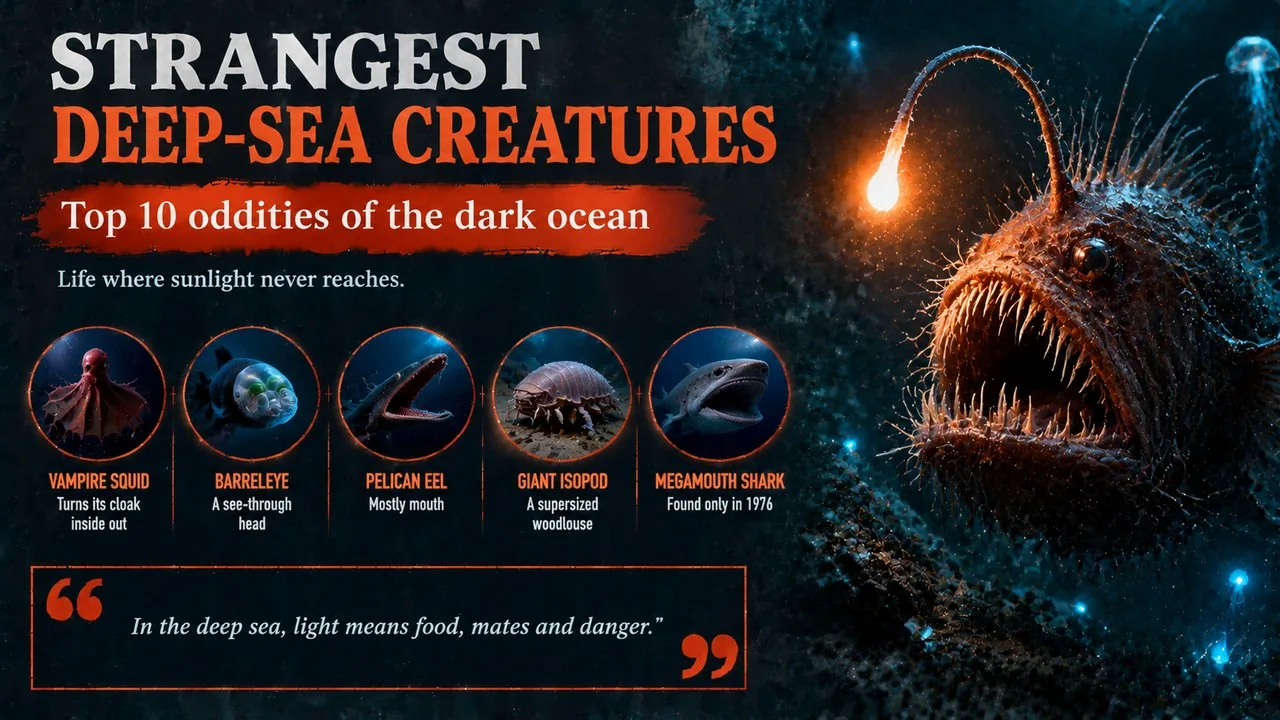
Strangest deep-sea creatures include the vampire squid, a barreleye fish with a see-through head and the pelican eel, whose mouth can swallow big prey.
This Finepedia guide, written in October 2026, introduces 10 of the oddest animals living in the dark waters hundreds or thousands of metres below the surface. Every entry explains how deep it lives, what makes it look so unusual and how its body helps it survive. For more ocean life, see the Finepedia guides Most Dangerous Sea Creatures: Top 10 and Longest-Living Animals on Earth: Top 10.
How We Chose These
Our picks are animals that spend most of their adult lives below about 200 metres, where sunlight fades out, and that look or behave in truly surprising ways. We left out the ocean sunfish, which appears in some similar lists but mostly lives near the surface. Facts come from ocean research centres such as MBARI in California, museum records and encyclopaedias. Many of these animals have rarely been seen alive, so sizes and depths are approximate. The order is a guide, not a scientific ranking.
The 10 Strangest Deep-Sea Creatures at a Glance
| Rank | Creature | Typical depth | Size | Strangest feature |
|---|---|---|---|---|
| 1 | Vampire squid | 600 to 900 m or more | up to about 30 cm | turns its cloak inside out |
| 2 | Pacific barreleye | 600 to 800 m | about 15 cm | see-through head |
| 3 | Pelican eel | deep open ocean | about 75 cm | mouth bigger than its body |
| 4 | Common fangtooth | 500 to 5,000 m | about 18 cm | huge teeth for its size |
| 5 | Giant isopod | sea floor | up to about 36 cm | can go years without food |
| 6 | Megamouth shark | deep water, rises at night | 4 to 5.5 m | rubbery lips, filter feeder |
| 7 | Pacific viperfish | midwater, rises at night | up to about 30 cm | fangs too big for its mouth |
| 8 | Footballfish | deep open ocean | females up to 60 cm | glowing lure on its head |
| 9 | Pacific blackdragon | 500 to 2,000 m | females much larger than males | ultra-black skin |
| 10 | Glass squid | surface to over 2 km | 10 cm to over 3 m | almost transparent body |
1. The Vampire Squid Lives Where Oxygen Is Scarce
The vampire squid is a small cephalopod of tropical and temperate oceans. Despite its scary scientific name, Vampyroteuthis infernalis, meaning "vampire squid from hell", it is gentle and feeds on drifting scraps of dead matter, not blood.
Key Facts
- Depth: about 600 to 900 metres, in waters very low in oxygen
- Size: up to about 30 cm long
- Family: sole survivor of an ancient order, closest to octopuses
- First described: 1903, by the German zoologist Carl Chun
Did You Know?
When threatened, the vampire squid pulls its webbed arms up over its body like a cloak, showing rows of soft spines. Scientists call this the "pineapple" posture. If an arm tip is bitten off, it can grow back.
2. The Barreleye Has a See-Through Head
The Pacific barreleye is a small fish whose head is topped by a clear, fluid-filled dome. Through it you can see its bright green tube-shaped eyes, which gather the faint light coming from above.
Key Facts
- Scientific name: Macropinna microstoma
- Depth: about 600 to 800 metres
- Size: about 15 cm
- Discovery: in 2008, MBARI researchers found that its eyes can rotate
Why It Matters
For years scientists believed those eyes could not move, giving it only a view straight up. Film from deep-sea robots showed that the eyes swivel forward to follow prey, while the clear shield protects them from the stings of the jellies it steals food from.
3. The Pelican Eel Is Mostly Mouth
The pelican eel, also called the gulper eel, has a loosely hinged jaw that makes up about a quarter of its length. It can open this pouch-like mouth wide enough to swallow animals larger than itself, though it mainly eats small shrimps and other crustaceans.
Key Facts
- Scientific name: Eurypharynx pelecanoides
- Size: about 75 cm, possibly up to 1 metre
- Tail: long and whip-like, ending in a light organ
- Fragility: specimens are often damaged when hauled up from the depths
Did You Know?
The tip of the pelican eel's tail glows pink and gives off red flashes, which may lure prey towards that enormous mouth. Eels caught in nets have been found with their long tails tied in several knots.
4. The Fangtooth Has Giant Teeth for Its Size
The common fangtooth is a small, dark fish with a big, bony head and a mouth full of long fangs. It is said to have the largest teeth of any ocean fish compared with its body size.
Key Facts
- Scientific name: Anoplogaster cornuta
- Depth: adults usually 500 to 5,000 metres
- Size: about 18 cm
- Young: live near the surface and look so different that they were once thought to be another species
Why It Matters
The fangtooth's lower fangs are so long that it has sockets on each side of its brain to hold them when its mouth is shut. Despite its fierce looks, this little fish is harmless to people and is not caught for food.
5. The Giant Isopod Is a Supersized Woodlouse
Giant isopods are relatives of garden woodlice that crawl the sea floor in three of the world's great oceans. They are a classic case of deep-sea gigantism, growing far bigger than their shallow-water cousins.
Key Facts
- Best-known species: Bathynomus giganteus
- Size: usually 19 to 36 cm
- Diet: scavenges carcasses that sink down to the seabed
- First described: 1879, by the French zoologist Alphonse Milne-Edwards
Did You Know?
Giant isopods can survive long famines. A captive isopod at Japan's Toba Aquarium refused food for about five years, until its death in 2014, and became famous across the country.
6. The Megamouth Shark Was Found Only in 1976
The megamouth shark is a rare, slow-moving filter feeder with a huge head and rubbery lips. It cruises along with its jaws agape, straining krill, jellyfish and other small animals from the water.
Key Facts
- Scientific name: Megachasma pelagios
- Size: about 4 to 5.5 metres
- Discovery: caught by a US Navy research vessel off Hawaii on 15 November 1976
- Sightings: fewer than 300 specimens recorded
Why It Matters
The megamouth was so unlike any known shark that scientists placed it in its own family. Of the three living sharks that feed by filtering, it is the smallest; the whale shark and basking shark are both far bigger.
7. The Viperfish Has Fangs Too Big for Its Mouth
The Pacific viperfish hunts in the dark waters of the North Pacific, rising towards the surface at night to feed. Its needle-like fangs are so long that they stick out beyond its jaws and reach up near its eyes.
Key Facts
- Scientific name: Chauliodus macouni
- Size: up to about 30 cm
- Skin: ultra-black, to hide from other animals' light
- Light: rows of glowing photophores along its belly
Did You Know?
The viperfish uses its belly lights to blend in with the faint glow from above, so predators below cannot see its outline. Its dark skin reflects almost no light at all.
8. The Footballfish Carries Its Own Lantern
Footballfish are round, deep-sea anglerfish found in warm waters around the globe. Females carry a fleshy lure on their heads that glows to attract prey in the darkness.
Key Facts
- Family: Himantolophidae, with 23 species
- First described: 1837, from a fish washed ashore in Greenland
- Female size: up to about 60 cm
- Male size: only about 4 cm
Why It Matters
The huge size difference between female and male footballfish is one of the most extreme in the animal world. It helps scientists study how deep-sea animals find mates in a vast, dark habitat where meetings are rare.
9. The Pacific Blackdragon Absorbs Almost All Light
The Pacific blackdragon is a long, thin dragonfish of the Pacific Ocean, recorded along the US Pacific coast as well as the Gulf of Mexico. Its skin is among the darkest of any animal, an ideal coat for a hunter that must not be seen.
Key Facts
- Scientific name: Idiacanthus antrostomus
- Depth: about 500 to 2,000 metres
- Skin: absorbs about 99.95 per cent of light falling on it
- Lure: a glowing barbel hangs from its chin
Did You Know?
Female blackdragons are much larger than males, which are small and larva-like. The species' ultra-black skin resembles Vantablack, the super-dark coating made by people.
10. Glass Squid Are Almost Invisible
Glass squid are a family of about 60 species with see-through bodies, which hide them from hunters in the open ocean. Young glass squid live near the surface and move deeper as they grow, some living more than 2 km down.
Key Facts
- Family: Cranchiidae
- Species: about 60
- Size: from about 10 cm to over 3 metres
- Biggest member: the colossal squid, the heaviest invertebrate alive
Why It Matters
Some glass squid have light organs on their eyes that cancel out their shadows from below. It shows how the deep sea has produced some of the most clever camouflage in nature.
Frequently Asked Questions
How do deep-sea creatures survive the pressure?
Most deep-sea animals have soft, watery bodies and no air spaces that could be crushed. Special proteins and chemicals in their cells also keep them working under pressure hundreds of times greater than at the surface.
Why do so many deep-sea animals glow?
In the dark, light is used to find food, attract mates and hide. Many deep-sea animals make their own light, called bioluminescence, using chemical reactions in special organs.
Conclusion
From the cloaked vampire squid to the see-through barreleye, the deep ocean is full of animals that look like they come from another world. Scientists have explored only a small part of it, so many more surprises are waiting. For more ocean life, read the Finepedia guides Most Dangerous Sea Creatures: Top 10 and Longest-Living Animals on Earth: Top 10.
- Monterey Bay Aquarium Research Institute (MBARI), barreleye and vampire squid research.
- Robison, B. H. and Reisenbichler, K. R. (2008), Macropinna microstoma and the paradox of its tubular eyes, Copeia.
- Davis, A. L. et al. (2020), Ultra-black camouflage in deep-sea fishes, Current Biology.
- Wikipedia (accessed October 2026): Vampire squid, Macropinna microstoma, Pelican eel, Anoplogaster cornuta, Giant isopod, Megamouth shark, Pacific viperfish, Footballfish, Idiacanthus antrostomus and Cranchiidae.
- 10 Most Today, 10 Most Unusual Deep-Sea Creatures, 10mosttoday.com (topic reference).
















Log in with