










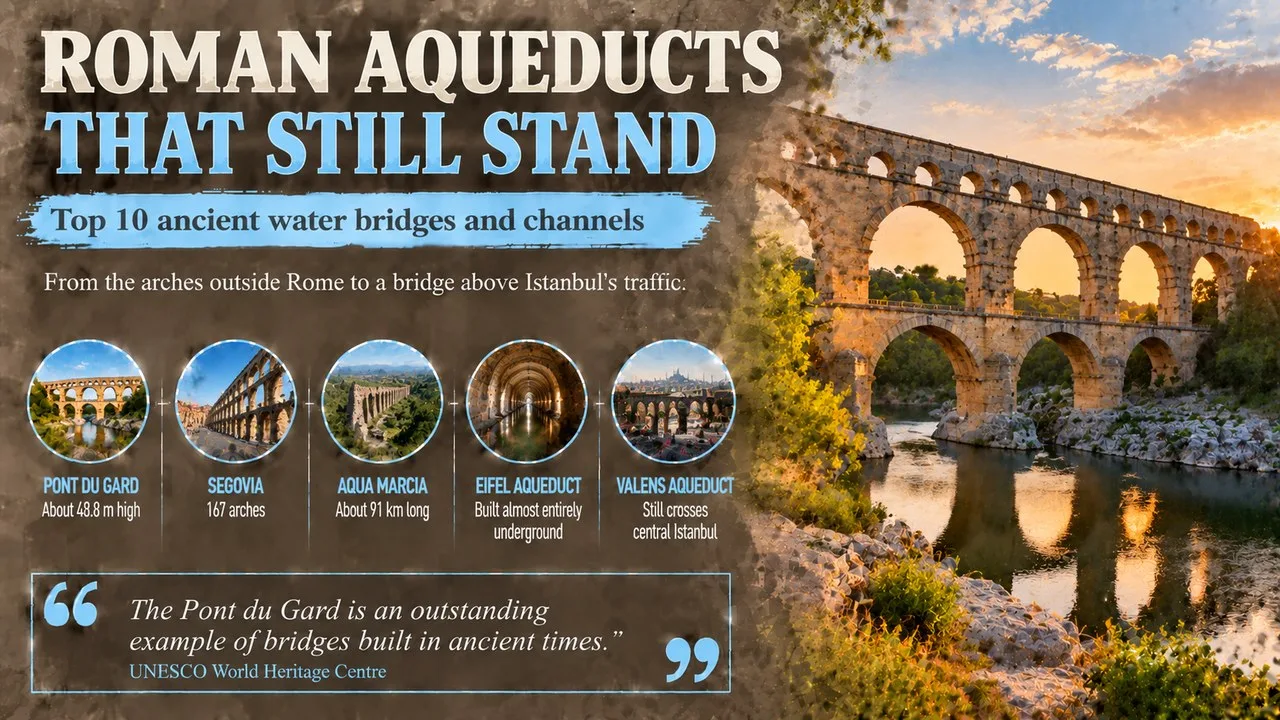
Roman aqueducts that still stand include France's soaring Pont du Gard, Segovia's 167 granite arches in Spain and the Valens Aqueduct crossing Istanbul.
This Finepedia guide, written in October 2026, looks at 10 of the finest surviving Roman aqueducts, from the arches outside Rome to bridges in France, Spain, Germany, Israel, Tunisia and Turkey. The facts come from UNESCO, archaeological studies and encyclopaedias. Many building dates are still debated by experts, so we give the most widely accepted estimate and say when a figure is uncertain. If you enjoy great feats of old engineering, you may also like Finepedia's guides to famous man-made arches in the world and spectacular fountains of the world.
How We Chose These
We looked for aqueducts that were built or begun in Roman times and that still have impressive remains you can see today, whether a towering bridge, a long line of arches or a rare underground channel. We also wanted a spread of places across the old empire. The list runs roughly in order of building date. Each entry has a short profile, four key facts and one more note on why it matters or a surprising detail.
The 10 Roman Aqueducts at a Glance
| No. | Aqueduct | Country | Built | Standout fact |
|---|---|---|---|---|
| 1 | Aqua Marcia | Italy | 144 to 140 BC | longest of Rome's eleven aqueducts |
| 2 | Les Ferreres Aqueduct | Spain | probably under Augustus | nicknamed the Devil's Bridge |
| 3 | Pont du Gard | France | mid-1st century AD | tallest Roman aqueduct bridge, 48.8 m |
| 4 | Aqua Claudia | Italy | AD 38 to 52 | arches over 30 m high near Rome |
| 5 | Aqueduct of the Miracles | Spain | 1st century AD | granite and red brick pillars |
| 6 | Caesarea Aqueduct | Israel | 1st century AD | in use for about six centuries |
| 7 | Eifel Aqueduct | Germany | about AD 80 | built almost entirely underground |
| 8 | Aqueduct of Segovia | Spain | about AD 100 | carried water until 1973 |
| 9 | Zaghouan Aqueduct | Tunisia | 2nd century AD | about 132 km long |
| 10 | Valens Aqueduct | Turkey | completed in the 370s AD | still crosses central Istanbul |
1. The Aqua Marcia Was Rome's Longest Water Line
The Aqua Marcia was built between 144 and 140 BC, when Rome's two older aqueducts could no longer meet demand. It ran for about 91 km from springs in the hills east of the city, making it the longest of the eleven aqueducts that eventually served ancient Rome. It was named after the magistrate who oversaw the work, the praetor Quintus Marcius Rex.
Key Facts
- Built: 144 to 140 BC
- Length: about 91 km
- Paid for: largely with treasure taken from Corinth and Carthage in 146 BC
- First: the first aqueduct to reach Rome on raised arches, for its final 11 km
Why It Matters
The Marcia set the pattern for the great aqueducts that followed. Romans prized its cold, clear water, and the line was repaired and enlarged by Augustus and by later emperors over several centuries. Experts count it as one of Rome's four great aqueducts, together with the Anio Vetus, the Anio Novus and the Aqua Claudia. Parts of its arches can still be seen on the edge of the modern city and in the countryside near Tivoli.
2. Tarragona's Les Ferreres Aqueduct Is the Devil's Bridge
About 4 km north of Tarragona, on Spain's Catalan coast, a two-storey bridge of golden stone crosses a wooded valley. It once carried part of the channel that brought water from the Francolí river to Tarraco, one of the main Roman cities in Spain. Local people call it the Pont del Diable, or Devil's Bridge, a name given to several old bridges in Europe.
Key Facts
- Date: probably the reign of Augustus, around the turn of the eras
- Height: up to 27 m
- Length: 249 m
- Arches: 25 on the upper tier and 11 on the lower
Did You Know?
All the arches were built to the same span of 20 Roman feet, about 5.9 m, with a difference of no more than about 15 cm between them, a sign of the careful planning behind Roman engineering. The bridge belongs to the Tarraco group of Roman remains, which was added to the UNESCO World Heritage List in 2000.
3. The Pont du Gard Is the Tallest Roman Aqueduct Bridge
Standing in the south of France, the bridge called the Pont du Gard is the best-known Roman aqueduct in the world. Built around the mid-1st century AD, its three tiers of limestone arches carry the water channel across the Gardon river at a height of about 48.8 m. The bridge was one part of a winding channel about 50 km long that supplied the Roman city of Nemausus, now Nîmes.
Key Facts
- Height: about 48.8 m, the tallest of all Roman aqueduct bridges
- Route: about 50 km from springs near Uzès to Nîmes
- Supply: an estimated 40,000 cubic metres of water a day
- World Heritage: listed by UNESCO in 1985
Why It Matters
The engineers managed a fall of roughly 1 cm for every 182 m of channel, an extraordinary level of precision for the period. After the aqueduct stopped working, the bridge survived largely because it was useful as a toll crossing, and local lords and bishops kept it in repair. It drew writers and artists from the 18th century onwards, and in 2000 the traffic was moved away and a visitor centre opened nearby.
4. The Aqua Claudia Marches Across the Roman Countryside
The Aqua Claudia was begun by the emperor Caligula in AD 38 and completed by Claudius in AD 52. Its channel ran for about 69 km, mostly underground, before rising onto arches for the last stretch into the city. As the ground fell away towards Rome, those arches climbed to more than 30 m, and long rows of them still stand in the fields south-east of the capital.
Key Facts
- Built: AD 38 to 52
- Length: about 69 km
- Flow: around 185,000 cubic metres in a day
- Entry: crossed into Rome at the Porta Maggiore gate
Did You Know?
The best place to see the Claudia today is the Parco degli Acquedotti, a large public park on the south-eastern edge of Rome. Its tall ruined arches are so striking that film-makers have used them many times. In the opening scene of Federico Fellini's La Dolce Vita, a helicopter carries a statue of Christ along the line of the Aqua Claudia towards the city.
5. Mérida's Aqueduct of the Miracles Earned Its Name From Awe
Mérida, in western Spain, was the Roman city of Emerita Augusta, capital of the province of Lusitania. Of the aqueducts that supplied it, the most dramatic survivor is a row of 38 tall pillars striding across a valley on the edge of town. Later inhabitants gave the ruin its name, the Aqueduct of the Miracles, because they marvelled that it was still standing.
Key Facts
- Built: 1st century AD, with later work around AD 300
- Height: about 25 m
- Surviving length: roughly 830 m
- Source: the Proserpina reservoir, about 5 km north-west of the city
Why It Matters
The pillars are built of granite blocks banded with layers of red brick, a mixed technique that gives the ruin its striped look. The ruin is protected within Mérida's wider group of Roman monuments, which UNESCO listed in 1993 and which ranks among the biggest Roman sites in Spain. The Proserpina dam that fed it is itself a Roman work, and its reservoir still holds water today.
6. The Caesarea Aqueduct Ran Beside the Mediterranean
Caesarea, on the coast of modern Israel, was a port city built by King Herod the Great and named after Augustus Caesar. To supply it, engineers built a channel from springs below the slopes of Mount Carmel, crossing two valleys on its way south. Long stretches of its arches survive close to the sea north of the ancient city, often half buried in the sand.
Key Facts
- Location: Caesarea, on Israel's Mediterranean coast
- Source: springs in the Carmel foothills
- Design: a high-level aqueduct with three channels built one after another
- Use: about six centuries, until the city fell in AD 640 or 641
Did You Know?
The so-called High Aqueduct was enlarged over time, with a second channel added under the emperor Hadrian in the 2nd century AD. A separate Low Aqueduct, probably built in the early Byzantine period around AD 500, brought more water from a reservoir to the north. Archaeologists still debate the exact building dates, and recent digs suggest the first channel came after Herod's reign.
7. The Eifel Aqueduct Hid Its Water Underground
The Eifel Aqueduct supplied Roman Cologne, then called Colonia Claudia Ara Agrippinensium, from about AD 80. It carried water around 95 km from springs in the Eifel hills, or about 130 km if its side branches are counted. Unlike the famous bridges in France and Spain, it ran almost entirely below ground to protect the water from frost and damage.
Key Facts
- Built: about AD 80
- Length: about 95 km, or 130 km with branches
- Supply: up to about 20,000 cubic metres a day
- Channel: about 70 cm wide and 1 m high, big enough for a worker to crawl inside
Did You Know?
During its working life, minerals in the hard spring water built up a hard brown crust inside the channel, in places up to 20 cm thick. In the Middle Ages people cut it out and polished it as a kind of artificial stone known as Eifel marble. It was used for columns and altars across the Rhineland and in cathedrals as far away as Paderborn and Hildesheim, and even for gravestones in Roskilde Cathedral in Denmark.
8. The Aqueduct of Segovia Carried Water Until 1973
The Aqueduct of Segovia ranks among the finest surviving pieces of Roman building in Spain and is the emblem of the city, appearing on its coat of arms. Its stone bridge runs through the old town in an arcade of 167 arches, reaching about 28.5 m at its highest point in the Plaza del Azoguejo. It brought mountain water to the city for roughly 1,900 years.
Key Facts
- Arches: 167 in total, on one or two tiers
- Height: up to about 28.5 m, including the foundations
- Building: granite blocks laid without mortar
- World Heritage: listed by UNESCO with the old town in 1985
Why It Matters
The date is still argued over. A study of the holes left by the lost bronze letters on its plaque pointed to the reign of Domitian, around AD 98, while later finds suggest a date after AD 112, under Trajan or early in Hadrian's reign. The aqueduct was damaged in 1072, and 36 of its arches were rebuilt in the 15th century. Traffic fumes and leaking water later harmed the stone, which led to a major conservation effort in the 2000s.
9. The Zaghouan Aqueduct Fed Ancient Carthage
In modern Tunisia, a channel about 132 km long carried water from the mountain springs of Zaghouan to the great city of Carthage, placing it among the longest water channels anywhere in the Roman world. Where the ground dipped, the engineers raised it on long arcades, some up to 20 m high. Its exact date is uncertain, but it is usually placed in the 2nd century AD.
Key Facts
- Length: about 132 km
- Source: springs on Jebel Zaghouan, around 60 km south of Carthage
- Date: probably linked to a visit by Hadrian in 128 or the opening of large baths in 162
- Arcades: up to 20 m high on the plains before the city
Did You Know?
At the spring, the Romans built an elegant shrine known as the Water Temple, with a curved colonnade around the pool. The aqueduct was damaged and repaired several times, and from 1859 a French engineer restored much of the channel to bring water to Tunis, with the supply flowing again in 1862. Today falcons and other birds nest in the holes and cracks of the old arches.
10. The Valens Aqueduct Still Crosses Central Istanbul
The Valens Aqueduct was the end of a vast network of channels that supplied Constantinople, the eastern capital of the Roman Empire. Work started under Constantius II, and the line was completed by the emperor Valens, after whom it is named, in the 370s AD. Its great bridge, known in Turkish as Bozdoğan Kemeri, still spans the valley between two of Istanbul's hills.
Key Facts
- Completed: around AD 368 to 373, sources differ
- Surviving bridge: about 921 m long, about 50 m shorter than the original
- Height: up to about 29 m
- Network: well over 250 km of channels in the first phase alone
Why It Matters
The water network that ended here became the longest of the ancient world once a second phase added channels reaching as far as Vize in Thrace, about 120 km away. Byzantine and Ottoman rulers kept the aqueduct working for centuries, and the architect Mimar Sinan added new supply lines in the 16th century. Today busy traffic on Atatürk Boulevard runs beneath its arches.
Frequently Asked Questions
How did Roman aqueducts move water?
Roman aqueducts worked by gravity alone. Engineers laid each channel on a very gentle, steady slope, usually below ground, and only raised it onto bridges or arches where a valley or low ground was in the way.
Are any Roman aqueducts still in use?
Most stopped working long ago, but some were kept in use or brought back. The Aqueduct of Segovia carried water until 1973, and parts of the Zaghouan line were restored in the 19th century to supply Tunis.
Conclusion
From the Aqua Marcia outside Rome to the arches above Istanbul's traffic, these ten aqueducts show how far Roman engineers would go to bring fresh water to their cities. Some soar over valleys, while others hid underground, but all of them have outlasted the empire that built them. For more great feats of design, read Finepedia's guides to famous man-made arches in the world and spectacular fountains of the world.
- UNESCO World Heritage Centre, Pont du Gard (Roman Aqueduct), whc.unesco.org/en/list/344.
- UNESCO World Heritage Centre, Old Town of Segovia and its Aqueduct, whc.unesco.org/en/list/311.
- UNESCO World Heritage Centre, Archaeological Ensemble of Tárraco, whc.unesco.org/en/list/875.
- UNESCO World Heritage Centre, Archaeological Ensemble of Mérida, whc.unesco.org/en/list/664.
- Hodge, A. T., Roman Aqueducts and Water Supply, Duckworth, 2002.
- Wikipedia (accessed October 2026), articles on Roman aqueduct, Aqua Marcia, Les Ferreres Aqueduct, Pont du Gard, Aqua Claudia, Parco degli Acquedotti, Acueducto de los Milagros, Caesarea Maritima, Eifel Aqueduct, Aqueduct of Segovia, Zaghouan Aqueduct and Valens Aqueduct.
- 10 Most Today, 10 Most Beautiful Roman Aqueducts in the World, 10mosttoday.com (topic reference).

















Log in with