







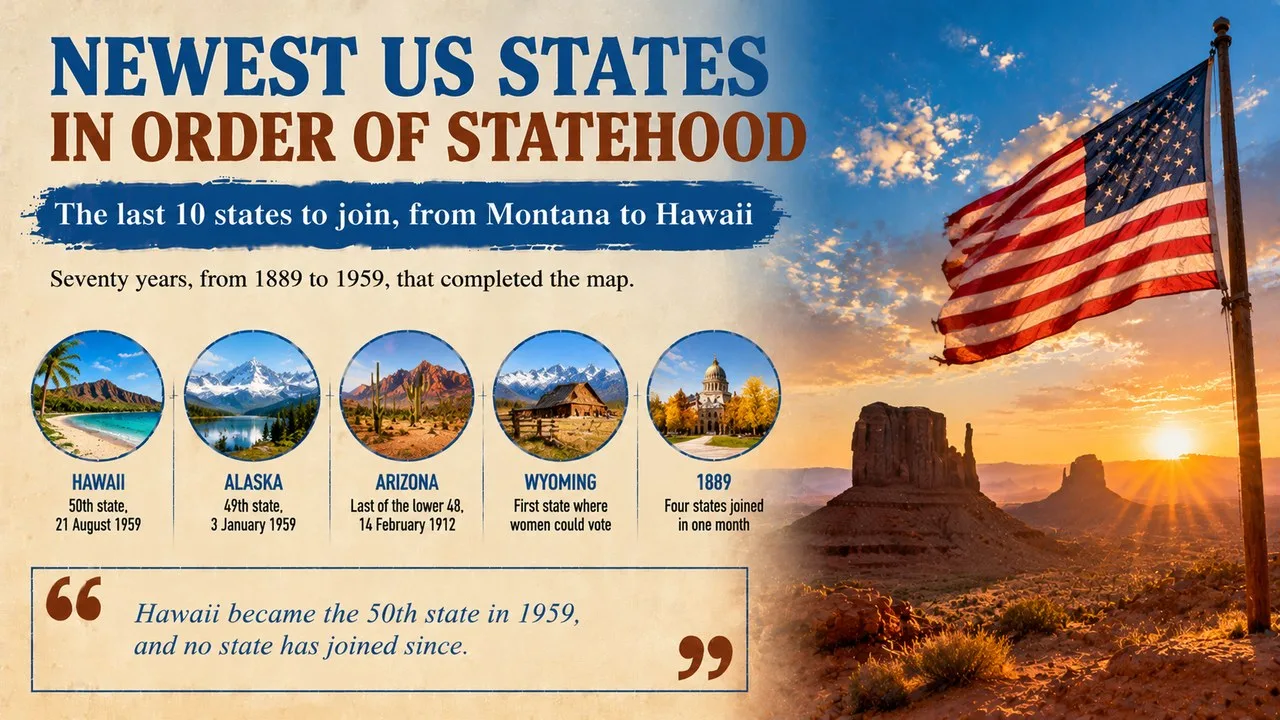
The newest US states in order of statehood run from Hawaii, the 50th state in 1959, back to Montana, which joined as the 41st state in November 1889.
This Finepedia guide, written in October 2026, counts down the 10 newest members of the United States, a story that spans 70 years, from the frontier days of 1889 to the jet age of 1959. Dates come from the official acts and proclamations, checked against state histories and reference works. For more about the country, see the Finepedia guides The United States: A Federal Republic of 50 States and Beyond and Top 10 Longest Rivers in North America.
How We Chose These
The United States began with 13 original states and grew to 50 as territories were settled and admitted by Congress. This list simply follows the official order of admission, starting with the 50th state and working back to the 41st. Before statehood, every one of them was a US territory, governed under federal law with limited self-rule. Each entry has a short profile, four key facts and a further note on its road to statehood.
The 10 Newest States at a Glance
| Order | State | Date of statehood | Capital | Nickname |
|---|---|---|---|---|
| 50th | Hawaii | 21 August 1959 | Honolulu | Aloha State |
| 49th | Alaska | 3 January 1959 | Juneau | The Last Frontier |
| 48th | Arizona | 14 February 1912 | Phoenix | Grand Canyon State |
| 47th | New Mexico | 6 January 1912 | Santa Fe | Land of Enchantment |
| 46th | Oklahoma | 16 November 1907 | Oklahoma City | Sooner State |
| 45th | Utah | 4 January 1896 | Salt Lake City | Beehive State |
| 44th | Wyoming | 10 July 1890 | Cheyenne | Equality State |
| 43rd | Idaho | 3 July 1890 | Boise | Gem State |
| 42nd | Washington | 11 November 1889 | Olympia | Evergreen State |
| 41st | Montana | 8 November 1889 | Helena | Treasure State |
1. Hawaii Became the 50th State in 1959
Hawaii is the newest state, admitted on 21 August 1959. It is the only state made up entirely of islands and the only one outside North America, lying in the Pacific Ocean about 3,200 km south-west of the US mainland. Before it became American, it was an independent kingdom, recognised by other nations.
Key Facts
- Order: 50th state
- Statehood: 21 August 1959
- Law: Hawaii Admission Act, signed by President Eisenhower on 18 March 1959
- Capital: Honolulu, on the island of Oahu
Why It Matters
In 1893, a group of American and European business leaders toppled the Hawaiian monarchy, and the US annexed the islands in 1898. In a vote held in June 1959, at least 93 percent of voters backed statehood. In 1993, the US government formally apologised for its role in overthrowing the kingdom, an event that still shapes debates about Native Hawaiian rights.
2. Alaska Joined as the 49th State
Alaska became the 49th state on 3 January 1959, less than eight months before Hawaii. It is easily the biggest state, covering more area than Texas, California and Montana put together, yet it has one of the smallest populations, with about 740,000 people in 2024.
Key Facts
- Order: 49th state
- Statehood: 3 January 1959
- Law: Alaska Statehood Act, signed on 7 July 1958
- Capital: Juneau, which has no road link to the rest of Alaska
Did You Know?
The United States bought Alaska from Russia in 1867 for 7.2 million dollars. Critics mocked the deal as Seward's Folly, after the Secretary of State William Seward, who arranged it. Gold rushes in the 1890s and the discovery of oil and other resources later proved its value many times over.
3. Arizona Was the Last of the Lower 48
Arizona became the 48th state on 14 February 1912, Valentine's Day, making it the last of the 48 contiguous states, the block of states that share borders on the mainland. It shares the Four Corners with Utah, Colorado and New Mexico, the only place where four states meet at a single point.
Key Facts
- Order: 48th state
- Statehood: 14 February 1912
- Capital: Phoenix, the most populous state capital in the US
- Famous for: the Grand Canyon
Why It Matters
Arizona's path to statehood was not smooth. In 1911, President William Howard Taft vetoed its first attempt because its proposed constitution allowed voters to recall judges. Arizona removed the clause, was admitted, and then put it back soon after. By then it was already known as the Copper State, the nation's leading copper producer.
4. New Mexico Waited 64 Years
New Mexico became the 47th state on 6 January 1912, just weeks before Arizona. It had been a US territory for 64 years, one of the longest waits of any state, partly because of debates in Congress about its Spanish-speaking and Native American population.
Key Facts
- Order: 47th state
- Statehood: 6 January 1912
- Capital: Santa Fe, founded in 1610
- Largest city: Albuquerque
Did You Know?
No US state capital is older than Santa Fe, founded as the seat of government of Spanish New Mexico, and, sitting about 2,134 m up, it is also the highest. In World War II, the state was home to the secret Los Alamos laboratory of the Manhattan Project, and the first atomic bomb was tested in its desert in 1945.
5. Oklahoma Was Born From Two Territories
Oklahoma became the 46th state on 16 November 1907, when President Theodore Roosevelt signed its proclamation. It was formed by joining Oklahoma Territory with Indian Territory, land where Native American nations, including the Cherokee, Choctaw, Chickasaw, Creek and Seminole, had been forced to move during the 19th century.
Key Facts
- Order: 46th state
- Statehood: 16 November 1907
- Capital: Oklahoma City
- Name: from Choctaw words meaning red people
Why It Matters
In 1905, leaders of the Native nations in Indian Territory proposed a separate state called Sequoyah, but Congress refused. Instead, the two territories were joined into one state. Oklahoma's nickname, the Sooner State, refers to settlers who sneaked onto land before the official start of the land runs, such as the famous rush of April 1889.
6. Utah Became a State After Long Delays
Utah became the 45th state on 4 January 1896. Latter-day Saint pioneers, often called Mormons, led by Brigham Young, began settling near the Great Salt Lake in 1847 and soon asked Congress for statehood, but they were turned down for decades.
Key Facts
- Order: 45th state
- Statehood: 4 January 1896
- Capital: Salt Lake City
- Nickname: the Beehive State
Did You Know?
The main obstacle was plural marriage, or polygamy, as practised by the church, which Congress opposed. In 1890, the church issued a statement known as the Manifesto, ending the practice, and Utah's state constitution then banned it. Early settlers had proposed a much larger state called Deseret, a word from the Book of Mormon meaning honeybee.
7. Wyoming Was First to Give Women the Vote
Wyoming became the 44th state on 10 July 1890, just a week after Idaho. As a territory, it had given women the right to vote in 1869, and on joining the nation it became the first state where women could vote, which is why it is nicknamed the Equality State.
Key Facts
- Order: 44th state
- Statehood: 10 July 1890
- Capital: Cheyenne, also its largest city
- Population: the smallest of any state, about 588,000 in 2024
Why It Matters
Wyoming also had the first woman to serve as a state governor in the US, Nellie Tayloe Ross, elected in 1924. The state is home to most of Yellowstone, set up in 1872 as the first national park anywhere, as well as Grand Teton National Park.
8. Idaho Joined as the Gem State
Idaho became the 43rd state on 3 July 1890, the day before Independence Day. Early in the 1800s it lay within the disputed Oregon Country and became a separate territory in 1863, during a gold rush that drew miners to its mountains.
Key Facts
- Order: 43rd state
- Statehood: 3 July 1890
- Capital: Boise, also its largest city
- Crop: about one-third of all US potatoes
Did You Know?
The origin of the name Idaho is uncertain. It was once claimed to be a Native American word meaning gem of the mountains, which inspired the nickname the Gem State, but that meaning is now thought to have been invented. The state is famous for its potatoes, and the words Famous Potatoes appear on many Idaho number plates.
9. Washington Is Named After a President
Washington became the 42nd state on 11 November 1889. It is the only state named after a US president, George Washington. During the statehood process, some people suggested a different name to avoid confusion with Washington, D.C., including Tacoma, but the idea was dropped.
Key Facts
- Order: 42nd state
- Statehood: 11 November 1889
- Capital: Olympia; largest city: Seattle
- Highest point: Mount Rainier, about 4,389 m
Why It Matters
Washington was one of four states made possible by a single law, the Enabling Act of 22 February 1889, which also created Montana and the two Dakotas. All four were admitted within two weeks of each other in November 1889. Today Washington is home to major companies in aircraft building, software and online retail.
10. Montana Is Big Sky Country
Montana became the 41st state on 8 November 1889, when President Benjamin Harrison issued its proclamation. Only three states cover more ground; it has the Rocky Mountains in the west and wide prairies in the east. Mining for gold, silver and copper drove its early growth.
Key Facts
- Order: 41st state
- Statehood: 8 November 1889
- Capital: Helena; largest city: Billings
- Nicknames: Big Sky Country and the Treasure State
Did You Know?
In the 1880s, Helena was said to have more millionaires per head than anywhere else in America, thanks to gold and silver mining. The state has no formal nickname, though Big Sky Country is the one most people know. Its Glacier National Park borders Canada.
Frequently Asked Questions
Which state was admitted most recently?
Hawaii, which became the 50th state on 21 August 1959. No new state has been added since then, although there have been campaigns for statehood for places such as Puerto Rico and Washington, D.C.
Which year saw the most states join?
1889, when four states joined in November: the two Dakotas, then Montana, then Washington. The following year, 1890, added two more, Idaho and Wyoming.
Conclusion
From Montana in 1889 to Hawaii in 1959, the ten newest states completed the map of the United States as it looks today. Each took its own road, shaped by gold rushes, land runs, wars and long debates in Congress. For more about the country, read the Finepedia guides The United States: A Federal Republic of 50 States and Beyond and Top 10 Longest Rivers in North America.
- US Congress, Hawaii Admission Act (1959), Alaska Statehood Act (1958) and Enabling Act of 1889.
- US National Archives and state archives, statehood proclamations.
- US Census Bureau, state population estimates, 2024.
- Wikipedia (accessed October 2026), articles on the admission of US states and on Hawaii, Alaska, Arizona, New Mexico, Oklahoma, Utah, Wyoming, Idaho, Washington and Montana.
- 10 Most Today, 10 Last States to Join the United States, 10mosttoday.com (topic reference).















Log in with