


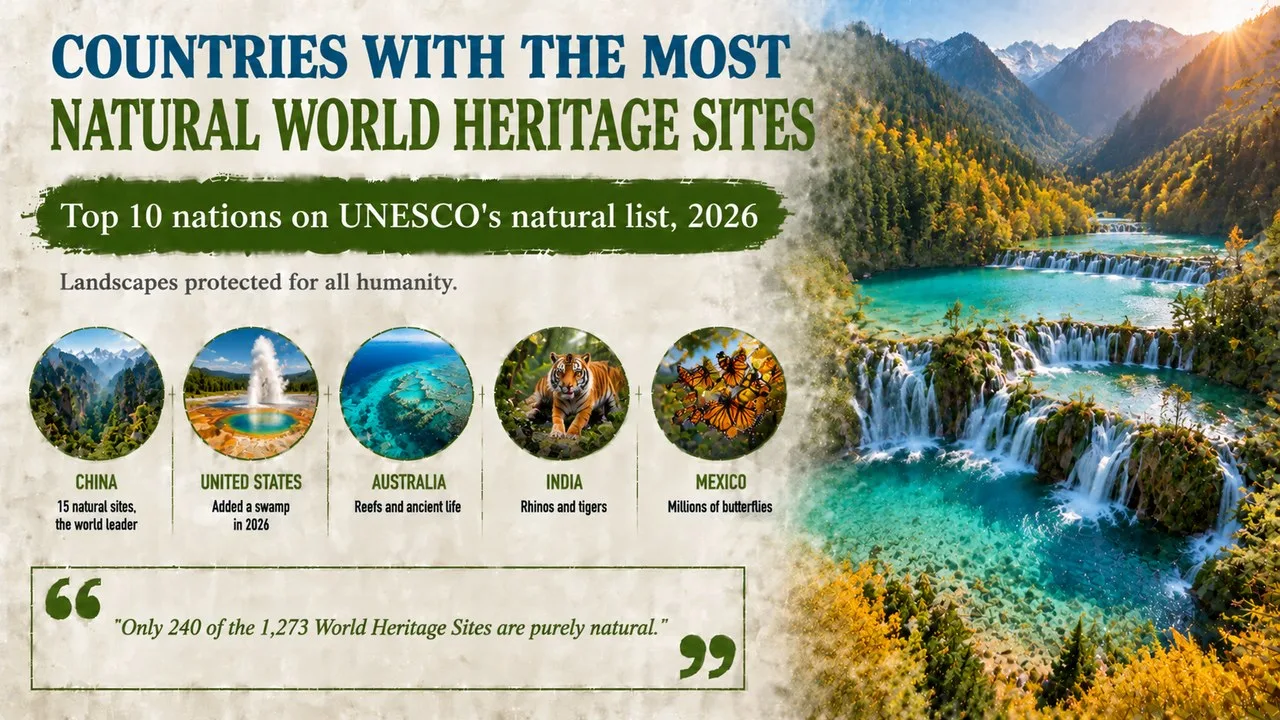
Countries with the most natural World Heritage Sites are led by China with 15, ahead of the United States with 13 and Australia with 12 in October 2026.
This Finepedia guide, written in October 2026, lists the 10 nations holding the largest number of natural sites on UNESCO's World Heritage List, from the karst peaks of China to the swamps of Georgia. Every entry gives the official count, a standout site and why it was protected. For more travel and nature rankings, see the Finepedia guides US States With the Most National Parks: Top 10 and Most Visited Countries in the World: Top 10.
How We Chose These
UNESCO divides World Heritage Sites into cultural, natural and mixed sites. This ranking counts only natural sites, listed for their landscapes, geology, ecosystems or wildlife, as shown on UNESCO's official list after the 48th session of the World Heritage Committee in Busan, South Korea, in July 2026. Sites shared by two or more countries count for each of them. Mixed sites, which are protected for both nature and culture, are shown separately and used only to break ties. In July 2026 the list held 1,273 sites, of which 240 were natural and 42 were mixed.
The 10 Countries at a Glance
| Rank | Country | Natural sites | Mixed sites | Standout site |
|---|---|---|---|---|
| 1 | China | 15 | 4 | Jiuzhaigou Valley |
| 2 | United States | 13 | 1 | Okefenokee National Wildlife Refuge |
| 3 | Australia | 12 | 4 | Shark Bay |
| 4 | Canada | 11 | 1 | Mistaken Point |
| 5 | Russia | 11 | 0 | Lena Pillars |
| 6 | Brazil | 9 | 1 | Pantanal Conservation Area |
| 7 | France | 7 | 2 | Réunion's peaks and cirques |
| 8 | India | 7 | 1 | Kaziranga National Park |
| 9 | Mexico | 6 | 2 | Monarch Butterfly Biosphere Reserve |
| 10 | Italy | 6 | 0 | The Dolomites |
1. China Leads the World
China has more natural World Heritage Sites than any other country, with 15, plus four mixed sites such as Mount Taishan and Mount Huangshan. Its newest natural site, the Badain Jaran Desert with its towering dunes and lakes, was added in 2024.
Key Facts
- Natural sites: 15
- Mixed sites: 4
- First natural sites: Jiuzhaigou, Huanglong and Wulingyuan, all listed in 1992
- Standout: Jiuzhaigou Valley in northern Sichuan
Did You Know?
Jiuzhaigou, meaning "valley of nine villages", is famous for its terraced turquoise lakes and multi-level waterfalls where the Min Mountains meet the Tibetan Plateau. The reserve covers about 72,000 hectares and rises from roughly 2,000 metres to 4,500.
2. The United States Added a Swamp in 2026
The United States has 13 natural sites, including Yellowstone, which in 1978 became one of the first sites ever listed. Two of its sites are shared with Canada, and the Hawaiian marine reserve Papahānaumokuākea is a mixed site.
Key Facts
- Natural sites: 13
- Mixed sites: 1
- Shared with Canada: Waterton Glacier and the Kluane-Wrangell-St Elias parks
- Newest: Okefenokee National Wildlife Refuge, inscribed in July 2026
Why It Matters
The Okefenokee, on the border of Georgia and Florida, is a vast peat-filled blackwater swamp, home to alligators and at least 238 bird species. UNESCO calls it probably the largest intact lowland freshwater peatland in the subtropics, and it is Georgia's first World Heritage Site.
3. Australia Protects Reefs and Ancient Life
Australia has 12 natural sites and four mixed sites, including Kakadu and Uluru-Kata Tjuta. They range from the Great Barrier Reef and Queensland's tropical rainforests to remote sub-Antarctic islands.
Key Facts
- Natural sites: 12
- Mixed sites: 4
- Remote sites: Heard and McDonald Islands, and Macquarie Island
- Standout: Shark Bay, Western Australia, listed in 1991
Did You Know?
Shark Bay, about 800 km north of Perth, is famous for its stromatolites, dome-shaped mats built by microbes, which are among the oldest forms of life known on Earth. The bay also has huge seagrass meadows and a large population of dugongs.
4. Canada Is a Fossil Treasure House
Canada has 11 natural sites and one mixed site, the boreal forest of Pimachiowin Aki. Several of its natural sites protect fossils, including Dinosaur Provincial Park, Miguasha, the Joggins Fossil Cliffs and Mistaken Point.
Key Facts
- Natural sites: 11
- Mixed sites: 1
- First listed: Nahanni National Park, in 1978
- Newest: Anticosti Island in Quebec, in 2023
Why It Matters
Mistaken Point, at the south-eastern tip of Newfoundland, preserves fossils of Ediacaran sea creatures from more than 560 million years ago. They are among the oldest known remains of large, complex life on Earth.
5. Russia Has Siberia's Stone Forest
Russia also has 11 natural sites, stretching from the Virgin Komi Forests of the Urals to the volcanoes of Kamchatka and Lake Baikal in Siberia. Two of them, Uvs Nuur and the Landscapes of Dauria, are shared with Mongolia.
Key Facts
- Natural sites: 11
- Mixed sites: none
- Famous sites: Lake Baikal, the Volcanoes of Kamchatka and the Golden Mountains of Altai
- Standout: Lena Pillars Nature Park, listed in 2012
Did You Know?
The Lena Pillars are rock towers 150 to 300 metres tall that rise beside the Lena River in Russia's Sakha Republic. They are about 180 km from Yakutsk, and the usual way to see them is by river cruise.
6. Brazil Holds the Greatest Wetland
Brazil has nine natural sites and one mixed site, Paraty and Ilha Grande. Its list includes Iguaçu National Park, Amazon reserves and Atlantic Forest areas, and it has grown fast, with new sites in 2024 and 2025.
Key Facts
- Natural sites: 9
- Mixed sites: 1
- Newest: the Peruaçu River Canyon, in 2025
- Standout: Pantanal Conservation Area, listed in 2000
Why It Matters
The Pantanal is the largest tropical wetland on Earth. In the rainy season about 80 per cent of its floodplains go under water, creating rich feeding grounds for jaguars, capybaras, caimans and hundreds of bird species.
7. France Protects Islands Far From Paris
France has seven natural sites and two mixed sites. Most of its natural heritage lies overseas, in places such as Réunion, New Caledonia, Martinique and the French Southern and Antarctic Lands.
Key Facts
- Natural sites: 7
- Mixed sites: 2, the Pyrénées-Mont Perdu and the Marquesas Islands
- In mainland France: the Chaîne des Puys volcanoes and the Gulf of Porto in Corsica
- Standout: the peaks, cirques and cliffs of Réunion, listed in 2010
Did You Know?
Réunion's World Heritage area covers its wild, mountainous interior, including Piton de la Fournaise, one of the most active volcanoes on Earth. The island's national park covers about 42 per cent of its land.
8. India Protects Rhinos and Tigers
India has seven natural sites and one mixed site, Khangchendzonga National Park in Sikkim. They include the Western Ghats, the Sundarbans mangroves and the Nanda Devi and Valley of Flowers parks in the Himalayas.
Key Facts
- Natural sites: 7
- Mixed sites: 1
- First listed: Kaziranga, Manas and Keoladeo, all in 1985
- Standout: Kaziranga National Park in Assam
Why It Matters
Kaziranga, on the Brahmaputra floodplain, holds about two thirds of the world's greater one-horned rhinoceroses. Established as a reserve forest in 1905, it is also a tiger reserve and home to wild elephants and water buffalo.
9. Mexico Hosts Millions of Butterflies
Mexico has six natural sites and two mixed sites, including the Maya city of Calakmul and its forests. Its natural sites range from the islands of the Sea of Cortez to the volcanic desert of El Pinacate.
Key Facts
- Natural sites: 6
- Mixed sites: 2
- On the danger list: the islands and reserves of the Gulf of California
- Standout: the Monarch Butterfly Biosphere Reserve, listed in 2008
Did You Know?
Every winter, millions of monarch butterflies from eastern North America fly thousands of kilometres to the fir forests of this reserve, about 100 km north-west of Mexico City. They cluster so densely that branches bend under their weight.
10. Italy Has the Dolomites
Italy has six natural sites, a small share of its 62 World Heritage Sites, most of which are cultural. They include the Aeolian Islands, Mount Etna and the Monte San Giorgio fossil site, which it shares with Switzerland.
Key Facts
- Natural sites: 6
- Mixed sites: none
- Newest: the gypsum karst and caves of the northern Apennines, in 2023
- Standout: the Dolomites, listed on 26 June 2009
Why It Matters
The pale limestone peaks of the Dolomites, in north-eastern Italy, glow pink and orange at sunset. Their towers, cliffs and valleys are a world centre for climbing, hiking and skiing.
Frequently Asked Questions
Who leads when all World Heritage Sites are counted?
Counting cultural, natural and mixed sites together, Italy leads with 62 and China follows with 61. Most of Italy's sites are cultural, while China leads for natural sites.
What is the difference between natural and mixed sites?
Natural sites are protected for their scenery, geology, ecosystems or wildlife. Mixed sites meet both natural and cultural criteria, such as Australia's Uluru-Kata Tjuta, which is both a striking landform and sacred to its Aboriginal owners.
Conclusion
From China's turquoise lakes to Mexico's butterfly forests, these countries guard some of the planet's most precious landscapes. The rankings change every year as new sites are added, so watch for next year's World Heritage Committee session. For more travel and nature rankings, read the Finepedia guides US States With the Most National Parks: Top 10 and Most Visited Countries in the World: Top 10.
- UNESCO World Heritage Centre, World Heritage List and State Party pages (accessed October 2026).
- UNESCO, 48th session of the World Heritage Committee, Busan, July 2026, and Decision 48 COM 8B.11 (Okefenokee).
- China's National Forestry and Grassland Administration, 2024 inscription of the Badain Jaran Desert.
- Wikipedia (accessed October 2026): World Heritage Site, Jiuzhaigou, Okefenokee Swamp, Shark Bay, Mistaken Point Ecological Reserve, Lena Pillars, Pantanal, Réunion National Park, Kaziranga National Park, Monarch Butterfly Biosphere Reserve and Dolomites.
- 10 Most Today, 10 Countries With Most Natural Heritage Sites, 10mosttoday.com (topic reference).













Log in with