








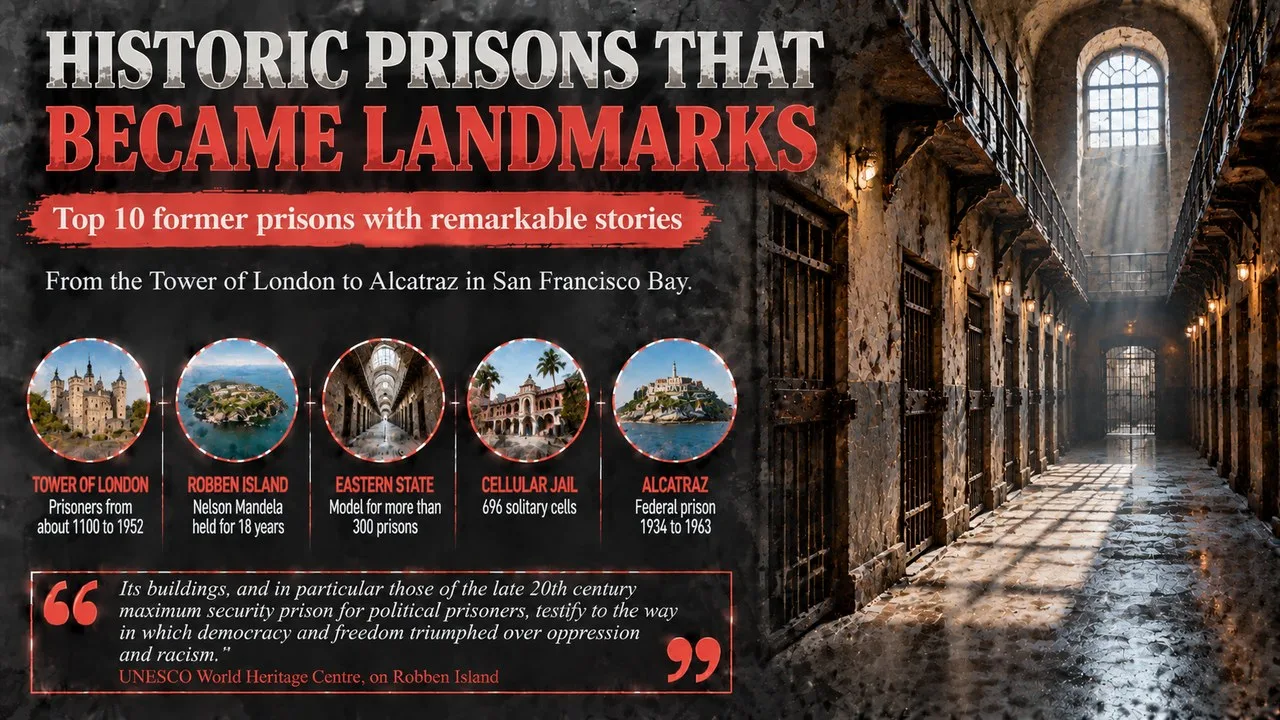
Historic prisons that became landmarks include the Tower of London, Mandela's cell on Robben Island, India's Cellular Jail and Alcatraz in San Francisco.
This Finepedia guide, written in October 2026, looks at 10 famous former prisons that now draw visitors from around the world, from medieval fortresses to island jails and the first modern penitentiary. The facts come from UNESCO, the museums and park services that run these sites, and encyclopaedias. Many of these places hold painful memories of injustice, cruelty and colonial rule, so we describe their history plainly and respectfully. If you enjoy dramatic history, you may also like Finepedia's guides to famous walls that shaped history and haunting ghost towns around the world.
How We Chose These
We picked ten prisons that are famous for their history, their prisoners, their design or the stories told about them. Most are now museums or memorials, and several are World Heritage Sites. They span five continents and nearly a thousand years. The list runs roughly by the date each place first held prisoners, from the oldest to the most recent. For each one you will find a short profile, four key facts and one more note on why it matters or a surprising detail.
The 10 Historic Prisons at a Glance
| No. | Prison | Country | Used as a prison | Best known for |
|---|---|---|---|---|
| 1 | Tower of London | England, UK | from about 1100 to 1952 | royal fortress and state prison |
| 2 | Château d'If | France | 16th to 19th century | a famous Dumas novel |
| 3 | Robben Island | South Africa | late 1600s to 1996 | Nelson Mandela |
| 4 | Kilmainham Gaol | Ireland | 1796 to 1924 | leaders of the 1916 Rising |
| 5 | Eastern State Penitentiary | United States | 1829 to 1971 | first true penitentiary |
| 6 | Port Arthur | Australia | 1833 to 1877 | convicts sent from Britain |
| 7 | Devil's Island | French Guiana | 1852 to 1953 | Alfred Dreyfus and Papillon |
| 8 | Hỏa Lò Prison | Vietnam | from 1901 | the Hanoi Hilton |
| 9 | Cellular Jail | India | 1906 to 1940s | Kala Pani, freedom fighters |
| 10 | Alcatraz | United States | 1934 to 1963 as a federal prison | The Rock |
1. London's Tower Held Prisoners for 850 Years
Standing beside the Thames in the heart of the capital, the Tower of London is one of England's oldest castles. Its oldest part, the White Tower, was begun by William the Conqueror around 1078, and by 1100 it already held its first known prisoner, Bishop Ranulf Flambard, who later escaped. Over the centuries it served as a royal palace, an armoury, a treasury, a zoo and the place where the nation's coins were made.
Key Facts
- Location: beside the Thames, central London
- Begun: around 1078, under William the Conqueror
- First known prisoner: Bishop Ranulf Flambard, in about 1100
- World Heritage: inscribed in 1988
Did You Know?
Some of the most famous people in English history were locked up in the Tower, including Anne Boleyn, Sir Thomas More, Lady Jane Grey and the young Elizabeth, before she became queen. Its last prisoners were the gangsters Ronald and Reginald Kray, held there briefly in 1952 after failing to report for national service. Today the Tower guards the Crown Jewels, and legend says the kingdom will fall if its ravens ever leave, so at least six are always kept there.
2. The Château d'If Inspired The Count of Monte Cristo
The Château d'If is a fortress on a tiny rocky island about 3.5 kilometres out to sea from Marseille's harbour, in southern France. King Francis I ordered it built between 1524 and 1531 to defend the coast, but no enemy ever attacked it. Instead, its isolation and strong currents made it a feared prison until the late 1800s.
Key Facts
- Location: Île d'If, off Marseille, France
- Built: 1524 to 1531, for King Francis I
- Prisoners: more than 3,500 Protestant Huguenots among them
- Opened to visitors: 1890
Why It Matters
The castle became world famous through The Count of Monte Cristo, the 1844 adventure story by Alexandre Dumas, in which the hero Edmond Dantès is wrongly locked up there for years before escaping. Visitors today can see cells named after Dantès and his fellow prisoner, the Abbé Faria, even though both are fictional characters. The fortress welcomes nearly 100,000 visitors a year, placing it among the city's top attractions.
3. Robben Island Held Nelson Mandela for 18 Years
Robben Island lies in Table Bay, about 7 kilometres off the coast near Cape Town, South Africa. Its name comes from the old Dutch word for seals. From the late 1600s it was used to hold prisoners, and during apartheid it became the main prison for political prisoners who fought white minority rule.
Key Facts
- Location: Table Bay, near Cape Town, South Africa
- Size: about 5 square km, flat and low-lying
- Prison use: from the late 17th century until 1996
- World Heritage: inscribed in 1999
Why It Matters
Nelson Mandela spent 18 of his 27 years in prison on Robben Island, much of it breaking rocks in a lime quarry, before he was freed in 1990 and elected president in 1994. Two later South African presidents, Kgalema Motlanthe and Jacob Zuma, were also held there. Since 1997 the island has been a museum, and many of its guides are former political prisoners, who show visitors the tiny cell where Mandela slept. It now stands as a symbol of the triumph of the human spirit over oppression.
4. Kilmainham Gaol Is Where Modern Ireland Was Born
Kilmainham Gaol is a former prison in Dublin, Ireland, opened in 1796 as the new county jail. Conditions were harsh, and men, women and children were held together, sometimes five to a cell, with a single candle that had to last two weeks. During the Great Famine of the 1840s, the jail was overwhelmed by a surge of prisoners, many of them desperately poor.
Key Facts
- Location: Kilmainham, Dublin, Ireland
- Opened: 1796
- Closed: 1924, soon after Irish independence
- Today: a museum managed by Ireland's state heritage body, the OPW
Why It Matters
Kilmainham is closely linked to Ireland's struggle for independence. After the Easter Rising of 1916, fourteen of its leaders, including Patrick Pearse and James Connolly, were shot by firing squad in the prison yard. Their deaths turned public opinion strongly towards independence. Many other Irish rebels were held here over the years, and the restored jail now tells their story. It has also appeared in many films.
5. Eastern State Penitentiary Pioneered Solitary Reform
Eastern State Penitentiary in Philadelphia, Pennsylvania, opened on 25 October 1829 and closed in 1971. Designed by the architect John Haviland, it had long corridors fanning out from a central hub in the shape of a wagon wheel. Each prisoner lived alone in a cell with a skylight, the idea being that silence and solitude would lead to regret and reform.
Key Facts
- Location: Fairmount, Philadelphia, Pennsylvania, US
- Open: 1829 to 1971
- Design: a wagon-wheel plan by John Haviland
- Famous prisoner: the gangster Al Capone
Did You Know?
On completion, no public building in the United States had been bigger or had cost more, and its design was copied by more than 300 prisons around the world. Its approach of keeping prisoners completely apart was later criticised for causing great mental suffering. Al Capone spent several months there and was allowed a cell furnished with rugs, a desk and a radio. Today the crumbling building is a museum and a National Historic Landmark.
6. Port Arthur Was Where Britain Sent Its Hardest Convicts
Port Arthur, an old convict station about 97 kilometres south-east of Hobart, sits on Tasmania's rugged Tasman Peninsula in Australia. It began in 1830 as a timber camp, and from 1833 to 1877 it held convicts who had committed fresh crimes after being transported from Britain to Australia. Its rugged setting, surrounded by sea and forest, made escape almost impossible.
Key Facts
- Location: Tasman Peninsula, Tasmania, Australia
- Convict use: 1833 to 1877
- Named after: George Arthur, who governed the colony then called Van Diemen's Land
- World Heritage: one of 11 convict sites listed together in 2010
Why It Matters
Port Arthur's Separate Prison, completed in 1853, was built on the idea that silence and isolation would change prisoners' behaviour. Inmates were hooded when they left their cells and were not allowed to speak. The settlement also had workshops where convicts learned trades, and a boys' prison at nearby Point Puer. It now ranks among the country's busiest heritage attractions, with ruins of stone buildings set among gardens by the water.
7. Devil's Island Was France's Most Feared Penal Colony
Devil's Island is one of the Salvation Islands off the coast of French Guiana in South America. From 1852 to 1953, France sent tens of thousands of convicts to the penal colony in this region, which included prisons on the mainland and on three small islands. Harsh treatment, heat and tropical diseases killed huge numbers of prisoners.
Key Facts
- Location: Salvation Islands, French Guiana
- Penal colony: 1852 to 1953
- Death rate: up to 75 percent at its worst
- Famous prisoner: Captain Alfred Dreyfus
Did You Know?
Devil's Island itself was kept for political prisoners. The most famous was Captain Alfred Dreyfus, a French army officer who was wrongly convicted of spying for Germany in 1894 and held there in a small hut for years before he was cleared. Another former convict of the colony, Henri Charrière, described a dramatic escape in his bestselling book Papillon, published in 1969, though historians doubt that all of his story is true.
8. Hỏa Lò Prison Became Known as the Hanoi Hilton
The French colonial rulers of Indochina built Hỏa Lò Prison in Hanoi between 1896 and 1901. It held Vietnamese people who campaigned for independence, often in overcrowded and brutal conditions. Its name, taken from a street of shops selling stoves, is often translated as fiery furnace.
Key Facts
- Location: Hoàn Kiếm, central Hanoi, Vietnam
- Built: 1896 to 1901, by the French colonial government
- Nickname: the Hanoi Hilton, given by American prisoners
- Today: its surviving gatehouse is a museum
Why It Matters
During the Vietnam War, North Vietnam used the prison to hold captured American pilots, who mockingly named it the Hanoi Hilton. The best known was John McCain, later a US senator and presidential candidate, who was held there for part of the more than five years he spent in captivity. The bulk of the prison was knocked down in 1993 and 1994 to make way for new buildings, but the gatehouse survives as a museum that tells both the colonial and wartime stories.
9. The Cellular Jail Is India's Kala Pani
The Cellular Jail stands in Port Blair, now renamed Sri Vijaya Puram, on the Andaman Islands in the Bay of Bengal. Built by the British between 1896 and 1906, it was used to exile political prisoners far from mainland India. Prisoners called being sent there Kala Pani, or black water, because crossing the sea meant losing home, family and, many believed, caste.
Key Facts
- Location: Andaman and Nicobar Islands, India
- Built: 1896 to 1906
- Cells: 696 solitary cells in seven wings around a central tower
- Status: declared a national memorial on 11 February 1979
Why It Matters
The jail's name comes from its design. Every prisoner had a separate cell, and the wings were arranged so that the front of one wing faced the back of the next, making it impossible for prisoners to talk to one another. Many leaders of India's freedom movement were held here, including Vinayak Damodar Savarkar and Batukeshwar Dutt. Only three of the seven wings and the central tower survive, and today the site holds a museum and an evening light and sound show about its history.
10. Alcatraz Was Called Escape-Proof
Alcatraz is a small rocky island in San Francisco Bay, about 2 kilometres from the city, known as The Rock. It held a fort and an army prison before it became a maximum-security federal prison in 1934. The cold water and strong currents around the island were meant to make escape impossible, and it held some of America's most notorious criminals, including Al Capone.
Key Facts
- Location: San Francisco Bay, California, US
- Federal prison: 1934 to 1963
- Escape attempts: 14, by 36 prisoners
- Today: a National Park Service site with about 1.5 million visitors a year
Did You Know?
In June 1962, Frank Morris and the brothers John and Clarence Anglin slipped out of their cells, leaving dummy heads in their beds, and set off across the bay on a raft made from raincoats. They were never found, and the mystery still fascinates people. The prison closed in March 1963 because it was too costly to run. In May 2025, US President Donald Trump called for it to be used as a prison again, and his 2027 budget request in April 2026 asked Congress for 152 million dollars to start the work, though as of October 2026 it remains a museum.
Frequently Asked Questions
Did anyone ever escape from Alcatraz?
Officially, no escaper has ever been confirmed to have survived. Frank Morris and the Anglin brothers vanished in 1962 and are listed as missing, presumed drowned, but their bodies were never found, so some people believe they survived.
Which historic prison is the oldest?
Of the prisons in this list, London's Tower is the oldest, holding prisoners from about 1100 until 1952. Some even older dungeons exist, but few were used for so long or are so well known.
Conclusion
From a Norman fortress in London to an island jail in San Francisco Bay, these ten prisons show how societies have punished crime, silenced opponents and later chosen to remember. Many now serve as museums that honour those once locked inside. For more dramatic history, read Finepedia's guides to famous walls that shaped history and haunting ghost towns around the world.
- UNESCO World Heritage Centre, Robben Island, whc.unesco.org/en/list/916.
- UNESCO World Heritage Centre, Tower of London, whc.unesco.org/en/list/488.
- UNESCO World Heritage Centre, Australian Convict Sites, whc.unesco.org/en/list/1306.
- US National Park Service, Alcatraz Island, Golden Gate National Recreation Area, nps.gov.
- Reuters, Trump seeks $152 million to reopen Alcatraz as active prison, 3 April 2026.
- Office of Public Works, Kilmainham Gaol Museum, kilmainhamgaolmuseum.ie.
- Wikipedia (accessed October 2026), articles on the Tower of London, Château d'If, Robben Island, Kilmainham Gaol, Eastern State Penitentiary, Port Arthur, Devil's Island, Hỏa Lò Prison, Cellular Jail and Alcatraz Federal Penitentiary.
- 10 Most Today, 10 Historic Prisons From Around The World, 10mosttoday.com (topic reference).















Log in with