






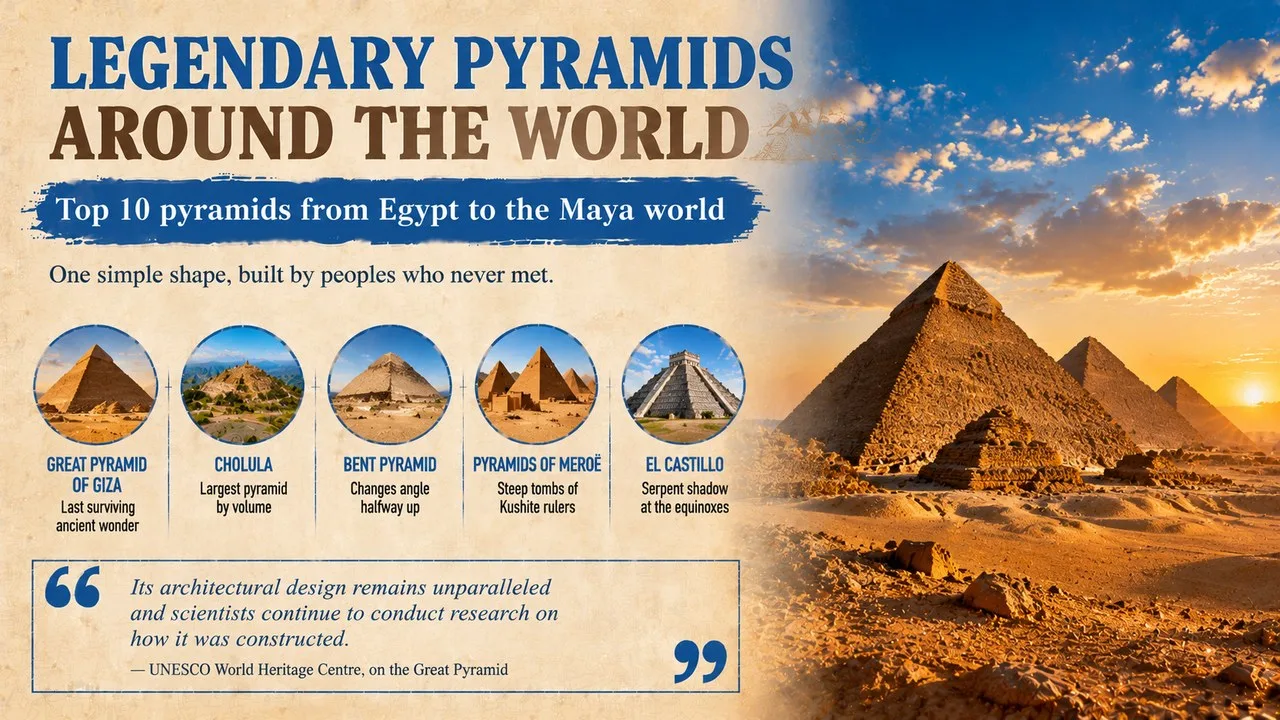
Legendary pyramids around the world stretch from Egypt's Great Pyramid of Giza to Maya temples in Mexico and Guatemala, and even a Roman tomb in Rome.
This Finepedia guide, written in October 2026, visits 10 famous pyramids across Africa, the Americas and Europe, built over a span of nearly 3,000 years. We checked each one against UNESCO listings, archaeological studies and reference works. Ancient dates and heights are often uncertain, so we give widely accepted estimates as of October 2026. To explore more of the ancient world, see the Finepedia guides Oldest Surviving Buildings on Earth: Top 10 and Famous Tombs and Mausoleums: Top 10.
How We Chose These
Pyramids were raised by very different peoples who never met, from Egyptian pharaohs and Kushite kings to Maya rulers and a Roman official. We chose ten that are important for their size, age, design or story. We left out modern buildings with pyramid shapes, such as hotels, and the Step Pyramid of Djoser, which appears in our oldest buildings guide. The list moves from Egypt to Mexico and Sudan, then Rome and the Maya world. Each pyramid has a short profile, four key facts and a further note.
The 10 Pyramids at a Glance
| No. | Pyramid | Country | Built | Standout fact |
|---|---|---|---|---|
| 1 | Great Pyramid of Giza | Egypt | about 2600 BC | last surviving ancient wonder |
| 2 | Great Pyramid of Cholula | Mexico | from about 300 BC | largest pyramid by volume |
| 3 | Red Pyramid | Egypt | about 2575 BC | first true smooth-sided pyramid |
| 4 | Bent Pyramid | Egypt | about 2600 BC | changes angle halfway up |
| 5 | Pyramid of the Sun | Mexico | about AD 200 | giant of Teotihuacan |
| 6 | Pyramids of Meroë | Sudan | about 300 BC to AD 300 | steep tombs of Kushite rulers |
| 7 | Pyramid of Cestius | Italy | about 18 to 12 BC | a Roman tomb built in 330 days |
| 8 | Tikal Temple I | Guatemala | about AD 732 | tomb of a great Maya king |
| 9 | El Castillo | Mexico | about AD 1000s | serpent shadow at the equinoxes |
| 10 | Pyramid of the Magician | Mexico | AD 500s to 900s | rare oval base |
1. Giza's Great Pyramid Is the Last Ancient Wonder Standing
Egypt's Great Pyramid at Giza was raised for the pharaoh Khufu, also known as Cheops, around 2600 BC, in a project that took roughly 26 years. Of the seven classical wonders listed by ancient writers, it is the earliest and the sole survivor in good shape. It was originally 146.6 m tall and covered in smooth white limestone.
Key Facts
- Location: Giza, near Cairo, Egypt
- Built for: Pharaoh Khufu of the Fourth Dynasty
- Height: 146.6 m when built, about 138.5 m today
- Blocks: an estimated 2.3 million, weighing about 6 million tonnes
Why It Matters
For upwards of 3,700 years, no structure made by humans was taller; it remained building on the planet. Most of its outer casing was later stripped away for building stone, revealing the stepped core seen today. UNESCO notes that its design is still unmatched and that researchers are still studying how it was built. It forms part of the World Heritage Site of Memphis and its Necropolis.
2. The Great Pyramid of Cholula Is the Biggest of All
Set in Puebla state in central Mexico, the Great Pyramid of Cholula looks at first like a natural hill topped by a church. Underneath lies a huge adobe brick pyramid, built in several stages over hundreds of years. Its Nahuatl name, Tlachihualtepetl, means made mountain.
Key Facts
- Location: Cholula, Puebla, Mexico
- Height: about 25 m above the plain
- Volume: more than 4.4 million cubic metres, by most estimates
- On top: a Spanish colonial church dedicated to the Virgin of Remedies
Did You Know?
Though it stands far lower than Khufu's pyramid in Egypt, the Cholula mound is much wider, giving it the largest volume of any known pyramid, almost twice that of Giza's. Archaeologists have dug about 8 km of tunnels inside it since 1931 to study its many building phases, and some of the tunnels are open to visitors.
3. The Red Pyramid Was Egypt's First True Pyramid
The Red Pyramid stands at Dahshur, south of Cairo, and was built for the pharaoh Sneferu, Khufu's father. Experts regard it as the earliest Egyptian pyramid to be finished with smooth sides, after earlier attempts with steps or changing angles. It is named for the rusty red colour of its stone, though it was once cased in white limestone.
Key Facts
- Location: Dahshur, Egypt
- Built: around 2575 to 2563 BC
- Height: about 105 m
- Rank: third-largest Egyptian pyramid, after two at Giza
Why It Matters
The Red Pyramid shows Egyptian builders learning by trial and error. It rises at a gentle slope of about 43 degrees, which made it stable. Its success paved the way for the even larger Great Pyramid built by Sneferu's son. Visitors can still climb inside and walk down a long sloping passage to its burial chambers.
4. The Bent Pyramid Changes Direction Halfway Up
Also found at Dahshur, the Bent Pyramid was Sneferu's second pyramid out of four. It rises steeply at about 54 degrees, but above a height of roughly 47 m the angle suddenly changes to a gentler 43 degrees, giving it a clearly bent outline.
Key Facts
- Location: Dahshur, about 40 km south of Cairo
- Built for: Pharaoh Sneferu
- Lower slope: about 54 degrees
- Upper slope: about 43 degrees
Did You Know?
The reason for the change in angle is still debated, but many experts think the builders saw signs of cracking and made the top less steep to reduce the weight. Unusually, the Bent Pyramid keeps much of its original polished limestone casing, more than any other of Egypt's roughly 118 known pyramids.
5. The Pyramid of the Sun Towers Over Teotihuacan
No structure at Teotihuacan, a vast ancient city north-east of present-day Mexico City, is bigger than the Pyramid of the Sun. It stands beside the city's main street, the Avenue of the Dead, with the smaller Pyramid of the Moon to the north. It was built mainly around AD 200.
Key Facts
- Location: Teotihuacan, State of Mexico
- Built: mostly around AD 200
- Base: about 225 m across
- UNESCO: part of the Pre-Hispanic City of Teotihuacan site, listed in 1987
Why It Matters
Teotihuacan ranked among the biggest cities of the ancient Americas, and later the Aztecs gave the site its name, often translated as the place where the gods were born. In the 1970s, archaeologists found a man-made cave under the Pyramid of the Sun, suggesting the spot was sacred before the pyramid rose. Visitors can climb its steep steps for wide views.
6. The Pyramids of Meroë Are Nubia's Royal Tombs
The Pyramids of Meroë stand in the desert of Sudan, about 200 km north-east of Khartoum. They were the burial places of rulers, royal family members and officials of the Kingdom of Kush, which ruled the region from Meroë. They are smaller and much steeper than Egyptian pyramids.
Key Facts
- Location: near Bagrawiya, Sudan
- Built: from about 300 BC to about AD 300
- Height: mostly under 30 m
- UNESCO: a World Heritage property since 2011
Did You Know?
The Meroë pyramids rise at a steep angle of about 72 degrees, compared with about 52 to 54 degrees for most Egyptian pyramids. In 1834, the Italian treasure hunter Giuseppe Ferlini tore the tops off dozens of them in his search for gold, which is why many now look broken at the top.
7. The Pyramid of Cestius Is a Pyramid in Rome
The Pyramid of Cestius is an ancient Roman tomb near the Porta San Paolo in Rome, beside the city's Protestant Cemetery. It was built for Gaius Cestius, a Roman magistrate and member of a priestly college, at a time when Egyptian styles were fashionable in Rome after the conquest of Egypt.
Key Facts
- Location: Rome, Italy
- Built: around 18 to 12 BC
- Height: about 37 m
- Materials: brick-faced concrete covered with white marble
Why It Matters
An inscription states that the tomb was finished in 330 days. Around AD 271 to 275, it was built into the Aurelian Walls as part of the city's defences, which helped it survive when many other ancient buildings were pulled apart for stone. Today it ranks among the best-kept ancient structures in the city.
8. Tikal Temple I Honours a Great Maya King
Tikal Temple I, nicknamed the Great Jaguar temple, stands on the Great Plaza of Tikal, a huge Maya city in the rainforest of northern Guatemala. It was built as a funerary temple for the ruler Jasaw Chan K'awiil I, whose tomb lies deep inside it.
Key Facts
- Location: Tikal National Park, Guatemala
- Built: around AD 732
- Ruler: Jasaw Chan K'awiil I, who reigned from AD 682 to 734
- Top: a stone shrine crowned with a tall roof comb
Did You Know?
The temple takes its nickname from a carved wooden beam showing a king seated on a jaguar throne. Archaeologists found the king's tomb in 1962, filled with jade, pearls and a set of carved bones bearing hieroglyphs. UNESCO gave Tikal National Park World Heritage status in 1979.
9. El Castillo Draws a Serpent of Shadow
El Castillo, also called the Temple of Kukulcan, rises at the centre of the great Maya city of Chichen Itza in Yucatán, Mexico. It is a step pyramid with nine terraces and a staircase on each of its four sides leading to a temple at the top. Carved feathered serpent heads guard the base of the north stairway.
Key Facts
- Location: Chichen Itza, Yucatán state, Mexico
- Height: about 24 m, plus a 6 m temple on top
- Steps: about 91 per side, giving 365 with the top platform
- Inside: an older, smaller pyramid hidden within
Why It Matters
Near the March and September equinoxes, the low sun of late afternoon casts a row of triangle-shaped shadows down the edge of the north stairway. Together they look like a serpent slithering down to join the carved stone head at the bottom, drawing large crowds. The total of 365 steps matches the number of days in the Maya solar year.
10. The Pyramid of the Magician Has an Oval Base
Rising above the ancient Maya city of Uxmal in Yucatán, Mexico, the Pyramid of the Magician stands as the site's tallest building. Unlike most Maya pyramids, it has rounded sides and an oval, rather than square, base, and it was built in several stages over about three centuries.
Key Facts
- Location: Uxmal, Yucatán, Mexico
- Height: about 35 m, though estimates vary
- Base: roughly 69 m by 49 m
- Style: Puuc, with rich stone decoration
Did You Know?
A Maya legend says a magical dwarf, hatched from an egg, built the whole pyramid in a single night, hence its name. In reality, it was built in at least five phases, with newer temples placed over older ones. UNESCO added Uxmal to its World Heritage List in 1996.
Frequently Asked Questions
Which is the largest pyramid in the world?
That depends on the measure used. Khufu's pyramid at Giza is the tallest ancient example, while Cholula in Mexico has the largest volume. Cholula's pyramid is much lower but far wider.
Why did so many cultures build pyramids?
A pyramid is one of the most stable shapes for a large, tall building, because most of the weight sits near the ground. Different peoples used it for different purposes: Egyptians and Kushites built pyramids as tombs, while the Maya and other peoples of Mexico mostly used them as bases for temples.
Conclusion
From Giza to Cholula, these ten pyramids show how people in different ages and continents turned to the same simple shape to honour kings and gods. Many still keep secrets that archaeologists are working to uncover. For more ancient wonders, read the Finepedia guides Oldest Surviving Buildings on Earth: Top 10 and Famous Tombs and Mausoleums: Top 10.
- UNESCO World Heritage Centre, Memphis and its Necropolis, the Pyramid Fields from Giza to Dahshur, whc.unesco.org/en/list/86.
- UNESCO World Heritage Centre, Pre-Hispanic City of Teotihuacan, whc.unesco.org/en/list/414.
- UNESCO World Heritage Centre, Pre-Hispanic City of Chichen-Itza, whc.unesco.org/en/list/483.
- UNESCO World Heritage Centre, Archaeological Sites of the Island of Meroe, whc.unesco.org/en/list/1336.
- Wikipedia (accessed October 2026), articles on Pyramid, Great Pyramid of Giza, Great Pyramid of Cholula, Red Pyramid, Bent Pyramid, Pyramid of the Sun, Pyramids of Meroë, Pyramid of Cestius, Tikal Temple I, El Castillo and Pyramid of the Magician.
- 10 Most Today, 10 Most Notable Pyramids in the World, 10mosttoday.com (topic reference).

















Log in with