








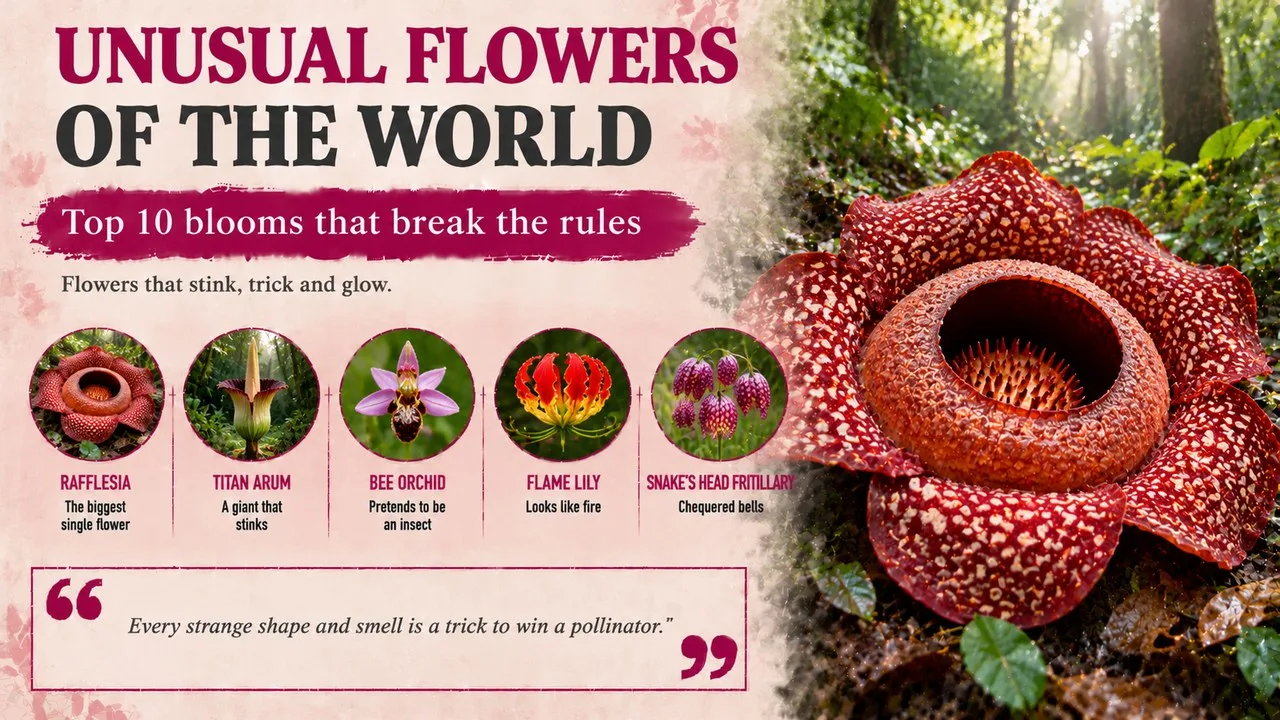
Unusual flowers of the world include Rafflesia, the biggest single bloom, the bee orchid that looks like an insect and the titan arum that smells of rot.
This Finepedia guide, written in October 2026, presents 10 of the most surprising flowers on Earth, from blooms that copy insects to flowers that open only at night. Every entry explains where the plant grows, what makes its flower so odd and how that strange design helps it survive. For more about plants, see the Finepedia guides Most Beautiful Flowers in the World: Top 10 and Most Poisonous Plants on Earth: Top 10.
How We Chose These
Our picks are flowers with truly odd shapes, smells, sizes or habits, rather than simply pretty ones. The bird of paradise flower, often included in similar lists, is not repeated here, since Finepedia's guide to beautiful flowers already includes it. Several plants here are poisonous, so they should be admired, not eaten. Facts come from botanic gardens, plant databases and reference works. The order is a guide, not a scientific ranking.
The 10 Unusual Flowers at a Glance
| Rank | Flower | Native to | Strange feature |
|---|---|---|---|
| 1 | Rafflesia arnoldii | Sumatra and Borneo | largest single flower, no leaves or stems |
| 2 | Titan arum | Sumatra | giant flower spike over 3 m tall |
| 3 | Bee orchid | Europe and the Mediterranean | petal copies a female bee |
| 4 | Flame lily | Africa and tropical Asia | flaming petals bent backwards |
| 5 | Huernia | eastern and southern Africa | starfish-like flowers that smell of carrion |
| 6 | Bleeding heart | north-east China and Korea | heart-shaped flowers with a dangling tip |
| 7 | Snake's head fritillary | Europe and western Asia | chequered bell flowers |
| 8 | Maypop passionflower | south-eastern United States | frilly purple corona |
| 9 | Torch ginger | Malay Peninsula, Indonesia and New Guinea | flower like a flaming torch |
| 10 | Fish poison tree | Indian Ocean and western Pacific coasts | powder-puff flowers that open at night |
1. Rafflesia Has the Biggest Single Flower
Rafflesia arnoldii grows in the steamy forests of Sumatra and Borneo and produces the biggest individual bloom known, about a metre across. It is a parasite with no leaves, stems or true roots, living hidden inside a tropical vine until its huge bud bursts out.
Key Facts
- Family: Rafflesiaceae
- Size: flowers can be about 1 metre wide
- Smell: like rotting meat, which attracts carrion flies
- Status: one of Indonesia's three national flowers
Did You Know?
The plant is named after Stamford Raffles, the British colonial official, and the surgeon Joseph Arnold, who collected a specimen in Sumatra in 1818. Arnold fell ill with fever and did not survive long after the discovery.
2. The Titan Arum Is a Giant That Stinks
The titan arum, found wild only in the rainforests of Sumatra, sends up a flower spike that can grow more than 3 metres tall. Strictly, this is not a single flower but a huge cluster of tiny flowers around a central column.
Key Facts
- Scientific name: Amorphophallus titanum
- Height: the flower spike can pass 3 metres
- Nicknames: corpse flower, from the Indonesian bunga bangkai
- First garden bloom: at Kew in London, in 1889
Why It Matters
A titan arum may take ten years to flower from seed and then blooms for only a day or two. When one opens at a botanic garden, crowds queue for hours and thousands watch online. The name titan arum was popularised by David Attenborough's 1995 series The Private Life of Plants.
3. The Bee Orchid Pretends to Be an Insect
The bee orchid grows wild in grassland across Europe and around the Mediterranean. The lowest petal, called the lip, is furry and patterned like the body of a female bee, which tricks male bees into trying to mate with it.
Key Facts
- Scientific name: Ophrys apifera
- Height: 15 to 50 cm
- Flowering: June to July in Britain
- Trick: sexual deception, a rare kind of pollination
Did You Know?
Despite its clever disguise, the bee orchid in northern Europe mostly pollinates itself. The bees it was built to fool are scarce there, so the flower bends its pollen onto its own stigma.
4. The Flame Lily Looks Like Fire
The flame lily, or Gloriosa superba, is a climbing plant found across much of Africa and tropical Asia. Its wavy red and yellow petals sweep backwards like flickering flames, and it climbs using tendrils at the tips of its leaves.
Key Facts
- Scientific name: Gloriosa superba
- Height: climbing stems up to 3 to 4 metres
- Toxin: colchicine, found in all parts of the plant
- Symbol: national flower of Zimbabwe and state flower of Tamil Nadu
Why It Matters
Almost every part of the flame lily is highly poisonous, yet it has long been used in traditional medicine. Its colchicine is the same compound used, in careful doses, to treat gout.
5. Huernia Flowers Smell Like Carrion
Huernia is a group of small succulent plants from the east and south of Africa and from Arabia. Their thick, five-pointed flowers are often striped or spotted in red, yellow and brown, and some are as glossy as plastic.
Key Facts
- Family: Apocynaceae, the dogbane family
- First named as a genus: 1810
- Pollinators: flies, attracted by a scent like rotting flesh
- Name: honours the Dutch missionary Justus van Heurne
Did You Know?
Huernia zebrina is nicknamed the lifesaver plant, because the shiny raised ring in the middle of its flower looks like a ring-shaped sweet. In parts of southern Ethiopia some Huernia species have been eaten as famine food.
6. The Bleeding Heart Hangs in Rows
The bleeding heart is a garden favourite native to north-east China and Korea. In spring its arching stems carry neat rows of pink and white heart-shaped flowers, each with a tiny white tip dangling from the bottom.
Key Facts
- Scientific name: Lamprocapnos spectabilis
- Family: the poppy family, Papaveraceae
- Older name: Dicentra spectabilis
- Other names: lyre flower, heart flower or lady-in-a-bath
Why It Matters
If you gently pull a bleeding heart flower apart and turn it upside down, it looks like a little lady in a bathtub, which explains one of its nicknames. The plant is mildly toxic, so it is kept for show, not for eating.
7. The Snake's Head Fritillary Is Chequered
The snake's head fritillary grows in damp river meadows in Europe and western Asia. Its nodding bell-shaped flowers have a striking chequerboard pattern in shades of purple, though some plants have pure white flowers.
Key Facts
- Scientific name: Fritillaria meleagris
- Height: 15 to 40 cm
- Flowering: March to May
- Name: meleagris refers to guineafowl-like spots
Did You Know?
In Croatia the flower is called kockavica, and some link its pattern to the red and white chequered shield on the Croatian coat of arms. In England, it still carpets the meadow of Magdalen College in Oxford each spring.
8. The Maypop Has a Flower Like a Firework
The maypop, or purple passionflower, is a fast-growing vine found wild across the American South-East. Its flowers have a ring of wavy purple and white threads, called a corona, around a striking central column.
Key Facts
- Scientific name: Passiflora incarnata
- Fruit: an oval, egg-sized berry, also called a maypop
- Pollinators: bumblebees and carpenter bees
- Hardiness: one of the toughest passionflowers
Why It Matters
Spanish missionaries in the Americas saw symbols of the Passion of Christ in the flower's parts, such as the crown of thorns in the corona, which gave passionflowers their name. The maypop's fruit is edible and tastes like a mild passion fruit.
9. Torch Ginger Looks Like a Flaming Torch
Torch ginger is a giant tropical plant from the Malay Peninsula, Indonesia and New Guinea. Its leafy stems can reach 3 to 6 metres tall, while its waxy pink or red flower heads rise on separate stalks from the ground.
Key Facts
- Scientific name: Etlingera elatior
- Family: Zingiberaceae, the ginger family
- Leaves: up to about 85 cm long
- Other name: porcelain rose
Did You Know?
Torch ginger buds are an important ingredient across South-East Asia. In Malaysia, where it is called bunga kantan, the chopped bud adds a sharp, fragrant flavour to dishes such as laksa, and in Bali it is used to make chilli sauces.
10. The Fish Poison Tree Blooms at Night
Barringtonia asiatica, the fish poison tree, grows on tropical coasts from East Africa and Madagascar to Asia, northern Australia and the western Pacific. Its large flowers look like powder puffs of long pink-tipped white threads.
Key Facts
- Height: usually about 20 metres
- Flowers: open at night, pollinated by bats and moths
- Fruit: square-shaped and buoyant, carried by the sea
- Traditional use: crushed seeds used to stun fish
Why It Matters
The tree's flowers open after dark and fall by morning, leaving the beach scattered with fluffy blooms. Its corky fruit can float for up to 15 years in tests, which helps the tree spread from island to island.
Frequently Asked Questions
Which flower is the biggest?
Rafflesia arnoldii has the largest single flower, about a metre across. The titan arum is taller, but its giant bloom is actually a cluster of many small flowers.
Why do some flowers smell bad?
Flowers such as Rafflesia, the titan arum and Huernia smell of rotting meat to attract flies and beetles that feed or lay eggs on dead animals. These insects then carry pollen from flower to flower.
Conclusion
From giant stinking blooms to orchids that fool bees, unusual flowers show how inventive plants can be when they need to attract pollinators. Many are rare or poisonous, so enjoy them in gardens, parks and photos. For more about plants, read the Finepedia guides Most Beautiful Flowers in the World: Top 10 and Most Poisonous Plants on Earth: Top 10.
- Royal Botanic Gardens, Kew, titan arum and Rafflesia profiles.
- Plants of the World Online (Kew), species records.
- Wikipedia (accessed October 2026): Rafflesia arnoldii, Amorphophallus titanum, Ophrys apifera, Gloriosa superba, Huernia, Lamprocapnos, Fritillaria meleagris, Passiflora incarnata, Etlingera elatior and Barringtonia asiatica.
- 10 Most Today, 10 Most Unusual Flowers in the World, 10mosttoday.com (topic reference).


















Log in with