




 By
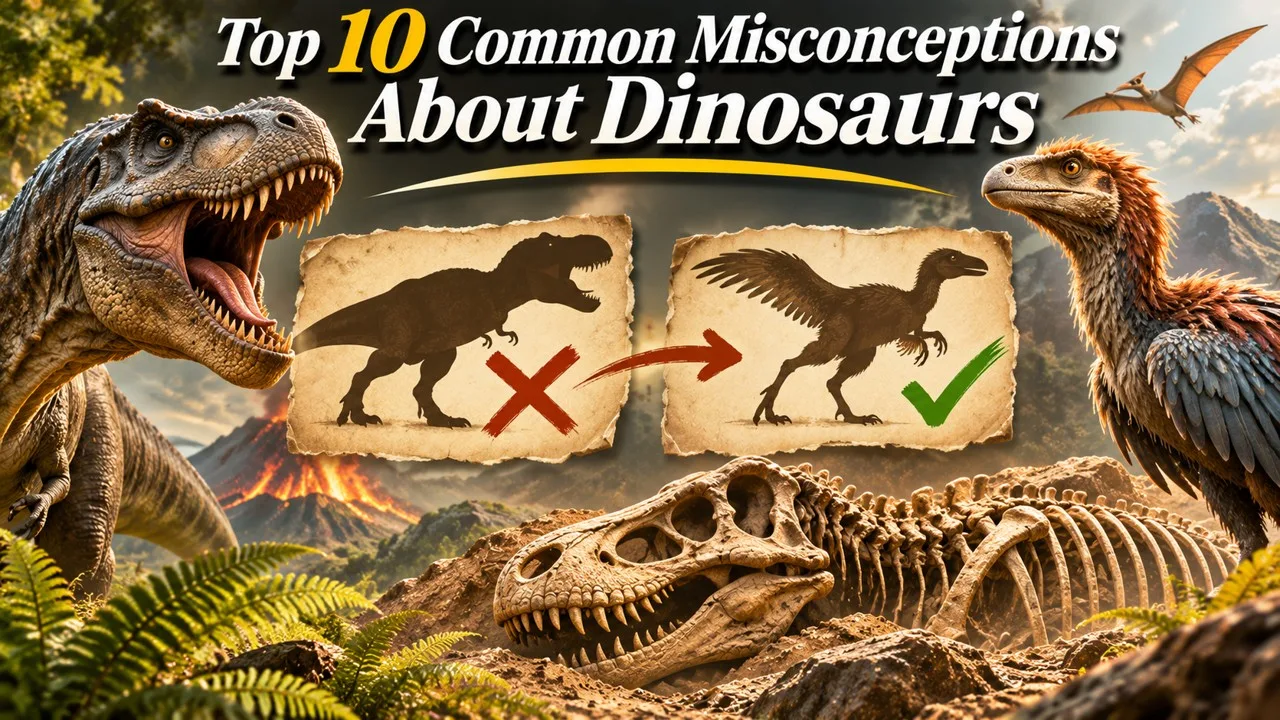
Birds are living dinosaurs, many species were small or feathered, and a tyrannosaur did not stand like a kangaroo or race a film vehicle. Popular pictures of dinosaurs are often a generation or two behind the papers [2][7][10]. A museum mount from the early twentieth century, a mid-century mural, or a later adventure film can freeze an error in public memory long after anatomists have moved on [3][7]. The ten corrections below are about those errors. They are not a parade of bizarre species, and they will not restage a chase, a vehicle, or a protected character from any film [3].
A fossil is a fact. A movie still is a design. The two should not be asked to do the same job.
Key Facts
These are common misconceptions, each set against a more careful reading of the fossil record and of living birds.
Ten Corrections at a Glance
| Rank | Popular idea | Careful version |
|---|---|---|
| 1 | We have found them all | New dinosaur species are still named most years; the record is incomplete |
| 2 | All ancient reptiles were dinosaurs | Pterosaurs, many marine reptiles, and earlier synapsids such as Dimetrodon were not dinosaurs |
| 3 | They were all huge | Many dinosaurs were small; living birds are a reminder of that range |
| 4 | A tyrannosaur could outrun a light vehicle | Biomechanics points to a fast walk or a limited run, not a chase from an adventure picture |
| 5 | They were all dull-colored | Some fossils preserve pigment structures; drab gray is not a scientific default |
| 6 | Mammals came after them | Mammals originated in the Mesozoic and lived alongside non-avian dinosaurs |
| 7 | They were all cold-blooded | Metabolism likely varied; birds are warm-blooded dinosaurs, and many extinct groups were not simple lizards |
| 8 | A tyrannosaur stood upright | The body was held more horizontally, with the tail as a counterbalance |
| 9 | They all had only scales | Many species, especially on the theropod line, had feathers; scales also existed |
| 10 | Dinosaurs are extinct | Non-avian dinosaurs died out at the end of the Cretaceous; birds are surviving dinosaurs |
1. A Record with Holes, and New Names
The list of named dinosaur species is long, and it is not closed [1]. Paleontologists describe new taxa most years, from well-known formations and from regions that were barely sampled a generation ago, and they also sink old names when two "species" prove to be one [1]. The fossil record is biased toward certain habitats, bones, and times. Soft parts, small bodies, and whole ecosystems are routinely missing. The unexpected fact is humility. A child's book that treats the roll call as finished is doing what a catalog has to do, and it is still wrong if it is read as a complete census. We have not found all the dinosaurs. We have found a sample, and the sample keeps growing.
A new name in a journal is a reminder, not a scandal. The past is larger than a museum hall.
2. A Club with Rules
Dimetrodon, with its back sail, often appears in dinosaur aisles and is more closely related to mammals than to Tyrannosaurus [2]. Pterosaurs were flying archosaurs, not dinosaurs. Ichthyosaurs, plesiosaurs, and their relatives were marine reptiles that lived at the same time as many dinosaurs and were not members of the dinosaur group [2]. Dinosaurs, in the strict sense, are a clade on the archosaur line, defined by a set of skeletal characters and by descent from a last common ancestor that they do not share with all other "ruling reptiles" of textbook art. The unexpected fact is typological. "Terrible reptile of the Age of Reptiles" is a mood, not a family. The family has a border, and many popular beasts live outside it.
A sail-backed animal can be a star of a mural and still be in the wrong room of the family tree.
Related: Top 10 Most Bizarre Dinosaurs
3. Giants, and a Crowd of Smaller Bodies
Some dinosaurs were enormous, and those are the ones that fill posters [3]. Many others were the size of a turkey, a dog, or a small deer, and the living dinosaurs, the birds, include animals that fit in a cup [3]. Even in the Mesozoic, small theropods, small ornithischians, and early members of later giant lines were part of the ordinary fauna. The unexpected fact is statistical. A group is not the same as its largest members. If the public word "dinosaur" means "colossal," the word is doing marketing, not anatomy. A complete mental picture has to have room for the small, the young, and the later, flying, often tiny survivors.
A femur the size of a person is real. It is not the average, and it was never the only story in the undergrowth.
4. A Pace, not a Vehicle Test
An adventure film once made a running tyrannosaur into a problem for a light motor vehicle, and that image has lasted longer than any single paper about stride [4]. Biomechanical work on bone strength, muscle mass, balance, and trackways points to an animal that could walk quickly and, in some models, run only at a moderate speed, not at the pace a later Hollywood chase implied [4]. This article will not restage that chase, name a film vehicle, or borrow a character. The unexpected fact is physical. A huge biped has to pay for each step, and the payments add up in ways a smaller sprinter does not have to consider. The careful fact is a range of estimates, not a single boastful number.
A film can make a good nightmare. It is a poor speedometer.
5. Color, sometimes Preserved
For a long time, artists had little to go on but analogy and taste, and a gray-green or brown dinosaur became a default [5]. In some exceptional fossils, especially of feathered species, microscopic pigment structures, melanosomes, have been used to infer black, rufous, iridescent, or patterned plumage [5]. Skin impressions can also constrain scales and, more rarely, tone. We still do not know the color of most species, and inferring a whole hide from a scrap is a cautious business. The unexpected fact is that color is no longer only a guess in every case. The careful fact is that "we do not know" remains the right answer for most museum labels, and that "therefore they were drab" was never a scientific deduction.
A pigment organelle in a feather is a fact with a hue. A murky plaster cast is only a murky plaster cast.
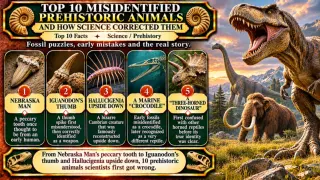
Related: Top 10 Misidentified Prehistoric Animals and How Science Corrected Them
6. Neighbors, not Heirs Waiting in a Queue
Mammals did not appear as a reward after the asteroid [6]. The mammal lineage originated in the Mesozoic, and small, varied mammals lived under the feet of dinosaurs for a very long time, including animals that climbed, dug, swam, and ate more than a single stereotyped diet [6]. The end-Cretaceous extinction opened ecological space that later mammals filled, which is a different sentence from "mammals began when dinosaurs ended." The unexpected fact is coexistence. The Age of Mammals is a later chapter of abundance and size, not a birth announcement. A shrew-like contemporary of a hadrosaur is still a mammal, and still a part of that older story.
A family tree can run in parallel for millions of years. A textbook chapter break should not be mistaken for a starting gun.
7. Not Simply Cold, and not Simply One Thing
The old picture of dinosaurs as oversized lizards, sluggish and "cold-blooded," has not survived a confrontation with bone histology, growth rates, posture, and the simple fact that birds are dinosaurs with a high metabolism [7]. Many researchers now talk about a range: some groups closer to a high, sustained metabolism, some perhaps in a middle state, with variation by size and lineage [7]. "All dinosaurs were cold-blooded" is the sentence that has to go. "All dinosaurs were just like modern birds" would also be too tidy. The unexpected fact is diversity. A clade that includes a sparrow and, in the past, a titanic sauropod, is allowed to have more than one thermal strategy, and the fossils, while incomplete, are no longer silent on the question.
A growth ring in a bone is not a thermometer, but it is a clue. The clues have already retired the lizard-in-the-schoolbook as a universal model.
Related: Top 10 Most Bizarre Phobias: Strange Fears That Exist
8. A Tail that Was not a Prop
Early mounts and textbook drawings often stood Tyrannosaurus in a tripod pose, tail on the ground, spine tilted up, a kangaroo-like silhouette that is still in some people's heads [8]. Later anatomical work, and a look at how the hips, the back, and the tail actually fit, supports a more horizontal body, with the tail held off the ground as a counterbalance to the head and chest [8]. Modern mounts have mostly made the correction. Popular memory is slower. The unexpected fact is engineering. A biped of that size is a seesaw, and the tail is half of the beam. The careful fact is that "upright" was always a little vague: the animal stood on two legs, but it did not stand like a person, and it did not slouch like a tired kangaroo.
A museum can teach a posture by the way it hangs a skeleton. Some of the older lessons were wrong, and they traveled far.
9. Integument, in More than One Material
Scales are real in dinosaurs. So are feathers [9]. The last few decades of fossils, especially from China and other fine-grained deposits, have shown feathers, protofeathers, or other filaments in many theropods, and in some ornithischians as well, while other specimens preserve scales, and some animals likely had a mix [9]. "All dinosaurs had scales" is a sentence from before that evidence. "All dinosaurs were fluffy" would be the equal and opposite error. The unexpected fact is mixed media. A living bird can have scaly feet and a feathered body, which is a hint, not a proof, that mosaics of covering are ordinary in the group. The careful fact is a specimen-by-specimen map, still being drawn.
A feather is a dinosaur fact, not only a bird fact. The family that made the feather is larger than the family that now flies it.
Related: Top 10 Oldest Buildings in the World
10. A Line that Did not Entirely End
Non-avian dinosaurs, the familiar giants and their closer cousins that were not birds, disappeared as a global fauna at the end of the Cretaceous, in a mass extinction tied to an impact and to its planetary effects [10]. Birds, which are nested inside theropod dinosaurs, survived, diversified, and are still here, which is why a careful speaker says that dinosaurs, as a clade, are not entirely extinct [10]. A sparrow is a dinosaur in the same way that a human is a mammal: not as a metaphor, as a branch on a tree. The unexpected fact is grammatical and also biological. The word that children learn as a synonym for "gone" is, in the technical sense, still on the bird table, and in the hedge, and on the wind. The careful fact is the adjective "non-avian," which exists because the simpler sentence was wrong.
An extinction can be real for one part of a family and not for the whole family. That is the whole correction, and it is large enough to end a list.
Conclusion
The ten popular ideas above fail in different ways. Some fail because the record is still growing. Some fail because a word was used too loosely, and a sail-backed cousin or a marine reptile was invited into the wrong club. Some fail because of a film, a mount, or a default color. Some fail because of a chapter title that made mammals look like they were waiting in the wings. The largest failure, and the most productive one to correct, is the idea that the whole group is gone. Birds are dinosaurs. Many of their extinct relatives were small, some were feathered, and a tyrannosaur was a horizontal, heavy animal, not a vertical cartoon and not a measuring stick for a movie vehicle.
A misconception is often a fossil of an older science. The polite thing is to put it in a case, with a date, and then walk over to the newer mount.
- ^ [1] Overviews of dinosaur discovery rates and of bias in the fossil record. Britannica: Dinosaur
- ^ [2] Distinctions among dinosaurs, pterosaurs, marine reptiles, and synapsids such as Dimetrodon. Britannica: Dimetrodon
- ^ [3] Accounts of body-size range in dinosaurs, including small species and birds. Britannica: Dinosaur
- ^ [4] Biomechanical studies of tyrannosaur locomotion, discussed without restaging a film chase. Britannica: Tyrannosaurus
- ^ [5] Research on melanosomes and other evidence for color in some feathered dinosaurs. Britannica: Fossil
- ^ [6] The Mesozoic origin of mammals and their coexistence with non-avian dinosaurs. Britannica: Mammal
- ^ [7] Reviews of dinosaur metabolism and growth, including the relevance of living birds. Britannica: related physiological discussions
- ^ [8] The correction of the old tripod, upright mount of Tyrannosaurus to a horizontal, tail-balanced posture. Britannica: Tyrannosaurus
- ^ [9] Fossil evidence for feathers and for scales in dinosaurs, treated as a mosaic rather than a single covering. Britannica: Feather
- ^ [10] The end-Cretaceous extinction of non-avian dinosaurs and the status of birds as living dinosaurs. Britannica: K-T extinction




















Discussion
Log in with