





 By
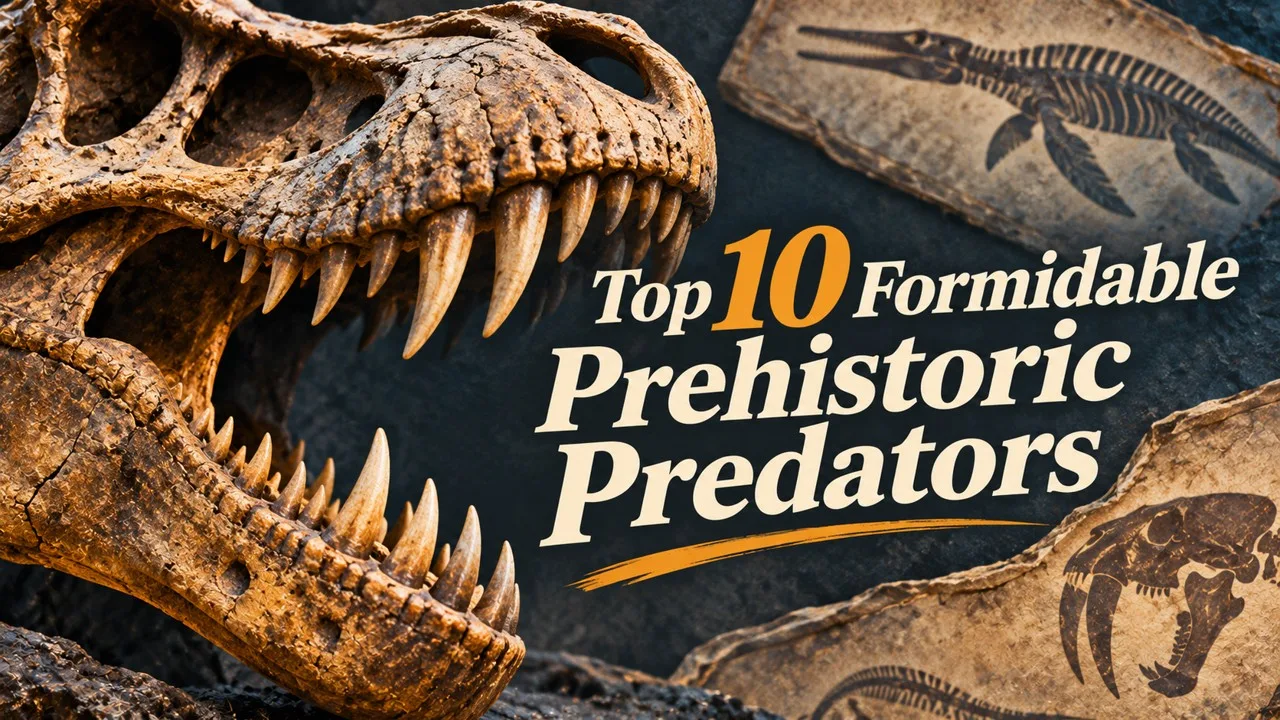
Prehistoric predators are easy to oversell; the better accounts keep the fossils, the size ranges, and the gaps in the skeletons in view.
A large extinct hunter is still a scientific object: a slab, a skull, a jaw, or a newly revised name. The ten entries below are a Cambrian arthropod with many legs, a Devonian scorpion reidentified in 2026, an early toothed whale, a famous skull called Andrewsarchus, a mosasaur newly named Tylosaurus rex, finned octopuses whose size is estimated from jaws, terrestrial sebecid crocodyliforms, the Permian therapsids Pampaphoneus and Anteosaurus, and hyaenodonts with more than one pair of shearing teeth. This article does not reconstruct hunts, and it does not treat a newspaper "kraken" as a field identification.
Key Facts
| Item | What the fossils support | What to keep cautious |
|---|---|---|
| 1 | Tegopelte, a sizable Cambrian marine arthropod with many pairs of legs | A body plan, not a cockroach villain |
| 2 | Praearcturus gigas, a Lower Devonian scorpion from Britain, reidentified in 2026 and estimated at about a meter | The largest known scorpion on current evidence, not a demon |
| 3 | Ankylorhiza tiedemani, an early Oligocene toothed whale from what is now South Carolina | An "orca-like" label is an ecological comparison, not a family tree |
| 4 | Andrewsarchus mongoliensis is known from a large Eocene skull found in Mongolia | Relationships and the rest of the body remain debated or missing |
| 5 | Tylosaurus rex, named in 2026 from mosasaur fossils long sitting in collections, ranks among the largest tylosaurs | A species name is not a personality, and length estimates have ranges |
| 6 | Late Cretaceous finned-octopus jaws, including Nanaimoteuthis, have been used to infer unusually large animals | Published length ranges are wide because the bodies almost never fossilize |
| 7 | Sebecids were land-dwelling crocodyliforms that lived on after the end-Cretaceous extinction | A later radiation, not a slogan about surviving "twice" |
| 8 | Pampaphoneus biccai was a Middle Permian dinocephalian therapsid from South America | It lived before dinosaurs; it was not a dinosaur in costume |
| 9 | Anteosaurus magnificus, another Middle Permian therapsid, has been reinterpreted as more capable than a sluggish caricature | Locomotion is inferred from bones, not filmed |
| 10 | Some hyaenodonts had several successive pairs of shearing cheek teeth | An anatomical fact, not a weapon inventory |
1. A Many-Legged Crawler, Not a Monster Roach
Tegopelte is a Cambrian marine arthropod known from exceptional deposits, with a broad, flattened body on the order of 30 centimeters long and a large number of paired legs, often counted at 25 pairs [1]. It was a sizable animal for its seafloor, and it is interesting as a body plan: a shield-like back, many appendages, and a place in the early radiation of arthropods. It is not a cockroach, and it is not a villain [1].
The unexpected fact is how often a many-legged fossil is introduced as something a person should shudder at. A Cambrian arthropod does not need that invitation [1]. This article will not compare it to a kitchen insect for effect, and it will not invent a hunting style the slabs do not show. The careful fact is a documented, relatively large Cambrian crawler, a high leg count, and a reminder that "formidable" on this list can mean "anatomically striking," not "designed to frighten." Soft-bodied or lightly sclerotized animals from this time are known mainly because a few sites preserved them unusually well.
A lot of legs is a description. It is not a reason to recast a fossil as a nightmare.
2. A Meter-Long Scorpion, Reidentified Late
Fossils from Britain, first discussed in the nineteenth century, were long hard to place, and some were treated as a giant crustacean [2]. A 2026 revision, using additional material and modern imaging, has argued that Praearcturus gigas is a scorpion, and that it is the largest scorpion so far known, with a body length estimated at about a meter. The same work has suggested that some other historic names may belong to this species, and that the animal may have been aquatic or amphibious, living in a river setting [2].
The unexpected fact is the delay. A large arthropod can sit in the literature, under the wrong group, for a century and a half, until enough pieces and a new study line up [2]. This article will not treat the pincers as a weapon display, and it will not invent a sound or a hunt from a possible stridulatory surface. The careful fact is a 2026 taxonomic revision, a size estimate that makes this the largest known scorpion on present evidence, and a habitat inference from river sediments. Living scorpions are mostly terrestrial; a large Devonian relative in the water would be, if the interpretation holds, a further surprise, not a movie scorpion made wet.
A record size is a measurement with a method. It is not a personality.
3. An Early Toothed Whale, Compared, Not Recast
Ankylorhiza tiedemani is an early toothed whale from Oligocene deposits in what is now South Carolina, dated to around 30 million years ago [3]. Papers that describe it have compared its body plan, in ecological terms, to later raptorial odontocetes, including killer whales, because it appears to have been a strong-swimming hunter rather than a suction specialist. That comparison is a way of talking about a niche. It is not a claim that the animal was an orca, or a close cousin of one, in the modern sense [3].
Related: Top 10 Misidentified Prehistoric Animals and How Science Corrected Them
The unexpected fact is how early a "modern-looking" hunting whale can appear, long before the living killer whale's lineage looked as it does now [3]. This article will not stage a hunt, and it will not treat a comparison as a family tree. The careful fact is a named early odontocete, a set of skeletal features used to infer a raptorial habit, and a reminder that the ocean has invented large toothed hunters more than once. South Carolina's Oligocene marine beds have produced a series of such early whales, which is why this one can be described at all.
A comparison can be useful and still be only a comparison. The fossil remains a whale of its own time.
4. A Famous Skull, and a Missing Body
Andrewsarchus mongoliensis is known primarily from a large skull, more than 80 centimeters long, collected in Eocene beds in Mongolia in the 1920s [4]. The animal has often been reconstructed as a huge terrestrial hunter, and it has been placed, at different times, among mesonychids or closer to even-toed ungulates. Those placements are still discussed, because a skull, however impressive, is not a complete animal [4].
The unexpected fact is how much of the popular "giant carnivore" depends on filling in the missing parts. Tooth wear and skull shape can support a flesh-eating, or at least a hard-object, diet; they cannot, by themselves, fix the gait, the coat, or the daily habit [4]. This article will not invent a full-body terror, and it will not pretend the relationships are closed. The careful fact is a documented, very large skull, an Eocene age, an open phylogenetic file, and a caution that some of the most famous prehistoric hunters are famous in proportion to a single specimen. A reconstruction is a hypothesis in a museum hall.
A skull can be enormous and still be only a skull. The decent list says so.
5. A Tylosaur That Waited in the Drawers
Mosasaurs were large marine lizards of the Late Cretaceous, and some of them were among the biggest animals in those seas [5]. In 2026, researchers gave a new name, Tylosaurus rex, to fossils that had been found as early as 1979 near Dallas and later recognized, in a broader museum survey, as a distinct tylosaur. Length estimates put the animal among the larger known mosasaurs, on the order of 13 meters in the largest reconstructions, which should be read as estimates, not as a tape measure on a living body [5].
The unexpected fact is how much of this "new" predator was already in collections, waiting for someone to compare the skulls [5]. This article will not lean on the name as a joke about Tyrannosaurus, and it will not describe injuries from possible fights as a gore scene. The careful fact is a newly distinguished species, a large but ranged size, and a set of teeth and skull features used to infer a powerful bite. Marine lizards at the end of the Cretaceous were already a diverse group. Adding a name is a taxonomic event, not the invention of a sea monster.
A king in a Latin name is a convention. The fossil is a mosasaur, and that is already a sufficiently large word.
Related: Top 10 Ancient Earth Events That Sound Like Science Fiction
6. Jaws, a Wide Size Range, and No Kraken
Octopus bodies almost never fossilize well, so a 2026 study that described Late Cretaceous finned, or cirrate, octopuses from preserved jaws was always going to attract a dramatic headline [6]. Among the named forms is Nanaimoteuthis haggarti. The authors used those jaws to estimate total lengths in a wide range, from several meters up to figures approaching the high teens of meters at the top end. That upper end, if it held, would place some of these animals among the larger invertebrates ever inferred. The range itself is a warning: a beak is not a body [6].
The unexpected fact is not that Cretaceous seas had large cephalopods. It is how much of the "kraken" language is a journalist's shortcut for a jaw-based estimate [6]. This article will not treat a mythical kraken as identified, and it will not present predation on marine reptiles as a filmed fact. Wear on the jaws has been used to infer a diet that included hard prey; proposals about plesiosaurs or mosasaurs as items on the menu remain proposals. The careful fact is a 2026 paper, a set of fossil beaks, and a size range that should be quoted as a range. Soft-bodied giants are allowed to be uncertain.
A jaw can be large. The animal around it is, until more of it is found, a calculated outline.
7. Land-Dwelling Crocodyliforms After the Asteroid
Sebecids were terrestrial relatives of crocodilians, known from the Cenozoic of South America and, in some related forms, from other regions, with longer legs, a more upright stance, and serrated, ziphodont teeth unlike the low, amphibious profile of many living crocodiles [7]. They lived on for many millions of years after the end-Cretaceous mass extinction, which is the fact that matters. A slogan that they "survived extinction twice" is tidier than the record and is not required [7].
The unexpected fact is that the end of the non-bird dinosaurs was not the end of large land-dwelling crocodyliforms. In some South American ecosystems they remained important hunters well into the Tertiary [7]. This article will not dress them as "crocodiles but worse," and it will not invent a double-survival myth. The careful fact is a documented terrestrial radiation, a distinctive stance and dentition, and a long survival after a famous extinction. Living crocodilians are mostly semiaquatic. That is a later, or at least a different, success, not the only one the wider group ever had.
A land-dwelling crocodyliform is a reminder that the familiar river silhouette is only one option the group has tried.
Related: Top 10 Extinct Animals That Were Misunderstood
8. A Permian Hunter, Earlier Than Dinosaurs
Pampaphoneus biccai is a Middle Permian dinocephalian therapsid from South America, on the order of 265 million years old, and it was a flesh-eating member of a group that lived well before the first dinosaurs [8]. Therapsids, sometimes popularly called "mammal-like reptiles," are a branch of synapsids; they are not dinosaurs, and they do not need a dinosaur nickname in order to be interesting. The skull and teeth support a predatory habit [8].
The unexpected fact, for a list that might want a "beast before the dinosaurs," is that the Permian already had a long, complicated ecology of large synapsids, of which this is one named piece [8]. This article will not treat the animal as a dinosaur ancestor in costume, and it will not reconstruct a hunt. The careful fact is a dated, named therapsid, a South American locality, and a place in the Middle Permian, tens of millions of years before dinosaurs appear in the record. The end-Permian extinction, later, would rearrange that world. Pampaphoneus belongs to the world before that rearrangement.
A predator can be formidable and still be a therapsid of its own period. The decent caption keeps the period.
9. A Bulky Therapsid, Reconsidered
Anteosaurus magnificus is a large Middle Permian therapsid from southern Africa, with a heavy skull and a robust build that once encouraged a picture of a sluggish, almost static animal [9]. Later work on the skeleton and on limb proportions has argued for a more capable, more active hunter than that caricature, while still leaving a lot of the daily life unknown. The revision is a change of inference, not a film of the animal running [9].
The unexpected fact is how much of a prehistoric "personality" is a posture in a drawing. A bulky chest can be read as clumsy, then reread as strong, depending on which joints and muscle marks the authors emphasize [9]. This article will not pick a mascot version, and it will not invent a chase. The careful fact is a well-known dinocephalian, a history of changing locomotor ideas, and a reminder that "misjudged" in paleontology often means "the first sketch was too simple." Both sketches should be labeled as sketches.
A heavy animal is not automatically a slow one, and a revised animal is not automatically a monster. The bones are the same; the reading is what moved.
Related: Top 10 Most Bizarre Dinosaurs
10. Several Pairs of Shearing Teeth
Hyaenodonts were an extinct group of carnivorous mammals, successful on several continents during the Paleogene and later, and they were not the same group as living carnivorans [10]. Some of them developed more than one pair of specialized shearing cheek teeth, whereas a typical living carnivoran has a single carnassial pair. That is an anatomical difference in how a bite was arranged, and it is the reason they appear on a list of "formidable" hunters [10].
The unexpected fact is that a famous living solution, one pair of scissors in the cheek, is not the only solution the mammals have tried [10]. This article will not inventory "blades," and it will not describe prey being cut. The careful fact is a documented dental pattern in an extinct group, a wide fossil range, and a reminder that "carnivore" in the living fauna is a narrower word than the fossil record of meat-eating mammals. Hyaenodonts eventually disappeared; cats, dogs, and their relatives inherited the popular idea of a mammalian hunter. The teeth say that the earlier idea was already sophisticated.
A shearing tooth is a shape in a jaw. Several such pairs are a pattern, and a pattern is enough, without a battle scene.
Conclusion
The ten animals above are a many-legged Cambrian arthropod, a Devonian scorpion reidentified at about a meter, an early toothed whale, a huge Eocene skull with a missing body, a tylosaur named in 2026, finned octopuses estimated, widely, from jaws, terrestrial sebecids, two Permian therapsids, and hyaenodonts with extra shearing pairs. Some of those sentences are new. Some are old fossils with new names or new cautions.
A formidable extinct hunter is allowed to be large. It is not allowed, in a careful list, to become a gore scene, a kraken, or a completed animal when the skeleton is still mostly missing.
- ^ [1] Paleontological accounts of Tegopelte as a Cambrian marine arthropod with a large number of paired legs, treated as a body plan rather than as a villain. Britannica: Burgess Shale Britannica: arthropod
- ^ [2] The 2026 revision of Praearcturus gigas as a large Lower Devonian scorpion from Britain, including a length estimate on the order of a meter. Natural History Museum: Praearcturus gigas Britannica: scorpion
- ^ [3] Descriptive papers and summaries of Ankylorhiza tiedemani as an early Oligocene toothed whale, with raptorial comparisons treated as ecology, not as a living-orca identity. Britannica: toothed whale Wikipedia: Ankylorhiza
- ^ [4] Accounts of Andrewsarchus mongoliensis as an Eocene taxon known mainly from a large Mongolian skull, with relationships and body reconstructions left open. Britannica: Andrewsarchus Wikipedia: Andrewsarchus
- ^ [5] 2026 naming of Tylosaurus rex and overviews of mosasaurs as large Late Cretaceous marine lizards, with length figures treated as estimates. Britannica: mosasaur Wikipedia: Tylosaurus
- ^ [6] The 2026 Science paper on Late Cretaceous finned-octopus jaws, including Nanaimoteuthis, with body-length inferences quoted as a wide range and "kraken" language rejected. Science: earliest octopuses as Cretaceous predators Britannica: octopus
- ^ [7] Paleontological overviews of sebecid crocodyliforms as terrestrial Cenozoic hunters, without a "survived twice" slogan. Britannica: crocodile Wikipedia: Sebecidae
- ^ [8] Accounts of Pampaphoneus biccai as a Middle Permian dinocephalian therapsid, distinct from dinosaurs and earlier than them. Britannica: therapsid Wikipedia: Pampaphoneus
- ^ [9] Discussions of Anteosaurus magnificus and of changing inferences about its locomotion, labeled as inferences from the skeleton. Britannica: therapsid Wikipedia: Anteosaurus
- ^ [10] Paleontological accounts of hyaenodonts, including the presence in some taxa of more than one pair of shearing cheek teeth, as anatomy rather than as a weapon list. Britannica: hyaenodont Wikipedia: Hyaenodonta




















Discussion
Log in with