






 By
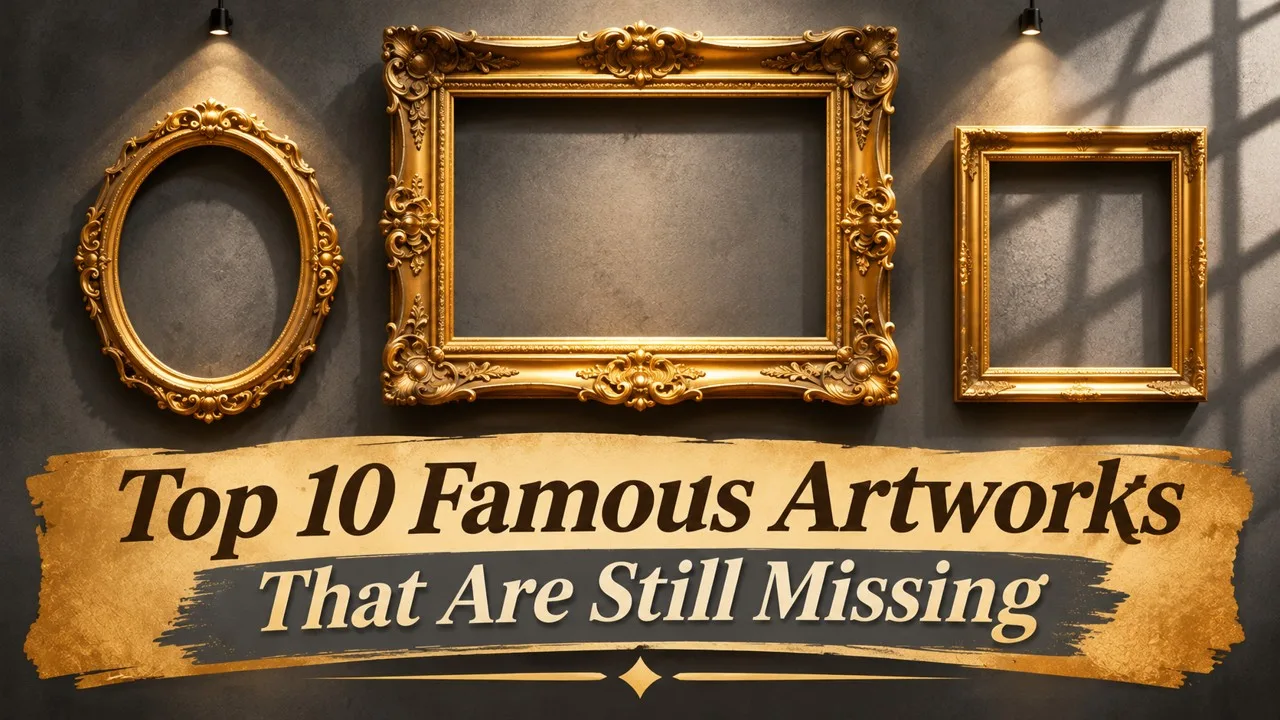
Some famous artworks survive only as records, copies, or empty frames, because the originals have never come back.
A missing work can be a panel cut from an altarpiece, a canvas taken in a night theft, a portrait lost in wartime looting, or an Imperial object that left the record after a revolution. The ten cases below are Govert Flinck's Landscape with an Obelisk, Jan van Eyck's Just Judges, Rembrandt's Christ in the Storm on the Sea of Galilee, a Van Gogh flower still life taken in Cairo, a Cezanne stolen from Oxford, Caravaggio's Palermo Nativity, a Francis Bacon portrait of Lucian Freud, the Danish Jubilee Egg, Raphael's Portrait of a Young Man, and Vermeer's The Concert. This article is an inventory of documented disappearances. It will not reconstruct the pictures themselves.
Key Facts
| Work | What is documented | What this article will not do |
|---|---|---|
| 1 | Landscape with an Obelisk, once given to Rembrandt, now to Govert Flinck, taken in 1990 | Describe the painted landscape as if to replace the panel |
| 2 | The Just Judges, a lower panel of the Ghent Altarpiece, stolen in 1934 | Treat a later copy as if it were the missing original |
| 3 | Rembrandt's only known seascape, also taken in 1990 from the same Boston museum | Restage the theft |
| 4 | A Van Gogh still life stolen from a Cairo museum and missing since 2010 | Reconstruct the flowers |
| 5 | A Cezanne landscape taken from the Ashmolean on New Year's Eve 1999 | Offer a theory presented as a solution |
| 6 | Caravaggio's large Palermo Nativity, stolen in 1969 and still unrecovered | Repeat unverified claims about its destruction as fact |
| 7 | A 1960s Bacon portrait of Lucian Freud, stolen in Berlin in 1988 | Imitate a modern picture still in copyright |
| 8 | The Danish Jubilee Egg, an Imperial Fabergé egg whose present location is unknown | Invent a current owner |
| 9 | Raphael's Portrait of a Young Man, looted in the Second World War and never found | Treat rumor as a last-seen certificate |
| 10 | Vermeer's The Concert, taken in the same 1990 Boston theft and still missing | Rank a missing painting by a theatrical price alone |
1. A Flinck Landscape Once Filed Under a Famous Name
Landscape with an Obelisk, a seventeenth-century Dutch panel now given to Govert Flinck, hung in the Isabella Stewart Gardner Museum in Boston and was long catalogued under Rembrandt's name [1]. In March 1990 it was among the works stolen from the museum in a night theft that has never been solved in public. The empty frame remains part of the hang. The painting has not been recovered [1].
The unexpected fact is that a missing work can change authors in the catalogue and still be, in the police file, the same object [1]. This article will not describe the landscape as if to stand in for the panel, and it will not restage the theft. The careful fact is a documented reattribution, a dated disappearance from a known collection, and a museum that has left the gap visible. A famous name on an old label is not the same as a recovered picture.
An empty frame can be an honest label. In Boston, it is also a reminder that the inventory is unfinished.
2. A Ghent Panel Replaced by a Copy
The Just Judges is one lower panel of the Ghent Altarpiece, the great early-fifteenth-century polyptych associated with Hubert and Jan van Eyck in Saint Bavo's Cathedral [2]. It was stolen in 1934. A related panel taken at the same time was later recovered; this one was not. A twentieth-century copy now stands in the altarpiece so that the ensemble can be read, which is a display solution, not a recovery [2].
The unexpected fact is that one of Europe's most watched sacred paintings can still have a hole more than ninety years old [2]. This article will not treat the copy as the original, and it will not turn a deathbed rumor into a map. The careful fact is a dated cathedral theft, a missing lower panel, a later copy in situ, and a case that remains open as a matter of the original object. The rest of the altarpiece has its own wartime story, which is not the 1934 theft and should not be folded into it.
A masterpiece can be almost complete and still be, in one rectangle, gone. Ghent has lived with that rectangle for generations.
3. A Rembrandt Seascape Cut from Its Frame
Christ in the Storm on the Sea of Galilee, painted by Rembrandt in 1633, is the artist's only known seascape, and it was taken from the Gardner Museum in the same 1990 theft as the Flinck panel [3]. Thieves cut the canvas from its frame, which is a brutal fact of the method and not a reason to reconstruct the picture. The frame is still on the wall. The canvas is not [3].
Related: Top 10 Most Famous Paintings in the World
The unexpected fact is that a unique subject in a famous body of work can disappear as part of a group crime, not as a lone targeted legend [3]. This article will not reconstruct the composition, and it will not narrate the night as a caper. The careful fact is a dated work, a unique subject in Rembrandt's surviving paintings, a documented removal from a known frame, and more than three decades without a recovery. One museum lost several of the works in this list on the same night. Each object still has its own catalogue line.
A seascape can be famous and still be, at present, a record and a frame. That is the whole of the public object now.
4. A Van Gogh Still Life Taken More Than Once
A small Van Gogh still life of flowers, often titled Poppy Flowers or Vase with Flowers and dated to the mid-1880s in Paris, belongs to the Mohamed Mahmoud Khalil Museum in Cairo [4]. It has been stolen from that museum more than once. After an earlier disappearance it was recovered; after a theft in 2010 it was not. The work remains missing from the public collection [4].
The unexpected fact is that the same modest panel can leave the same rooms twice, and that the second loss is the one that has lasted [4]. This article will not reconstruct the flowers, and it will not treat a repeated theft as a curiosity. The careful fact is a documented Cairo ownership, a 2010 disappearance that has not been reversed, and a reminder that a famous artist's smallest works are as movable as they are valuable. Recovery after a first theft is not a promise about a second.
A museum can lose the same picture twice. The inventory should say so, and then stop short of a painted substitute.
5. A Cezanne Taken While a City Was Celebrating
Paul Cezanne's View of Auvers-sur-Oise, a late-nineteenth-century landscape in the Ashmolean Museum at Oxford, was stolen on the night of 31 December 1999, while New Year fireworks were being used as cover [5]. The theft looked carefully aimed at one picture. The painting has not been recovered, and no public solution has replaced the police file [5].
The unexpected fact is how ordinary a great museum's worst night can look from the street: a celebration, and a missing landscape in the morning [5]. This article will not offer a pet theory as if it were a finding, and it will not reconstruct the view. The careful fact is a dated millennial theft, a known collection, and a blank that has now lasted into a second century of the work's absence. Fireworks explain the distraction. They do not explain where the canvas went.
Related: Top 10 Artists Who Made a Sharp Change of Style
A calendar night can hide a burglary. The painting's absence has lasted much longer than the night.
6. A Palermo Altarpiece That Left the Oratory
A large Nativity associated with Caravaggio, painted around 1609 and long housed in the Oratory of Saint Lawrence in Palermo, was stolen in 1969 [6]. The work has never been securely recovered. Later claims have pointed to organized crime, to damage, or to secret storage; some of those claims have been officially explored, and none has produced the painting for the public [6].
The unexpected fact is that a major altarpiece can remain, after more than half a century, in the category of "still missing" rather than of a closed legend [6]. This article will not repeat unverified destruction stories as fact, and it will not reconstruct the sacred scene. The careful fact is a documented 1969 theft from a known oratory, a still-empty place in that room (now usually filled by a copy or a reproduction for the congregation), and an investigation that has not ended in a return. Rumor is plentiful. The original is not.
A church can keep the feast and still lack the picture that once hung over it. Palermo's oratory has had to do exactly that.
7. A Modern Portrait Stolen in Berlin
In 1988, a 1960s portrait of the painter Lucian Freud by Francis Bacon was stolen while it was in Berlin, and it has not been recovered [7]. The two artists' long, difficult friendship is part of twentieth-century art history; the missing canvas is part of a theft file. Because the work is still protected by copyright, this article will not describe or imitate its surface at all [7].
The unexpected fact is that a missing modern picture can be as firmly gone as a seventeenth-century panel, even when it left a gallery in living memory [7]. This article will not reconstruct the portrait, and it will not use either artist's likeness. The careful fact is a documented 1988 disappearance, a named sitter and a named painter, and a blank in the later catalogue of Bacon's portraits of Freud. Inventory is allowed. Substitution is not.
Related: Top 10 Famous Artworks Damaged in Public Attacks
A late work can vanish in a city and stay vanished. The honest entry is a title, a date, and a still-open line.
8. An Imperial Egg That Left the Record
The Danish Jubilee Egg, also called the Royal Danish Egg, was one of the Imperial Easter eggs made by the House of Faberge for the Russian court, and it is usually dated to 1903 [8]. Unlike the eggs whose present locations are documented in museums or in known private collections, this one is among the small group whose whereabouts are not publicly established. It is known from period descriptions and from a design record, not from a currently exhibited object [8].
The unexpected fact is that a court object this carefully made can slip, after revolution and sale, into a documentary half-light rather than onto a well-published shelf [8]. This article will not invent a current owner, and it will not reconstruct the egg as a showpiece. The careful fact is a documented Imperial commission, a place in the incomplete census of the eggs, and an absence that is about the object, not about a legendary curse. Revolutions scatter inventories. Some of those inventories never fully come back together.
A famous workshop can still have a missing number in the set. The Danish Jubilee Egg is that number, until someone can show the thing itself.
9. A Raphael Lost in Wartime Looting
Portrait of a Young Man, a Raphael portrait of the early 1510s, belonged to the Czartoryski collection in Poland and was seized during the German occupation in the Second World War [9]. It was last securely tied to that wartime looting path and was not recovered in the returns that followed 1945. It remains one of the most important missing Old Master portraits on official lost-art lists [9].
The unexpected fact is that a work of this rank can have a clear prewar home and still have no clear postwar one [9]. This article will not treat rumor as a last-seen certificate, and it will not reconstruct the sitter's face. The careful fact is a documented prewar collection, a wartime seizure, and a gap that restitution efforts have not closed. Looting is a historical crime already on the record. The portrait is the missing evidence that would complete one file.
Related: Top 10 Most Popular Artists of All Time
A museum can know exactly what it lost and still be unable to hang it. That is the present tense of this Raphael.
10. A Vermeer That Is Still an Empty Frame
The Concert, a mid-1660s interior by Johannes Vermeer, was taken from the Gardner Museum in the same 1990 theft, and it is often called the most valuable missing painting in the world [10]. The price talk is a market estimate for an object that cannot, at present, be sold in the open. The more stubborn fact is simpler: a rare Vermeer left a known wall and has not been seen in public since [10].
The unexpected fact is that rarity, not only a headline value, is what makes the loss so hard to repair [10]. This article will not reconstruct the interior, and it will not rank a missing work as if it were a trophy. The careful fact is a documented mid-seventeenth-century painting, a 1990 disappearance from a named museum, and an empty frame that the Gardner has chosen to leave on view. Several works from that night are still gone. This one is among the rarest of them.
A quiet room in paint can be, for decades, only a quiet room in a catalogue. Until the canvas returns, the catalogue is what we have.
Conclusion
The ten missing works above include a reattributed Dutch landscape, a Ghent altarpiece panel, a Rembrandt seascape, a twice-stolen Van Gogh, a millennial Cezanne theft, a Palermo Caravaggio, a modern Bacon portrait, a lost Imperial egg, a looted Raphael, and a Vermeer whose frame is still on a Boston wall. Three of the paintings left the same museum on the same night. The others left churches, civic museums, a gallery, a court inventory, and a wartime collection.
An inventory of absence should be precise, and it should refuse to paint a substitute. The originals are the point, and they are not here.
- ^ [1] Museum and lost-art records for Govert Flinck's Landscape with an Obelisk, including the former Rembrandt attribution and its disappearance in the 1990 Isabella Stewart Gardner Museum theft. Isabella Stewart Gardner Museum Britannica: Govert Flinck
- ^ [2] Cathedral and art-historical accounts of the 1934 theft of The Just Judges from the Ghent Altarpiece, and of the later copy now shown in the ensemble. Saint Bavo's Cathedral Britannica: Ghent Altarpiece
- ^ [3] Museum records for Rembrandt's Christ in the Storm on the Sea of Galilee, including its 1633 date, its status as his only known seascape, and its 1990 removal from the Gardner Museum. Isabella Stewart Gardner Museum Britannica: Rembrandt
- ^ [4] Museum and news accounts of the Van Gogh still life often titled Poppy Flowers, including ownership by Cairo's Mohamed Mahmoud Khalil Museum and the unresolved 2010 theft. Britannica: Vincent van Gogh Wikipedia: Poppy Flowers
- ^ [5] Museum and police-reporting accounts of the 31 December 1999 theft of Cezanne's View of Auvers-sur-Oise from the Ashmolean Museum. Ashmolean Museum Britannica: Paul Cezanne
- ^ [6] Historical and official accounts of the 1969 theft of Caravaggio's Nativity from the Oratory of Saint Lawrence in Palermo, treating later claims about its fate as unverified unless the work itself is produced. Britannica: Caravaggio Wikipedia: Nativity with St. Francis and St. Lawrence
- ^ [7] Lost-art and news accounts of the 1988 Berlin theft of Francis Bacon's 1960s portrait of Lucian Freud, cited here as an inventory fact only, without a description of the picture. Britannica: Francis Bacon Britannica: Lucian Freud
- ^ [8] Catalogue and historical accounts of the Danish Jubilee Egg, or Royal Danish Egg, as a 1903 Imperial Faberge commission whose present location is not publicly established. Britannica: Faberge egg Wikipedia: Danish Jubilee Egg
- ^ [9] Lost-art and collection histories of Raphael's Portrait of a Young Man, including its place in the Czartoryski collection and its unrecovered wartime seizure. Britannica: Raphael Lost Art Database / related official registers
- ^ [10] Museum records for Vermeer's The Concert, including its mid-1660s date and its disappearance in the 1990 Gardner Museum theft, with market-value talk treated as an estimate, not as a present fact about a sale. Isabella Stewart Gardner Museum Britannica: Johannes Vermeer




















Discussion
Log in with