




 By
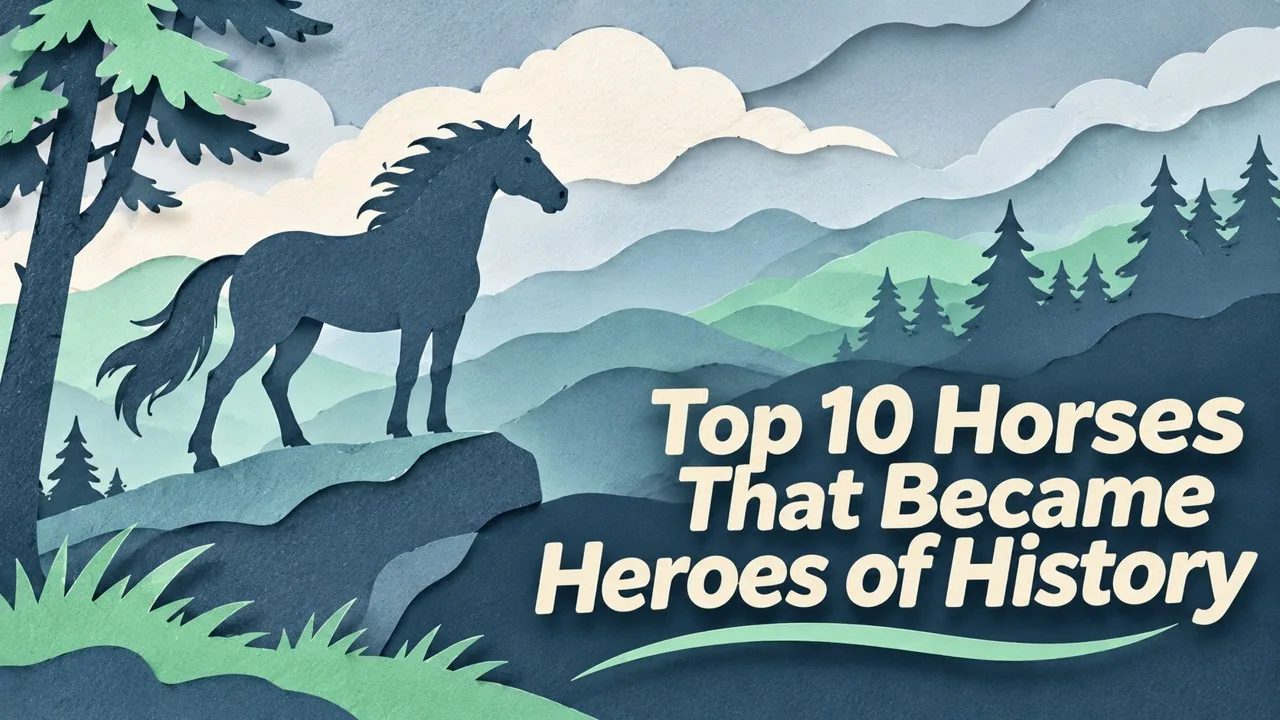
From Alexander's Bucephalus to a Korean War packhorse and a cavalry horse that survived a bomb, some horses earned places in history. For thousands of years, horses carried people into battle, pulled ploughs and carriages and raced for glory. Most of their names have been forgotten, but a few horses became famous in their own right. They were celebrated in paintings, statues, songs and books, and some were mourned like national heroes.
Several of these horses served in wars, where they faced the same dangers as soldiers. Others became symbols of hope during hard times, or of courage in the face of violence. Their stories also reflect the close bond between horses and the people who rode and cared for them.
The ten horses below are Bucephalus, Marengo, Copenhagen, Comanche, Traveller, Warrior, Sergeant Reckless, Seabiscuit, Phar Lap and Sefton. Some of their stories have been embellished over time, and the most uncertain details are noted where they appear.
Historians caution that many famous horse stories were polished by later writers, who liked to give heroes noble companions. Even so, the documented facts are often remarkable enough, and the affection these animals inspired is itself part of history. Museums still display saddles, bridles, skeletons and even preserved remains of several of these horses.
Key Facts
| # | Horse | Era and role | Why it is remembered |
|---|---|---|---|
| 1 | Bucephalus | Macedonia, fourth century BC | Carried Alexander the Great across an empire |
| 2 | Marengo | France, early nineteenth century | Survived wars and was captured after Waterloo |
| 3 | Copenhagen | Britain, 1815 | Carried Wellington through the Battle of Waterloo |
| 4 | Comanche | United States, 1876 | Found wounded after the battle and honored by the army |
| 5 | Traveller | United States, 1860s | Robert E. Lee's horse through the Civil War |
| 6 | Warrior | Western Front, 1914 to 1918 | Survived four years of the First World War |
| 7 | Sergeant Reckless | Korean War, 1950s | Carried ammunition under fire for the US Marines |
| 8 | Seabiscuit | United States, 1930s | A racehorse that inspired Depression-era America |
| 9 | Phar Lap | Australia, 1920s and 1930s | A racing champion who died mysteriously |
| 10 | Sefton | London, 1982 | Recovered from severe injuries |
1. A Horse Tamed by a Young Prince
According to the Greek writer Plutarch, a horse named Bucephalus was offered for sale to King Philip II of Macedonia, but no one could ride it. The young Alexander noticed that the horse was afraid of its own shadow, turned it to face the sun and calmed it [1].
Alexander rode Bucephalus in his campaigns across Persia and into India. The horse died after the Battle of the Hydaspes in 326 BC, possibly from wounds or old age. Alexander founded a city named Bucephala in its honor, near the site of the battle [1].
Bucephalus became one of the most famous horses in history, appearing in art and legend for centuries. The story of the taming is a classic tale of observation and patience, and it was used to show Alexander's insight even as a boy.
2. Napoleon's Gray Horse
Marengo was a gray Arabian horse ridden by Napoleon Bonaparte. He was named after the Battle of Marengo of 1800, a famous French victory in Italy. Marengo was said to have carried Napoleon in several campaigns [2].
After Napoleon's defeat at Waterloo in 1815, Marengo was captured by the British and taken to England, where he lived to an old age. Some details of his career are uncertain, since Napoleon owned many horses and stories about them were sometimes mixed together [2].
Related: Top 10 Most Famous Pets on the Internet
Marengo's skeleton is displayed at the National Army Museum in London. The horse appears in many paintings of Napoleon, though the most famous painting of Napoleon crossing the Alps shows him on a rearing horse, while in reality he crossed on a mule.
3. The Duke's Horse at Waterloo
Copenhagen was a chestnut horse owned by the Duke of Wellington. He was named after the British victory at the Second Battle of Copenhagen in 1807 [3].
At the Battle of Waterloo in 1815, Wellington rode Copenhagen for many hours, directing his troops throughout the long day. According to one story, when Wellington dismounted at the end of the day, the horse kicked out, nearly hitting him [3].
Copenhagen spent his retirement at Wellington's estate at Stratfield Saye, where he died in 1836. He was buried there with military honors, and his grave can still be seen. Wellington reportedly said that there may have been faster horses, but never one with more endurance.
4. The Survivor of the Little Bighorn
Comanche was a horse of the Seventh Cavalry, ridden by Captain Myles Keogh. At the Battle of the Little Bighorn in June 1876, Lakota, Northern Cheyenne and Arapaho warriors defeated the forces under George Armstrong Custer, a major victory for the Native nations defending their lands [4].
After the battle, soldiers found Comanche badly wounded. He was nursed back to health, and the Seventh Cavalry issued an order that he should never be ridden again and should be cared for by the regiment. He took part in parades and was treated as a living memorial [4].
Comanche died in 1891, and his body was preserved and displayed at the University of Kansas. His story reflects the army's view of the battle. Today, the battlefield memorial also honors the Native warriors who fought there, presenting a fuller account of the event.
5. A General's Companion
Traveller was a gray horse ridden by the Confederate general Robert E. Lee during most of the American Civil War. Lee acquired him in 1862, and the horse became well known to soldiers [5].
Related: Top 10 Most Bizarre Phobias: Strange Fears That Exist
Lee wrote affectionately about Traveller, describing his strength and endurance. After the war, Lee became president of Washington College in Lexington, Virginia, and continued to ride Traveller [5].
Traveller died in 1871, the year after Lee. He was buried near the chapel at the college, now Washington and Lee University. The horse appears in many depictions of Lee, which are now viewed in the context of debates about Confederate memorials. Traveller is remembered mainly as an example of the bond between a rider and his horse.
6. The Horse the Germans Could Not Kill
Warrior was a horse owned by the British officer Jack Seely, who took him to France in 1914. The horse served on the Western Front for most of the war, surviving shelling, machine gun fire and being trapped in mud at Passchendaele [6].
In March 1918, Seely rode Warrior in a cavalry charge at Moreuil Wood during the German spring offensive. Soldiers reportedly called Warrior the horse the Germans could not kill. Seely wrote a book about him, and Warrior returned home to the Isle of Wight after the war [6].
Warrior died in 1941 at the age of 33. In 2014, he was awarded an honorary Dickin Medal by the veterinary charity PDSA, often described as the animal equivalent of the Victoria Cross. Millions of horses served in the First World War, and many did not survive.
7. A Packhorse Who Became a Sergeant
Reckless was a small Mongolian mare bought by a United States Marine Corps unit in Korea in 1952 from a Korean boy who needed money. The Marines trained her to carry ammunition for recoilless rifles [7].
During the Battle for Outpost Vegas in March 1953, Reckless made dozens of trips under fire, carrying ammunition to the front line and bringing wounded soldiers back, mostly on her own. She was wounded twice. The Marines promoted her to sergeant and later to staff sergeant [7].
Related: Top 10 Oldest Buildings in the World
After the war, Reckless was brought to the United States and lived at Camp Pendleton in California. She died in 1968. She received many military honors and, in 2016, a Dickin Medal. Statues of Reckless stand at several sites, including the National Museum of the Marine Corps.
8. An Underdog in Hard Times
Seabiscuit was a small racehorse with an unpromising start. He was bought by the businessman Charles Howard and trained by Tom Smith, and he began to win major races in the late 1930s [8].
In 1938, Seabiscuit beat the champion War Admiral in a famous match race at Pimlico in Maryland, followed by a huge radio audience. In 1940, after recovering from an injury, he won the Santa Anita Handicap, a race that had eluded him [8].
During the Great Depression, Seabiscuit became a symbol of hope for many Americans, an underdog who succeeded against the odds. His story was told in a best-selling book by Laura Hillenbrand in 2001 and a film in 2003.
9. A Champion Mourned by Two Nations
Phar Lap was a racehorse bred in New Zealand and raced in Australia, where he became a national hero during the Great Depression. He won the Melbourne Cup in 1930, along with many other major races [9].
In 1932, Phar Lap traveled to North America and won a major race in Mexico. Soon afterward, he died suddenly in California. His death caused great grief in Australia and New Zealand, and rumors spread that he had been poisoned. Tests in 2006 and 2008 found evidence of arsenic, but whether it came from deliberate poisoning or from tonics commonly used at the time is debated [9].
Phar Lap's remains are displayed in three countries: his hide in Melbourne Museum, his skeleton in Te Papa in Wellington and his large heart at the National Museum of Australia in Canberra. He remains one of Australia's best-loved sporting heroes.
Related: 10 Sikh Gurus: The Pillars of Sikhism Who Shaped Faith, Equality, Courage, and Humanity
10. A Survivor of a Bombing
Sefton was a horse of the Household Cavalry, the regiment that guards the British monarch on ceremonial occasions. On 20 July 1982, a bomb planted by the Provisional IRA exploded as a group of soldiers rode through Hyde Park in London [10].
Four soldiers and seven horses were killed. Sefton suffered dozens of wounds and underwent hours of surgery. His recovery was followed by the public, and he received thousands of cards and gifts [10].
Sefton returned to duty and later retired. He was named Horse of the Year in 1982, and a fund in his name raised money for a veterinary surgical wing. He died in 1993. His survival became a symbol of resilience after a violent attack.
Conclusion
The ten horses above show the many ways horses have shaped history. Bucephalus, Marengo, Copenhagen and Traveller carried famous commanders, while Comanche, Warrior and Reckless survived or served in battles that cost many lives. Seabiscuit and Phar Lap gave hope during the Depression, and Sefton became a symbol of recovery.
Their stories reflect both the bravery and the suffering of animals in human conflicts and the deep bond between horses and people. They remind us that history is not made by humans alone.
Today, horses still serve in ceremonial units, mounted police and therapy programs, and memorials to animals in war remind visitors of the millions of horses that served and suffered in human conflicts.
- ^ [1] Accounts of Bucephalus and Plutarch's story. Wikipedia: Bucephalus Wikipedia: Battle of the Hydaspes
- ^ [2] Accounts of Marengo. Wikipedia: Marengo (horse) Wikipedia: National Army Museum
- ^ [3] Accounts of Copenhagen and Waterloo. Wikipedia: Copenhagen (horse) Wikipedia: Battle of Waterloo
- ^ [4] Accounts of Comanche and the Little Bighorn. Wikipedia: Comanche (horse) Wikipedia: Battle of the Little Bighorn
- ^ [5] Accounts of Traveller. Wikipedia: Traveller (horse) Wikipedia: Washington and Lee University
- ^ [6] Accounts of Warrior and Jack Seely. Wikipedia: Warrior (horse) Wikipedia: Dickin Medal
- ^ [7] Accounts of Sergeant Reckless. Wikipedia: Sergeant Reckless Wikipedia: Korean War
- ^ [8] Accounts of Seabiscuit. Wikipedia: Seabiscuit Wikipedia: War Admiral
- ^ [9] Accounts of Phar Lap. Wikipedia: Phar Lap Wikipedia: Melbourne Cup
- ^ [10] Accounts of Sefton and the 1982 bombing. Wikipedia: Sefton (horse) Wikipedia: Hyde Park and Regent's Park bombings























Discussion
Log in with