






 By
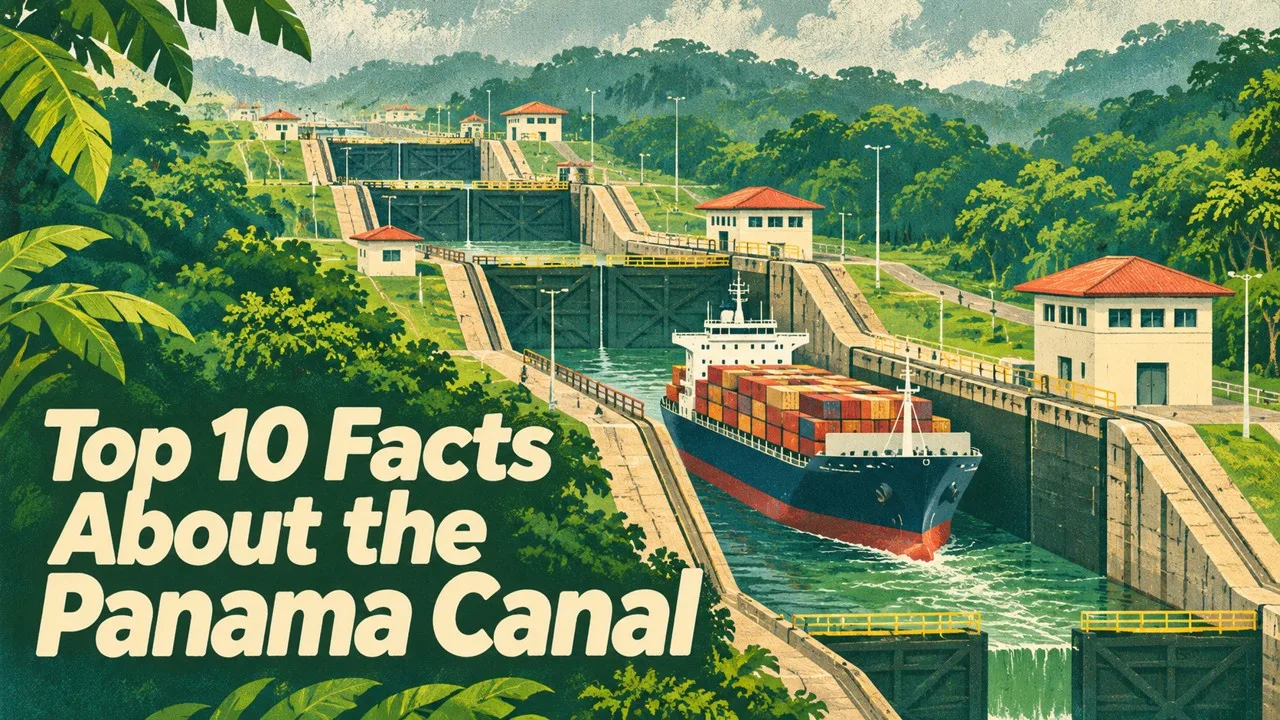
The Panama Canal cut weeks off sea voyages, but building it took a failed French attempt, a war on mosquitoes, a huge artificial lake and decades of politics. The Panama Canal is one of the most important shortcuts in world trade. By crossing the Isthmus of Panama, ships traveling between the Atlantic and Pacific oceans avoid the long and dangerous journey around the southern tip of South America. The canal is about 82 kilometers long, and thousands of ships pass through it each year.
Its history is full of surprises. The ten facts below cover the failed French attempt, the politics of Panama's independence, the fight against tropical disease, the great cut through the mountains, the artificial lake at the canal's heart, the gravity-powered locks, the opening in 1914, the cheapest toll ever paid, the handover to Panama in 1999 and the expansion and water problems of the twenty-first century.
The canal also has a human story that is easy to forget. Tens of thousands of workers from Panama, the Caribbean, Europe and the United States built it, often in dangerous conditions and under a system that paid and housed workers differently depending on their origin. Many of the laborers came from Barbados and Jamaica, and their descendants remain part of Panamanian society today.
Key Facts
| # | Fact | Period | Key detail |
|---|---|---|---|
| 1 | The French attempt | 1881 to 1889 | Disease and engineering problems defeated the project |
| 2 | Panama's independence and the canal treaty | 1903 | The United States gained control of a canal zone |
| 3 | The fight against disease | 1904 to 1914 | Sanitation work sharply reduced yellow fever and malaria |
| 4 | The Culebra Cut | 1907 to 1913 | Landslides repeatedly filled the excavation |
| 5 | Gatun Lake | Created 1913 | Once the largest artificial lake in the world |
| 6 | The lock system | Opened 1914 | No pumps are needed to fill the original locks |
| 7 | The official opening | 15 August 1914 | The cargo ship SS Ancon made the first official transit |
| 8 | A man who swam the canal | 1928 | Richard Halliburton paid 36 cents |
| 9 | The transfer to Panama | 1977 to 1999 | Panama took full control on 31 December 1999 |
| 10 | The expansion and drought | 2016 and 2023 | Larger ships pass, but water limits remain |
1. A French Attempt That Failed
The first serious attempt to build a canal across Panama was led by Ferdinand de Lesseps, the French diplomat who had developed the Suez Canal. Work began in 1881, when Panama was part of Colombia. De Lesseps planned a sea-level canal without locks, similar to Suez [1].
The plan underestimated the difficulty of digging through mountains and jungle, the force of the Chagres River and the danger of tropical diseases such as yellow fever and malaria. Thousands of workers died, with estimates of total deaths in the French period often given as around 22,000 [1].
The French company went bankrupt in 1889, wiping out the savings of many investors and leading to a political scandal in France. Some of the French excavation and equipment was later used by the United States, so the failed effort was not entirely wasted.
2. A Canal Tied to a New Country
After the French failure, the United States decided to build a canal. When the Colombian Senate rejected a treaty in 1903, a movement for Panamanian independence gained support. With the backing of the United States, including the presence of American warships, Panama declared independence in November 1903 [2].
Soon afterward, the Hay–Bunau-Varilla Treaty gave the United States rights to a zone around the canal route. The treaty was signed for Panama by Philippe Bunau-Varilla, a Frenchman involved in the earlier canal company, which caused lasting resentment among Panamanians [2].
The Panama Canal Zone became a United States territory in practice, with its own government, police and courts. The arrangement shaped relations between the two countries for most of the twentieth century and later became the subject of protests and negotiations.
Related: Top 10 Greatest Engineering Achievements
3. A War Against Mosquitoes
When the Americans began work, disease remained a huge danger. William C. Gorgas, an army doctor, led a campaign based on the then-recent discovery that yellow fever and malaria are spread by mosquitoes [3].
Gorgas's teams drained standing water, sprayed oil on breeding sites, installed screens on buildings and fumigated houses. They also improved water supplies and sewage systems in Panama City and Colón. Yellow fever was eliminated from the canal zone by 1906, and malaria rates fell substantially [3].
The campaign made the construction possible. Thousands of workers still died during the American period, with an official figure of about 5,600 deaths, many of them workers from the Caribbean. The sanitation work became a model for later public health programs in tropical regions.
4. A Cut Through the Mountains
The hardest part of the construction was the Culebra Cut, later renamed the Gaillard Cut after the engineer David du Bose Gaillard. It is a channel through the continental divide, the mountains in the center of the isthmus [4].
Workers used steam shovels, dynamite and railroads to remove huge volumes of rock and earth. Landslides repeatedly filled the excavation, forcing engineers to remove the same ground several times and to widen the slopes. At its peak, thousands of men worked in the cut every day [4].
The cut is about 12 kilometers long. A surprising fact about the canal's geography is that, because of the shape of the isthmus, the Pacific entrance lies to the east of the Atlantic entrance. Ships traveling from the Atlantic to the Pacific actually move toward the southeast.
5. A Lake Made by a Dam
The American plan used locks to raise ships over the mountains instead of digging to sea level. A key part of this design was Gatun Lake, created by damming the Chagres River with the Gatun Dam [5].
When it was created, Gatun Lake was the largest artificial lake in the world. Ships cross it for a large part of their journey through the canal. Former hills became islands, including Barro Colorado Island, which is now a famous tropical research station [5].
Related: Top 10 Largest Dams in the World
The lake also provides the water that operates the locks and supplies drinking water to much of Panama. That double role makes the lake's water level important, especially during droughts. The decision to use a lake and locks made the canal feasible, but tied its operation to rainfall.
6. Locks Powered by Gravity
The original Panama Canal has three sets of locks: Gatun on the Atlantic side and Pedro Miguel and Miraflores on the Pacific side. Together, they raise ships about 26 meters to the level of Gatun Lake and lower them again [6].
The locks work by gravity. Water flows from the lake into the lock chambers through large culverts, and no pumps are needed. Each transit uses millions of liters of fresh water, which flows out to the sea [6].
Ships in the original locks are guided by electric locomotives running on tracks along the lock walls, nicknamed mules after the animals once used on canals. The lock gates were massive steel structures, and the system was an engineering marvel of its time. The original locks are still in use more than a century later.
7. An Opening Overshadowed by War
The Panama Canal officially opened on 15 August 1914, when the cargo and passenger ship SS Ancon passed through. The opening came just weeks after the outbreak of the First World War, so it received less attention than planners had hoped [7].
The canal dramatically shortened sea routes. For example, a ship traveling from New York to San Francisco through the canal could save thousands of kilometers compared with the route around South America [7].
Related: Top 10 Longest Canals in the World
Landslides in the Culebra Cut closed the canal for months in 1915 and 1916, showing the challenges that remained. Over time, the canal became central to world trade and to American naval strategy, since it allowed ships to move between the Atlantic and Pacific fleets.
8. The Cheapest Toll in History
Ships pay tolls to use the canal, based on their size and type. Large modern ships can pay hundreds of thousands of dollars for a single transit. The lowest toll on record is a famous exception [8].
In 1928, the American adventurer and writer Richard Halliburton swam the length of the canal over several days. Canal authorities treated him as a ship and charged him based on his weight. His toll was 36 cents [8].
Halliburton had to go through the locks like a vessel. The swim became one of his best-known adventures. The story is often told as a light-hearted contrast to the high tolls paid by commercial shipping, which provide a major part of Panama's government revenue.
9. A Handover in 1999
Panamanian frustration with the American-controlled canal zone grew during the twentieth century. In 1964, protests over the right to fly the Panamanian flag in the zone led to deadly riots, a turning point in relations [9].
In 1977, the Torrijos–Carter Treaties were signed by Panamanian leader Omar Torrijos and United States President Jimmy Carter. The treaties provided for the canal to be transferred to Panama and for the canal to remain neutral and open to ships of all nations [9].
The canal zone was gradually dissolved, and Panama took full control of the canal on 31 December 1999. It is now run by the Panama Canal Authority. Since the handover, the canal has continued to operate successfully, and its revenues have become an important part of Panama's economy.
Related: Top 10 Most Bizarre Phobias: Strange Fears That Exist
10. New Locks and Low Water
As ships grew larger, many could no longer fit through the original locks. Panama approved an expansion project in 2006, and new, larger locks opened in June 2016. They allow much larger ships, known as Neopanamax vessels, to use the canal [10].
The new locks use water-saving basins that reuse part of the water for each transit. Instead of locomotives, ships in the new locks are positioned with tugboats [10].
In 2023, a severe drought lowered Gatun Lake, forcing the canal authority to limit the number of daily transits and the depth of ships. The restrictions caused delays and showed how the canal depends on rainfall. Panama has considered new water projects to secure supplies for the future.
Conclusion
The ten facts above show that the Panama Canal is as much a story of politics, medicine and water as of engineering. A French failure, a new country, a campaign against mosquitoes and a great artificial lake all made the canal possible.
More than a century after opening, the canal still uses its original gravity-fed locks, alongside new ones built for larger ships. Its future depends on rain and on careful management, just as its past depended on courage, money and the hard work of tens of thousands of laborers.
Visitors can watch ships pass through the Miraflores Locks from a public viewing center near Panama City, and the canal remains one of the country's leading attractions. For anyone who sees a large ship rise slowly in a lock chamber, the scale of the achievement becomes easy to understand.
- ^ [1] Accounts of de Lesseps and the French canal effort. Wikipedia: Ferdinand de Lesseps Wikipedia: Panama Canal
- ^ [2] Accounts of Panama's independence and the 1903 treaty. Wikipedia: Hay–Bunau-Varilla Treaty Wikipedia: Panama Canal Zone
- ^ [3] Accounts of Gorgas's sanitation campaign. Wikipedia: William C. Gorgas Wikipedia: yellow fever
- ^ [4] Accounts of the Culebra Cut and its landslides. Wikipedia: Culebra Cut Wikipedia: Panama Canal
- ^ [5] Accounts of Gatun Lake and Barro Colorado Island. Wikipedia: Gatun Lake Wikipedia: Barro Colorado Island
- ^ [6] Accounts of the design and operation of the locks. Wikipedia: Panama Canal locks Wikipedia: Miraflores Locks
- ^ [7] Accounts of the 1914 opening. Wikipedia: SS Ancon Wikipedia: Panama Canal
- ^ [8] Accounts of Halliburton's 1928 swim. Wikipedia: Richard Halliburton Wikipedia: Panama Canal
- ^ [9] Accounts of the 1964 riots and the 1977 treaties. Wikipedia: Torrijos–Carter Treaties Wikipedia: Panama Canal Authority
- ^ [10] Accounts of the expansion and recent water restrictions. Wikipedia: Panama Canal expansion project Wikipedia: Gatun Lake



















Discussion
Log in with