





Top 10 Attempts to Bring Species Back From Extinction
 By Dhiraj Sharma · Published
Share Post
Loading…
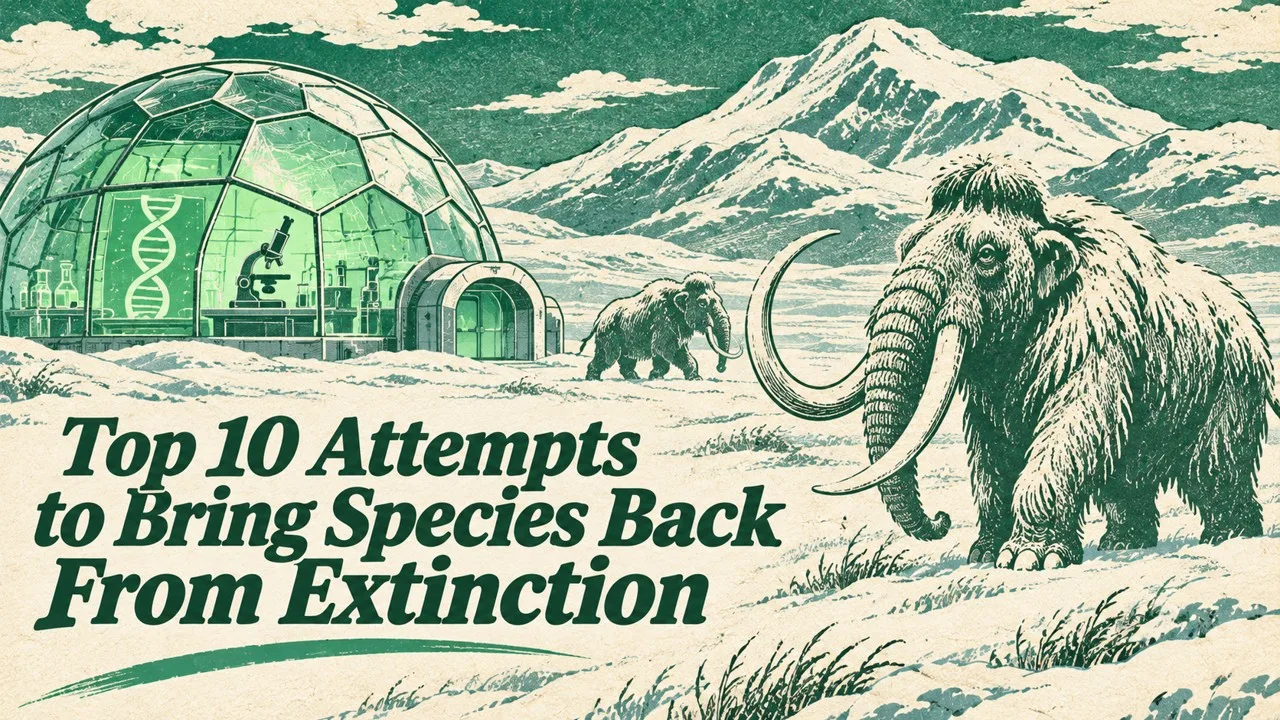
Scientists have cloned an extinct goat, bred zebras to look like quaggas and edited wolf genes in the controversial quest to bring vanished species back. Extinction has long been considered final. Once the last individual of a species dies, it was assumed that the species was gone forever. Advances in genetics, cloning and selective breeding have challenged that idea, leading to a field known as de-extinction, which aims to bring back extinct species or animals that closely resemble them.
The idea is controversial. Supporters argue that restoring lost species could repair damaged ecosystems and inspire new interest in conservation. Critics worry about animal welfare, cost and the risk that de-extinction will distract from protecting species that still exist. Many scientists also argue that a genetically engineered animal is not truly the same as the species that was lost.
The ten efforts below are the back-breeding of aurochs-like cattle, the Quagga Project, the cloned Pyrenean ibex, the gastric-brooding frog, the passenger pigeon, the woolly mammoth, the thylacine, the so-called dire wolves, the Floreana Island giant tortoise and the cloned black-footed ferret. They range from century-old breeding programs to recent experiments in gene editing.
Key Facts
| # | Species | Approach | Result so far |
|---|---|---|---|
| 1 | The aurochs | Back-breeding of domestic cattle | Produced aurochs-like cattle, not true aurochs |
| 2 | The quagga | Selective breeding of plains zebras | Produced animals with quagga-like markings |
| 3 | The Pyrenean ibex | Cloning from preserved cells | A clone was born in 2003 but died shortly after birth |
| 4 | The gastric-brooding frog | Cloning embryos from frozen tissue | Early embryos were created but did not survive |
| 5 | The passenger pigeon | Genetic engineering of a related pigeon | Research continues |
| 6 | The woolly mammoth | Gene editing of Asian elephants | Research under way, no mammoths yet |
| 7 | The thylacine | Gene editing of a related marsupial | Research announced, far from completion |
| 8 | The dire wolf | Gene editing of gray wolves | Three pups born in 2025, but their status is debated |
| 9 | The Floreana giant tortoise | Breeding from hybrid tortoises | Breeding program under way |
| 10 | The black-footed ferret | Cloning to restore genetic diversity | A healthy clone was born in 2020 |
1. Breeding Back Wild Cattle
The aurochs was a large wild ox that once roamed Europe, Asia and North Africa. It is the ancestor of domestic cattle. The last known aurochs died in a forest in Poland in 1627 [1].
In the 1920s and 1930s, the German zoo directors Heinz and Lutz Heck tried to recreate the aurochs by crossing breeds of domestic cattle that showed primitive traits. The resulting animals, known as Heck cattle, were promoted in Germany during the Nazi era. Experts generally agree that they look only partly like aurochs [1].
Newer projects, such as the Tauros Programme in Europe, use genetic information and careful breeding to produce cattle closer to the aurochs in size, shape and behavior. The animals are being released in rewilding areas, where large grazing animals help maintain open landscapes. The aim is to restore an ecological role rather than the exact species.
2. Zebras Bred to Look Like Quaggas
The quagga was a type of zebra in southern Africa with stripes only on the front part of its body. It was hunted to extinction in the nineteenth century, and the last known quagga died in a zoo in Amsterdam in 1883 [2].
In 1984, the quagga became one of the first extinct animals to have its DNA analyzed. The results suggested that it was a form of plains zebra rather than a separate species. In 1987, the naturalist Reinhold Rau started the Quagga Project in South Africa to breed plains zebras selectively for reduced striping [2].
After several generations, the project has produced animals with markings similar to the quagga, called Rau quaggas. Critics argue that they are simply zebras with a particular appearance, not true quaggas. Supporters say the project restores the look and possibly the ecological role of the lost animal.
Related: Top 10 Animals Once Thought Extinct That Turned Up Alive
3. A Clone That Lived for Minutes
The Pyrenean ibex, or bucardo, was a wild goat that lived in the Pyrenees mountains between Spain and France. The last known individual, a female named Celia, died in 2000. Before her death, scientists collected and froze samples of her cells [3].
Researchers used these cells to create cloned embryos, which were implanted into domestic goats and hybrid goats. In 2003, one clone was born, making the Pyrenean ibex the first extinct animal to be brought back, if only briefly. The newborn died minutes later because of a lung defect [3].
The experiment showed that cloning an extinct animal was technically possible, but also how difficult it is. With only one individual's cells, any population would lack genetic diversity. The bucardo remains extinct, though its story is often cited as the first de-extinction.
4. A Frog That Gave Birth Through Its Mouth
The gastric-brooding frogs of Australia had an extraordinary way of reproducing. The female swallowed her fertilized eggs, and the young developed in her stomach before she gave birth to them through her mouth. Both known species became extinct in the 1980s [4].
In 2013, scientists working on the Lazarus Project at the University of Newcastle in Australia announced that they had created cloned embryos using cells from frozen frog tissue placed into eggs of a related frog. The embryos began to develop but died after a few days [4].
The researchers said the result was an important step toward bringing the frogs back. The project also highlighted the global crisis facing amphibians, many of which are threatened by a fungal disease called chytridiomycosis. The gastric-brooding frog remains extinct.
5. Reviving a Vanished Pigeon
The passenger pigeon was once one of the most numerous birds in North America, flying in flocks of millions. Hunting and habitat loss drove it to extinction. The last known passenger pigeon, a female named Martha, died at the Cincinnati Zoo in 1914 [5].
Related: Top 10 Amazing Animals of the Amazon Rainforest
The conservation organization Revive and Restore has supported research to bring back a bird resembling the passenger pigeon by editing the genome of its closest living relative, the band-tailed pigeon, to include passenger pigeon traits. Researchers have sequenced passenger pigeon DNA from museum specimens [5].
The project faces major challenges, including the difficulty of genetic engineering in birds and the question of whether a social species that lived in huge flocks could survive in small numbers. It has nonetheless increased public interest in the story of the passenger pigeon and the dangers of overexploitation.
6. Elephants With Mammoth Traits
The woolly mammoth lived in cold regions of the Northern Hemisphere and disappeared from most of its range by about 10,000 years ago. A small population survived on Wrangel Island until about 4,000 years ago. Well-preserved remains in frozen ground have allowed scientists to study mammoth DNA in detail [6].
In 2021, a company called Colossal Biosciences was founded with the aim of creating cold-resistant elephants with mammoth traits, using gene editing of Asian elephant cells. In 2025, the company announced mice with altered genes producing long, woolly hair as a step toward the project [6].
Many scientists are skeptical about the project's timeline and goals, and there are serious questions about the welfare of elephants used as surrogates. Supporters argue that mammoth-like elephants could help restore Arctic grasslands. No mammoth or mammoth-like elephant has yet been produced.
7. The Tasmanian Tiger
The thylacine, also known as the Tasmanian tiger, was a carnivorous marsupial that lived in Australia and New Guinea and survived longest in Tasmania. The last known thylacine died in a zoo in Hobart in 1936 [7].
In 2022, Colossal Biosciences and researchers at the University of Melbourne announced a project to bring back an animal resembling the thylacine by editing the genome of a living relative, the fat-tailed dunnart, a small marsupial. Scientists have reconstructed a large part of the thylacine genome from preserved specimens [7].
Related: Top 10 Unique Animals Found Only in Africa
The project has generated excitement and criticism. Critics point out the enormous technical challenges, including how to grow a thylacine-sized animal from a much smaller surrogate. The project has also funded research into marsupial reproduction that may help protect living species.
8. Wolves Edited to Resemble Dire Wolves
The dire wolf was a large wolf-like animal that lived in the Americas and became extinct more than 10,000 years ago. It became widely known through fiction and television [8].
In April 2025, Colossal Biosciences announced the birth of three pups that it described as dire wolves. They were created by editing a number of genes in gray wolf cells to produce traits associated with dire wolves, such as a larger size and a pale coat, based on analysis of ancient DNA [8].
Many scientists criticized the claim, arguing that the animals are genetically modified gray wolves rather than dire wolves. The announcement sparked a wide debate about what de-extinction really means and whether the term was being used for publicity. The animals are kept in a protected reserve.
9. A Tortoise Found in Hybrids
The giant tortoises of Floreana Island in the Galápagos were driven to extinction in the nineteenth century, largely because sailors and settlers took them for food. However, scientists later found that many tortoises living on another island, near Wolf Volcano on Isabela Island, carried Floreana ancestry, probably because sailors moved tortoises between islands [9].
In 2015, an expedition collected tortoises with high levels of Floreana genes, and a breeding program was set up by the Galápagos National Park. The aim is to produce tortoises with mostly Floreana ancestry and eventually return them to Floreana Island [9].
Related: Exploring the Great Barrier Reef: Ecosystem and Biodiversity
Floreana Island is also being restored by removing invasive species such as rats and cats. The project shows how genetic research can reveal hidden survivors of extinct lineages. It is a slower, more traditional approach to restoring a species than genetic engineering.
10. A Clone From Cells Frozen in 1988
The black-footed ferret is not extinct, but it came very close. By the 1980s, only a few individuals remained in the wild, and all living ferrets descend from a small group. This lack of genetic diversity makes the species vulnerable [10].
In December 2020, a clone named Elizabeth Ann was born, created from the cells of a ferret named Willa that had been frozen in 1988. Willa had no living descendants, so the clone brought back genetic diversity that had been lost. It was the first clone of a native endangered species in the United States [10].
Later clones were produced, and in 2024 a cloned ferret named Antonia gave birth, a major milestone. The project shows how techniques developed for de-extinction can also help save endangered species before they disappear, which many conservationists see as the most valuable use of the technology.
Conclusion
The ten efforts above show the range of approaches to reversing extinction. Some rely on traditional breeding, such as the aurochs and quagga projects. Others use cloning or gene editing, from the brief life of the bucardo clone to the controversial dire wolf pups. Some, like the Floreana tortoise and black-footed ferret, focus on restoring lost genes to living populations.
De-extinction remains scientifically challenging and ethically debated. Its greatest value may lie in helping living species survive. Preventing extinction in the first place remains far easier and cheaper than trying to bring a species back.
- ^ [1] Accounts of aurochs back-breeding projects. Wikipedia: Heck cattle Wikipedia: aurochs
- ^ [2] Accounts of the quagga and the Quagga Project. Wikipedia: quagga Wikipedia: Quagga Project
- ^ [3] Accounts of the Pyrenean ibex clone. Wikipedia: Pyrenean ibex Wikipedia: de-extinction
- ^ [4] Accounts of the gastric-brooding frog and the Lazarus Project. Wikipedia: gastric-brooding frog Wikipedia: chytridiomycosis
- ^ [5] Accounts of the passenger pigeon and revival research. Wikipedia: passenger pigeon Wikipedia: Martha (pigeon)
- ^ [6] Accounts of the woolly mammoth and Colossal Biosciences. Wikipedia: woolly mammoth Wikipedia: Colossal Biosciences
- ^ [7] Accounts of the thylacine and revival research. Wikipedia: thylacine Wikipedia: fat-tailed dunnart
- ^ [8] Accounts of the dire wolf and the 2025 announcement. Wikipedia: dire wolf Wikipedia: Colossal Biosciences
- ^ [9] Accounts of the Floreana tortoise and Galápagos tortoises. Wikipedia: Floreana giant tortoise Wikipedia: Galápagos tortoise
- ^ [10] Accounts of black-footed ferret cloning. Wikipedia: black-footed ferret Wikipedia: cloning




















Discussion
Log in with