





 By
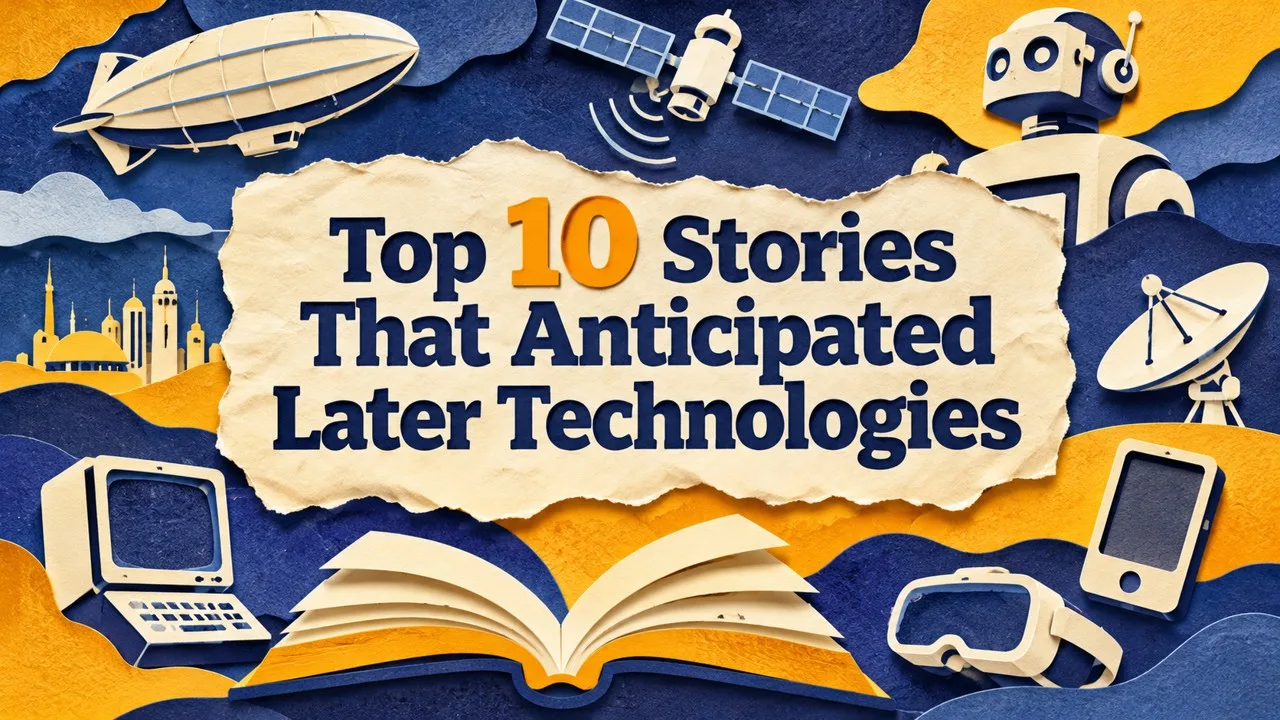
Some stories anticipated later tools in a loose way, from a national credit in a novel to a later handheld device, and resemblance is not prophecy.
The ten works below are Edward Bellamy's Looking Backward, H. G. Wells's The Land Ironclads, Jonathan Swift's satire on Laputa, Hugo Gernsback's Ralph 124C 41+, Wells's When the Sleeper Wakes, Rokeya Sakhawat Hossain's Sultana's Dream, Wells's The World Set Free, E. M. Forster's The Machine Stops, William Morrison's The Sack, and Frederik Pohl's The Age of the Pussyfoot. A resemblance between a tool and an earlier scene is not a prophecy, and it is not a scorecard that makes the story nail a future. This article will not quote long passages, will not display copyrighted character designs or likenesses, and will not treat a weapon in fiction as a design. It is distinct from Finepedia lists about stopgap technologies and quiet technology shifts.
Key Facts
| Work | The modest resemblance | A limit |
|---|---|---|
| 1 | Bellamy imagined a national credit and a card-like way to spend a share | His credit is a political-economic scheme, not a bank product in every detail |
| 2 | Wells described armored, cross-country fighting machines that readers have compared with tanks | A 1903 story is not a blueprint, and the tank had its own inventors |
| 3 | Swift's Laputa had astronomers speak of two Martian moons, a coincidence that needs a heavy hedge | Kepler had already guessed at two, and Swift's sizes and periods are not the later facts |
| 4 | Gernsback's serial packed the book with gadgets, including a radio-location idea often compared with radar | A catalog of gizmos is not a single accurate forecast |
| 5 | Wells also imagined doors that opened without a touch, a convenience rather than a marvel | Automatic doors have more than one ancestor |
| 6 | Hossain's feminist utopia used collected sunlight as a power, among other civic ideas | The solar industry was not invented in a novella |
| 7 | Wells wrote of radioactive bombs and a poisoned aftermath, decades before 1945 | The devices of 1945 were not this book, and this article will not describe a weapon |
| 8 | Forster imagined isolated people talking through screens in rooms, a social warning | He did not invent a meeting application |
| 9 | Morrison imagined an entity that answered factual questions on demand | A search company is not a living sack, and the resemblance is functional |
| 10 | Pohl's "joymaker" is a handheld that talks, pays, informs, and monitors, a cluster of functions | A smartphone is an industry, not a fulfilled charm |
1. A National Credit, Not a Bank Card in Every Detail
In Looking Backward, published in 1888, Edward Bellamy imagined a Boston in which a national credit replaced ordinary cash, and a person spent a share with a card-like instrument [1]. The resemblance to payment cards is real and often cited. The system in the book is a political-economic scheme for a planned society, not a forecast of a particular bank's product, interest, or network. Resemblance is not prophecy. The novel is a reform argument that happened to include a handy object [1].
The unexpected fact is that a payment habit can have, in a utopian novel, a cousin that was meant as a moral [1]. This article will not quote the book at length. The careful fact is a documented 1888 text and a documented comparison. Reform was the point. A logo is not implied.
A card can appear in a book and still not have been, except as a convenience in an argument, the card in a later wallet.
2. Armored Machines, and Tanks
In 1903, H. G. Wells published The Land Ironclads, a story of armored, cross-country fighting machines that readers have compared with tanks [2]. The resemblance is fair in outline: armor, a crew, a land ship that frightens infantry used to an older field. The tank, developed in the First World War, had its own inventors, committees, and failed prototypes. Wells did not design those machines, and the story is not a manual. This article will not extract a weapon from the fiction [2].
The unexpected fact is that a battlefield object can have, in a magazine story, a cousin that was meant to shock an Edwardian reader [2]. The careful fact is a documented 1903 text and a documented comparison. Imagination ran at land ironclads. Engineering ran separately.
A story can look ahead and still not have been, except as a compliment, the patent.
3. Two Moons, a Coincidence That Needs a Hedge
In Gulliver's Travels, first published in 1726, not in 1735 as some lists have it, the astronomers of Laputa speak of two moons of Mars [3]. Phobos and Deimos were observed in 1877. The coincidence is famous and should be heavily qualified. Johannes Kepler had already guessed that Mars might have two moons, in a numerological pattern of satellites, and Swift's sizes and periods are not the facts later measured. A satire of projectors is not an observatory. Resemblance, here, is the most fragile kind: a number that happened to be right [3].
Related: Top 10 Memorable Moments in the Original Sherlock Holmes Stories
The unexpected fact is that a joke about astronomers can be, in a caption, treated as discovery [3]. This article will not quote the voyage at length. The careful fact is a documented 1726 text, a documented 1877 discovery, and a documented earlier guess by Kepler. Satire was the genre. Prophecy is the over-claim.
A moon can be named in a satire and still not have been, except as a lucky number, a measurement.
4. A Catalog of Gadgets, Including a Radio-Location Idea
Hugo Gernsback's Ralph 124C 41+, first serialized in 1911, is less a single prophecy than a shop window of devices [4]. Among them is a radio-location idea that readers have compared with radar. The book is a catalog, and a catalog will hit something if it lists enough tools. Credit for radar belongs to laboratories, not to a magazine hero. The useful point is only that a pulp engineer was already thinking about echoes in air [4].
The unexpected fact is that a crowded invention list can be, in hindsight, right about one shelf [4]. This article will not quote the serial at length or display a character. The careful fact is a documented 1911 serial and a documented comparison. Pulp was the form. A laboratory did the work.
A gadget can appear in a magazine and still not have been, except as a wish, a set of later instruments.
5. Doors That Open Without a Touch
In When the Sleeper Wakes, later revised as The Sleeper Awakes, Wells imagined doors that opened without a hand on a knob [5]. Automatic doors have more than one ancestor in buildings and vehicles, and they do not need a novel as a parent. The resemblance is real and modest: a convenience that a writer could already see as a mark of a future city. Resemblance is not prophecy [5].
The unexpected fact is that an everyday slide can be, in a book, a sign of arrival [5]. The careful fact is a documented text and a documented comparison. Architecture did the work. A story noticed the wish.
Related: Top 10 Literary Works That Almost Had Other Titles
A door can open by itself in a novel and still not have been, except as a hint, the door in a station.
6. Collected Sunlight, in a Feminist Utopia
In 1905, Rokeya Sakhawat Hossain published Sultana's Dream, a short utopia in which women run a land called Ladyland and in which collected sunlight does civic work, among other scientific ideas [6]. Readers have compared that power with solar technology. The comparison is fair as a wish for a clean heat and light. The solar industry was not invented in the novella. The book's main work is an argument about gender and science. A panel farm is a cousin of an idea, not a fulfillment of a plan. This article will not quote the text at length [6].
The unexpected fact is that an early feminist novella can be, in an energy caption, asked to stand as a source [6]. The careful fact is a documented 1905 text and a documented, modest comparison. Politics was the engine. Sunlight was one of the tools in the dream.
A garden can run on light in a story and still not have been, except as a hope, a power station.
7. Radioactive Bombs, as a Warning, Not a Design
In 1914, Wells published The World Set Free, which described radioactive bombs and a poisoned aftermath, decades before 1945 [7]. The resemblance is often cited, and it should stay modest. Wells imagined a continuing, spreading radioactive weapon, not the particular devices of 1945, and he was writing as a novelist of ideas, not as a laboratory. Those later devices had their own, terrible history. This article will not describe a weapon, and it will not treat the novel as a manual or as a completed prophecy [7].
The unexpected fact is that a warning can be, in hindsight, too close for comfort and still not be a blueprint [7]. The careful fact is a documented 1914 text and a documented, qualified comparison. Fear was the literary brief. Engineering was someone else's crime and achievement.
Related: The Last Kingdom: A Deep Dive into the Saxon Era Drama
A novel can smell a coming weapon and still not have been, except as a warning, the thing itself.
8. Rooms, Screens, and a Social Warning
In 1909, E. M. Forster published The Machine Stops, a story of isolated people who live in rooms and speak through screens, rarely meeting in the flesh [8]. Readers have compared the arrangement with later video calls and with a life lived online. The resemblance is real as a social pattern, and it is not a claim that Forster invented a meeting application. The story is a warning about dependence and about a machine that can stop. A conference tool is a faint cousin of that anxiety, not a fulfilled gadget list [8].
The unexpected fact is that a short story can be, in a caption, asked to stand in for a whole later habit [8]. This article will not quote the story at length. The careful fact is a documented 1909 text and a documented, modest comparison. Isolation was the fear. A brand is not implied.
A screen can carry a face in a book and still not have been, except as a warning, a product.
9. An Entity That Answers, Not a Search Company
In 1950, William Morrison published The Sack, a story of an entity that can answer factual questions on demand [9]. Readers have compared it with later search engines. The resemblance is functional: a place, or a thing, that stores and returns information quickly. The Sack, in the story, is not a company, not an index of the public web, and not a fulfilled business plan. A search box is a faint cousin of a wish for an oracle, and the wish is older than either [9].
The unexpected fact is that a later office tool can have, in a mid-century story, a living metaphor [9]. This article will not quote the story at length. The careful fact is a documented 1950 text and a documented, functional comparison. Answering was the brief. A logo is not implied.
Related: Top 10 Best-Selling Books of All Time
A question can be answered at once in a story and still not have been, except as a wish, a later index.
10. A Handheld Cluster of Functions, Not a Charm
In 1965, Frederik Pohl published The Age of the Pussyfoot, in which a device called a joymaker talks, pays, informs, and monitors, a cluster of functions that readers have compared with a smartphone [10]. The resemblance is fair as a bundle: one object in the hand that does many jobs. A smartphone is an industry, a set of networks, and a pile of later patents, not a fulfilled charm from a book. Pohl was playing with a social future, not issuing a specification. Resemblance is not prophecy [10].
The unexpected fact is that a pocket can be, in a mid-1960s novel, already too full [10]. This article will not quote the book at length or display a character. The careful fact is a documented 1965 text and a documented, modest comparison. Convenience was the dream. A store shelf is the later fact.
A handheld can do many jobs in a novel and still not have been, except as a cluster of wishes, the phone in a later pocket.
Conclusion
The ten works above include a national credit, land ironclads, two lucky moons, a catalog of gadgets, a door that opens itself, collected sunlight in a feminist utopia, a radioactive warning, screen-talk in isolated rooms, an answer-on-demand entity, and a handheld cluster of functions. A story can notice a wish early. That is not the same as nailing a future.
A resemblance can be real and still not have been, except in a later caption, a prophecy.
- ^ [1] Literary-historical accounts of Edward Bellamy's Looking Backward (1888) and of later comparisons with payment cards, treating the book's credit as a political-economic scheme rather than as a forecast of a particular bank product, without long quotation. https://www.britannica.com/biography/Edward-Bellamy https://www.britannica.com/topic/Looking-Backward
- ^ [2] Literary-historical accounts of H. G. Wells's The Land Ironclads (1903) and of later comparisons with tanks, without treating the story as a blueprint or extracting a weapon design. https://www.britannica.com/biography/H-G-Wells https://www.britannica.com/technology/tank-military-vehicle
- ^ [3] Literary and astronomical accounts of the two Martian moons in Swift's Gulliver's Travels (1726), including Kepler's earlier guess and the 1877 observations, with the coincidence heavily qualified and without long quotation. https://www.britannica.com/topic/Gullivers-Travels https://www.britannica.com/place/Phobos-moon-of-Mars
- ^ [4] Literary-historical accounts of Hugo Gernsback's Ralph 124C 41+ (serialized 1911) as a catalog of devices, including a radio-location idea later compared with radar, without long quotation or a character display. https://www.britannica.com/biography/Hugo-Gernsback https://www.britannica.com/technology/radar
- ^ [5] Literary-historical accounts of automatic doors in Wells's When the Sleeper Wakes, later revised as The Sleeper Awakes, treated as a modest resemblance and not as a unique invention. https://www.britannica.com/biography/H-G-Wells https://www.britannica.com/technology/door
- ^ [6] Literary-historical accounts of Rokeya Sakhawat Hossain's Sultana's Dream (1905) and of later comparisons with solar power, without treating the novella as an industrial origin or quoting it at length. https://www.britannica.com/biography/Rokeya-Sakhawat-Hossain https://www.britannica.com/technology/solar-energy
- ^ [7] Literary-historical accounts of Wells's The World Set Free (1914) and of later comparisons with radioactive weapons, without a weapon description, a design, or a claim that the 1945 devices were this book. https://www.britannica.com/topic/The-World-Set-Free https://www.britannica.com/biography/H-G-Wells
- ^ [8] Literary-historical accounts of E. M. Forster's The Machine Stops (1909) and of later comparisons with screen communication, without a claim that the story invented a meeting application and without long quotation. https://www.britannica.com/biography/E-M-Forster https://www.britannica.com/topic/The-Machine-Stops
- ^ [9] Literary-historical accounts of William Morrison's The Sack (1950) and of later functional comparisons with on-demand factual search, without identifying the story with a later company or quoting it at length. https://www.britannica.com/topic/science-fiction https://www.britannica.com/technology/search-engine
- ^ [10] Literary-historical accounts of Frederik Pohl's The Age of the Pussyfoot (1965) and of later comparisons between the joymaker and a smartphone, treated as a cluster of functions rather than as a fulfilled specification, without long quotation or a character display. https://www.britannica.com/biography/Frederik-Pohl https://www.britannica.com/technology/smartphone





















Discussion
Log in with