





Top 10 Indicator Species That Reveal Environmental Health
 By Dhiraj Sharma · Published
Share Post
Loading…
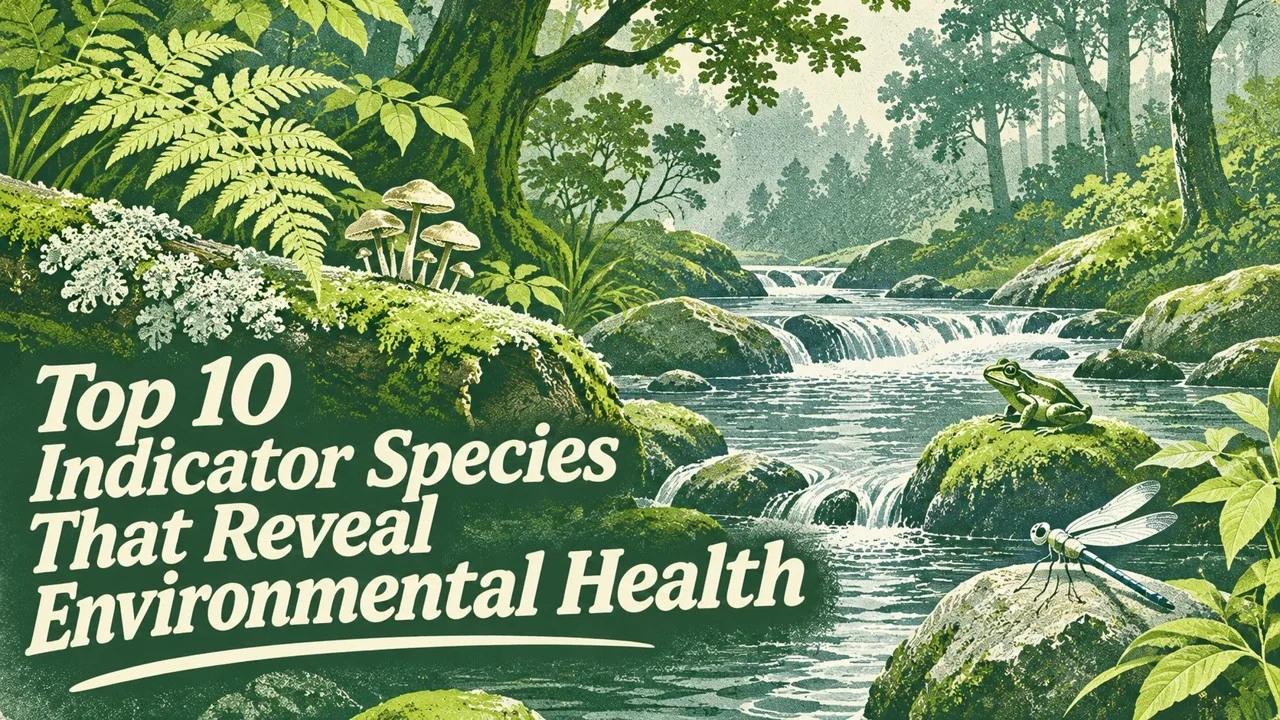
Some living things act as natural warning systems, from lichens that reveal air pollution to mayflies that signal clean water and corals that bleach in heat. Measuring the health of an environment can be expensive and complicated. Scientists can test air and water for chemicals, but those tests show conditions only at a single moment. Living organisms, by contrast, respond to conditions over weeks, months or years. Their presence, absence or health can reveal problems that instruments might miss.
Species used in this way are called indicator species or bioindicators. Some are sensitive to pollution and disappear when conditions worsen. Others are tolerant and become more common in polluted places. Some show changes in climate, while others reveal the health of whole ecosystems.
The ten examples below are lichens, the peppered moth, canaries in coal mines, mayflies, stoneflies and caddisflies, amphibians, freshwater mussels, reef-building corals, the northern spotted owl, diatoms and earthworms. Each one helps people understand changes in the environment, and several have shaped laws and conservation policies.
Using living indicators is not new. Farmers, fishers and hunters have long read the land and water through the plants and animals around them. What modern science adds is careful measurement, long-term records and an understanding of why particular species respond as they do, which allows their signals to be used in policy and law.
Key Facts
| # | Species or group | Habitat | What it reveals |
|---|---|---|---|
| 1 | Lichens | Trees, rocks and walls | Sensitivity to air pollution, especially sulfur dioxide |
| 2 | The peppered moth | Britain, industrial era | Showed the effects of soot on natural selection |
| 3 | Canaries | Coal mines | Early warning of toxic gases |
| 4 | Mayflies, stoneflies and caddisflies | Streams and rivers | Indicate high water quality |
| 5 | Amphibians | Ponds, streams, forests | Sensitive to pollution, disease and climate change |
| 6 | Freshwater mussels | Rivers and lakes | Indicate long-term water quality |
| 7 | Reef-building corals | Tropical oceans | Reveal ocean heat stress |
| 8 | Northern spotted owl | Pacific Northwest forests | Indicates the health of old-growth forest |
| 9 | Diatoms | Lakes, rivers and oceans | Record past water conditions |
| 10 | Earthworms | Soils | Indicate soil health |
1. A Living Air Quality Monitor
Lichens are partnerships between fungi and algae or cyanobacteria. They grow on tree bark, rocks and buildings and absorb water and nutrients directly from the air and rain. Because they have no roots and no protective outer layer, they also absorb pollutants [1].
Many lichens are highly sensitive to sulfur dioxide, a pollutant produced by burning coal. In the nineteenth and twentieth centuries, lichens disappeared from large areas around industrial cities in Europe. In 1970, the scientists David Hawksworth and Francis Rose published a scale that used lichens to estimate levels of sulfur dioxide pollution [1].
As sulfur dioxide levels fell after clean air laws, many lichens returned to cities. Today, scientists use lichens to monitor other pollutants, such as nitrogen compounds from traffic and farming. Some lichens thrive in nitrogen-rich conditions, so changes in lichen communities reveal changes in pollution.
2. A Moth That Changed Color
The peppered moth is usually pale with dark speckles, which helps it hide on lichen-covered tree bark. During the Industrial Revolution in Britain, soot darkened trees and killed lichens in many areas. A dark form of the moth, which had been rare, became common near industrial cities [2].
The change was explained as natural selection: dark moths were better camouflaged on blackened trees and less likely to be eaten by birds. Experiments by Bernard Kettlewell in the 1950s supported this idea, though his methods were later criticized. Later research by Michael Majerus confirmed the role of bird predation [2].
Related: Top 10 Documented Animal Hybrids and What They Show
After clean air laws reduced soot pollution, the pale form became common again. The peppered moth is a famous example of evolution in action and of how wildlife can reveal the effects of pollution. Studies in 2016 identified the gene responsible for the dark coloration.
3. Birds in the Mines
For much of the twentieth century, coal miners in Britain and elsewhere took canaries underground. The birds are more sensitive than humans to carbon monoxide and other dangerous gases, because of their high rate of breathing and metabolism [3].
If a canary showed signs of distress or collapsed, miners knew that gas levels were dangerous and could escape before being affected. The physiologist John Scott Haldane is credited with promoting the use of canaries and other small animals for this purpose [3].
Canaries were phased out of British coal mines in 1986 and replaced by electronic gas detectors. The phrase canary in the coal mine is still widely used to describe any early warning of danger. The practice is an early and literal example of using animals as environmental indicators.
4. Insects That Need Clean Water
The young stages of mayflies, stoneflies and caddisflies live in streams and rivers, often under stones or in gravel. Many species need clean, well-oxygenated water and are sensitive to pollution, sediment and warming [4].
Scientists and volunteers monitor rivers by collecting small animals from the riverbed and counting the groups present. A healthy stream usually contains many mayflies, stoneflies and caddisflies. A polluted stream may contain mostly tolerant animals, such as certain worms and midge larvae [4].
Simple monitoring schemes based on these insects are used by environmental agencies and citizen scientists in many countries. They provide a cheap and effective way to track water quality over time. The insects are also important food for fish, so their decline can affect entire river ecosystems.
5. Animals With Permeable Skin
Frogs, toads and salamanders breathe partly through their skin, which absorbs water and chemicals easily. Many amphibians also live both in water and on land, so they are exposed to changes in both environments [5].
Related: Top 25 Interesting Facts About the Solar System
Since the 1980s, scientists have recorded widespread declines in amphibian populations around the world. Causes include habitat loss, pollution, climate change and especially a fungal disease called chytridiomycosis, which has caused the decline or extinction of many species [5].
Because of their sensitivity, amphibians are often considered indicators of environmental health. Deformities in frogs, reported in some places in the 1990s, led to research into causes such as parasites and chemicals. Amphibian declines are widely seen as a warning about the wider loss of biodiversity.
6. Filters of the River Bed
Freshwater mussels live buried in the beds of rivers and lakes, filtering water to feed on tiny particles. A single mussel can filter large volumes of water each day, improving water clarity [6].
Many species live for decades, and some, such as the freshwater pearl mussel, can live for more than a century. Because they stay in one place and live a long time, mussels reflect the long-term condition of their habitat. They are sensitive to pollution, sediment and changes in water flow [6].
Freshwater mussels are among the most threatened animals in North America and Europe. Many species have declined sharply because of dams, pollution and habitat loss. Their shells also record chemical information over time, allowing scientists to study changes in water quality across years.
7. Reefs That Turn White
Reef-building corals depend on tiny algae living inside their tissues, which provide food through photosynthesis and give the corals much of their color. When water becomes too warm for long periods, corals expel the algae and turn white, a process called bleaching [7].
Bleached corals can recover if temperatures return to normal, but prolonged bleaching can kill them. Mass bleaching events have become more frequent as ocean temperatures rise. The Great Barrier Reef experienced major bleaching events in 1998, 2002, 2016, 2017, 2020, 2022 and 2024 [7].
Related: Top 25 Interesting Facts About the Universe
Corals are therefore among the clearest indicators of the effects of climate change on the oceans. Scientists monitor reefs using satellites, aerial surveys and divers. Coral reefs support about a quarter of marine species, so their decline has major consequences for ocean life.
8. An Owl of Old Forests
The northern spotted owl lives in old-growth forests in the Pacific Northwest of the United States and in southern British Columbia. It depends on large, old trees for nesting and on the complex forest structure for hunting [8].
In 1990, the northern spotted owl was listed as a threatened species under the US Endangered Species Act. Because it depends on old-growth forests, protecting the owl meant limiting logging. The decision led to bitter disputes between environmentalists and timber communities, sometimes called the timber wars [8].
The Northwest Forest Plan of 1994 protected large areas of old forest. The owl is often described as an indicator species for the health of old-growth ecosystems. Its population has continued to decline, partly because of competition from the barred owl, which has spread into its range.
9. Tiny Algae in Lake Mud
Diatoms are microscopic algae with glass-like cell walls made of silica. Different species prefer different conditions, such as levels of acidity, nutrients and salt [9].
When diatoms die, their silica shells sink and accumulate in lake sediments. By examining layers of sediment, scientists can reconstruct the history of a lake's water quality over hundreds or thousands of years. This method was important in proving that acid rain had acidified lakes in Europe and North America in the twentieth century [9].
Diatoms are also used to monitor current water quality in rivers and lakes, as part of environmental regulations in Europe. They are an essential part of aquatic food webs and produce a large share of the oxygen generated by photosynthesis on Earth.
Related: Top 10 Mythical Creatures in World Mythology - That Inspired Myths Across Civilizations (unchanged)
10. Engineers of the Soil
Earthworms live in soil, eating organic matter and mixing the soil as they burrow. Their tunnels help air and water move through the soil, and their waste enriches it with nutrients [10].
The number and types of earthworms in a field can indicate soil health. Intensive plowing, compaction and some pesticides can reduce earthworm populations, while organic matter and reduced tillage can increase them. Farmers and scientists sometimes count earthworms as a simple measure of soil quality [10].
Earthworms can also accumulate heavy metals and other pollutants from the soil, so they are used to assess contaminated land. Charles Darwin was fascinated by earthworms and published a book about them in 1881, describing their role in forming soil.
Conclusion
The ten indicators above show how living things can reveal the state of the environment. Lichens and peppered moths tracked air pollution, canaries warned of deadly gas, insects and diatoms measure water quality and corals show the effects of ocean heat.
Indicator species help scientists detect problems early and measure the success of environmental policies. They also remind us that changes in the environment affect all living things, including people. Paying attention to these natural warning systems is one way to protect the health of the planet.
Citizen scientists play a growing part in this work, counting insects in streams, recording lichens on trees and reporting sightings of frogs and birds. Their observations, gathered over many years, give scientists a much broader picture than professional surveys alone.
- ^ [1] Accounts of lichens as indicators of air pollution. Wikipedia: lichen Wikipedia: bioindicator
- ^ [2] Accounts of the peppered moth and industrial melanism. Wikipedia: peppered moth evolution Wikipedia: industrial melanism
- ^ [3] Accounts of canaries in coal mines. Wikipedia: animal sentinel Wikipedia: John Scott Haldane
- ^ [4] Accounts of river insects as water quality indicators. Wikipedia: mayfly Wikipedia: caddisfly
- ^ [5] Accounts of amphibian declines. Wikipedia: decline in amphibian populations Wikipedia: chytridiomycosis
- ^ [6] Accounts of freshwater mussels. Wikipedia: freshwater mussel Wikipedia: freshwater pearl mussel
- ^ [7] Accounts of coral bleaching. Wikipedia: coral bleaching Wikipedia: Great Barrier Reef
- ^ [8] Accounts of the northern spotted owl. Wikipedia: northern spotted owl Wikipedia: Northwest Forest Plan
- ^ [9] Accounts of diatoms and lake sediments. Wikipedia: diatom Wikipedia: paleolimnology
- ^ [10] Accounts of earthworms and soil health. Wikipedia: earthworm Wikipedia: soil health























Discussion
Log in with