




Top 10 Utopian Visions Most People Have Never Heard Of
 By Dhiraj Sharma · Published
Share Post
Loading…
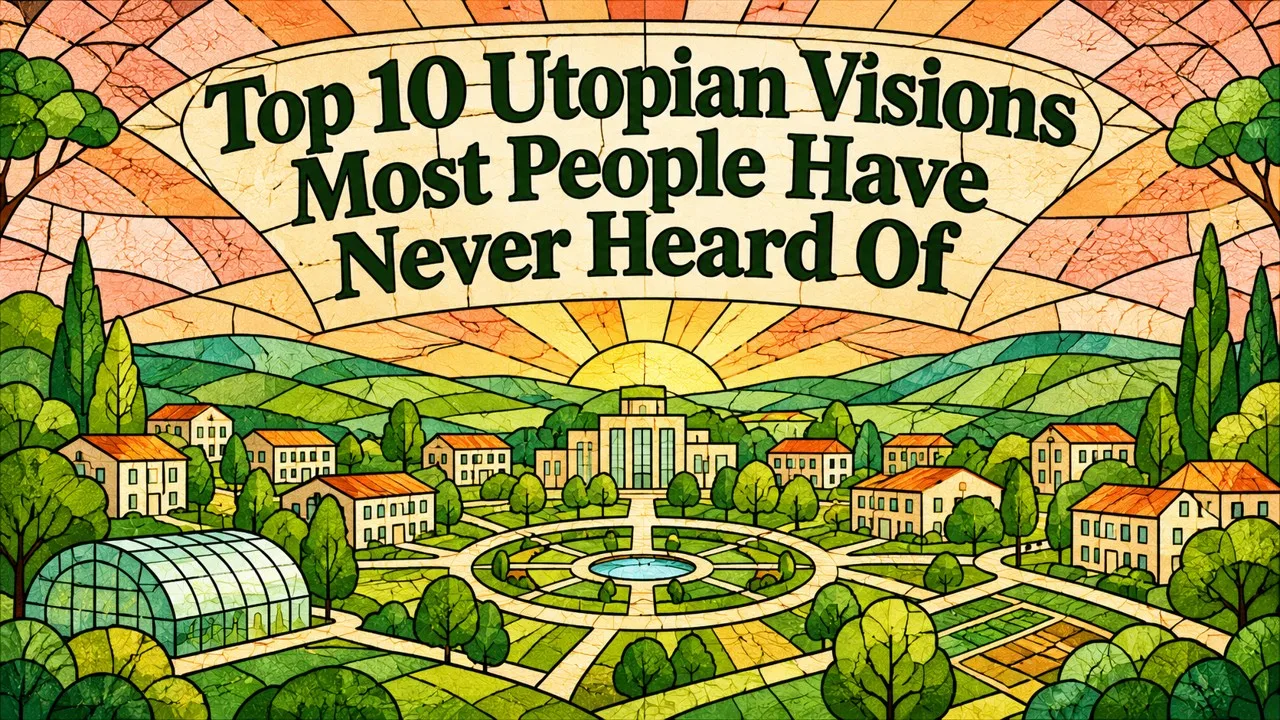
Reformers have tried to build perfect communities from Indiana to India, and their short-lived experiments still shape ideas about housing, work and towns. The word utopia comes from Thomas More's book of 1516, and it can mean either a good place or no place. Since then, many reformers have tried to turn ideal societies into real ones. Most of these experiments were small, many lasted only a few years, and some ended in bitter disputes. Yet a surprising number left lasting marks on architecture, education, town planning and the cooperative movement.
The ten experiments below are New Harmony, Brook Farm, Fruitlands, the Icarians, the Familistère at Guise, the garden city of Letchworth, Llano del Rio, Fordlândia, Auroville and Arcosanti. They range from religious and socialist projects to an industrialist's company town in the Amazon. Each is described with what it aimed to do and what actually happened.
Key Facts
| # | Community | Founder and date | What became of it |
|---|---|---|---|
| 1 | New Harmony | Robert Owen, Indiana, 1825 | Collapsed within about two years but left educational institutions |
| 2 | Brook Farm | George and Sophia Ripley, Massachusetts, 1841 | Ended in 1847 after a fire and debts |
| 3 | Fruitlands | Amos Bronson Alcott and Charles Lane, Massachusetts, 1843 | Collapsed after about seven months |
| 4 | The Icarians | Étienne Cabet, Texas, Illinois and beyond, from 1848 | Several colonies lasted into the 1890s |
| 5 | The Familistère | Jean-Baptiste André Godin, Guise, France, from 1859 | A cooperative that lasted until 1968 |
| 6 | Letchworth Garden City | Ebenezer Howard, England, 1903 | A model that influenced town planning worldwide |
| 7 | Llano del Rio | Job Harriman, California, 1914 | Moved to Louisiana and closed in 1939 |
| 8 | Fordlândia | Henry Ford, Brazil, 1928 | Failed as a rubber plantation; abandoned by Ford in 1945 |
| 9 | Auroville | Mirra Alfassa, Tamil Nadu, 1968 | Still active, with a few thousand residents |
| 10 | Arcosanti | Paolo Soleri, Arizona, from 1970 | Still under construction, far smaller than planned |
1. A Social Experiment on the Wabash
The Welsh industrialist and reformer Robert Owen had run model mills at New Lanark in Scotland, where he improved working conditions and schooling. In 1825, he bought the town of Harmony in Indiana from a religious group, the Harmony Society, and renamed it New Harmony [1].
Owen hoped to create a community based on shared property, education and cooperation. He attracted scientists and educators, including the geologist William Maclure, and the town became a center for natural science. But the community struggled with disputes over work, property and governance, and the communal experiment broke down by 1827 [1].
New Harmony nevertheless had a long influence. It hosted early free public schools, a library and scientific work, and some of its residents helped found important American scientific institutions. The town is now a historic site. Its failure as a commune and its success as a center of learning show how utopian projects can fail on their main goal while succeeding in others.
2. Transcendentalists on a Farm
Brook Farm was founded in 1841 near Boston by George Ripley, a former Unitarian minister, and his wife Sophia. It was linked to the Transcendentalist movement and aimed to combine manual labor with intellectual life, so that members would share work and have time for study and culture [2].
The community ran a well-regarded school and attracted writers and thinkers. The novelist Nathaniel Hawthorne lived there briefly and later drew on the experience in his novel The Blithedale Romance. In the mid-1840s, Brook Farm reorganized along the lines of the French social theorist Charles Fourier [2].
In 1846, a fire destroyed a large new building that was meant to house members, and the community was left with heavy debts. It dissolved in 1847. Brook Farm is remembered as one of the most famous American utopian experiments, partly because of the writers connected with it.
3. An Experiment That Lasted Months
Fruitlands was founded in 1843 by Amos Bronson Alcott, father of the novelist Louisa May Alcott, and the English reformer Charles Lane. Members followed a strict diet without animal products, refused to use animal labor and avoided many goods produced through exploitation [3].
Related: Top 10 Stories That Anticipated Later Technologies
The community suffered from poor planning and a lack of farming skills. Few members joined, and the men were often away promoting their ideas while women, particularly Abigail Alcott, carried much of the work. By early 1844, after about seven months, the community had broken up [3].
Louisa May Alcott later wrote a satirical account of the experiment, Transcendental Wild Oats. Fruitlands is now a museum. Its brief life shows how idealism without practical knowledge of farming and community management could quickly fail, and how unequal the burdens within such experiments could be.
4. A Novel Turned Into Colonies
Étienne Cabet was a French political writer whose novel Voyage en Icarie described an ideal communist society. In 1848, his followers, known as Icarians, traveled to Texas to found a colony. The Texas site was poorly chosen, and the settlers suffered from disease and hardship [4].
The group moved to Nauvoo, Illinois, which had recently been abandoned by members of the Latter Day Saint movement. There they built a community with shared property. Internal disputes, including over Cabet's leadership, split the group, and Cabet left in 1856, dying soon after [4].
Icarian colonies continued in Iowa and California for several decades, with the last dissolving in 1898. The movement is one of the longest-lasting secular communal experiments in the United States. Its story shows how a utopian novel could inspire real communities, and how difficult it was to sustain shared ideals across generations.
5. A Social Palace for Factory Workers
Jean-Baptiste André Godin made his fortune manufacturing cast-iron stoves. Influenced by Charles Fourier, he built a large residential complex for his workers next to his factory at Guise in northern France, starting in 1859. He called it the Familistère, or social palace [5].
The buildings had apartments around glass-roofed courtyards, with shared facilities such as schools, a theater, laundries and shops. In 1880, Godin turned the business into a cooperative owned by its workers. The Familistère provided housing, education and social insurance well beyond what most workers of the time could expect [5].
Related: Top 10 Most Bizarre Phobias: Strange Fears That Exist
The cooperative continued to operate until 1968. Today, the buildings are a museum and heritage site. Unlike many utopian projects, the Familistère lasted for over a century, partly because it was tied to a successful business. It is often studied as an example of paternalistic industrial reform combined with cooperative ownership.
6. Towns Ringed by Greenbelts
In 1898, the British reformer Ebenezer Howard published a book later known as Garden Cities of To-morrow. He proposed new towns that combined the advantages of city and countryside, with planned housing, industry and farmland, surrounded by a permanent belt of green space [6].
Letchworth, in Hertfordshire, was founded in 1903 as the first garden city. It was designed by the architects Raymond Unwin and Barry Parker, with low-density housing and a mix of homes and gardens. The land was held in trust so that rising land values could benefit the community. Welwyn Garden City followed in 1920 [6].
Letchworth did not become a utopia, and it changed over time, but the garden city idea had a huge influence on town planning. It shaped new towns in Britain after the Second World War and planned communities in many other countries. Howard's vision is one of the most successful utopian ideas in practical terms.
7. A Socialist Colony in the Desert
Job Harriman, a socialist lawyer who had nearly been elected mayor of Los Angeles, founded the Llano del Rio colony in the Antelope Valley of California in 1914. It aimed to show that a cooperative community could run farms, workshops and schools without private profit [7].
The colony grew to several hundred residents and operated a school, a newspaper and various workshops. It faced serious problems, including disputes over water rights, internal conflict and financial difficulties. In 1917, most members moved to a new site at New Llano in Louisiana [7].
Related: Top 10 Oldest Buildings in the World
The Louisiana colony lasted until 1939. The ruins of the California site, including stone walls and chimneys, can still be seen. Llano del Rio is an example of the many small socialist colonies founded in the United States in the early twentieth century, most of which struggled with similar problems.
8. An Industrialist's Town in the Amazon
In 1928, Henry Ford acquired a large area of land in the Brazilian Amazon to grow rubber for his car tires. He built a company town, Fordlândia, with American-style houses, a hospital, schools and recreational facilities, and imposed rules on workers' diets and behavior [8].
The project went badly. Rubber trees planted close together in plantations suffered from leaf blight and pests. Workers resented the rules and the imported American way of life, and there was unrest. A second site, Belterra, was developed but also struggled [8].
Synthetic rubber reduced the need for plantations, and the Ford company sold the land back to the Brazilian government in 1945 at a large loss. Fordlândia is often cited as an example of a corporate utopia that ignored local ecology and culture. Some of its buildings still stand, and people still live in the town.
9. A Universal Town in South India
Auroville was founded in 1968 near Puducherry in southern India by Mirra Alfassa, known as the Mother, a spiritual leader associated with the philosopher Sri Aurobindo. It was intended to be a universal town where people from all countries could live in peace and progressive harmony [9].
At its inauguration, representatives of many countries placed soil from their homelands in an urn. The town's center is the Matrimandir, a large golden spherical building used for concentration. Residents have worked on reforestation, sustainable building and education on land that was once heavily eroded [9].
Related: 10 Sikh Gurus: The Pillars of Sikhism Who Shaped Faith, Equality, Courage, and Humanity
Auroville has a few thousand residents from many countries. It has faced disputes over governance, development plans and its relationship with surrounding villages. It is one of the largest and longest-lasting intentional communities of its kind, and it remains an evolving, contested experiment rather than a completed utopia.
10. An Arcology in the Arizona Desert
The Italian-American architect Paolo Soleri developed the idea of arcology, a combination of architecture and ecology. He proposed dense, compact cities that would reduce sprawl, car use and environmental impact. In 1970, he began building Arcosanti in the Arizona desert as a prototype [10].
Arcosanti was planned for thousands of residents, but construction has proceeded slowly, relying on volunteers, workshops and the sale of handmade bronze and ceramic bells. Only a small part of the plan has been built, and the community has had a small number of residents at any time [10].
Soleri died in 2013. Arcosanti continues as an educational and architectural experiment. It has influenced discussions of sustainable urban design, even though it has not become the city it was meant to be. Like many utopian projects, its ideas have traveled further than its buildings.
Conclusion
The ten experiments above show common patterns. Many struggled with practical problems, such as farming, finance and governance, and with disagreements among members. Some failed within months, like Fruitlands, while others, such as the Familistère and Auroville, lasted for generations.
Utopian projects are often remembered as failures, but that judgment can be too simple. New Harmony advanced education and science, Letchworth influenced town planning around the world, and the Familistère showed how housing and cooperative ownership could work together. Even unsuccessful visions can leave useful ideas behind.
- ^ [1] Accounts of Robert Owen's New Harmony community. Wikipedia: New Harmony, Indiana Wikipedia: Robert Owen
- ^ [2] Accounts of Brook Farm and its Fourierist phase. Wikipedia: Brook Farm Wikipedia: The Blithedale Romance
- ^ [3] Accounts of Fruitlands and Louisa May Alcott's satire. Wikipedia: Fruitlands Wikipedia: Amos Bronson Alcott
- ^ [4] Accounts of Étienne Cabet and the Icarian colonies. Wikipedia: Icarians Wikipedia: Étienne Cabet
- ^ [5] Accounts of Godin and the Familistère at Guise. Wikipedia: Jean-Baptiste André Godin Wikipedia: Charles Fourier
- ^ [6] Accounts of Ebenezer Howard and Letchworth. Wikipedia: Letchworth Garden City Wikipedia: garden city movement
- ^ [7] Accounts of the Llano del Rio colony. Wikipedia: Llano del Rio Wikipedia: Job Harriman
- ^ [8] Accounts of Fordlândia and Belterra. Wikipedia: Fordlândia Wikipedia: South American leaf blight
- ^ [9] Accounts of Auroville and the Matrimandir. Wikipedia: Auroville Wikipedia: Matrimandir
- ^ [10] Accounts of Paolo Soleri and Arcosanti. Wikipedia: Arcosanti Wikipedia: Paolo Soleri






















Discussion
Log in with