






 By
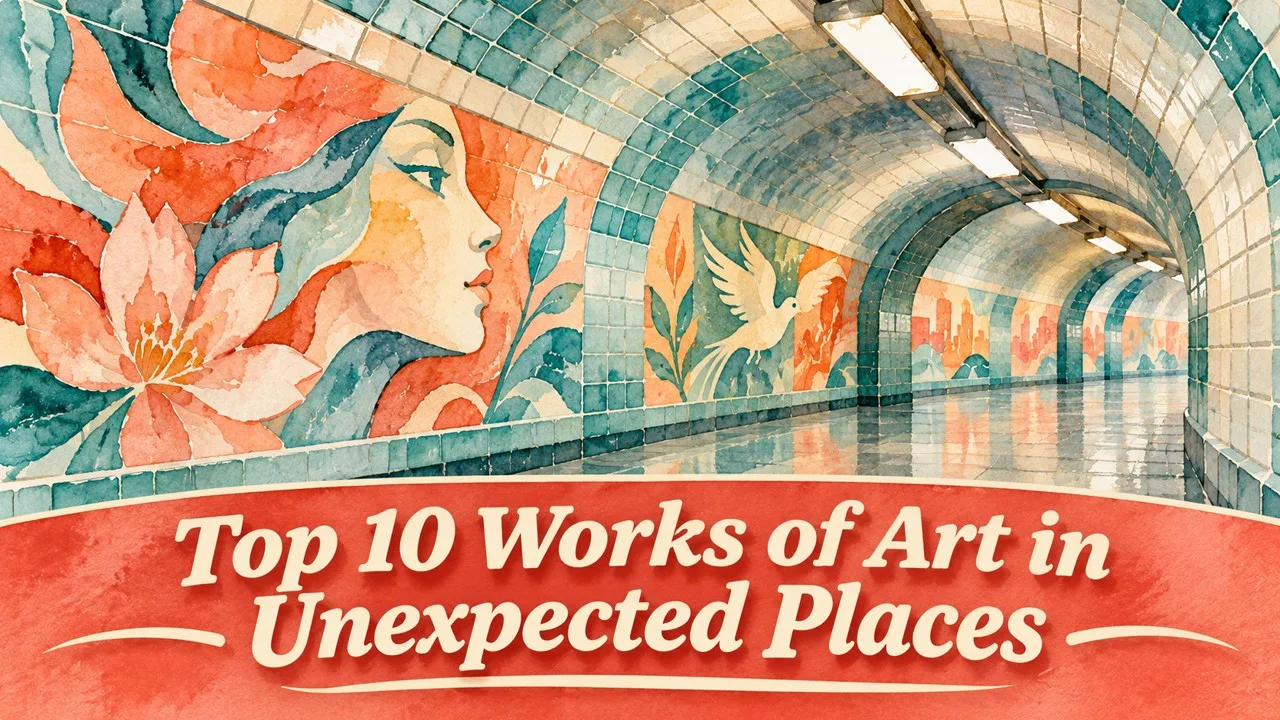
Some artworks sit in astonishing places, from a small sculpture on the Moon and a painting sent to Mars to statues under the sea and a fake shop in the desert. Most art lives in galleries, museums and homes, where visitors expect to find it. But some artists have placed their work in far stranger locations: on other worlds, at the bottom of the sea, in the middle of deserts, on remote beaches and in the Arctic. These works challenge ideas about what art is, who sees it and how long it lasts.
Some of these works were meant to be seen by very few people, or perhaps by no one at all. Others draw thousands of visitors who travel long distances to find them. Several were made to change over time, as tides, salt, weather or marine life alter them. A few raise questions about whether art belongs in such places at all.
The ten works below are a sculpture on the Moon, a disputed miniature museum on a lunar lander, a painting sent to Mars, a golden record leaving the Solar System, a statue under the Mediterranean, an underwater museum in Mexico, a fake designer shop in Texas, iron figures on an English beach, a spiral of rock in a salt lake and a glowing installation at an Arctic seed vault. Street art and murals are left out on purpose.
Taken together, they show how artists have used location itself as part of the meaning of a work. Finding art where nobody expects it can surprise, delight or unsettle, and that response is often exactly what the artists intended.
Key Facts
| # | Work | Location | Why it is unexpected |
|---|---|---|---|
| 1 | Fallen Astronaut | Hadley Rille, the Moon, 1971 | The only artwork known to have been placed on the Moon officially |
| 2 | Moon Museum | Reportedly on the Apollo 12 lander, 1969 | Its presence has never been officially confirmed |
| 3 | Beagle 2 calibration target | Mars, 2003 | A spot painting by Damien Hirst on a lost lander |
| 4 | Voyager Golden Record | Interstellar space, launched 1977 | Sounds and images for possible alien listeners |
| 5 | Christ of the Abyss | San Fruttuoso, Italy, 1954 | A bronze statue placed on the seabed |
| 6 | Cancún Underwater Museum | Mexico, from 2009 | Hundreds of sculptures form an artificial reef |
| 7 | Prada Marfa | Near Valentine, Texas, 2005 | A permanently closed boutique on a lonely highway |
| 8 | Another Place | Crosby Beach, England, from 2005 | A hundred figures facing the sea |
| 9 | Spiral Jetty | Great Salt Lake, Utah, 1970 | Disappeared and reappeared with water levels |
| 10 | Perpetual Repercussion | Svalbard Global Seed Vault, Norway, 2008 | A light installation at a doomsday vault |
1. A Memorial on the Moon
In August 1971, the crew of Apollo 15 placed a small aluminum figure of an astronaut on the lunar surface near Hadley Rille. The sculpture, about 8.5 centimeters tall, was made by the Belgian artist Paul Van Hoeydonck [1].
Beside it, the astronauts placed a plaque listing the names of fourteen American astronauts and Soviet cosmonauts who had died in the space programs. The sculpture was designed to be abstract, without features that would identify race or gender [1].
The placement was not widely publicized at the time. Controversy followed when plans emerged to sell replicas, which NASA and the astronauts opposed. Fallen Astronaut remains on the Moon and is often described as the only work of art on another world placed with official knowledge.
2. A Museum Smaller Than a Stamp
The Moon Museum is a tiny ceramic wafer, about the size of a postage stamp, bearing drawings by six artists, including Andy Warhol, Robert Rauschenberg and Claes Oldenburg. The project was organized by the sculptor Forrest Myers [2].
Myers said that NASA did not respond to his request to send the wafer to the Moon, so he arranged with an engineer to attach it secretly to a leg of the Apollo 12 lunar module in November 1969. According to the story, a telegram confirmed that it had been attached [2].
Related: Top 10 Iconic Statues Through the Ages
NASA has never officially confirmed that the wafer went to the Moon, and there is no photograph proving it. If the story is true, it is the first art museum on the Moon. Copies of the wafer are held by museums, including the Museum of Modern Art in New York.
3. A Painting Sent to Mars
Beagle 2 was a British lander carried to Mars by the European Space Agency's Mars Express mission. It was intended to search for signs of life. Its instruments included a calibration target, used to check the colors of its cameras, designed as a spot painting by the artist Damien Hirst [3].
The lander was released toward Mars in December 2003 but failed to make contact after landing. It was presumed lost. In 2015, images from NASA's Mars Reconnaissance Orbiter revealed that Beagle 2 had landed safely but had not fully unfolded its solar panels [3].
Hirst's painting presumably lies on the Martian surface, inside the partly opened lander. The project also included a call signal composed by the band Blur. It is one of the few artworks to have reached another planet.
4. A Record for the Stars
In 1977, NASA launched the two Voyager spacecraft, each carrying a gold-plated copper record. The records contain sounds and images chosen to represent life and culture on Earth, in case the spacecraft are ever found by intelligent beings [4].
The contents were chosen by a committee chaired by the astronomer Carl Sagan. They include greetings in 55 languages, natural sounds such as wind and birds, encoded images and music ranging from Bach and Beethoven to Chuck Berry and traditional music from many cultures. The cover contains instructions for playing the record [4].
Both Voyager spacecraft have left the heliosphere and entered interstellar space. The records are expected to last for many millions of years. They are among the most distant human-made artworks, sent on a journey with no clear destination.
5. A Statue Beneath the Waves
Christ of the Abyss is a bronze statue of Christ with raised arms, placed on the seabed in the bay of San Fruttuoso, near Portofino on the Italian coast, in 1954. It stands at a depth of about 17 meters [5].
Related: Top 10 Art Restorations That Went Badly Wrong
The statue was created by the sculptor Guido Galletti, in memory of the diver Dario Gonzatti, who died in 1947. It became a destination for divers and snorkelers. Copies were later placed in other locations, including off the coast of Grenada and in the Florida Keys [5].
The statue has been restored several times after damage from the sea. Each year, a ceremony is held to honor people who have died at sea. The work is one of the earliest and best-known examples of underwater sculpture.
6. A Museum Under the Sea
The Cancún Underwater Museum, known as MUSA, was founded in 2009 in the waters around Cancún and Isla Mujeres in Mexico. It contains hundreds of sculptures placed on the seabed, many created by the British artist Jason deCaires Taylor [6].
One of the best-known installations, The Silent Evolution, includes hundreds of life-size human figures modeled on local people. The sculptures are made from materials that encourage corals and other marine life to grow on them [6].
The museum was intended partly to reduce pressure on natural reefs by giving divers and snorkelers an alternative site to visit. Over time, the sculptures have become covered with marine life, changing their appearance. The project has inspired similar underwater sculpture parks elsewhere.
7. A Designer Shop in the Desert
Prada Marfa is a sculpture by the artists Elmgreen and Dragset, installed in 2005 beside a highway near the small town of Valentine in West Texas. It looks like a small Prada boutique, with shoes and handbags displayed in the windows [7].
Related: Top 10 Famous Street Art Works
The door does not open, and the shop is not a real store. The artists intended the work to be left to decay slowly in the desert, as a comment on luxury consumerism and the art world. Shortly after it opened, vandals broke in and stole the goods, which were replaced and secured [7].
Prada Marfa has become a popular destination for photographs and has appeared widely on social media. It has also raised debates about whether it is art or advertising, and about its place in the landscape. It is one of the most recognizable works of land-based conceptual art.
8. Iron Figures on a Beach
Another Place is an installation by the British sculptor Antony Gormley, consisting of 100 cast-iron figures standing on Crosby Beach near Liverpool. Each figure is a cast of the artist's own body [8].
The figures are spread along about three kilometers of beach and extend up to a kilometer out to sea. As the tide comes in and out, they are covered and uncovered, and many have become encrusted with barnacles and seaweed. The installation was originally temporary, but it was made permanent in 2007 [8].
The figures all face the sea, and visitors often interpret them as reflecting emigration, loss or the relationship between people and nature. Some people have dressed the figures in clothes. The work has become one of the best-known pieces of public art in Britain.
9. A Spiral in a Salt Lake
Spiral Jetty is an earthwork created by the American artist Robert Smithson in 1970. It is a coil of basalt rocks and earth extending into the Great Salt Lake in Utah, about 460 meters long and 4.6 meters wide [9].
Smithson chose the site partly because of the reddish color of the water, caused by salt-tolerant bacteria and algae. Soon after its completion, rising water levels submerged the jetty, and it remained underwater for decades [9].
Related: Top 10 Most Popular Artists of All Time
When water levels fell in the early 2000s, the jetty re-emerged, now covered with white salt crystals. Its appearance changes with the level of the lake. Spiral Jetty is considered one of the most important works of land art, and visitors travel long distances to see it.
10. A Glowing Light in the Arctic
The Svalbard Global Seed Vault, opened in 2008, is built into a mountain on the Arctic island of Spitsbergen. It stores millions of seed samples from around the world as a backup in case of disasters [10].
Above the entrance is a light installation called Perpetual Repercussion, created by the Norwegian artist Dyveke Sanne. It uses mirrors, prisms and fiber optic lights that reflect sunlight in summer and glow in the long polar night [10].
Norwegian regulations require some public buildings to include art, and the installation was commissioned for this purpose. Few people ever enter the vault, but the glowing facade can be seen from a distance and has become a symbol of the vault. It brings art to one of the most remote places on Earth.
Conclusion
The ten works above show how artists have used unusual places to make their art more powerful. A sculpture on the Moon and a painting on Mars connect art with exploration. Underwater statues and iron figures on a beach interact with the sea. A fake shop in the desert and a spiral in a salt lake change slowly with time and weather.
These works challenge the idea that art belongs only in galleries. They invite people to discover art in the world around them, and sometimes far beyond it. Their locations become part of their meaning.
- ^ [1] Accounts of Fallen Astronaut and Apollo 15. Wikipedia: Fallen Astronaut Wikipedia: Apollo 15
- ^ [2] Accounts of the Moon Museum. Wikipedia: Moon Museum Wikipedia: Apollo 12
- ^ [3] Accounts of Beagle 2 and its calibration target. Wikipedia: Beagle 2 Wikipedia: Damien Hirst
- ^ [4] Accounts of the Voyager Golden Record. Wikipedia: Voyager Golden Record Wikipedia: Voyager program
- ^ [5] Accounts of Christ of the Abyss. Wikipedia: Christ of the Abyss Wikipedia: San Fruttuoso
- ^ [6] Accounts of the Cancún Underwater Museum. Wikipedia: Cancún Underwater Museum Wikipedia: Jason deCaires Taylor
- ^ [7] Accounts of Prada Marfa. Wikipedia: Prada Marfa Wikipedia: Elmgreen and Dragset
- ^ [8] Accounts of Another Place by Antony Gormley. Wikipedia: Antony Gormley Wikipedia: Crosby Beach
- ^ [9] Accounts of Spiral Jetty. Wikipedia: Spiral Jetty Wikipedia: Robert Smithson
- ^ [10] Accounts of the Svalbard Global Seed Vault and its artwork. Wikipedia: Svalbard Global Seed Vault Wikipedia: percent for art





















Discussion
Log in with