





Top 10 Everyday Fashion Items With Military Origins
 By Dhiraj Sharma · Published
Share Post
Loading…
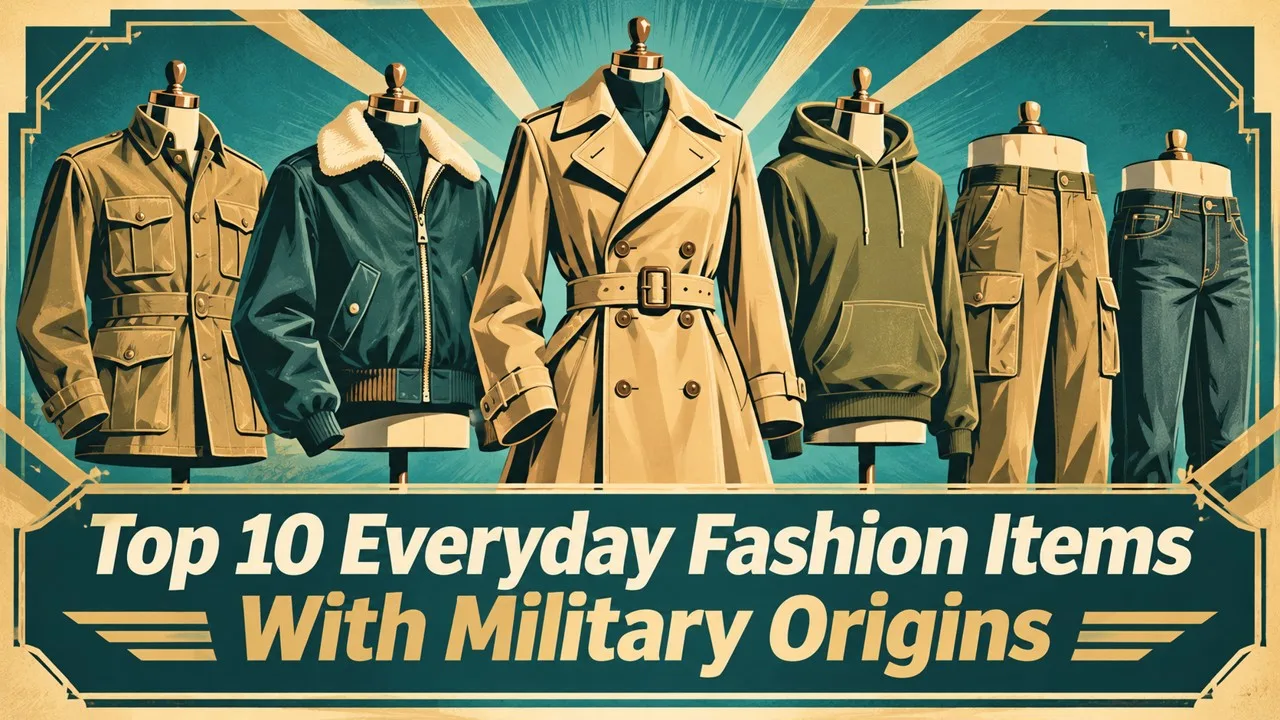
Many wardrobe staples began in uniform, from the trench coat and cardigan to aviator sunglasses, the bomber jacket, the T-shirt and the striped sailor shirt. Military clothing has to be practical, durable and suited to harsh conditions. Those same qualities have made many military designs popular with civilians. After wars ended, surplus clothing filled shops, returning soldiers kept wearing what they knew and designers borrowed military details for fashion collections.
Some of these items are named after battles or commanders, while others simply became so common that their military history was forgotten. Their stories show how war has shaped everyday life in unexpected ways, including what people wear to work, on weekends and on holiday.
The ten items below are the trench coat, the cardigan, the balaclava, aviator sunglasses, the bomber jacket, the wristwatch, the T-shirt, khakis and chinos, the pea coat and the Breton striped shirt. Each one moved from the battlefield or the deck of a ship into ordinary wardrobes.
Military surplus stores played an especially important role. After the two world wars, governments sold huge quantities of unused uniforms and equipment cheaply, and students, workers and artists bought them because they were affordable and hard-wearing. Over time, items that had once marked someone as a soldier or sailor simply became normal clothes.
Key Facts
| # | Item | Military origin | How it became everyday fashion |
|---|---|---|---|
| 1 | The trench coat | British officers, First World War | Became a classic raincoat |
| 2 | The cardigan | Crimean War, 1850s | A knitted jacket named after the Earl of Cardigan |
| 3 | The balaclava | Crimean War, 1854 | Knitted head coverings sent to soldiers |
| 4 | Aviator sunglasses | United States military aviators, 1930s | Became a symbol of cool |
| 5 | The bomber jacket | United States Army Air Corps, 1930s | Became a casual fashion staple |
| 6 | The wristwatch | Boer War and First World War | Replaced the pocket watch for men |
| 7 | The T-shirt | United States Navy, 1913 | Became the most common garment in the world |
| 8 | Khakis and chinos | British India and the United States Army | Became everyday casual trousers |
| 9 | The pea coat | Navies of northern Europe | Became a classic winter coat |
| 10 | The Breton shirt | French Navy, 1858 | Became a fashion classic |
1. A Coat From the Trenches
The trench coat developed from waterproof coats worn by British officers. The British companies Burberry and Aquascutum both claim credit for early designs. Thomas Burberry had invented gabardine, a tightly woven, water-resistant fabric, in 1879 [1].
During the First World War, officers wore the coats in the muddy trenches of the Western Front, giving the coat its name. Features such as shoulder straps, a storm flap and metal D-rings on the belt were designed for military use, though many later versions keep them only as decoration [1].
After the war, officers continued to wear the coats as civilians, and the trench coat became associated with style and adventure. Film stars such as Humphrey Bogart helped make it iconic. Today, it is a standard item in fashion collections around the world.
2. Named After a Cavalry Commander
The cardigan is named after James Brudenell, the seventh Earl of Cardigan, a British army officer who led the Charge of the Light Brigade during the Crimean War in 1854. The charge became famous as a heroic but disastrous attack [2].
Knitted wool waistcoats were worn by British officers in the cold Crimean winter, and the style became associated with the earl. The fame of the charge helped popularize the name for a knitted jacket that buttons down the front [2].
Related: Top 10 Best Fashion Designers in the World
The cardigan later became a staple of civilian clothing. Coco Chanel helped make it fashionable for women in the early twentieth century, and it became associated with comfort and casual style. Few people who wear one today think of the cavalry charge that gave it its name.
3. A Hood From a Siege
The balaclava is a knitted hood that covers the head and neck, leaving only part of the face exposed. It is named after the town of Balaclava near Sevastopol in Crimea, where an important battle was fought in 1854 [3].
During the harsh winter of the siege of Sevastopol, British soldiers suffered greatly from the cold. People in Britain knitted warm head coverings and sent them to the troops. The name balaclava was later attached to this type of hood, probably decades after the war [3].
Today, balaclavas are worn by skiers, climbers, motorcyclists and people working in cold conditions. They are also used by soldiers and special forces. The garment's name keeps alive the memory of a nineteenth-century war that many people have otherwise forgotten.
4. Glasses for Pilots
As planes flew higher in the early twentieth century, pilots needed protection from intense sunlight and glare. The American optical company Bausch and Lomb developed sunglasses for military aviators, with large lenses to cover the eyes and a thin metal frame [4].
The glasses were sold to the public under the brand name Ray-Ban, introduced in 1937. Their popularity grew during the Second World War, when photographs showed military figures wearing them. General Douglas MacArthur was famously photographed wearing aviators when he landed in the Philippines in 1944 [4].
After the war, aviators became popular with civilians, and they were worn by musicians, film stars and police officers. Films such as Top Gun in 1986 boosted their popularity again. The style remains one of the most recognizable sunglasses designs in the world.
5. A Jacket for Cold Cockpits
Early military aircraft had open or unheated cockpits, and pilots needed warm jackets. In 1931, the United States Army Air Corps adopted a leather flight jacket known as the A-2, which became widely worn by pilots during the Second World War [5].
Related: Top 10 Historical Status Symbols That Now Look Strange
After the war, the military introduced the MA-1 jacket, made of nylon. It had a bright orange lining so that it could be reversed for visibility in a rescue. The design was lighter and better suited to jet aircraft [5].
Bomber jackets became popular with civilians, especially in the second half of the twentieth century. They were adopted by different youth subcultures and later by fashion designers. Today, the bomber jacket is sold in many materials and colors, far removed from its practical origins.
6. A Watch Worn on the Wrist
Before the twentieth century, men usually carried pocket watches, while wristwatches were mainly worn by women as jewelry. Soldiers, however, needed to check the time quickly without taking a watch out of a pocket, especially when coordinating attacks [6].
Wristwatches were used by some soldiers in conflicts such as the Second Boer War, and they became widespread during the First World War. Soldiers and officers wore trench watches, often converted pocket watches with wire lugs for straps. Synchronized attacks made accurate timekeeping vital [6].
After the war, wristwatches became the normal choice for men. Watchmakers produced new models designed for the wrist, and pocket watches declined. Military and pilot watches remain an important category in watch design, and many models still borrow details from military originals.
7. From Undershirt to Outerwear
The T-shirt began as an undergarment. In 1913, the United States Navy adopted a short-sleeved white cotton undershirt for its sailors. It was comfortable, cheap and easy to clean, and sailors often wore it on its own while working in hot conditions [7].
During the Second World War, T-shirts were widely worn by American servicemen, and photographs of soldiers and sailors in T-shirts appeared in magazines. After the war, veterans continued to wear them as casual clothing [7].
Related: Top 10 Most Bizarre Phobias: Strange Fears That Exist
Films in the 1950s, including A Streetcar Named Desire with Marlon Brando and Rebel Without a Cause with James Dean, made the T-shirt a symbol of youth and rebellion. It later became a canvas for printed messages and designs. Today, it is one of the most widely worn garments in the world.
8. Dust-Colored Trousers
The word khaki comes from a Hindi and Urdu word meaning dust-colored. In the mid-nineteenth century, British troops in India began dyeing their uniforms a dull brownish color, which offered better camouflage than bright red coats. Khaki uniforms were later adopted widely by the British Army [8].
The related word chino refers to a cotton twill fabric used for American military uniforms around the time of the Spanish–American War in 1898. The name is often linked to fabric originally obtained from China, though its exact origin is uncertain [8].
After the Second World War, veterans brought their khaki trousers home, and students and workers adopted them. Chinos and khakis became standard casual and business wear in the United States and elsewhere, especially from the 1950s onward.
9. A Sailor's Heavy Coat
The pea coat is a short, double-breasted coat made of heavy wool, traditionally navy blue. It was worn by sailors in several navies because it was warm, wind-resistant and short enough to allow free movement when climbing rigging [9].
The name may come from the Dutch word pij, meaning a coarse woolen cloth, though other explanations have been suggested. The United States Navy adopted the pea coat as part of its uniform, and it remained standard issue for many decades [9].
Pea coats became popular with civilians in the twentieth century, worn by people of all ages. Their simple, practical design has remained largely unchanged, and they are still sold by military surplus shops and fashion brands alike.
Related: Top 10 Oldest Buildings in the World
10. The Striped Sailor Shirt
The Breton shirt, or marinière, is a knitted shirt with horizontal navy and white stripes. In 1858, the French Navy made it part of the official uniform for sailors in Brittany. According to popular tradition, the 21 stripes on the original shirt stood for the victories of Napoleon, though this is generally regarded as a legend [10].
The stripes were said to make sailors easier to spot if they fell overboard, though this explanation is also uncertain. The shirt was practical, warm and suited to life at sea [10].
Coco Chanel helped bring the Breton shirt into fashion in the early twentieth century, after seeing sailors wearing it on the French coast. It was later worn by artists such as Pablo Picasso and by many film stars. Today, it is one of the most recognizable styles in casual fashion.
Conclusion
The ten items above show how much military design has shaped everyday clothing. Coats, jackets, sweaters, shirts, trousers, watches and sunglasses were all developed for soldiers, sailors and pilots before they entered civilian wardrobes.
Many of these items succeeded because they were practical, comfortable and durable. War and military service spread them widely, and fashion designers and film stars made them desirable. The next time you put on a T-shirt or cardigan, you are wearing a small piece of military history.
Designers continue to borrow from military dress, using details such as epaulettes, cargo pockets, camouflage patterns and utility jackets. The relationship between uniforms and fashion is likely to keep evolving, with each generation finding new ways to adapt clothing first designed for service.
- ^ [1] Accounts of the trench coat's origins. Wikipedia: trench coat Wikipedia: gabardine
- ^ [2] Accounts of the cardigan and the Earl of Cardigan. Wikipedia: cardigan Wikipedia: 7th Earl of Cardigan
- ^ [3] Accounts of the balaclava and the Crimean War. Wikipedia: balaclava Wikipedia: Battle of Balaclava
- ^ [4] Accounts of aviator sunglasses and Ray-Ban. Wikipedia: aviator sunglasses Wikipedia: Ray-Ban
- ^ [5] Accounts of military flight jackets. Wikipedia: flight jacket Wikipedia: MA-1 bomber jacket
- ^ [6] Accounts of the trench watch and the rise of wristwatches. Wikipedia: trench watch Wikipedia: watch
- ^ [7] Accounts of the T-shirt's naval origins. Wikipedia: T-shirt Wikipedia: uniforms of the United States Navy
- ^ [8] Accounts of khaki and chino cloth. Wikipedia: khaki Wikipedia: chino cloth
- ^ [9] Accounts of the pea coat. Wikipedia: pea coat Wikipedia: military surplus
- ^ [10] Accounts of the Breton shirt. Wikipedia: Breton shirt Wikipedia: Coco Chanel


















Discussion
Log in with