





Top 10 Everyday Words That Began as Names of People and Places
 By Dhiraj Sharma · Published
Share Post
Loading…
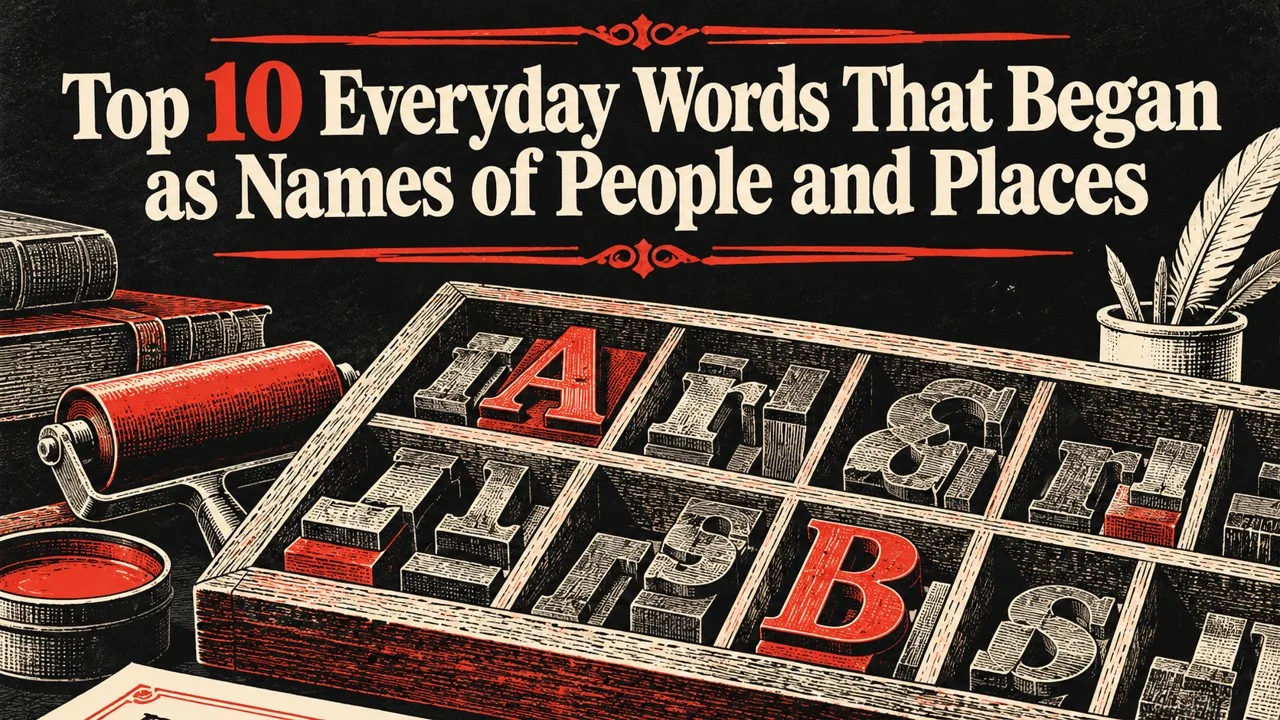
Some everyday words began as the names of real people and places, from a boycotted Irish land agent to a Pacific atoll and a French finance minister. English is full of words that started as proper names. Linguists call a word taken from a person's name an eponym, and one taken from a place a toponym. Over time, most speakers forget the person or place entirely, and the capital letter quietly disappears.
The ten words below are boycott, cardigan, silhouette, guillotine, nicotine, saxophone, denim, bikini, marathon and tuxedo. The first six come from people and the last four from places. Some of their stories are well documented, while others have gathered colorful details that are less certain, and those are flagged as such.
Key Facts
| # | Word | Named after | What the word means now |
|---|---|---|---|
| 1 | Boycott | Captain Charles Boycott, Ireland, 1880 | Refusing to deal with a person or organization as a protest |
| 2 | Cardigan | James Brudenell, 7th Earl of Cardigan | A knitted sweater that opens at the front |
| 3 | Silhouette | Étienne de Silhouette, France, 1759 | A dark outline or shadow image of a shape |
| 4 | Guillotine | Joseph-Ignace Guillotin, France, 1789 | An execution device with a falling blade |
| 5 | Nicotine | Jean Nicot, French ambassador, 1560 | The stimulant compound in tobacco |
| 6 | Saxophone | Adolphe Sax, Belgium and France, 1840s | A single-reed brass instrument |
| 7 | Denim | Nîmes, France | A sturdy cotton twill used for jeans |
| 8 | Bikini | Bikini Atoll, Marshall Islands | A two-piece swimsuit |
| 9 | Marathon | Marathon, Greece | A long-distance running race of 42.195 km |
| 10 | Tuxedo | Tuxedo Park, New York | A dinner jacket for semi-formal evening wear |
1. A Land Agent Left Alone
Charles Boycott was a retired British army captain working as a land agent for an absentee landlord in County Mayo, Ireland. In 1880, during the Land War, tenants asked for rent reductions after poor harvests. Boycott refused and began eviction proceedings [1].
The Irish National Land League, encouraged by its leader Charles Stewart Parnell, urged people to shun such landlords and agents rather than use violence. Local workers stopped working for Boycott, shops refused to serve him and even the post was disrupted. To bring in the harvest, volunteers from Ulster came under a large military guard, at a cost far greater than the crops were worth [1].
The campaign was widely reported, and by the end of 1880 the word boycott was being used as a verb in newspapers. It spread quickly into other languages, including French, German and Russian. Boycott himself left Ireland soon afterward. Few people now remember the man, but his name became a standard term for organized refusal.
2. An Earl's Knitted Jacket
James Brudenell, the 7th Earl of Cardigan, was a British army officer best known for leading the Charge of the Light Brigade at the Battle of Balaclava in 1854, during the Crimean War. The charge, a disastrous attack caused by confused orders, made him briefly famous [2].
The knitted woolen waistcoat or jacket that opened at the front became associated with him and was named after him. Accounts say that British officers in the cold Crimean winter wore such knitted garments, and that Cardigan was known for wearing one. The details of exactly how the name became attached are not perfectly documented [2].
The cardigan later became a standard item of clothing, popularized in the twentieth century by designers such as Coco Chanel, who adapted it for women's fashion. The garment's association with comfort and informality is far removed from the military figure whose title it carries.
3. A Minister's Cheap Profiles
Étienne de Silhouette was appointed controller-general of finances in France in 1759, during the Seven Years' War, when the state was in serious financial difficulty. He imposed strict economy measures and new taxes on the wealthy, which made him unpopular, and he lasted only a few months in office [3].
Related: Top 10 Everyday English Words With Surprising Histories
His name came to be used for things done cheaply or in outline only, perhaps as mockery of his austerity. One popular explanation says that he himself liked to cut paper profiles as a hobby and decorated his château with them. Both explanations are given in reference works, and the exact reason for the association is uncertain [3].
Whatever the origin, the cut-paper profile portraits that were popular in the late eighteenth and nineteenth centuries became known as silhouettes. The word later broadened to mean any dark outline against a lighter background, including the shape of a person or a building seen against the sky.
4. A Doctor Who Wanted a Humane Death
Joseph-Ignace Guillotin was a French physician and member of the National Assembly. In 1789, he proposed that all death sentences in France should be carried out by the same method, a quick mechanical beheading, so that executions would be equal for all classes and less painful [4].
Guillotin did not invent or build the machine. The design was developed by the surgeon Antoine Louis, and the first device was built by Tobias Schmidt, a German harpsichord maker. The machine was first used in April 1792. It was initially called a louisette or louison, after Antoine Louis, but the name guillotine soon prevailed [4].
Guillotin was reportedly distressed to have his name attached to the device, and his family later petitioned to change it. When that failed, they changed their own family name instead. The guillotine remained in use in France until 1977, and capital punishment was abolished there in 1981.
5. An Ambassador's Gift to a Queen
Jean Nicot was the French ambassador to Portugal in the mid-sixteenth century. Around 1560, he sent tobacco plants or seeds to the French court, recommending tobacco as a remedy. Catherine de' Medici, the queen mother, was reported to use it as snuff [5].
Because of Nicot's role, the tobacco plant was given the botanical name Nicotiana, a name later formalized by the botanist Carl Linnaeus. When chemists isolated the main active compound from tobacco leaves in the early nineteenth century, it was named nicotine [5].
Related: Top 10 Words That Used to Mean Something Else
Nicot is also remembered for compiling one of the earliest French dictionaries. His association with tobacco, though, is the one that survived in everyday language. Today nicotine is known primarily as an addictive substance, a long way from Nicot's recommendation of tobacco as a medicine, which reflected the medical beliefs of his time.
6. An Instrument Maker's Invention
Adolphe Sax was a Belgian instrument maker who moved to Paris and developed the saxophone in the early 1840s. He patented it in 1846, along with a family of instruments in different sizes. His aim was an instrument that combined the power of brass with the agility of woodwinds [6].
Although the saxophone is made of metal, it is classed as a woodwind because it uses a single reed, like a clarinet. Sax also developed other instruments, including the saxhorn family. His career involved repeated legal disputes with rival instrument makers, and he went bankrupt more than once [6].
The saxophone was first used mainly in military bands and some orchestral works. Its great popularity came later, in the twentieth century, with jazz and popular music. The instrument now carries its inventor's name in almost every language, even though its sound is more associated with American music than with Belgium or France.
7. A Fabric From Nîmes
The word denim is generally traced to the French phrase serge de Nîmes, meaning a serge fabric from Nîmes, a city in southern France. Over time, de Nîmes was shortened in English to denim [7].
Historians of textiles note that the fabric originally known as serge de Nîmes may not have been identical to modern denim, and some cloth sold under that name may have been made elsewhere. Similarly, the word jeans is often linked to Genoa in Italy, whose French name is Gênes, because of a fabric associated with that city [7].
Related: Top 10 Writers Who Helped Coin Everyday Words
Denim became central to workwear in the nineteenth century, especially after Levi Strauss and Jacob Davis patented riveted work trousers in 1873. In the twentieth century, denim jeans became a global fashion item. The name of a French city now describes a fabric worn worldwide, by many people who have never heard of Nîmes.
8. A Swimsuit Named After a Test Site
In July 1946, the United States began nuclear weapons tests at Bikini Atoll in the Marshall Islands, after moving the island's inhabitants to another atoll. A few days later, the French engineer Louis Réard presented a very small two-piece swimsuit in Paris and named it the bikini [8].
Réard is said to have chosen the name because he expected the swimsuit to create an explosive reaction. Another French designer, Jacques Heim, had launched a similar design shortly before under the name atome. Two-piece swimwear had existed earlier, but Réard's version was notably smaller [8].
The bikini was considered scandalous at first and was banned on some beaches. It became widely accepted in the 1960s. Meanwhile, the people of Bikini Atoll were displaced for decades, and the atoll remains affected by radioactive contamination. The everyday word hides a serious history of nuclear testing and displacement.
9. A Battle, a Legend and a Race
Marathon is a town in Greece and the site of a battle in 490 BC, in which the Athenians defeated a Persian invading force. A later legend says that a messenger, often named Pheidippides, ran from Marathon to Athens to announce the victory and then died [9].
Ancient sources do not agree on this story. Herodotus describes a runner sent from Athens to Sparta before the battle to ask for help, not a run from Marathon to Athens afterward. The famous version appears in much later writers and was popularized in the nineteenth century, including by the poet Robert Browning [9].
Related: Top 10 Everyday Tech Words with Surprising Origins
The modern marathon race was introduced at the first modern Olympic Games in Athens in 1896, inspired by the legend. Its distance varied in early Games. The now standard distance of 42.195 kilometers is usually traced to the 1908 London Olympics and was formally adopted in 1921.
10. A Jacket From a Private Club
Tuxedo Park is a private community in New York State, developed in the 1880s by the tobacco heir Pierre Lorillard IV as a retreat for wealthy families. The name Tuxedo comes from a Lenape word, though its exact meaning is uncertain [10].
According to the usual account, in 1886 some members of the Tuxedo Club wore short, tailless dinner jackets instead of formal tailcoats to an autumn ball. The style, which had already appeared in Britain as an informal evening jacket, became associated with the club. The details of who wore it first are disputed [10].
In the United States, tuxedo became the common name for the dinner jacket and later for the whole outfit. In Britain, the term dinner jacket is still more common. The word is a reminder that a fashion name can come from a place rather than a designer, and from a small private community rather than a major city.
Conclusion
The ten words above show how easily names become ordinary vocabulary. Boycott, cardigan, silhouette, guillotine, nicotine and saxophone preserve the names of individuals, some of whom would not have wanted the honor. Denim, bikini, marathon and tuxedo preserve places, from a French city to a Pacific atoll.
Many eponym stories have been polished over time. The useful habit is to separate the documented core, such as Boycott's isolation in 1880 or Guillotin's 1789 proposal, from the colorful details that may have been added later. The words themselves, though, are a reliable record that these people and places once mattered enough to be talked about.
- ^ [1] Accounts of Charles Boycott and the 1880 campaign in County Mayo. Wikipedia: Charles Boycott Wikipedia: boycott
- ^ [2] Biography of the 7th Earl of Cardigan and the history of the garment. Wikipedia: 7th Earl of Cardigan Wikipedia: cardigan (sweater)
- ^ [3] Biography of Étienne de Silhouette and the history of silhouette portraits. Wikipedia: Étienne de Silhouette Wikipedia: silhouette
- ^ [4] Accounts of Joseph-Ignace Guillotin, Antoine Louis and the guillotine. Wikipedia: Joseph-Ignace Guillotin Wikipedia: guillotine
- ^ [5] Biography of Jean Nicot and the naming of Nicotiana and nicotine. Wikipedia: Jean Nicot Wikipedia: Nicotiana
- ^ [6] Biography of Adolphe Sax and the history of the saxophone. Wikipedia: Adolphe Sax Wikipedia: saxophone
- ^ [7] History of denim, serge de Nîmes and riveted jeans. Wikipedia: denim Wikipedia: jeans
- ^ [8] Accounts of Louis Réard, the 1946 swimsuit and the Bikini Atoll tests. Wikipedia: bikini Wikipedia: Bikini Atoll
- ^ [9] Accounts of the Battle of Marathon, the runner legend and the modern race distance. Wikipedia: marathon Wikipedia: Pheidippides
- ^ [10] Accounts of Tuxedo Park and the origin of the dinner-jacket name. Wikipedia: Tuxedo Park, New York Wikipedia: tuxedo





















Discussion
Log in with