



Top 10 Logistics Feats Behind the World's Biggest Events
 By Dhiraj Sharma · Published
Share Post
Loading…
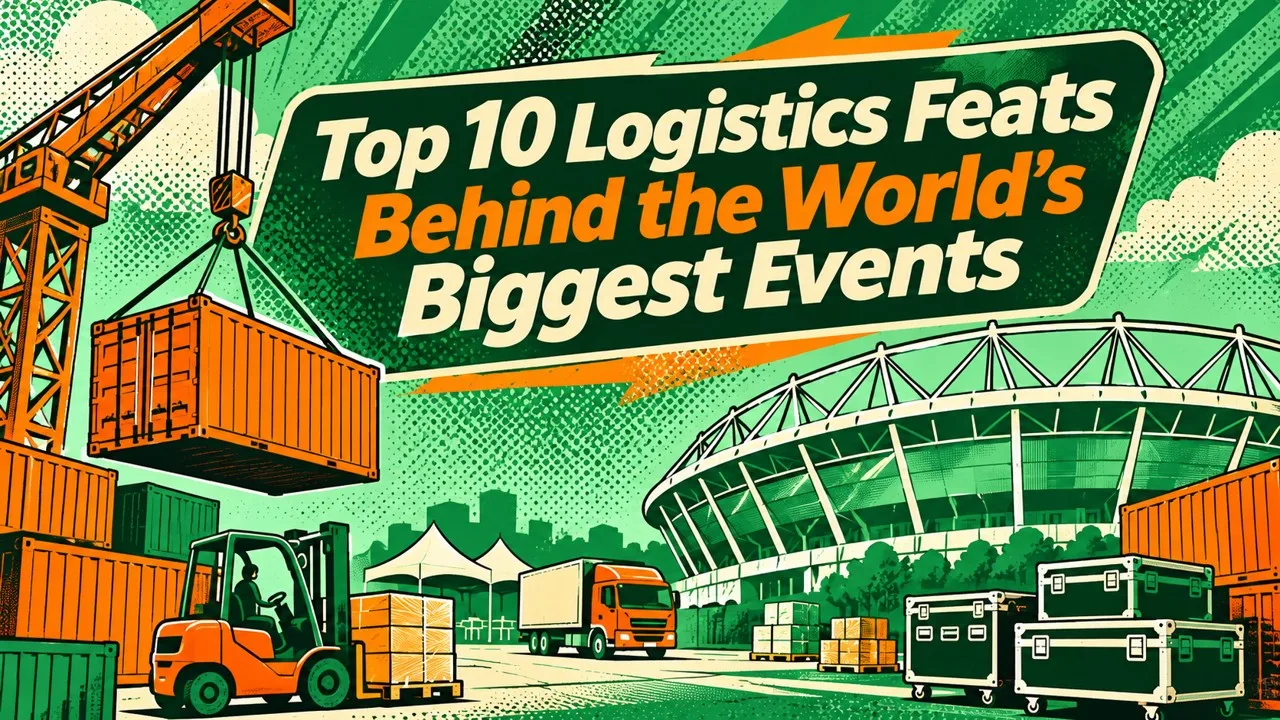
Behind the world's biggest gatherings are huge logistics efforts: tent cities for millions, mass migrations by rail and temporary towns built and removed. When millions of people gather in one place, someone has to feed them, house them, move them and keep them safe. The biggest events in the world, from religious pilgrimages to sporting contests and music festivals, depend on planning that often begins years in advance and involves thousands of workers.
Most visitors never see this work. They see a stadium, a festival field or a sacred site. Behind the scenes are temporary water systems, transport networks, medical centers, communications equipment and plans for every kind of emergency. When logistics succeed, events run smoothly. When they fail, the consequences can be serious, and several of the events in this list have been shaped by past tragedies.
The ten events below are the Hajj, the Kumbh Mela, China's Spring Festival travel season, the Olympic Village at the Paris 2024 Games, the Tour de France, the Glastonbury Festival, Burning Man, Live Aid, the state funeral of Queen Elizabeth II and the Woodstock festival of 1969, which shows what can happen when planning falls short.
The figures quoted for crowd sizes come mainly from organizers and governments, and some are disputed. Counting people at enormous gatherings is difficult, and different methods produce different results, so the numbers should be read as approximate.
Key Facts
| # | Event | Scale | Logistics challenge |
|---|---|---|---|
| 1 | The Hajj | Mecca, Saudi Arabia, every year | Around two million pilgrims in a few days |
| 2 | The Kumbh Mela | Prayagraj, India, 2025 | Officially counted in hundreds of millions of visits |
| 3 | Chunyun | China, every year | Billions of trips around the Lunar New Year |
| 4 | The Olympic Village | Paris 2024 | Housing and feeding about 14,000 athletes and officials |
| 5 | The Tour de France | France, every July | A traveling village that moves each day |
| 6 | Glastonbury Festival | Somerset, England | About 200,000 people on a working farm |
| 7 | Burning Man | Black Rock Desert, Nevada | Tens of thousands of people, leaving no trace |
| 8 | Live Aid | London and Philadelphia, 13 July 1985 | A global broadcast to raise money for famine relief |
| 9 | The state funeral of Queen Elizabeth II | London, September 2022 | Hundreds of thousands queued to pay respects |
| 10 | Woodstock | New York State, August 1969 | Far more people came than expected |
1. A Tent City for Pilgrims
The Hajj is the annual Islamic pilgrimage to Mecca, which every Muslim who is able is expected to make at least once. In recent years, around two million pilgrims have taken part, all performing the same rituals at the same sites over a few days [1].
In the valley of Mina, pilgrims stay in a vast tent city of tens of thousands of air-conditioned, fire-resistant tents, introduced after a deadly fire in 1997. A light railway connects the main sites, and the Jamarat Bridge, where pilgrims perform the ritual stoning, was rebuilt as a multi-level structure after a crowd disaster in 2006 [1].
Saudi authorities use quotas for each country, crowd monitoring and large medical teams. Extreme heat remains a major danger, and hundreds of pilgrims died in the heat of 2024. Managing the Hajj is one of the most complex crowd management tasks in the world.
2. A Temporary City Beside the River
The Kumbh Mela is a Hindu festival in which pilgrims bathe in sacred rivers. The 2025 Maha Kumbh Mela at Prayagraj, at the meeting of the Ganges and Yamuna rivers, was described by the authorities as the largest gathering in human history, with official figures counting hundreds of millions of visits over about six weeks [2].
A temporary city was built on the riverbanks, with pontoon bridges, roads, hospitals, police stations, power lines, water supply and sanitation. Special trains and buses carried pilgrims from across India, and technology such as cameras and drones was used to monitor crowds [2].
Related: Top 10 Annual World Festivals Worth the Travel
Despite the planning, a crowd crush in January 2025 killed dozens of people. The Kumbh Mela shows both the scale of modern event logistics and the difficulty of managing enormous crowds on the busiest days.
3. The Largest Annual Migration
Chunyun, the Spring Festival travel season, is the period of about 40 days around the Lunar New Year when hundreds of millions of people in China travel home to see their families. Many are migrant workers who live far from their home towns [3].
The Chinese government counts the total number of trips, including journeys by car, train, bus and plane, in the billions. China's railway system adds extra trains, and tickets are sold online through a national booking system that must handle huge numbers of requests [3].
The travel rush is often called the largest annual human migration in the world. It requires coordination among rail operators, airlines, road authorities and police. China's high-speed rail network has greatly increased capacity, but tickets for the most popular routes still sell out quickly.
4. Feeding the World's Athletes
At every Summer Olympics, thousands of athletes and team officials live in an Olympic Village for several weeks. For the 2024 Games in Paris, the village was built in Saint-Denis, north of the city, and housed around 14,000 people during the Olympics [4].
Athletes from more than 200 teams need food suited to many diets, cultures and training plans. The main dining hall served tens of thousands of meals each day, operating around the clock. The village also included medical services, gyms, transport links and security [4].
The Paris village was designed to be converted into housing, offices and shops after the Games, part of an effort to reduce the waste of Olympic construction. Planning for such villages begins years in advance and involves architects, caterers, transport planners and security services.
5. A Race That Moves a Town
The Tour de France is a three-week cycling race covering about 3,500 kilometers, usually with 21 stages. Each day, the race starts in one town and finishes in another, and its entire organization moves with it [5].
Related: Top 10 Most Bizarre Phobias: Strange Fears That Exist
Besides the riders and their teams, the Tour includes officials, journalists, television crews, police, medical staff and a publicity caravan of decorated vehicles that throws gifts to spectators. Thousands of people and vehicles travel with the race, needing accommodation and food each night [5].
Roads are closed along the route, and towns pay to host stages. Millions of spectators line the roads during the race. Moving such a large operation every day, often through mountains, requires detailed planning and close cooperation with local authorities.
6. A Farm That Becomes a City
The Glastonbury Festival takes place at Worthy Farm in Somerset, England, a working dairy farm. For a few days each summer, it becomes a temporary city of around 200,000 people, larger than many English towns [6].
Organizers build stages, roads, water pipes, toilets, medical centers and shops. The festival has its own recycling operation and encourages people to take their tents home. A security fence was introduced after problems with gate-crashing [6].
The festival usually takes a fallow year every few years to allow the land to recover. Glastonbury shows how a huge event can be built from scratch on agricultural land and removed again, with the cows returning to the fields afterward.
7. A City Built and Removed
Burning Man is an annual event held in the Black Rock Desert of Nevada, where tens of thousands of participants build a temporary community known as Black Rock City. It is known for large art installations and the burning of a giant wooden figure [7].
Participants must bring most of their own supplies, including water, food and shelter, because there are few services. The organization lays out a street plan and provides some infrastructure, such as toilets and medical services [7].
Related: Top 10 Oldest Buildings in the World
A core principle is Leave No Trace. After the event, participants and volunteers remove all structures and search the desert floor for debris, because the event uses public land managed by the Bureau of Land Management. In 2023, heavy rain turned the site to mud and trapped participants for several days.
8. A Concert on Two Continents
Live Aid was a benefit concert organized by Bob Geldof and Midge Ure to raise money for famine relief in Ethiopia. It took place on 13 July 1985 at Wembley Stadium in London and John F. Kennedy Stadium in Philadelphia, with other performances around the world [8].
The concert was broadcast live by satellite to many countries, one of the largest television broadcasts of its time, with estimates of the global audience often given as more than a billion people. Coordinating live performances on two continents required complex scheduling and satellite links [8].
Phil Collins performed at both venues, flying across the Atlantic on Concorde. The concert raised large sums for famine relief and became a model for later benefit concerts. It also showed how global broadcasting could bring huge audiences together.
9. A Funeral Planned for Decades
Plans for the death and funeral of Queen Elizabeth II, known as Operation London Bridge, were prepared and updated over many decades. When the queen died on 8 September 2022, the plans were put into action [9].
Her coffin lay in state in Westminster Hall for several days. Hundreds of thousands of people waited in a queue that stretched for kilometers along the River Thames, sometimes for more than a day. Volunteers, police and stewards managed the queue, which became a national event in itself [9].
The state funeral on 19 September was attended by many world leaders and was watched by a huge television audience. It was the first state funeral in Britain since that of Winston Churchill in 1965. Security and transport arrangements were among the largest ever organized in London.
Related: 10 Sikh Gurus: The Pillars of Sikhism Who Shaped Faith, Equality, Courage, and Humanity
10. When Planning Fell Short
The Woodstock Music and Art Fair took place in August 1969 on a dairy farm in Bethel, New York. Organizers expected tens of thousands of people, but an estimated 400,000 or more arrived [10].
Roads were jammed for kilometers, and many people abandoned their cars and walked. Fences were not finished, and the festival became free. Food, water and toilets were in short supply, and heavy rain turned the site to mud. Volunteers, local residents and the National Guard helped provide supplies and medical care [10].
Despite the problems, the festival became famous as a peaceful gathering and a symbol of the 1960s counterculture. It also became an example for later festival organizers of the importance of planning for crowds, sanitation and safety.
Conclusion
The ten events above show the hidden work behind huge gatherings. Pilgrimages, festivals, sporting events and ceremonies require temporary cities, transport systems and plans for every emergency. Many of their arrangements were improved after earlier disasters.
Event logistics continue to evolve with new technology, from crowd monitoring cameras to online ticketing. Yet the basic challenges remain the same: feeding, housing, moving and protecting large numbers of people.
When everything works, visitors barely notice the planning at all, which is perhaps the greatest compliment the organizers can receive.
- ^ [1] Accounts of the Hajj and the Mina tent city. Wikipedia: Hajj Wikipedia: Mina
- ^ [2] Accounts of the 2025 Kumbh Mela. Wikipedia: 2025 Prayag Maha Kumbh Mela Wikipedia: Kumbh Mela
- ^ [3] Accounts of the Spring Festival travel season. Wikipedia: Chunyun Wikipedia: high-speed rail in China
- ^ [4] Accounts of the Paris 2024 Olympic Village. Wikipedia: Olympic Village (Paris) Wikipedia: 2024 Summer Olympics
- ^ [5] Accounts of the Tour de France. Wikipedia: Tour de France Wikipedia: Grand Tour (cycling)
- ^ [6] Accounts of the Glastonbury Festival. Wikipedia: Glastonbury Festival Wikipedia: Worthy Farm
- ^ [7] Accounts of Burning Man. Wikipedia: Burning Man Wikipedia: Black Rock Desert
- ^ [8] Accounts of Live Aid. Wikipedia: Live Aid Wikipedia: Bob Geldof
- ^ [9] Accounts of Operation London Bridge and the state funeral. Wikipedia: Operation London Bridge Wikipedia: state funeral of Elizabeth II
- ^ [10] Accounts of the Woodstock festival. Wikipedia: Woodstock Wikipedia: Bethel, New York





















Discussion
Log in with