






 By
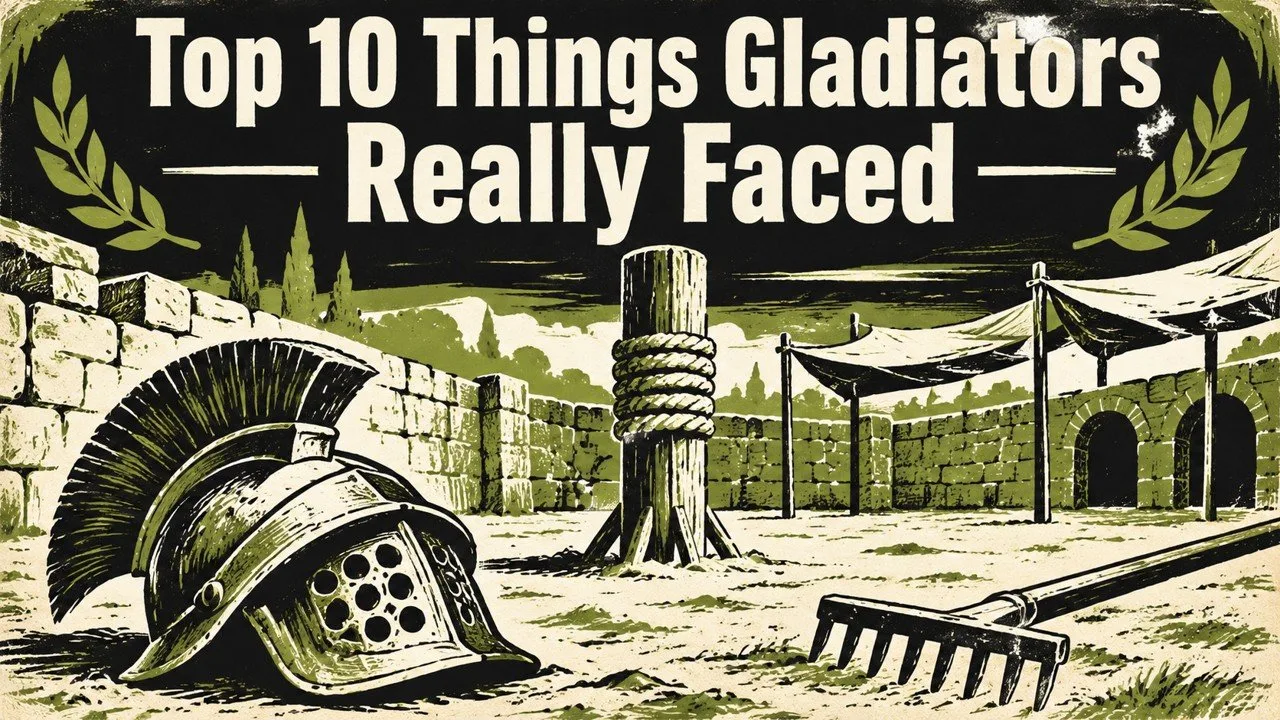
A binding oath, harsh training schools, a barley-heavy diet and a lasting legal stain: ten realities gladiators faced beyond the myths of the Roman arena. Popular films have fixed a few famous images in the mind, among them the thumb signal and the idea that every bout ended in a corpse. Those myths are already examined in Finepedia's Top 10 Colosseum Facts and Myths. This list turns instead to the daily conditions of the men, and the few women, who trained and fought.
Most gladiators were enslaved people, prisoners or condemned criminals, though a minority were free volunteers. All of them entered a world of contracts, grades, referees and medical bills that looked more like a harsh profession than a free-for-all. The schools that held them were businesses, and a trained fighter was too expensive to be wasted lightly.
The ten entries below rest on Roman writers, the remains of training schools, and the graffiti of Pompeii. Where a picturesque detail comes from a single author, that is stated. The aim is not to soften the violence of the games, but to show what a gladiator actually had to live with before, during and after a bout.
Key Facts
The table below gives a quick overview of all ten entries before each one is described in detail.
| # | Reality | What it meant | Best evidence | Period |
|---|---|---|---|---|
| 1 | The gladiator's oath | A sacred promise of total submission | Petronius, Satyricon 117 | 1st century AD wording of an older rite |
| 2 | Infamia, the legal stain | Loss of standing that outlasted the fight | Roman legal usage of infamia | Republic and Empire |
| 3 | The ludus and the lanista | A locked training school run as a business | Ludus Magnus and other ludi | Late Republic to late Empire |
| 4 | A barley-heavy diet | High-energy vegetarian food, nicknamed after barley | Medical and anecdotal Roman testimony | Imperial period |
| 5 | Matched fighting types | Set pairings of armour and weapons, under referees | Reliefs, mosaics and a long list of types | Mainly Imperial period |
| 6 | Galen's surgery in the school | Professional medical care, because a fighter was costly | Galen at Pergamon, from 157 AD | Mid-2nd century AD |
| 7 | Volunteers who sold themselves | Free men who took the oath for pay or debt | Roman notices of auctorati | Late Republic and Empire |
| 8 | The rudis and a way out | A wooden sword as the sign of discharge | Martial and other Imperial writers | 1st century AD and after |
| 9 | Walls covered with their names | Graffiti, souvenirs and a celebrity that cut two ways | Pompeii and Herculaneum | Frozen in 79 AD |
| 10 | A funeral gift that became a political show | The munus began as a duty to the dead | Livy on the games of 264 BC | Mid-Republic to late Empire |
1. The gladiator's oath
Before a recruit could train, he was bound by a sacramentum, a solemn oath that Roman writers treated as something close to a religious vow. The novelist Petronius, writing in the first century AD, gives the formula as a promise "to endure to be burned, to be bound, to be beaten, and to be killed by the sword."[1][2] The wording is theatrical, as befits the Satyricon, but modern accounts of the games accept it as a fair summary of the surrender a novice had to make.
The oath applied to condemned men and to volunteers alike. It placed the fighter under the authority of his manager and, in the arena, under the editor who paid for the show. There was no honourable desertion and no half-measure: the recruit agreed, at least in law and ritual, that his body could be used up.
That starting point colours everything else on this list. The skills, diet and medical care that followed were not kindnesses in the modern sense. They were ways of keeping a sworn, and costly, asset fit enough to perform.
2. Infamia, the legal stain
Even a famous gladiator lived with infamia, a formal loss of legal and social standing. In Roman law an infamis could be barred from certain civic protections, from giving evidence in the usual way, and from the respect owed to a citizen in good honour.[3] The stain attached to actors, prostitutes and funeral workers as well as to arena fighters, a grouping that tells us how respectable Romans classed the job.
Volunteers accepted this cost along with the pay. A free man who took the oath stepped downward in the eyes of the law, even if the crowd later shouted his name. Enslaved gladiators, who had less standing to lose, still carried the taint if they were later freed.
Related: Top 10 Ancient Rome Myths and What the Evidence Shows
The paradox is well attested in Roman letters. Cicero could admire the courage of men in the sand and still use "gladiator" as an insult.[2] Glory in the amphitheatre did not wash out the legal mark. It was one of the prices a fighter paid for the palm branch, the purse, or mere survival.
3. The ludus and the lanista
A gladiator's ordinary world was not the amphitheatre but the ludus, a training school owned or leased by a lanista. The largest of these in Rome, the Ludus Magnus, was built under the emperor Domitian just east of the Colosseum, and later rebuilt on a higher level under Trajan. It had its own practice arena and barracks, and an underground passage towards the great amphitheatre so that fighters could be moved in without a street procession.[4][5]
Life inside was graded and repetitive. Novices trained under instructors, often retired fighters, in a hierarchy of palus grades, and they rehearsed with weighted wooden weapons rather than sharp ones.[2] Discipline was harsh, because a school that could not present fit, obedient pairs would lose money. At the same time, the men were a capital investment: they were housed, fed and, as we shall see, given medical care that many farm slaves never saw.
Schools existed wherever the games were popular, not only in the capital. Capua was already famous for them in the late Republic, and it was from a Capuan ludus that Spartacus and his companions broke out in 73 BC. For most men, though, the school was not a prelude to revolt. It was the place where they slept, ate and practised for years.
4. A barley-heavy diet
Roman sources repeatedly link gladiators with barley. They were sometimes called hordearii, "barley men," and their usual diet is described as a high-energy vegetarian mix of barley, boiled beans, oatmeal, ash and dried fruit.[2] To legionaries, barley could be a punishment ration, inferior to wheat. In the schools it was thought to build bulk and to help wounds knit, and the ash, probably as a supplement, would have added minerals.
The diet was not a matter of taste. A lanista needed men who looked impressive, recovered between bouts and could last a long contest in heavy equipment. Modern analysis of gladiator cemeteries, notably at Ephesus, has been cited in support of a plant-rich, barley-heavy regimen, though the samples are limited and should not be stretched into a single empire-wide menu.[2]
Galen, who worked with fighters at Pergamon, later criticised aspects of their training and food even as he treated their injuries.[6] The "barley man" nickname is therefore both a joke and a clue: what gladiators really faced at table was a carefully managed, rather monotonous fuel, not the meat-heavy feasts of popular imagination.
5. Matched fighting types
A bout was not a random brawl. By the early Empire, gladiators specialised in named types, each with its own kit, and they were usually paired against a different but balanced opponent so that the contest would be fair to watch.[7] A murmillo, with a large shield and a distinctive helmet, might face a thraex or a hoplomachus; a retiarius, with net and trident and almost no helmet, was often set against a secutor, whose smooth visor was harder for the net to catch.
Related: Top 10 Great Roman Amphitheatres Still Standing
These types had histories. Some of the earliest echoed the arms of defeated peoples, such as Samnites and Thracians. Later, the names became technical labels more than ethnic costumes. Fighters trained in one style and rose through its grades; they did not casually swap a net for a heavy shield from week to week.[7][2]
Referees, often retired gladiators themselves, controlled the pace with long staffs and could pause or halt a match. Music from trumpets and a water organ seems to have accompanied the action. The spectacle was violent, but it was also a rule-bound performance, which is why a fighter's type, record and manner of fighting could be advertised in advance, and scratched as graffiti on a city wall afterwards.
6. Galen's surgery in the school
In 157 AD the young physician Galen came home to Pergamon as doctor to the gladiators of the High Priest of Asia. He later wrote that he won the post by showing his skill on a wounded ape when other doctors would not attempt the repair, and that in four years only five of the fighters died, compared with sixty under his predecessor.[6] Those numbers are Galen's own, not an independent register, but they show what he wanted readers to believe: careful treatment of wounds could keep a school from being emptied.
The work itself is not in doubt. He described the gashes of the arena as "windows into the body," and he learned practical lessons about diet, fitness, cleanliness, fractures and severe trauma that no lecture-room could have given him.[6][8] A trained gladiator was expensive to replace, so the lanista had a motive to hire the best help he could find.
This is one of the starker realities behind the games. The same business that bound a man by oath also paid for massage, dressing and surgery, not out of tenderness, but because a living fighter could be hired out again. Galen's later fame as a court physician in Rome had an unlikely beginning in a provincial ludus.
7. Volunteers who sold themselves
Not every gladiator was a prisoner or a slave. Some were auctorati, free men who hired themselves to a lanista, took the same oath as the condemned, and fought under their own names rather than invented stage names.[9][2] They might be desperate, in debt, or simply attracted by the purse and the roar of the crowd. The law still marked them with infamia.
Related: Top 20 Ancient Roman Laws That Seem Strange Today
Their presence mattered, because it shows that the arena was not only a dumping ground for the unfree. It was also a labour market, grim and tightly bound, in which a citizen could trade status for wages and a chance of fame. Roman moralists found this especially shocking, which is why they mention it.
Volunteers did not escape the school or the diet or the risk of death. They accepted those conditions in a contract. When graffiti at Pompeii record a fighter as freeborn, they are marking that unusual, and to many Romans disreputable, choice as part of his public identity.[2]
8. The rudis and a way out
For a man condemned to the school, the greatest prize was not a palm branch or a cash bonus but manumission. The usual symbol was the rudis, a wooden sword or staff presented by the editor, the official who paid for the games. Martial describes a celebrated bout under the emperor Titus in which Priscus and Verus fought so evenly that both were declared winners and both received a rudis.[2]
Discharge did not make a former gladiator into an ordinary gentleman. Many remained in the trade as trainers or referees, and the legal stain of infamia could linger. But the wooden sword was real, and it was publicly given. It meant that the oath of the school no longer held in the same way, and that the man could not be sent back into the sand at a lanista's whim.
The very need for such a symbol tells us what gladiators really faced: a career from which exit had to be granted, witnessed and staged, like everything else in their working lives. Survival was not, by itself, the same as freedom.
9. Walls covered with their names
The best everyday evidence for gladiators as public figures comes from the walls of Pompeii and Herculaneum, buried in 79 AD.[10] Graffiti there name individual fighters, give their records, and sometimes note whether they were slaves or free volunteers.[2] A thraex might be praised as a favourite; a defeated man might be mocked. The same cities have also yielded lamps, knives and other cheap objects stamped with arena scenes.
This was celebrity of a particular Roman kind. Juvenal later sneered at a senator's wife who ran off with a scarred fighter, and Cicero had already shown how the word "gladiator" could praise courage in one sentence and insult an enemy in the next.[2] Admiration and contempt lived side by side, often in the same household.
Related: Top 10 Roman Emperors Who Shaped History
For the men themselves, fame was a working fact. It could raise their hire price, win gifts from the crowd, and still leave them locked in the ludus at night. The graffiti are not fan fiction from a later age. They are what their own neighbours wrote on the street while the schools were still open.
10. A funeral gift that became a political show
Roman tradition, as told by Livy, places the first gladiatorial munus in 264 BC, when Decimus Junius Brutus Scaeva had three pairs fight at the Forum Boarium to honour his dead father, Brutus Pera.[11][2] Livy calls it a munus, a gift or duty owed to the spirit of an ancestor. Other writers looked for even older roots among the Campanians or the Etruscans, and modern scholars still debate the exact origin. What is reasonably clear is that the earliest Roman shows were tied to funerals, not to a state holiday.
Over the next two centuries the gift changed its meaning. Ambitious men used larger and larger munera to win votes and display generosity. Under the emperors the biggest games became official spectacles, paid for by magistrates or by the emperor himself, and private persons needed permission to put them on.[2][12] The religious frame never entirely disappeared, but the political use of the show was obvious to contemporaries, including Cicero.
That long change is part of what gladiators really faced. They were not only athletes or victims. They were the living expense of a public ritual that had grown from a handful of funeral pairs into one of the central entertainments of the Roman state, with all the regulation, cost and cruelty that implied.
Conclusion
The ten realities above do not make the arena any less brutal. They do make it more intelligible. Gladiators trained under oath in closed schools, ate a managed diet, fought in named styles under referees, and, if they were lucky, left with a wooden sword and a legal stain that fame could not quite remove.
Readers who want the building, the seating and the most familiar myths will find them in Top 10 Colosseum Facts and Myths. For the army that supplied some of the same Roman taste for discipline and display, see Top 10 Punishments and Rewards in the Roman Army.
- ^ [1] "Satyricon 117". Perseus Digital Library. Perseus: Petronius, Satyricon
- ^ [2] "Gladiator". Wikipedia. Wikipedia
- ^ [3] "Infamia". Wikipedia. Wikipedia
- ^ [4] "Ludus Magnus". Wikipedia. Wikipedia
- ^ [5] "Gladiators in the Arena, between Colosseum and Ludus Magnus". Parco archeologico del Colosseo. Parco archeologico del Colosseo
- ^ [6] "Galen". Wikipedia. Wikipedia
- ^ [7] "List of Roman gladiator types". Wikipedia. Wikipedia
- ^ [8] "Galen". Encyclopaedia Britannica. Encyclopaedia Britannica
- ^ [9] "Auctorati". Wikipedia. Wikipedia
- ^ [10] "Pompeii". Wikipedia. Wikipedia
- ^ [11] "Livy, Ab Urbe Condita". Perseus Digital Library. Perseus: Livy
- ^ [12] "Gladiator". Encyclopaedia Britannica. Encyclopaedia Britannica

























Discussion
Log in with