






 By
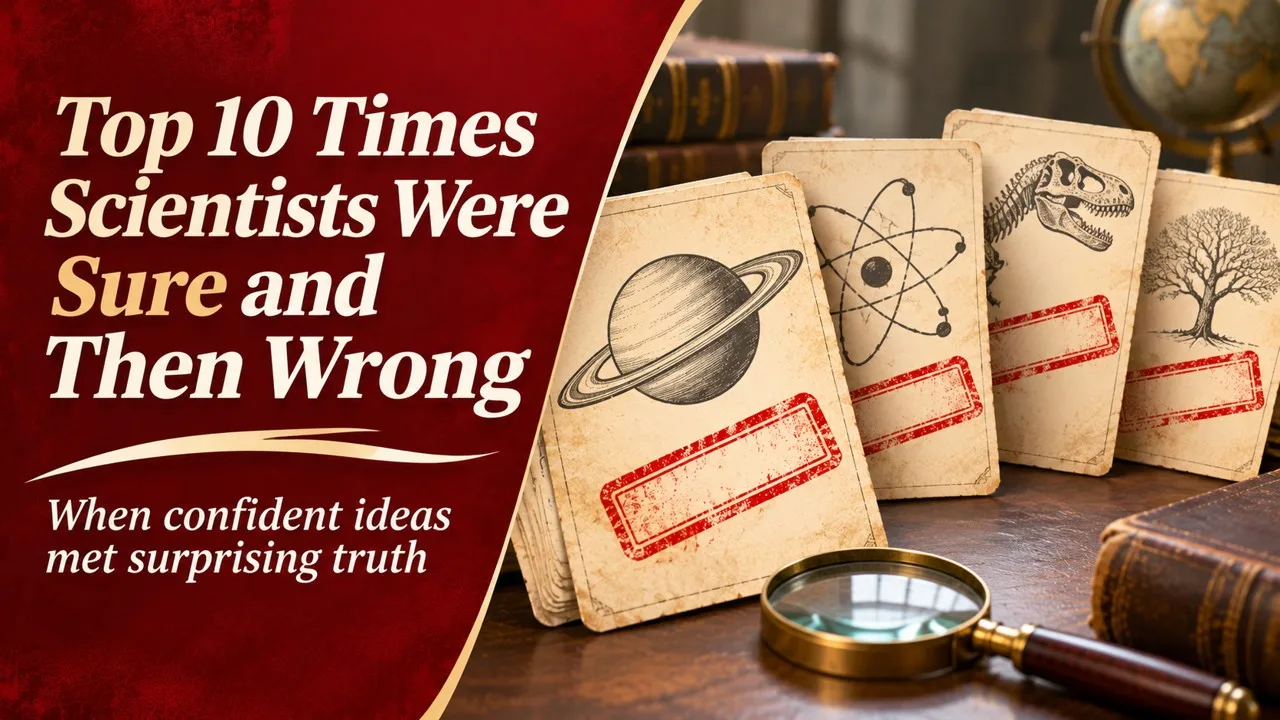
Some famous scientific ideas were later abandoned; in at least one popular case, "scientists were sure" is itself the part that needs a correction.
The ten episodes below are mid-century global-cooling talk that was never a settled consensus, cold fusion as announced in 1989, Blondlot's N-rays, the luminiferous aether, phlogiston, caloric, the steady-state universe, the expanding-Earth idea, miasma, and spontaneous generation. Several of those ideas were, for a time, serious attempts to organize evidence. A few were already weaker than their press. This list is not a brief against science. It is a record of how a field corrects itself, and of how a magazine cover can outrun a field.
Key Facts
| Idea | What later replaced or confined it | What not to claim | |
|---|---|---|---|
| 1 | A coming ice age, as a 1970s popular story | Measured warming, and a literature that was already mixed | That "scientists" as a body were sure of a new ice age |
| 2 | Cold fusion, as announced in 1989 | Failed independent replication of the claimed effect at the claimed ease | That the entire subject of nuclear fusion is a folly |
| 3 | N-rays, reported in early-1900s France | A failure to find the rays under controlled conditions, after a famous visit by R. W. Wood | A national slight; the episode is about method |
| 4 | A luminiferous aether as the medium of light | Relativity and a null result in careful optical experiments | That earlier wave theories of light were foolish as a whole |
| 5 | Phlogiston, as the substance released in burning | Oxygen and a modern chemistry of combustion and mass | That every early chemist was simply inventing names |
| 6 | Caloric, as a weightless fluid of heat | Heat as energy, and the laws of thermodynamics | That calorimetry itself was a mistake |
| 7 | A steady-state universe, with ongoing creation of matter | The expanding-universe evidence, including the cosmic microwave background | That debate in cosmology is a sign of failure |
| 8 | An expanding Earth, as an account of the continents | Plate tectonics, with a planet of relatively stable radius | That every pre-plate idea was idle |
| 9 | Miasma, or bad air, as the main cause of diseases such as cholera | Germ theory, and John Snow's work on water, among other results | That all sanitation inspired by "bad air" was useless |
| 10 | Spontaneous generation of animals from nonliving matter | Controlled experiments, including those of Redi and Pasteur | A modern laboratory lesson in creating life |
1. A Cooling Story That Outran the Consensus
In the 1970s, some popular magazines ran stories about a coming ice age, often built on a run of mid-century cooling in parts of the Northern Hemisphere and on research into aerosols and orbital cycles [1]. A handful of scientific papers discussed the possibility of future cooling. That is not the same as a field that was "absolutely sure." Reviews of the literature have found a mixed, and already often warming-oriented, set of papers, and a much louder set of covers [1].
The unexpected fact, on a list of scientists who were sure and wrong, is that this famous exhibit does not actually show a sure profession [1]. This article will not use a 1970s headline as a reason to dismiss later, much stronger evidence of warming. The careful fact is a popular trope, a real mid-century temperature wiggle, and a scientific literature that was not united behind an imminent ice age. The later instrumental record went, clearly, toward warming. That record, not a magazine file, is the comparison that matters.
A field can be misremembered as having been certain. The decent correction is to shrink the certainty, and then to leave the later measurements in place.
2. A 1989 Claim That Did Not Replicate
In 1989, Martin Fleischmann and Stanley Pons announced that they had produced a fusion-like effect in a tabletop electrochemical cell at ordinary temperatures [2]. The claim, quickly labeled cold fusion, drew enormous attention. Independent laboratories did not reproduce a reliable, readily repeated version of the announced effect, and the episode became a standard caution about going public before a result has been checked [2].
The unexpected fact is how much of the story is about process: a press conference, a difficult experiment, and a community that could not make the same cell tell the same story [2]. This article will not treat all research into unusual low-energy nuclear claims as one cancelled subject, and it will not offer a cell design. The careful fact is a specific, widely publicized claim that failed the ordinary test of independent replication. Fusion as a physical process in the Sun, and as a difficult engineering goal in hot plasmas, is a different file. The 1989 announcement does not close that file, and it does not reopen itself by remaining famous.
A result that cannot be repeated is not yet a result. The 1989 claim remains, on that test, a warning.
3. N-Rays, and a Visit That Ended Them
In the early 1900s, the French physicist René Blondlot reported a new form of radiation, N-rays, with a long list of properties and a growing group of confirming colleagues in some French laboratories [3]. Other physicists could not find the rays. In 1904, the American experimenter R. W. Wood visited Blondlot's laboratory, secretly removed a crucial part of the apparatus, and later reported that the "observations" continued anyway. The episode is now a textbook case of observer effects and of a result that depended on a setup the observer thought was intact [3].
Related: Albert Einstein: The Theoretical Physicist Who Redefined Science
The unexpected fact is how many sincere people can see a phenomenon that is not there, once a laboratory has a script for seeing it [3]. This article will not treat the affair as a joke about a nation, and it will not reconstruct the apparatus as a how-to. The careful fact is a reported radiation that vanished under a controlled check, and a reminder that replication, and sometimes a single unwelcome visitor, are part of how a science polices itself. X-rays, discovered a few years earlier, were real. N-rays took a similar public shape and then failed the same kind of test.
A named ray can still be a mistake. The method that exposed the mistake is the part of the story worth keeping.
4. A Medium for Light That Experiments Did Not Need
Through much of the nineteenth century, many physicists treated light as a wave in a medium, the luminiferous aether, that filled space and allowed radiation to travel [4]. The idea organized a great deal of work, including careful attempts to detect the Earth's motion through that medium. The most famous of those attempts, by Albert A. Michelson and Edward W. Morley, did not find the expected shift. In the twentieth century, special relativity provided a theory of light and of moving frames that did not require the aether as a mechanical substance [4].
The unexpected fact is that a "wrong" medium sat inside a research program that was otherwise extremely productive. Wave optics, precision measurement, and the problem of the aether were entangled [4]. This article will not treat nineteenth-century physics as a blunder, and it will not present relativity as a slogan. The careful fact is a discarded mechanical medium, a set of null or difficult-to-reconcile experiments, and a replacement theory that kept the successes of wave optics without the substance. Scientists can be serious, widely agreed, and still be wrong about a piece of the furniture of the world.
An aether was a reasonable furniture. The room, measured more carefully, did not need it.
5. A Substance of Burning, Replaced
Phlogiston theory, developed in the seventeenth and eighteenth centuries, held that combustible materials contained a substance, phlogiston, that was released when they burned [5]. The theory organized a large amount of chemical practice, including the behavior of metals and calxes, until work associated with Antoine Lavoisier and with the recognition of oxygen made combustion a combination with a gas, not a loss of a fiery essence. Weighing, in particular, was hard to square with a substance that sometimes seemed to leave a calx heavier than the metal [5].
The unexpected fact is that phlogiston was not a joke. It was a framework that could be used, for a time, to make predictions and to talk across laboratories [5]. This article will not mock early chemists, and it will not retell the whole Chemical Revolution. The careful fact is a discarded explanatory substance, a replacement in terms of oxygen and mass, and a reminder that a theory can be fertile and still be wrong in its central object. Modern chemistry kept the laboratory and dropped the essence.
Related: Top 10 Turning Points in the History of Biology
A flame can be explained without a special fire-stuff. That sentence took a long time to become obvious, which is why the older theory belongs on this list.
6. Heat as a Fluid, Then as Energy
Caloric theory treated heat as a weightless, self-repelling fluid that flowed from hotter bodies to colder ones [6]. It was good enough, for a time, to support a quantitative art of calorimetry and to make sense of why a hot object warms a cool one. Experiments on friction, including those associated with Count Rumford, and later the work that led to the mechanical equivalent of heat and to thermodynamics, made the fluid unnecessary. Heat is a form of energy, not a conserved stuff that is stored in bodies like a liquid [6].
The unexpected fact is how much of the measuring practice survived the death of the fluid. A calorie can be a unit without caloric being a substance [6]. This article will not treat every useful table of heat capacities as a relic, and it will not offer a thermodynamic course. The careful fact is a discarded fluid, a surviving set of measurements, and a conceptual shift from stuff to energy. Scientists can be wrong about what heat is and still be careful about how much of it moves.
A fluid was a model. The better model kept the numbers and changed the ontology, which is a polite way of saying the fluid had to go.
7. A Universe Without a Beginning, and a Background That Arrived
In the mid-twentieth century, Hermann Bondi, Thomas Gold, and Fred Hoyle developed a steady-state account of the universe: expansion without an overall beginning, maintained by the ongoing appearance of new matter, so that the large-scale look of the cosmos would not change with time [7]. It was a serious rival to what Hoyle himself mockingly called the "big bang." The discovery of the cosmic microwave background, and a range of other evidence about the universe's earlier, hotter, denser state, left the steady-state idea without a workable home [7].
The unexpected fact is that a wrong cosmological model can still force a field to say what its evidence actually is. The debate sharpened the predictions [7]. This article will not treat Hoyle as a buffoon, and it will not present a beginning of the universe as a theological conclusion. The careful fact is a well-formulated alternative, a set of observations that it could not comfortably absorb, and a standard hot-expansion account that remains the framework, with its own later open questions. A discarded model is part of how the surviving model earned its keep.
Related: Top 10 Inventors Who Did Not Live to See Their Success
A universe that always looked the same was an elegant idea. The leftover radiation from a hotter past is a more stubborn fact.
8. Continents That Move, on a Planet That Need Not Grow
Before plate tectonics became the standard account of the continents, some geologists argued that the Earth itself was expanding, and that the fit of the continents was the opening of a smaller, once-covered globe [8]. The idea tried to solve a real problem, the matching of coastlines and of older rocks, without a fully convincing mechanism for seafloor creation and destruction. Plate tectonics, with spreading ridges and subduction, and with a radius that does not have to grow in order for continents to move, took that problem over [8].
The unexpected fact is that an expanding Earth was not only a curiosity. It was one of the stories a mid-twentieth-century geologist could tell while the field was still arguing [8]. This article will not treat every opponent of early continental drift as a fool, and it will not retell the whole plate-tectonic revolution. The careful fact is a discarded global mechanism, a surviving set of continental fits, and a standard theory that moves plates on a planet of relatively stable size. The continents really do move. The planet does not have to inflate for that motion to occur.
A growing Earth was a way to make room. Spreading and subduction made room without the growth.
9. Bad Air, Germs, and a Partial Usefulness
For a long time, many physicians attributed diseases such as cholera, plague, and malaria to miasma, a poisonous or foul air rising from waste and rotting matter [9]. The theory was wrong as a complete account of those diseases. John Snow's work on a London cholera outbreak, the later identification of specific microbes, and the rise of germ theory replaced "bad air" as the main cause. Some of the practical advice that miasma had supported, such as cleaning waste and improving drains, was still useful, because filth and standing water can matter for reasons the older theory only partly grasped [9].
The unexpected fact is that a wrong cause can sit next to a partly right policy [9]. This article will not offer medical advice, and it will not treat every nineteenth-century sanitary reform as an accident. The careful fact is a discarded causal theory, a replacement in terms of specific organisms and routes, including water in the case of cholera, and a reminder that malaria's name, "bad air," is a fossil of the older view. Mosquitoes, not a vapor from a swamp as such, were the missing piece in that example.
Related: Top 10 Lasting Traces of Nuclear Testing
Miasma was a mistake about mechanism. It was not always a mistake about the places that needed cleaning, which is a narrower compliment than the theory wanted.
10. Life From Nonliving Matter, as an Everyday Claim, Refuted
For centuries, including in work that followed Aristotle, it was widely held that some animals could arise spontaneously from nonliving matter: maggots from meat, mice from grain, and so on [10]. Francesco Redi, in the seventeenth century, and later Louis Pasteur, in the nineteenth, published experiments that cut against those everyday claims, using covers, flasks, and controls that kept flies, or microbes, from arriving unnoticed. Pasteur's swan-necked flasks, in particular, became a standard demonstration that a boiled broth does not generate life by itself under those conditions [10].
The unexpected fact is how long a common-sense claim can last when the hidden source of the animals is small or is a fly the observer did not watch [10]. This article will not discuss modern laboratory work on the origin of life, and it will not treat Pasteur's result as a verdict on every chemical question about a deep past. The careful fact is a discarded account of everyday generation, a set of classic controls, and a remaining, separate question about how life began on the early Earth, which is not the same question as whether a piece of meat breeds maggots by itself. Scientists were, in this case, sure for a very long time, and then they were wrong in the everyday sense that matter, left as it is, does not sprout animals.
A covered jar can be a decisive instrument. The older belief did not survive the jar, and it does not need to be revived as a proverb.
Conclusion
The ten ideas above are a 1970s ice-age story that was never a sure consensus, a 1989 cold-fusion claim that did not replicate, N-rays, the luminiferous aether, phlogiston, caloric, a steady-state universe, an expanding Earth, miasma, and everyday spontaneous generation. Some were serious theories. One was a press conference. One was a magazine habit that has been misremembered as a consensus.
A science that can be wrong in public, and then say so, is doing part of its job. The decent way to list those wrong turns is to keep the evidence that ended them, to shrink the claims that were never as certain as the covers, and to leave methods, flasks, and medical advice off the page except as history.
- ^ [1] Historical reviews of 1970s climate literature and popular "coming ice age" stories, distinguishing a mixed scientific file from magazine certainty, and noting the later instrumental warming record. Britannica: climate change IPCC
- ^ [2] Historical accounts of the 1989 Fleischmann and Pons cold-fusion announcement and of the failure of independent replication of the claimed effect. Britannica: cold fusion Wikipedia: cold fusion
- ^ [3] Historical accounts of Blondlot's N-rays and of R. W. Wood's visit, treated as a case of method and observer effects, not as a national slight. Wikipedia: N-ray Britannica: scientific method
- ^ [4] Accounts of the luminiferous aether, the Michelson–Morley experiment, and the later abandonment of a mechanical medium in favor of relativity. Britannica: ether Britannica: special relativity
- ^ [5] Historical accounts of phlogiston theory and of its replacement by an oxygen-based chemistry of combustion and mass. Britannica: phlogiston Britannica: Antoine Lavoisier
- ^ [6] Historical accounts of caloric theory and of the shift to heat as energy in nineteenth-century thermodynamics. Britannica: caloric theory Britannica: thermodynamics
- ^ [7] Accounts of the mid-twentieth-century steady-state cosmology and of evidence, including the cosmic microwave background, that favored a hot, expanding early universe. Britannica: steady-state theory Britannica: cosmic microwave background
- ^ [8] Historical discussions of the expanding-Earth idea and of its replacement by plate tectonics on a planet of relatively stable radius. Britannica: plate tectonics Wikipedia: expanding Earth
- ^ [9] Historical accounts of miasma theory, John Snow's work on cholera, and the rise of germ theory, with later sanitation treated as only partly overlapping the older causal story, and with no medical advice offered. Britannica: miasma theory Britannica: germ theory
- ^ [10] Historical accounts of spontaneous generation and of experiments by Redi and Pasteur that undercut everyday claims of animals arising from nonliving matter, without discussion of modern origin-of-life methods. Britannica: spontaneous generation Britannica: Louis Pasteur






















Discussion
Log in with