






 By
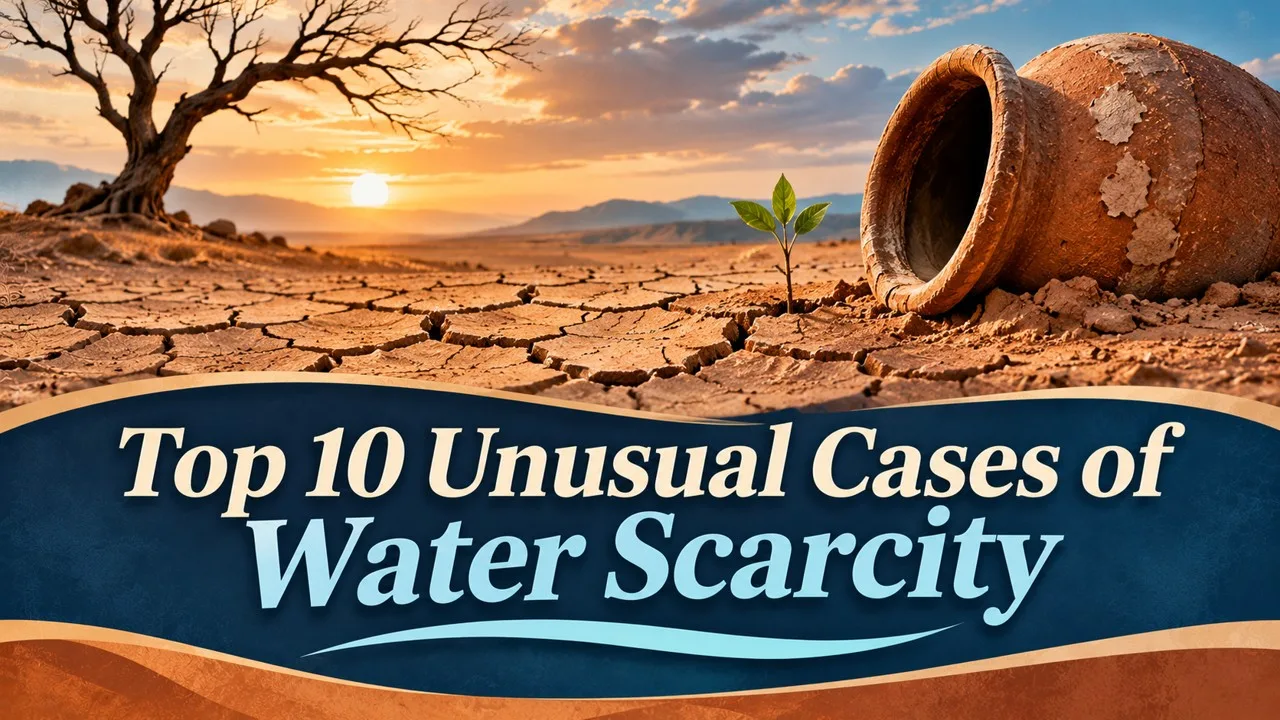
Jordan rations piped water, and a Libyan project moves fossil aquifer water across the desert; scarcity is hydrology and policy, not a national joke. Water stress is usually a mixture of climate, aquifers, rivers that cross borders, and the state of pipes and pumps [1][6][8]. The ten cases below are documented examples of that mixture, including scheduled household supply, fossil groundwater, desalination, and cities that have overdrawn the wells they stand on [2][3][9]. This article will not turn a country into a caricature, will not use a flag, and will not treat a serious shortage as a punchline or as a final verdict on a people [5][7][10]. Rates and forecasts vary by basin and by year; they will be qualified [4][8][9]. Mexico City appears here as a water-supply problem, related to, but not a repeat of, an earlier entry on land subsidence [2].
A scarce liter is a hydrologic and a political fact. The useful sentence names the source, the infrastructure, and the limit, and then stops.
Key Facts
These are documented water-stress cases, told as hydrology and policy.
Ten Cases at a Glance
| Rank | Place | Careful version |
|---|---|---|
| 1 | Jordan | Among the world's most water-scarce countries per capita; many households receive piped water on a schedule and store it in roof tanks |
| 2 | Mexico City | A high, former-lake capital that depends on aquifers and long-distance transfers; pumping is also the main reason the ground has subsided |
| 3 | Libya | The Great Man-Made River moves fossil water from Saharan aquifers to the coast; the resource is largely non-renewable, and conflict has damaged infrastructure |
| 4 | Lebanon | A country with rainfall and rivers that still faces uneven, unreliable supply because of infrastructure, finance, and added demand |
| 5 | Iraq | The Tigris and Euphrates, once the basis of irrigation, are now constrained by upstream dams, drought years, and damaged works |
| 6 | India | Water stress is regional, not uniform: monsoon variability, groundwater overdraft in some plains, and pollution all matter, and they do not make one national verdict |
| 7 | Pakistan | The Indus basin supports a dense irrigation economy; storage, timing, and climate in the headwaters are the real constraints, not a single faucet metaphor |
| 8 | Saudi Arabia | With almost no permanent rivers, the kingdom has used fossil aquifers, including for a later-reduced wheat program, and now relies heavily on desalination |
| 9 | Chile and the Atacama | The world's driest desert and a mining economy make water a local allocation problem among mines, farms and communities |
| 10 | Yemen | Deep aquifers, a stressed capital, and years of conflict have produced one of the region's most serious urban water shortages; this is a humanitarian and hydrologic fact, not a prize |
1. A Schedule, and a Roof Tank
Jordan is routinely ranked among the most water-scarce countries on Earth, on a per-person basis, with a dry climate, limited rivers, and aquifers that have been heavily used [1]. In much of the country, municipal water is delivered on a weekly or otherwise limited schedule; households store what arrives in roof tanks, and some communities still depend on tanker deliveries [1]. The unexpected fact, for a reader used to a constant tap, is the diary: water is a date on the calendar as much as a pipe in the wall. This article will not treat that diary as a joke about optimism. The careful fact is the scarcity, the scheduling, and the storage, all of which are ordinary public knowledge in Amman and in many towns.
A tank on a roof is a piece of infrastructure. The infrastructure is what a dry country looks like when the network cannot run all week.
2. A Capital That Drinks from Its Own Foundation
Mexico City, built in a high basin on the former bed of Lake Texcoco, draws a large share of its water from aquifers under the city and the rest from long-distance transfers, including the Cutzamala system [2]. Decades of pumping have both strained supply, especially in poorer neighborhoods, and compacted the clay, which is why the same wells appear in an earlier list of sinking cities [2]. The unexpected fact is the double cost of a glass of water: a shortage at the tap, and a street that slowly lowers. This article will not repeat that earlier rate map, and it will not use a flag. The careful fact is a megacity whose hydrology and whose foundations are the same overdrawn basin.
A well can feed a capital and still undermine it. The feeding is the water story; the undermining is the geological footnote.
3. Fossil Water, Moved on Purpose
Libya's Great Man-Made River is among the largest irrigation and conveyance projects ever built, a network of wells, pipes and reservoirs that carries groundwater from Saharan fossil aquifers, including parts of the Nubian Sandstone system, toward coastal cities and farms [3]. Much of that water was stored over geological time and is not recharged on a human schedule; using it is a one-way draw, however carefully it is engineered [3]. Conflict, fuel shortages and damaged works have, in later years, made delivery less reliable, a political and logistical fact, not a thriller [3]. This article will not treat the project as an absurdity, and it will not offer a map for interference. The careful fact is a desert country that chose to move ancient groundwater, at scale, because it had few other rivers to move.
Related: Top 10 Largest Dams in the World
A pipe in the Sahara can be a civic project and still be a withdrawal from a finite store. The store is the hydrologic fact that remains after the engineering is admired.
4. Rainfall, and a Network That Does not Keep Up
Lebanon is not a desert. It has mountains, a wet season, and rivers, and it still faces chronic, uneven shortages, especially in cities such as Beirut, where households rely on roof tanks, private wells, and scheduled or intermittent municipal supply [4]. Aging pipes, financial crisis, pollution, and a larger population, including people displaced by regional conflict, have all added demand or reduced the useful yield of the system [4]. The unexpected fact is the mismatch between a relatively well-watered map and a dry tap. This article will not blame a single group for the shortfall, and it will not use a postcard of cedars as a stand-in for policy. The careful fact is infrastructure and governance, as much as rainfall.
A wet climate can still have a dry kitchen. The kitchen, in this case, is waiting on a network that does not run as a right all day.
5. Two Rivers, under New Constraints
Iraq's agriculture and cities have, for millennia, depended on the Tigris and the Euphrates, rivers that now arrive after upstream dams, especially in Turkey and in neighboring basins, and after years of drought, overuse, and infrastructure damaged in conflict [5]. Marshlands in the south, already drained in the late twentieth century and later partly reflooded, remain sensitive to the leftover flow [5]. The unexpected fact is how political a cubic meter has become, once a river is shared. This article will not settle a diplomatic argument, and it will not treat a civilization's origin as a punchline. The careful fact is a reduced and more variable flow, in a country that was built on irrigation.
A river can be ancient and still be new in its politics. The politics, here, are dams, drought and repair, and they belong in a hydrology list only as those facts.
Related: Top 10 Tallest Dams in the World
6. A Subcontinent, not a Single Verdict
India's water problems are real and they are not one story. Some of the northwest and other intensively farmed plains have overdrawn aquifers; monsoon rainfall is variable; many rivers and city supplies are polluted; and some regions remain far wetter than a crisis headline will allow [6]. The unexpected fact is the scale of the variation. A country this large cannot be filed under a single metaphor about rivers with personalities. This article will not invent a national collapse date, and it will not flatten a hundred basins into one mood. The careful fact is regional stress, measured in wells, canals and seasons, with different numbers in different states.
A monsoon can fail a district and still spare another. The district is the proper unit, until a careful national account says otherwise.
7. An Irrigation Economy, Timed to a River
Pakistan's settled agriculture is, to a remarkable degree, an Indus-basin irrigation system, fed by snow and ice in the high catchments, by monsoon rain, and by a dense network of canals [7]. Population growth, aging and silted works, contentious storage, and a changing headwater climate all tighten the margin between a good year and a short one; glacier melt is a part of that climate story, and it should be stated as a trend with a complicated timetable, not as a single collapse already underway [7]. The unexpected fact is how much of a modern economy can hang on the timing of a river. This article will not say that a country is teetering on a faucet. The careful fact is a basin under pressure, with irrigation as both the achievement and the constraint.
A canal can be a national fact. The fact, in a dry year, is the gap between water allocated and water that actually arrives.
Related: Top 10 Environmental Fixes That Backfired
8. Wheat, for a Time, and then Desalination
Saudi Arabia has almost no permanent rivers or lakes, and for a period it used fossil aquifer water to support a large wheat program, a policy later reduced as the cost to the aquifers became clear [8]. Today the kingdom relies heavily on desalination, along with remaining groundwater, to supply cities and some agriculture [8]. The unexpected fact is the sequence: a desert state can grow a grain crop from ancient water, and then decide that the crop was too expensive in cubic meters. This article will not sneer at oil wealth, and it will not treat desalination as a magic substitute for a river. The careful fact is a fossil aquifer drawn down, a policy reversal, and a coast of desalination plants.
A wheat field can be a hydrologic experiment. The experiment, once retired, still leaves a lower water table behind.
9. The Driest Desert, and a Contest for What Little There Is
The Atacama, in northern Chile, is often called the driest desert on Earth, with some stations recording years without measurable rain, and it is also a region of copper and lithium mining, oasis agriculture, and Indigenous and local communities that depend on scarce surface and groundwater [9]. Water scarcity there is not a riddle about a desert "refusing" to help; it is an allocation among users in a place that never had much to allocate [9]. Small adaptations, including fog collection in some coastal sites, exist and should be kept in proportion: they are local tools, not a replacement for a river. This article will not use a flag, and it will not turn a mining economy into a cartoon. The careful fact is extreme aridity, plus a modern demand that the desert did not invent.
A dry place can still have a water politics. The politics are about who gets the aquifer, and they are more interesting than a joke about uncooperative sand.
Related: Top 10 Drowned Towns That Reappear in Dry Years
10. A Capital, Deep Wells, and a Damaged System
Yemen has long been among the most water-stressed countries in the region, with highlands that depend on deep, overdrawn aquifers; Sana'a has been discussed for years as a capital whose wells would be increasingly expensive and difficult [10]. Conflict has damaged infrastructure and made fuel, pumps and repairs harder to obtain, which turns a hydrologic shortage into a wider humanitarian one [10]. This article will not award a grim title, will not describe a battle, and will not treat a glass of water as a lottery ticket. The careful fact is a serious, documented urban and rural shortage, made worse by war, and still a matter of wells, rainfall and pipes.
A well can be a civic fact and a wartime fact at once. The civic fact is the falling water table; the wartime fact is that the pumps and the pipes are harder to keep running.
Conclusion
The ten cases above are a scheduled Jordanian tap, a Mexican capital drinking from its own basin, a Libyan river of fossil water, a Lebanese network that does not match the rainfall, two Iraqi rivers under constraint, a regional Indian map, an Indus irrigation economy, a Saudi sequence from aquifer wheat to desalination, an Atacama allocation problem, and a Yemeni shortage worsened by conflict. None of them is a national joke. All of them are about sources, infrastructure and limits.
Water scarcity is a measured imbalance. The decent way to list it is to keep the aquifer, the dam and the tank in view, to refuse a caricature, and to leave flags, and despair as style, off the page.
- ^ [1] Hydrological and policy accounts of Jordan's water scarcity, including scheduled municipal supply and household storage. Britannica: Jordan Britannica: water scarcity
- ^ [2] Accounts of Mexico City's water supply from aquifers and long-distance transfers, and of the link between pumping and subsidence, without repeating an earlier rate map. Britannica: Mexico City
- ^ [3] Descriptions of Libya's Great Man-Made River and of the use of Saharan fossil aquifers, including later damage to infrastructure, without a conflict scene. Britannica: Libya Britannica: aquifer
- ^ [4] Overviews of Lebanon's water supply problems, including intermittent urban service, infrastructure and added demand. Britannica: Lebanon
- ^ [5] Accounts of the Tigris and Euphrates in Iraq, including upstream dams, drought and the southern marshes. Britannica: Tigris-Euphrates river system Britannica: Iraq
- ^ [6] Reviews of groundwater, monsoon variability and regional water stress in India, treated as a basin-level problem rather than a single national verdict. Britannica: India Britannica: monsoon
- ^ [7] Accounts of the Indus irrigation system in Pakistan, including storage, headwater climate and the need to qualify glacier-melt timelines. Britannica: Indus River Britannica: Pakistan
- ^ [8] Histories of Saudi Arabian agriculture on fossil aquifers, including the later reduction of a wheat program, and of desalination as a major urban source. Britannica: Saudi Arabia Britannica: desalination
- ^ [9] Geographical accounts of the Atacama and of water allocation among mining, agriculture and communities in northern Chile. Britannica: Atacama Desert Britannica: Chile
- ^ [10] Reports on Yemen's aquifer and urban water stress, including the added effect of conflict on infrastructure, without graphic wartime detail. Britannica: Yemen Britannica: Sanaa




















Discussion
Log in with