






 By
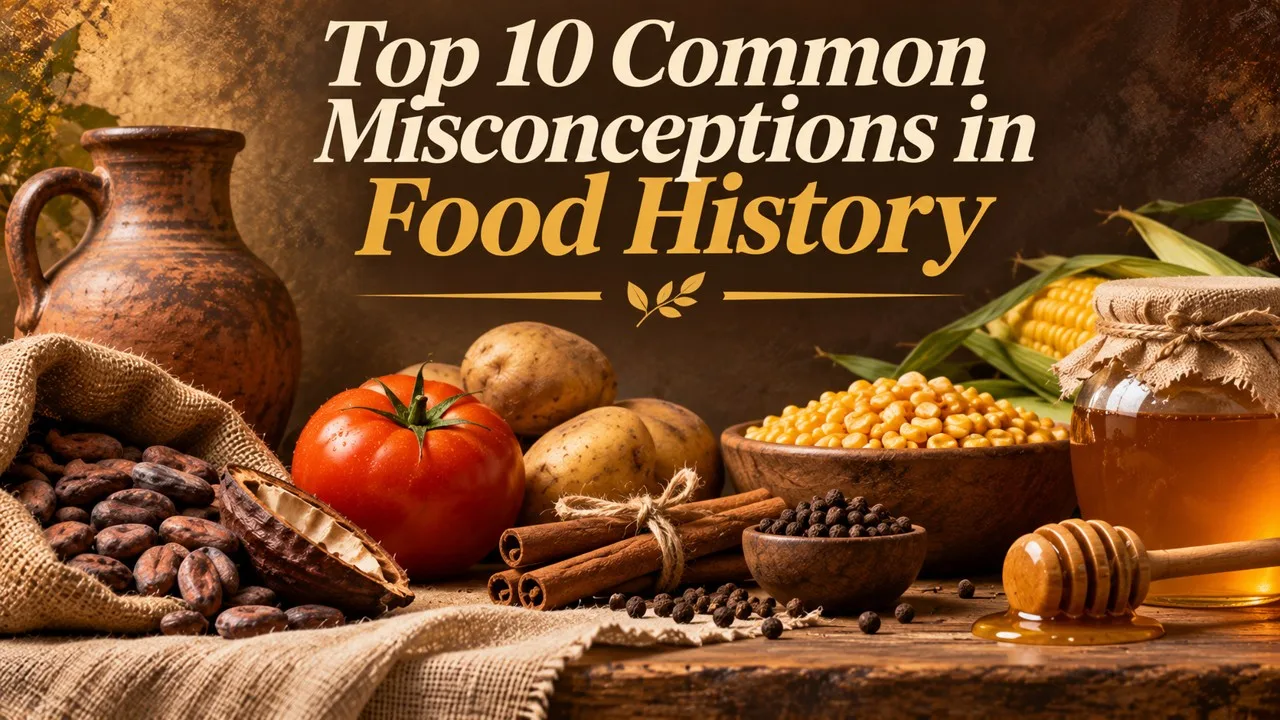
Several famous food stories assign an invention, a country, or an ingredient to the wrong person or the wrong century.
The ten corrections below concern Caesar salad, Dom Perignon and champagne, meat substitutes, an early cola formula, Hydrox and Oreo, the croissant, pasta and Marco Polo, George Washington Carver and peanut butter, fortune cookies, and the Earl of Sandwich. A companion article in this series has already treated Caesar salad as a personal eponym; this entry keeps the narrower point that Julius Caesar does not belong in the story. Other items are kept distinct from this project's lists of food fads, poor-man's dishes, kitchen accidents, and flavor chemistry.
Key Facts
| Popular story | What a careful record supports | A limit |
|---|---|---|
| 1 | Caesar salad is named for Julius Caesar | It is named for Caesar Cardini, in Tijuana |
| 2 | Dom Perignon invented champagne | He was an important monk-winemaker; sparkling champagne was a longer, later development |
| 3 | Modern "fake meat" begins with a wartime German sausage that led straight to today's burger substitutes | Mock meats are much older, and that lineage is not a straight line |
| 4 | A famous cola either never contained cocaine, or routinely "got people high" | Early glasses used a coca extract that included a small amount of it; the formula was later changed |
| 5 | Hydrox copied Oreo | Hydrox was first, in 1908; Oreo followed in 1912 |
| 6 | The croissant is simply Austrian, not French | The kipferl is older; the modern laminated croissant was developed in France |
| 7 | Marco Polo brought pasta to Italy | Italy had pasta before his return; China had noodles on a separate track |
| 8 | George Washington Carver invented peanut butter | He was a major peanut researcher and promoter, not the first person to grind peanuts |
| 9 | Fortune cookies are a Chinese dessert | They are an American restaurant custom with Japanese roots |
| 10 | The fourth Earl of Sandwich invented eating food in bread | The English name follows him; the form is much older |
1. The Emperor Is Not on the Bill
Caesar salad is still, in casual talk, credited to Julius Caesar, because the name sounds like a Roman monument [1]. It is not. As already noted in this series, the namesake is Caesar Cardini, an Italian-born restaurateur in Tijuana in the 1920s, when American visitors crossed the border during Prohibition. Later he marketed a bottled dressing and trademarked it in 1948. The Roman general is a coincidence of a first name [1].
The unexpected fact is how little it takes for an emperor to annex a salad [1]. This article will not retell the whole Tijuana service story, and it will not settle every family claim about who first tossed the bowl. The careful fact is a documented modern namesake and a documented absence of any ancient Roman recipe under that title. Classical dressing, here, is a sound-alike.
A famous name can be borrowed by accident, without a forum or a forumula. The accident is the whole of the Roman part.
2. A Monk Who Improved Wine, Not a Solo Inventor
Dom Pierre Perignon, a Benedictine cellarer at Hautvillers in the late seventeenth and early eighteenth centuries, is often thanked for "inventing champagne" [2]. He did important work on blending, clarity, and the management of a still-tricky wine. He did not, in any simple sense, create the sparkling drink now sold under the region's name, and he is often recorded as trying to control unwanted refermentation rather than to invent a party style. Sparkling wine from Champagne was developed over a long period, including later English and French technical work. In the early nineteenth century, Barbe-Nicole Clicquot and her cellar collaborators helped make a reliable, clear bottle. A later abbey storyteller, Dom Groussard, inflated Perignon's legend. The line about tasting stars is later folklore [2].
The unexpected fact is that the most famous "founder" may have been trying, in part, to keep the wine from misbehaving [2]. This article will not treat a luxury label as a shrine, and it will not quote a motto that he likely never said. The careful fact is a documented monk, a documented later sparkling-wine industry, and a gap between improvement and invention. Regions invent more slowly than advertisements.
A name can be put on a cork and still not be the first hand that made the bubbles stay.
3. Substitute Meats Have More Than One Ancestor
A tidy modern story says that meat substitutes were invented to keep people alive in wartime, sometimes pointing at Konrad Adenauer's First World War experiments with a soy sausage in Cologne, and then leaping to today's supermarket burger substitutes [3]. Adenauer, later a German chancellor, did work on a wartime sausage extender. That is one chapter. It is not the origin of "vegetarian meat," and it is not the parent of later branded burgers. Chinese Buddhist kitchens have long made mock meats from wheat gluten, tofu, and related foods. Nineteenth-century health reformers also sold nut and grain "meats." Scarcity, religion, and health fads all produced substitutes, often for people who still ate meat at other meals [3].
Related: Top 10 Most Popular Food Rivalries in the World
The unexpected fact is how many different problems have asked for a meat-shaped answer [3]. This article will not credit a single wartime kitchen with a century of later products, and it will not treat those later products as a logo list. The careful fact is a documented set of older mock-meat traditions, a documented wartime substitute, and a refusal to draw a straight line that the record does not support. "Not created for vegetarians" is true of many of these foods. It is not a license to invent a genealogy.
A substitute can be a temple dish, a ration, or a later market item. Those are different inventions that happen to share a silhouette.
4. A Small Early Dose, and a Later Change
A famous American cola, first sold in the 1880s, sits under two opposite myths: that it never contained cocaine, and that Victorian customers were routinely taking a modern recreational dose [4]. Early formulas used a coca-leaf extract that did include cocaine, in amounts the company itself has later described as small, far below a later illicit "line." Around the turn of the twentieth century the formula was changed so that the drug was no longer in the drink; later flavoring talk about "spent" leaves is a separate, tightly controlled industrial story, not a recipe. John Pemberton first sold the drink as a temperance-era fountain specialty. That origin does not cancel the early coca, and the early coca does not mean a city was intoxicated by a glass [4].
The unexpected fact is that both popular extremes are wrong at once [4]. This article will not give a formula, a dose to copy, or a method, and it will not use a bottle mark as a badge. The careful fact is a documented early use of a coca extract, a documented later removal, and a public memory that prefers a scandal or a clean denial to a dull, dated change. History can be specific without being lurid.
A recipe can change and still leave a rumor standing at the counter. The change is the fact that matters.
5. The Lesser-Known Cookie Came First
In American sandwich-cookie lore, Hydrox is often treated as a later knock-off of Oreo [5]. The dates run the other way. Sunshine Biscuits introduced Hydrox in 1908. The National Biscuit Company introduced Oreo in 1912. The later cookie became, by mid-century, the dominant name, helped by marketing and by a name that was easier to love than "Hydrox," which sounded to many ears like a chemical, not a dessert. Copying, in this file, is not a simple story of a small brand aping a giant. The giant arrived second [5].
The unexpected fact is how completely market share can rewrite the order of invention [5]. This article will not use either company's mark as a picture, and it will not pretend the two cookies are identical in every later formula. The careful fact is a documented 1908 first, a documented 1912 follower, and a later popular memory that swapped them. Fame is not a birth certificate.
Related: Top 10 Historical Food Fads That Left a Mark
A first can lose the aisle and still have been first. The aisle is what most people remember.
6. A Viennese Teacher, and a French Croissant
The croissant is so tightly tied to Paris breakfasts that a correction sometimes overcorrects and calls it simply Austrian [6]. The older crescent pastry, the kipferl, is Central European, and Vienna is central to that story. A colorful tale that bakers invented the crescent after the 1683 siege of Vienna, in the shape of an Ottoman emblem, is later folklore and should not be treated as a factory log. In the nineteenth century, Viennese baking arrived in Paris, notably through a "Viennese bakery" associated with August Zang. French bakers then developed the light, laminated, yeast-raised croissant now recognized worldwide [6].
The unexpected fact, as with the Danish pastry discussed earlier in this series, is that a technique can have a teacher and a hometown that are not the same city [6]. This article will not take the croissant away from France, and it will not give Vienna a monopoly on every later flake. The careful fact is a documented Austrian root, a documented French development, and a legend about a battle that should stay in the legend column. The modern pastry is a Paris career with a Viennese education.
A crescent can be older than a nation-brand breakfast. The breakfast, as now eaten, is still a French one.
7. Pasta Was Already in Italy
The story that Marco Polo returned from China in the 1290s with noodles, and so gave Italy its pasta, is a later popular myth [7]. Polo's book does mention foods that later readers have compared to noodles. It does not record a founding import. Sicily and other parts of Italy already had dried pasta and related doughs; a well-known twelfth-century description of pasta manufacture exists for Sicily. Roman and later Italian doughs, including forms of lagana, belong to a longer Mediterranean history. China has its own, deep noodle history, which does not have to be the parent of Bologna in order to be real [7].
The unexpected fact is that a traveler this famous can be drafted as a delivery service for a food that was already at home [7]. This article will not invent a single "first pasta," and it will not over-read Etruscan tomb art as a trattoria. The careful fact is a documented pre-Polo Italian pasta, a documented independent Asian noodle tradition, and a myth that is younger than both. Trade and travel can still move recipes. They did not have to invent this one from scratch in 1295.
Related: Top 10 Foods Named After Real People
A famous voyage can explain a lot. It cannot explain a cupboard that was already full.
8. A Scientist Who Promoted Peanuts, Not a First Grinder
George Washington Carver did extraordinary work on Southern agriculture and on uses for the peanut, and later schoolroom memory sometimes thanks him for inventing peanut butter [8]. He did not. Indigenous peoples in the Americas used ground peanuts long before any modern patent. In the 1880s and 1890s, other inventors, including Marcellus Gilmore Edson and John Harvey Kellogg, filed patents on peanut-paste processes. Carver's contribution was research, teaching, and promotion at a moment when the Southern economy needed crops other than cotton. That is already a large enough fact. It does not require a first-inventor medal he never claimed in that form [8].
The unexpected fact is how often a popularizer is promoted, in gratitude, to an inventor [8]. This article will not shrink Carver's actual work in order to be correct about a jar. The careful fact is a documented older use of ground peanuts, documented nineteenth-century patents, and a documented scientific career that made the peanut more important in American farming and kitchens. Credit can be precise and still be generous.
A jar in a cupboard can have many parents. The parent who taught a region to take the crop seriously still belongs in the story.
9. A Cookie That Became "Chinese" in America
The fortune cookie served with American Chinese restaurant meals is not a traditional dessert in China [9]. Its nearest ancestors are Japanese, including crackers sold with a written slip, and its modern restaurant life was shaped in California in the early twentieth century, with Japanese immigrant bakeries among the early makers. After the wartime incarceration of Japanese Americans, the cookie's later mass production and its bond with Chinese-American restaurants made a new public meaning. Visitors to China who expect the same cookie at the end of a meal are often surprised [9].
The unexpected fact is that a "Chinese" ending can be, in its working history, a Japanese-American and then Chinese-American invention for an American table [9]. This article will not treat that shift as a trick, and it will not flatten wartime dispossession into a cute menu anecdote. The careful fact is a documented Japanese root, a documented California popularization, and a documented absence of the cookie as a Chinese national custom. Association is not origin.
Related: Top 10 Famous Foods Born from Kitchen Mistakes
A slip of paper can change nationality in one generation of restaurants. The paper is still not a report from Beijing.
10. A Name from an Earl, a Form from Older Tables
John Montagu, fourth Earl of Sandwich, is the reason English speakers call a filling between bread a sandwich [10]. An eighteenth-century story, often set at a gaming table, says he asked for meat in bread so that he would not have to leave his cards. The anecdote may be polished, but the association of the name with him is early and real. The form is much older. People have wrapped or stacked food with bread or flatbreads in many cultures, including a well-known Passover practice associated with Hillel in antiquity, which is a related idea even if it is not two slices of a modern loaf. The earl did not invent hunger, bread, or the combination [10].
The unexpected fact is that an English title can christen a habit without having to have been first in the world [10]. This article will not deny Montagu his word, and it will not turn every older wrapping into a "sandwich" in the modern legal sense. The careful fact is a documented English eponym, a documented older family of bread-and-filling practices, and a gossip story that should be labeled as such. Names start somewhere. Forms usually start in more than one kitchen.
A title can stick to a lunch. The lunch, as a human idea, did not have to wait for a card table.
Conclusion
The ten corrections above take an emperor off a salad, shrink a monk's legend, refuse a straight line from a wartime sausage to a modern freezer, date a cola formula, restore Hydrox's first place, give the croissant both a teacher and a hometown, send Marco Polo home without a pasta monopoly, keep Carver's real work in view, place the fortune cookie in an American restaurant history, and leave the earl his word but not a world first. Invention stories love a single hero. Kitchens are usually more crowded than that.
A careful food history is mostly a matter of putting a date and a place back where a nickname had erased them.
- ^ [1] Historical accounts of Caesar Cardini and of Caesar salad's Tijuana origin, already noted as a personal eponym in this series, and distinguished here from Julius Caesar. Britannica: Caesar salad Britannica: Tijuana
- ^ [2] Wine-historical accounts of Dom Pierre Perignon's work at Hautvillers, of later sparkling-wine technique including the early-nineteenth-century contribution associated with Barbe-Nicole Clicquot, and of later legendary inflation. Britannica: champagne Britannica: Dom Perignon
- ^ [3] Historical accounts of mock meats in Buddhist Chinese cookery, of nineteenth-century nut-and-grain "meats," and of Konrad Adenauer's wartime soy sausage, without a straight line to later branded burger substitutes. Britannica: vegetarianism Britannica: Konrad Adenauer
- ^ [4] Company-historical and secondary accounts of an early cola formula that used a coca extract, and of the later removal of cocaine, without a recipe or a method. Britannica: Coca-Cola Company Britannica: coca
- ^ [5] Commercial-historical accounts of Hydrox (1908) and Oreo (1912), treating the later and more famous cookie as the follower, without reproducing logos. Britannica: cookie later corporate histories
- ^ [6] Baking histories of the Austrian kipferl and of the nineteenth-century French development of the modern croissant, with the 1683 siege story treated as folklore. Britannica: croissant Britannica: Vienna
- ^ [7] Culinary-historical accounts of pasta in Italy before Marco Polo's return, and of a separate Chinese noodle tradition, rejecting the later import myth. Britannica: pasta Britannica: Marco Polo
- ^ [8] Agricultural and food-historical accounts of George Washington Carver's peanut research, of older Indigenous uses of ground peanuts, and of nineteenth-century peanut-paste patents, without shrinking Carver's actual work. Britannica: George Washington Carver Britannica: peanut
- ^ [9] Food-historical accounts of the fortune cookie's Japanese roots and California popularization, and of its later bond with American Chinese restaurants, not with dessert custom in China. Britannica: fortune cookie related immigration-history context
- ^ [10] Historical discussions of John Montagu, fourth Earl of Sandwich, as the English namesake, and of older bread-and-filling practices, including the Passover wrapping associated with Hillel, without treating the earl as a world first. Britannica: sandwich Britannica: John Montagu





















Discussion
Log in with