




Top 10 Armies Defeated by Their Own Supply Problems
 By Dhiraj Sharma · Published
Share Post
Loading…
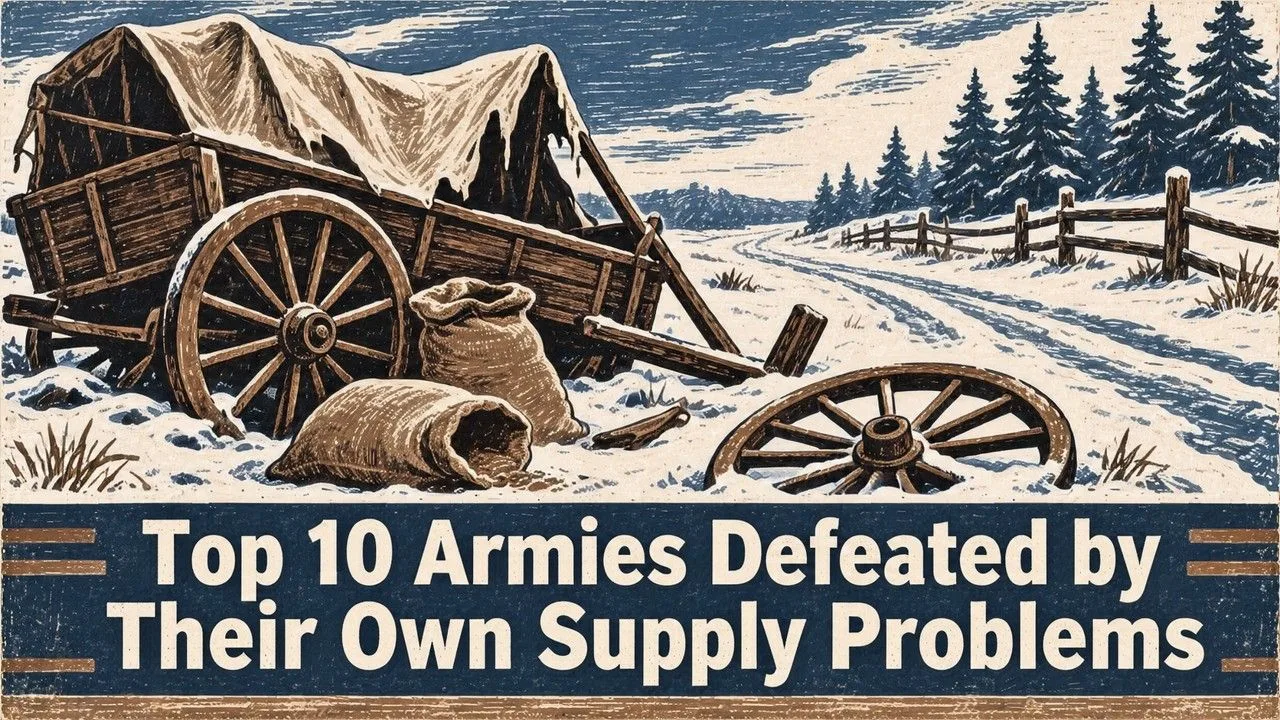
From Napoleon's march on Moscow to the fall of Stalingrad, these ten armies were beaten less by a final charge than by hunger, thirst and broken supply lines. A campaign can look irresistible on a map and still fail if bread, water, powder and fodder cannot keep up with the men who need them.
Generals have always known that an army marches on its stomach, yet ambition, poor roads, weather and over-long routes have repeatedly cancelled that lesson. In some of the cases below a commander cut himself off from his magazines on purpose, hoping to live off the country. In others the enemy deliberately burned crops, blocked roads or simply waited until hunger did the work of a pitched battle.
This Finepedia list keeps to the first half of that story: field armies and garrisons that were undone by their own lack of supplies, not by a formal plan to starve a city from the outside. The ten campaigns run from classical Sicily to the Second World War. Where published figures disagree, the range is given rather than a single neat number.
Key Facts
The table below gives a quick overview of all ten entries before each one is described in detail.
| # | Campaign | Year | Commander | Where it broke down | Outcome |
|---|---|---|---|---|---|
| 1 | Napoleon's march on Moscow | 1812 | Napoleon I | Forage and winter on the long road into Russia | Grande Armée shattered |
| 2 | The German Sixth Army at Stalingrad | 1942–1943 | Friedrich Paulus | Failed airlift after encirclement | Army destroyed, remnants captured |
| 3 | The Athenian invasion of Sicily | 415–413 BC | Nicias, later with Demosthenes | A distant fleet cut off from home supplies | Expedition destroyed at Syracuse |
| 4 | The British retreat from Kabul | 1842 | William Elphinstone | Winter march without food, fuel or a promised escort | Column almost annihilated |
| 5 | Charles XII and the road to Poltava | 1708–1709 | Charles XII of Sweden | A lost supply column and a starving winter in Ukraine | Defeat at Poltava, flight into exile |
| 6 | Mark Antony in Media Atropatene | 36 BC | Mark Antony | Siege train lost, then a hungry retreat | Heavy losses, campaign abandoned |
| 7 | The Horns of Hattin | 1187 | Guy of Lusignan | Army cut off from water in the July heat | Crusader field army destroyed |
| 8 | The siege of Kut | 1915–1916 | Charles Townshend | A river garrison starved after relief failed | Surrender of the 6th Division |
| 9 | Imphal and Kohima | 1944 | Renya Mutaguchi | A monsoon offensive that outran its own rations | Japanese Fifteenth Army broken |
| 10 | Burgoyne's Saratoga campaign | 1777 | John Burgoyne | A Hudson Valley advance cut off from Canada | British army surrendered |
1. Napoleon's march on Moscow
In June 1812 Napoleon led the Grande Armée across the Neman River into the Russian Empire. Contemporary and later tallies disagree on the exact headcount, but historians generally put the first wave at well over 400,000 men, with further formations bringing the numbers committed to the campaign close to 600,000.[1][2] The invasion force was then the largest army Europe had ever seen. It was also far too large for the poor roads and thin farms of western Russia to feed once the Russians refused a quick decisive battle and fell back, emptying the country as they went.
Napoleon did reach Moscow in September, after the bloody stalemate at Borodino, but the city was soon in flames and offered little food or shelter. With winter closing in and no Russian surrender forthcoming, the retreat began in October. Horses died first, then wagons were abandoned, and the remaining food could not be hauled. Disease and cold killed far more men than formal combat.[2]
Encyclopaedia Britannica estimates that of roughly 612,000 men who entered Russia during the campaign, only about 112,000 recrossed the frontier, and that deaths from illness and weather dwarfed those killed in action.[2] Other historians use slightly different opening and closing figures, but they agree on the shape of the disaster: the army was destroyed as a fighting force by distance, hunger and climate long before the last rear-guard actions were fought.
2. The German Sixth Army at Stalingrad
In the summer of 1942 the German Sixth Army, under General Friedrich Paulus, drove towards Stalingrad (now Volgograd) on the Volga. Street fighting through the autumn wore the formation down, and on 19 November the Red Army opened Operation Uranus against the weaker flanking forces. Within days Paulus's army, and parts of the Fourth Panzer Army, were cut off in a pocket west of the river.[3][4]
Adolf Hitler forbade a break-out and promised that the Luftwaffe would keep the pocket fed and armed from the air. The airlift never came close to the daily tonnage of food, fuel and ammunition a trapped field army required, and winter weather, limited airfields and mounting losses among transport aircraft made the shortfall worse week by week.[3] By late January the pocket was starving, short of ammunition and split into smaller fragments.
Related: Top 10 Most Lopsided Battles in History
Paulus surrendered on 31 January 1943; the last German positions in the northern pocket gave up on 2 February. Britannica records that about 91,000 men went into captivity, of whom only some 5,000 to 6,000 ever returned home, and that total Axis losses in the campaign ran to more than 800,000 dead, wounded, missing or captured.[4] Stalingrad is often called a turning point of the war on the Eastern Front. It was also a textbook case of an army held in place until its supplies failed.
3. The Athenian invasion of Sicily
In 415 BC Athens sent a great fleet and army against Syracuse, the leading Greek city of Sicily, hoping to cut grain routes and open a new western front in the long war with Sparta. Thucydides, the principal surviving source, presents the expedition as huge by the standards of the city-state world, and as poorly thought through from the start. The talented general Alcibiades was recalled almost immediately to face charges at home and defected; command fell chiefly to the cautious Nicias.[5][6]
Athens was more than a thousand kilometres from the siege lines. Every reinforcement, every replacement mast and every shipment of food had to come by sea, while Syracuse received help from Sparta and Corinth, including the general Gylippus. A first attempt to wall off the city failed. When Demosthenes arrived with a relief force in 413 BC, a night attack on the heights of Epipolae went badly wrong, and the Athenians at last tried to leave. Their retreat was delayed, their beached ships were smashed in the harbour, and the remnants were hunted down on the run inland.[5]
Few of the men who had sailed from the Piraeus ever saw it again. Many of the survivors were penned in the stone quarries of Syracuse, where thirst and disease finished the work that battle had begun. The loss of the fleet broke Athens's aura of naval invincibility and shifted the wider Peloponnesian War against it. Distance, hesitation and a supply line that ran the length of the Ionian crossing had done as much as Syracusan spears.[6]
4. The British retreat from Kabul
After a revolt in Kabul in late 1841, Major-General William Elphinstone agreed to withdraw his garrison towards Jalalabad. In January 1842 about 4,500 British and Indian troops, together with some 12,000 camp followers, marched out of the city on the promise of a safe passage, food and fuel for the mountain crossing. The escort, the rations and the fuel did not appear.[7][8]
Junior officers urged Elphinstone to turn back and occupy the strong Bala Hissar citadel while there was still time. He ordered the column onwards instead. In deep snow, and under constant attack from the heights, the march became a running disaster. Long-barrelled jezails outranged many of the garrison's muskets, stragglers were cut off, and there was almost nothing left to eat or burn for warmth.[7]
The last organised stand was made at the Gandamak Pass. The National Army Museum records that only a few troops escaped that final killing ground, and that just one European, the army surgeon Dr William Brydon, reached Jalalabad. Other British survivors were those already held as hostages, including Elphinstone, who died in captivity later that spring. It remains one of the worst military disasters of nineteenth-century Britain, and it began with a withdrawal that had no supplies behind it.[7][8]
5. Charles XII and the road to Poltava
Charles XII of Sweden spent the first years of the Great Northern War winning battles against Denmark, Poland and Saxony. In 1708 he turned east against Peter the Great of Russia, taking a relatively small, highly trained army deep into a country whose ruler was prepared to burn farms rather than feed an invader. A vital Swedish supply column under General Adam Lewenhaupt was intercepted and largely destroyed at Lesnaya in October 1708, stripping Charles of much of the powder, food and clothing he needed for a winter campaign.[9][10]
Related: Stalingrad Was a Major Turning Point
The king then swung south into Ukraine, hoping for help from the Cossack leader Ivan Mazepa. The winter of 1708–1709 was exceptionally severe. By the time Charles laid siege to the small fortress of Poltava, his army was lean, short of powder and missing many of the guns lost with the baggage. Charles himself was wounded in the foot shortly before the main battle and could not command in the usual way.[11]
On 8 July 1709 (27 June in the Swedish calendar then in use) Peter's larger, better-supplied army shattered the Swedes outside Poltava. Charles fled south to Ottoman territory with a small party. The battle ended Sweden's run as the great power of the Baltic and showed, like Napoleon's later march, how a winter without magazines can undo a famous army.[11][10]
6. Mark Antony in Media Atropatene
In 36 BC Mark Antony, then the Roman ruler of the east, marched against the Parthian Empire through Armenia into Media Atropatene, in what is now north-western Iran. He was in a hurry to match the glory of earlier eastern campaigns and pushed ahead of his slow-moving siege train. The Parthians fell on that baggage, capturing or destroying the engines Antony needed to take the fortified city of Phraaspa. The siege stalled, and autumn was coming on.[12][13]
The retreat that followed was the real disaster. Antony had to lead his men back through difficult country with the Parthian horse pressing the column, little remaining food, and no prospect of a quick rescue. Ancient writers, chiefly Plutarch, give very high figures for the dead on the return march; modern historians treat the exact totals with caution, but they agree that the losses were severe and that hunger and exposure did as much damage as enemy arrows.[12]
The failure in Atropatene weakened Antony politically as well as militarily. It left him dependent on his Armenian allies, cost him veteran troops he could not easily replace, and handed his rival Octavian a useful contrast between a careful war in the west and a hungry fiasco in the east. The campaign is an early lesson in what happens when a commander outruns the wagons that make a siege possible.[13]
7. The Horns of Hattin
In the summer of 1187 Saladin, sultan of Egypt and Syria, raided into the Kingdom of Jerusalem and took the town of Tiberias. King Guy of Lusignan, pressed by hard-line nobles and by the Grand Master of the Templars, marched a large crusader army east from the springs of Sephoria to relieve the town. The July heat in Galilee is fierce, and the route he chose left the army poorly watered as it moved towards the hills known as the Horns of Hattin, above the Sea of Galilee.[14][15]
Related: Top 10 Notable Friendly Fire Incidents in Military History
Saladin's forces harassed the column, set fire to the dry grass and held the wells. By the morning of 4 July the crusader army was exhausted, thirsty and crowded onto the two rocky hills. A charge by the mounted knights could not break the ring. The True Cross, carried as a battle standard, was captured, King Guy was taken prisoner, and most of the army was killed or captured. Many of the surviving Templars and Hospitallers were later put to death.[15]
With the field army gone, the kingdom's castles and cities could not be held. Jerusalem itself surrendered on 2 October 1187. Hattin is often told as a story of rash counsel and lost piety, but its immediate cause was simpler: an army marched away from its water in midsummer and was brought to battle before it could drink.[14]
8. The siege of Kut
After a costly fight at Ctesiphon in November 1915, Major-General Charles Townshend pulled the British and Indian 6th (Poona) Division back to the town of Kut-al-Amara on a loop of the Tigris. Ottoman forces closed round the town on 7 December. Townshend at first kept his men on full rations, expecting a relief column to arrive within weeks. The relief force, under Lieutenant-General Fenton Aylmer and later other commanders, failed in a series of attacks through the winter and spring, at very heavy cost.[16][17]
Inside Kut the rations shrank from plenty to bare adequacy and then to starvation. An Imperial War Museums account of the Mesopotamia campaign records Townshend's own later summary: seven weeks of plenty, ten weeks of shrinking adequacy, and four weeks of hunger. Attempts to send food up river, including a last effort by the steamer Julnar, did not break through, and the small amounts flown in by aircraft were nowhere near enough.[16]
On 29 April 1916 the garrison surrendered. Most modern summaries put the number of soldiers who went into Ottoman captivity at about 13,000, including several thousand British and more than 10,000 Indian troops, though a few unit narratives give slightly lower figures for those who marched out.[17] Large numbers later died on the march to prison camps. Townshend himself was held in relative comfort. Kut became a byword in Britain for a campaign that had advanced farther than its supplies, or its river transport, could support.
9. Imphal and Kohima
In March 1944 Lieutenant-General Renya Mutaguchi sent the Japanese Fifteenth Army across the Chindwin into north-east India. The plan, named U-Go, was to seize the British supply base at Imphal on the Manipur plain and cut the road to the railhead at Dimapur by taking the ridge village of Kohima. Mutaguchi counted on a quick victory and on captured Allied stocks to feed his men. He did not get either.[18][19]
British and Indian troops of the Fourteenth Army, supplied from the air once the roads were cut, held both positions. At Kohima a small garrison endured close fighting, including the famous struggle around the district commissioner's tennis court, until relief arrived in April. At Imphal four Indian divisions held a wide ring against repeated attacks. By the time the Kohima–Imphal road was reopened on 22 June, the monsoon had broken and the Japanese, still short of food, were trying to fight in the hills with almost no remaining transport.[18]
Related: Top 10 Inventions That Changed Warfare: Chariots to Drones
When the Fifteenth Army finally pulled back in July 1944, it had suffered what the Imperial War Museums calls the greatest defeat yet inflicted on the Japanese army, with "upwards of 50,000" casualties, most of them from starvation and disease rather than from a single climactic charge.[18] A second IWM account of the same battles puts Japanese losses at almost 60,000 dead and wounded. The precise total is still argued, but the cause is not: the offensive had been launched farther than its supply columns, or the captured depots it never took, could ever have sustained.
10. Burgoyne's Saratoga campaign
In 1777 General John Burgoyne led a British army south from Canada down the Lake Champlain–Hudson corridor, intending to meet other British forces and cut New England off from the rest of the rebellious colonies. The plan looked neat on paper. In practice the column depended on a long, vulnerable line back to Canada, on wilderness roads that wagons could barely use, and on a hoped-for advance up the Hudson from New York that never arrived.[20][21]
American forces delayed him at Fort Ticonderoga's aftermath, at Bennington, where a Hessian foraging column was mauled, and then in the woods around Saratoga. Two battles followed, at Freeman's Farm on 19 September and at Bemis Heights on 7 October. Burgoyne could not break the American lines, could not feed his army where it stood, and could not retreat north without abandoning his wounded and his remaining stores.[20]
On 17 October 1777 he surrendered the remnants of his army to Horatio Gates. The U.S. National Park Service, which now cares for the battlefield, still describes the result as a crucial American victory that renewed the patriot cause and helped to secure foreign recognition, above all from France.[21] Saratoga is remembered for Arnold's charge and for Morgan's riflemen, but it was also a campaign that simply ran out of road, food and friends.
Conclusion
Taken together, these ten campaigns show the same pattern in very different landscapes. An army stretches its line of magazines, or trusts that it can live off a country that has already been emptied, or marches away from water and forage in the hope of a short, sharp success. When the gamble fails, hunger and thirst finish the fighting more efficiently than any pursuit.
The list is also a reminder to read military history from the wagon train backwards. For related Finepedia reading, see Top 10 Planned Invasions That Never Happened and Top 10 Battles the British Empire Lost, which pick up other ways ambitious campaigns have come apart.
- ^ [1] "French invasion of Russia". Wikipedia. Wikipedia
- ^ [2] "French invasion of Russia". Encyclopaedia Britannica. Encyclopaedia Britannica
- ^ [3] "Battle of Stalingrad". Wikipedia. Wikipedia
- ^ [4] "Battle of Stalingrad". Encyclopaedia Britannica. Encyclopaedia Britannica
- ^ [5] "Sicilian Expedition". Wikipedia. Wikipedia
- ^ [6] "Peloponnesian War". Encyclopaedia Britannica. Encyclopaedia Britannica
- ^ [7] "First Afghan War". National Army Museum. National Army Museum
- ^ [8] "1842 retreat from Kabul". Wikipedia. Wikipedia
- ^ [9] "Charles XII". Wikipedia. Wikipedia
- ^ [10] "Battle of Poltava". Wikipedia. Wikipedia
- ^ [11] "Battle of Poltava". Encyclopaedia Britannica. Encyclopaedia Britannica
- ^ [12] "Antony's Atropatene campaign". Wikipedia. Wikipedia
- ^ [13] "Mark Antony". Encyclopaedia Britannica. Encyclopaedia Britannica
- ^ [14] "Battle of Hattin". Wikipedia. Wikipedia
- ^ [15] "Battle of Ḥaṭṭīn". Encyclopaedia Britannica. Encyclopaedia Britannica
- ^ [16] "Voices of the First World War: Mesopotamia". Imperial War Museums. Imperial War Museums
- ^ [17] "Siege of Kut". Wikipedia. Wikipedia
- ^ [18] "Burma Campaign". Imperial War Museums. Imperial War Museums
- ^ [19] "Battle of Imphal". Wikipedia. Wikipedia
- ^ [20] "Battles of Saratoga". Wikipedia. Wikipedia
- ^ [21] "History and Culture". Saratoga National Historical Park, U.S. National Park Service. U.S. National Park Service





















Discussion
Log in with