











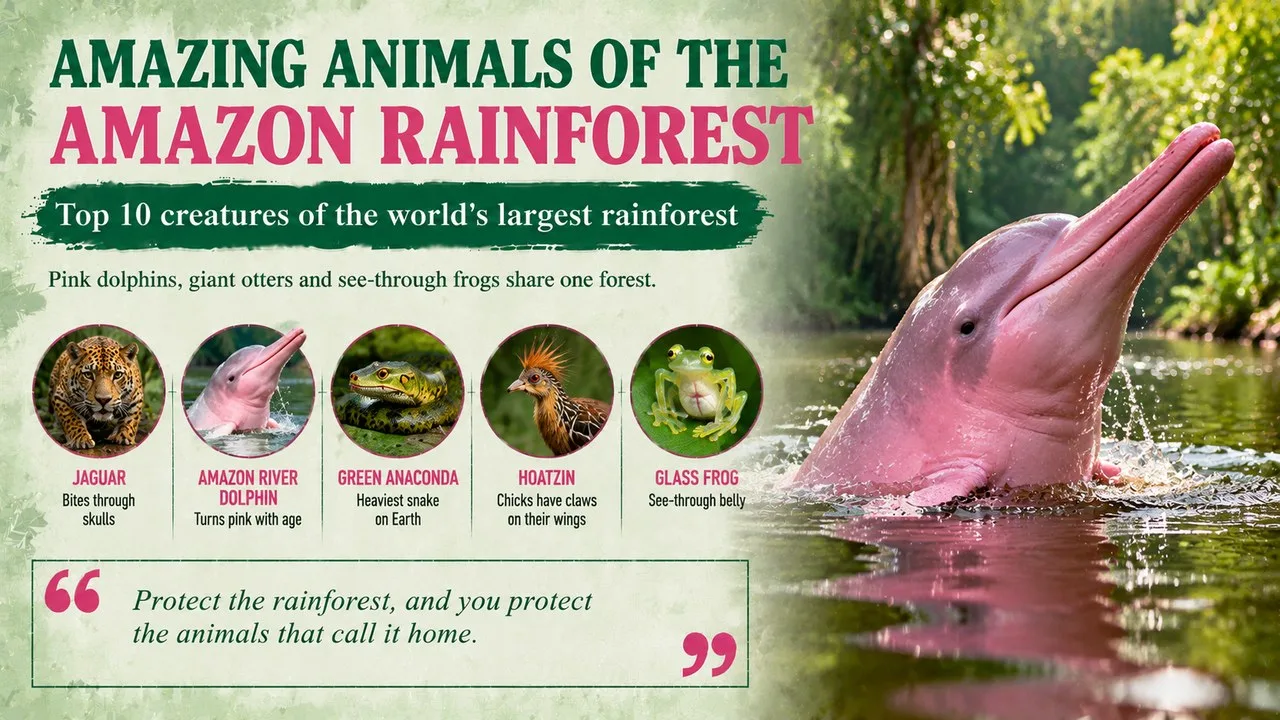
Amazing animals of the Amazon rainforest include a pink river dolphin, the heaviest snake on Earth and a frog so see-through that its heart can be seen.
This Finepedia guide, written in October 2026, introduces 10 remarkable animals of the Amazon, the largest tropical rainforest on Earth. We checked each animal against conservation groups, scientific studies and reference works, and we note IUCN Red List status where it applies. Sizes are typical figures or recorded maximums as of October 2026. For more wildlife, see the Finepedia guides Slowest Animals on Earth: Top 10 and Colourful Parrots of the World: Top 10.
How We Chose These
The Amazon covers about 6 million square km of rainforest spread over nine countries, with Brazil holding about 60 percent. We chose ten animals that show off its variety: big predators, river giants, odd birds and strange insects. We left out the sloth, piranha and electric eel, which already appear in other Finepedia guides. Each animal has a short profile, four key facts and a further note on why it matters or a surprising detail.
The 10 Amazon Animals at a Glance
| No. | Animal | Group | Size | Standout fact |
|---|---|---|---|---|
| 1 | Jaguar | mammal | up to about 1.85 m long | bites through skulls |
| 2 | Amazon river dolphin | mammal | up to about 2.5 m | turns pink with age |
| 3 | Giant otter | mammal | up to 1.8 m | longest of all weasel relatives |
| 4 | Green anaconda | reptile | females often over 4 m | heaviest snake on Earth |
| 5 | Arapaima | fish | up to about 3 m | gulps air at the surface |
| 6 | Harpy eagle | bird | females up to about 9 kg | snatches sloths from trees |
| 7 | Toco toucan | bird | about 56 cm | bill works as a radiator |
| 8 | Hoatzin | bird | about 65 cm | chicks have claws on their wings |
| 9 | Glass frog | amphibian | mostly 2 to 3 cm | see-through belly |
| 10 | Peanut-headed lanternfly | insect | up to about 9 cm | fake lizard head |
1. The Jaguar Is the Amazon's Top Cat
No cat in the Americas is bigger than the jaguar, and worldwide only lions and tigers outsize it. It is a strong swimmer and often hunts along rivers, taking caimans, turtles, capybaras and fish. Most jaguars have golden coats with dark rosettes, but some are almost black.
Key Facts
- Species: Panthera onca
- Size: body up to about 1.85 m, weight up to about 158 kg
- Status: near threatened, according to the IUCN
- Range: from Mexico to northern Argentina, with the Amazon as a stronghold
Why It Matters
The jaguar has an unusually powerful bite for its size. Instead of strangling prey like many big cats, it often kills with a bite that punches through the back of the skull, and it can crack open turtle shells. As a top predator, it helps keep populations of plant-eating animals in balance, so healthy jaguar numbers are a sign of a healthy forest.
2. The Amazon River Dolphin Turns Pink
The Amazon river dolphin, also called the boto, lives in the rivers and flooded forests of the Amazon and the Orinoco. It is the largest of the river dolphins. Young botos are grey, but many adults, especially males, turn pink, partly through scarring from fights and play.
Key Facts
- Species: Inia geoffrensis
- Size: males up to about 2.5 m and 185 kg
- Status: listed as endangered by the IUCN
- Diet: dozens of kinds of fish, plus crabs and turtles
Did You Know?
Unlike ocean dolphins, the boto has neck bones that are not fused, so it can turn its head from side to side. This, along with large flippers, helps it weave between tree trunks when the forest floods. In local folklore, the boto can change into a handsome young man, called an encantado, who comes ashore to charm people at festivals.
3. The Giant Otter Is a River Wolf
No member of the weasel family is longer than the giant otter, which can measure 1.8 m from nose to tail. It lives in family groups of about three to eight animals that fish, rest and defend their stretch of river together. In Spanish it is sometimes called the river wolf.
Key Facts
- Species: Pteronura brasiliensis
- Length: up to 1.8 m
- Status: an IUCN endangered species
- Diet: mainly fish, especially catfish and characins
Why It Matters
Giant otters were hunted heavily for their velvety fur in the middle of the 20th century, and numbers crashed. Hunting is now banned, but they still face threats from mining, overfishing and habitat loss. They are the noisiest of all otters, using a range of calls to warn, threaten or reassure one another.
4. The Green Anaconda Is the Heaviest Snake
The green anaconda lives in the swamps, slow rivers and flooded grasslands of tropical South America, including the Amazon. It is mostly aquatic, lying in wait with only its eyes and nostrils above the surface. It is not venomous; it kills by wrapping its body around prey and squeezing.
Key Facts
- Species: Eunectes murinus
- Rank: heaviest snake in the world
- Size: females grow far bigger than males, whose average is about 3 m
- Weight: typical adults about 30 to 80 kg
Did You Know?
The reticulated python of Asia can grow slightly longer, but the green anaconda is far bulkier. A 5.2 m anaconda weighs about as much as a 7.4 m python. Reports of anacondas 11 to 12 m long have never been confirmed.
5. The Arapaima Breathes Air
The arapaima, also called pirarucu or paiche, is one of the largest freshwater fish in the world. It lives in the Amazon and nearby river basins. Its name in Portuguese comes from Tupi words meaning red fish, after the red markings near its tail.
Key Facts
- Genus: Arapaima
- Size: usually over 2 m, with a record of about 3 m
- Weight: recorded up to about 200 kg
- Status: data deficient on the IUCN Red List
Why It Matters
The arapaima must come up to the surface every few minutes to gulp air, which lets it survive in warm, low-oxygen water. It also makes it easy for fishers to find, and it was badly overfished. Community-managed fisheries in Brazil, where locals count the fish when they rise to breathe and set catch limits, have helped arapaima numbers recover in some areas.
6. The Harpy Eagle Hunts in the Treetops
The harpy eagle is one of the largest and most powerful eagles in the world. It hunts in the upper canopy of lowland rainforest, swooping between trees to grab sloths and monkeys from branches. Females outweigh males by a wide margin, usually at 6 to 9 kg.
Key Facts
- Species: Harpia harpyja
- Weight: females about 6 to 9 kg
- Status: rated vulnerable on the IUCN Red List
- Symbol: national bird of Panama
Did You Know?
The harpy eagle can carry prey weighing about half of its own body weight. It is named after the harpies, the winged spirits of Greek myth. The species is most common in Brazil, and pairs raise just one chick every two to three years, which makes them slow to recover from losses.
7. The Toco Toucan Has a Giant Bill
The toco toucan is the largest of all toucans, with a glossy black body, white throat and a huge orange bill. It lives in open woodland and forest edges across much of South America, including parts of the Amazon basin. It feeds mainly on fruit but also takes insects, eggs and nestlings.
Key Facts
- Species: Ramphastos toco
- Length: about 56 cm on average
- Range: from the Guianas to northern Argentina
- Diet: mostly fruit
Why It Matters
The toco toucan's bill looks heavy but is light, built from a honeycomb of bone covered by keratin. Research has shown that it also works as a radiator. By sending more or less blood to the bill, the toucan can shed or keep body heat. As it swallows fruit and passes the seeds, it also helps to spread forest trees.
8. The Hoatzin Looks Like a Living Fossil
The hoatzin is a pheasant-sized bird with a blue face, maroon eyes and a spiky orange crest. It lives in swamps and riverside forests along the Amazon and Orinoco rivers. It is the only living member of its family, and scientists still argue about where it fits in the bird family tree.
Key Facts
- Species: Opisthocomus hoazin
- Length: about 65 cm
- Diet: mainly leaves
- Symbol: national bird of Guyana
Did You Know?
Young hoatzins carry a pair of claws on every wing. If a predator attacks, they plunge into the water below the nest, swim away and then use the claws to climb back up. Adults digest leaves by fermenting them in an enlarged crop, as cows do in their stomachs, which gives the bird a smell like manure and its nickname, stinkbird.
9. The Glass Frog Is See-Through
Glass frogs are small, mostly lime-green frogs found in rainforest from Central America down through South America, the Amazon included. In many species, the skin of the belly is transparent, so the heart, liver and gut can be seen from below. They usually live in trees along streams.
Key Facts
- Family: Centrolenidae
- Size: most species about 2 to 3 cm long
- Habitat: trees and leaves over forest streams
- Parenting: males of many species guard the eggs
Why It Matters
A 2022 study found that sleeping glass frogs hide most of their red blood cells in their liver, which makes them up to two or three times more transparent. Packing blood this way would cause dangerous clots in most animals, so researchers are studying the frogs for clues that could help human medicine.
10. The Peanut-Headed Lanternfly Wears a Disguise
The peanut-headed lanternfly is a large planthopper found in tropical forests from Mexico to South America, including the Amazon. The front of its head swells into a hollow, peanut-shaped bump painted with fake eyes and teeth, making it look like the head of a small lizard or alligator.
Key Facts
- Species: Fulgora laternaria
- Length: about 8.5 to 9 cm
- Wingspan: up to about 15 cm
- Diet: sap sucked from trees
Did You Know?
When the lanternfly is disturbed, it flashes large yellow eyespots on its back wings and can release a bad smell. Early naturalists wrongly believed that its head glowed in the dark, which gave it the name lanternfly. Despite local legends, it is harmless to people and does not have a dangerous bite.
Frequently Asked Questions
How many animal species live in the Amazon?
Nobody knows exactly. Scientists have described thousands of fish, birds, mammals, reptiles and amphibians from the region, and millions of insects may live there. The forest also holds an estimated 390 billion trees of about 16,000 species, and new species are still described every year.
Which Amazon animals are most at risk?
Several are threatened. The Amazon river dolphin and giant otter are listed as endangered, and the harpy eagle as vulnerable. Forest clearing, fires, dams, mining and illegal hunting are the main pressures.
Conclusion
From the jaguar to a tiny see-through frog, these ten animals show why the Amazon is one of the richest places for wildlife on the planet. Many depend on healthy rivers and unbroken forest, so protecting the rainforest protects them too. For more wildlife, read the Finepedia guides Slowest Animals on Earth: Top 10 and Colourful Parrots of the World: Top 10.
- IUCN Red List of Threatened Species, assessments for the jaguar, Amazon river dolphin, giant otter and harpy eagle.
- Taboada, C. and others, Glassfrogs conceal blood in their liver to maintain transparency, Science, 2022.
- Tattersall, G. and others, Heat exchange from the toucan bill reveals a controllable vascular thermal radiator, Science, 2009.
- Wikipedia (accessed October 2026), articles on the Amazon rainforest, Jaguar, Amazon river dolphin, Giant otter, Green anaconda, Arapaima, Harpy eagle, Toco toucan, Hoatzin, Glass frog and Fulgora laternaria.
- 10 Most Today, 10 Most Incredible Animals Found in Brazil's Amazon Rainforest, 10mosttoday.com (topic reference).

















Log in with