









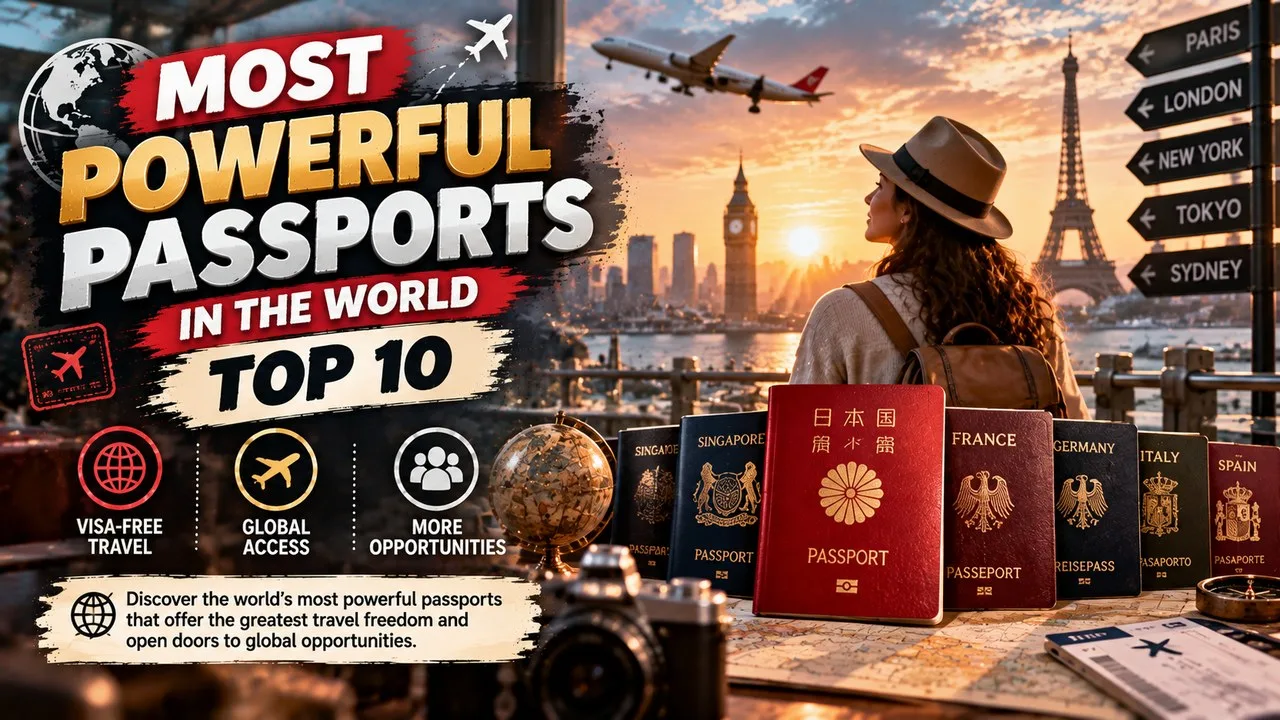
The most powerful passports in the world in October 2026 belong to Singapore, Japan, South Korea and the UAE, according to the Henley Passport Index.
A passport is more than a booklet with a photo page. It is a bundle of agreements that other governments have made with the country that issued it, and those agreements decide whether a holder can simply board a plane or must first queue at a consulate, pay fees and wait for approval. Measured that way, the gap between the strongest and weakest travel documents is enormous: a Singaporean can reach 193 destinations without arranging a visa in advance, while an Afghan passport holder can reach 22.
This Finepedia guide, written as of October 2026, explains which passports sit at the top of the latest Henley ranking, how the scores are calculated, where the method has limits and why the leaderboard keeps changing. Every rank and score below comes from the October 2026 edition of the index and its official data, checked against news coverage of the same release. Nothing has been estimated or rounded.
Passport power often tracks wider national influence, but not perfectly. Readers who want the bigger geopolitical picture can compare this list with Most Powerful Countries in the World: Top 10, which ranks nations by economic, military and diplomatic weight rather than travel access.
What Makes a Passport Powerful?
Passport power is a simple idea: the more places a citizen can visit without asking permission beforehand, the stronger the passport. In practice, the details of entry rules matter a great deal, and different indexes count them in different ways.
Visa-Free, Visa on Arrival and ETA
Henley & Partners, the residence and citizenship advisory firm that publishes the index, gives a passport one point for every destination its holders can enter without a visa issued before departure. That includes three situations:
- Visa-free entry, where an ordinary passport and the usual entry checks are enough
- Visa on arrival, where travellers collect a visa or visitor permit at the airport without any pre-departure government approval
- Electronic travel authorisation (ETA), a quick online clearance for visa-exempt visitors, such as the US ESTA, Canada's eTA or the UK's ETA
What Counts as Visa Required
A destination scores zero when a traditional visa is needed, when the traveller must obtain an e-Visa before departure, or when a so-called visa on arrival in fact needs pre-departure approval. Henley explains the ETA versus e-Visa distinction by effort: ETAs are usually processed automatically within minutes or hours, while e-Visas tend to involve manual review, supporting documents and waits of days or weeks.
The Limits of Any Passport Ranking
A high score is a measure of short-stay access, not a guarantee of entry. Border officers can still refuse admission, and the index assumes an adult citizen with a valid ordinary passport, travelling alone for tourism or business, arriving and leaving through the same major airport and meeting basic entry conditions such as proof of funds. It does not measure the right to work, study or settle abroad, and it does not weigh destinations by size or popularity, so access to a small island state counts the same as access to a large economy. Henley itself advises travellers to confirm visa rules with an embassy or travel agent before booking.
How We Ranked the Most Powerful Passports
Finepedia used the October 2026 edition of the Henley Passport Index, which covers 199 passports and 227 travel destinations and is updated monthly. Its core data comes from the Timatic database of the International Air Transport Association (IATA), the system airlines use to check travel documents, and is cross-checked by Henley's research team against government sources.
Scores are binary and unweighted, so a passport's total is simply the number of destinations reachable without a prior visa. Passports with the same total share a rank, and the next score down takes the next consecutive rank number. Statisticians call this dense ranking; Henley argues it prevents a one-point difference from looking like a large gap, but it also means that the index's top ten ranks contain 38 passports, not ten.
To turn that into a readable top ten, this article lists passports by Henley rank and then alphabetically within a tie. That gives Singapore first; Japan, South Korea and the United Arab Emirates (joint second); Sweden (third); and the first five of the eleven passports tied for fourth: Belgium, Denmark, Finland, France and Germany. The other six members of the fourth-place group, Ireland, Italy, Luxembourg, the Netherlands, Norway and Spain, have exactly the same score of 186 and are covered in their own section below. Alphabetical order inside a tie is a presentation choice, not a judgement that one passport is stronger.
Historical figures quoted for 2006 come from Henley's own published historical data. For a second opinion, the article also compares the results with the Arton Capital Passport Index, which uses a different method.
Most Powerful Passports at a Glance
| # | Passport | Henley rank (Oct 2026) | Destinations without a prior visa | Henley rank and score in 2006 |
|---|---|---|---|---|
| 1 | Singapore | 1 | 193 | 8th, 122 |
| 2 | Japan | 2 (joint) | 188 | 3rd, 128 |
| 3 | South Korea | 2 (joint) | 188 | 11th, 115 |
| 4 | United Arab Emirates | 2 (joint) | 188 | 62nd, 35 |
| 5 | Sweden | 3 | 187 | 2nd, 129 |
| 6 | Belgium | 4 (joint) | 186 | 4th, 127 |
| 7 | Denmark | 4 (joint) | 186 | 1st, 130 |
| 8 | Finland | 4 (joint) | 186 | 1st, 130 |
| 9 | France | 4 (joint) | 186 | 3rd, 128 |
| 10 | Germany | 4 (joint) | 186 | 2nd, 129 |
The Full Henley Top 10 Ranks in October 2026
Because of ties, the index's first ten rank positions hold far more than ten passports. The table below shows every passport in those positions so that no country is hidden by the shorter list.
| Henley rank | Passports | Score |
|---|---|---|
| 1 | Singapore | 193 |
| 2 | Japan, South Korea, United Arab Emirates | 188 |
| 3 | Sweden | 187 |
| 4 | Belgium, Denmark, Finland, France, Germany, Ireland, Italy, Luxembourg, Netherlands, Norway, Spain | 186 |
| 5 | Austria, Greece, Malta, Portugal, Switzerland | 185 |
| 6 | Hungary, Malaysia, Poland, United Kingdom | 184 |
| 7 | Australia, Canada, Czechia, Latvia, New Zealand, Slovakia, Slovenia | 183 |
| 8 | Croatia, Estonia | 182 |
| 9 | Liechtenstein, Lithuania | 181 |
| 10 | Iceland, United States | 180 |
Europe supplies most of the 38 passports in that group, yet four of the top five individual scores belong to Asian passports. The spread is also tight: the eleven passports in fourth place sit just seven destinations behind the leader.
1. Singapore
| Attribute | Details |
|---|---|
| Henley rank (October 2026) | 1st, alone at the top |
| Destinations without a prior visa | 193 of 227 |
| Henley rank in 2006 | 8th, with 122 destinations |
| Passport issuer | Immigration and Checkpoints Authority (ICA) |
| Validity | 10 years for citizens aged 16 and over (since October 2021) |
Background and History
Singapore is the clearest example of how a small state can build outsized travel access through diplomacy. When the Henley index launched in 2006, the city-state was eighth with 122 destinations. Twenty years later it holds first place on its own, and Henley's historical data puts it first or joint first in five of the six annual snapshots from 2021 to 2026.
The October 2026 score of 193 is one destination higher than the 192 reported in Henley's July 2026 release. That leaves a lead of five destinations over the three passports tied in second place, a wide margin at the very top of a ranking where many places are decided by a single point.
Key Features
- Highest score in the October 2026 index, five clear of the nearest rivals
- Mutual 30-day visa exemption with China for ordinary passport holders since 9 February 2024
- Member of the US Visa Waiver Program, so short visits to the United States need only ESTA approval
- Adult passports now last ten years, up from five, for applications made from 1 October 2021
- Strong access across Asia, Europe and the Americas without pre-departure visas
Significance
Singapore shows that passport strength is built on relationships rather than size. With no large military or vast territory, it is widely seen as relying on stable governance, secure documents and open trade, qualities that make other governments comfortable waiving visas for its citizens. Henley's July 2026 analysis noted that Singapore ranks 8th on the Global Peace Index and 1st on the passport index, an example of the link between stability and mobility.
For Singaporeans, the practical effect is that most holiday and business trips need little more than a valid passport, a return ticket and, in some countries, a quick online authorisation.
Interesting Facts
- Singapore climbed seven places between 2006 and 2026 while adding 71 destinations to its score
- Its lead of 171 destinations over Afghanistan, the lowest-ranked passport, is even wider than the record 170-destination gap Henley reported in July 2026
- ICA kept the passport application fee at S$70 when it doubled adult validity in 2021, reversing a 2005 cut from ten to five years made when biometric passports arrived
- Singapore is one of only four non-European passports in the index's top five rank positions
2. Japan
| Attribute | Details |
|---|---|
| Henley rank (October 2026) | 2nd, shared with South Korea and the UAE |
| Destinations without a prior visa | 188 of 227 |
| Henley rank in 2006 | 3rd, with 128 destinations |
| Passport issuer | Ministry of Foreign Affairs of Japan |
| Design | 2020 passport featuring Hokusai woodblock prints of Mount Fuji |
Background and History
Japan has spent the whole history of the index near the summit. It was third in 2006 and, according to Henley's annual data, held or shared first place every year from 2018 to 2024, before Singapore moved clear. In January 2026 Japan and South Korea were reported joint second with 188 destinations each, and that score is unchanged in the October edition.
Japan's strong showing rests on decades of reciprocal visa waivers with Europe, North America and much of Asia, built up through its long-standing role as a major economy and trading partner.
Key Features
- Joint second place with 188 destinations in October 2026
- Member of the US Visa Waiver Program and visa-exempt for short stays in the Schengen Area
- New passport design issued from 4 February 2020, with Hokusai's Thirty-Six Views of Mount Fuji on the visa pages
- Upgraded IC chip in the 2020 passport to resist illicit reading of personal data
- Five-year and ten-year booklets, with different numbers of Hokusai designs in each
Significance
Japan's rank shows how soft power and administrative trust translate into mobility. The country rarely makes headlines for visa diplomacy, yet its passport has been at or near the top for two decades. Henley's July 2026 peace analysis listed Japan among countries that lead both the Global Peace Index and the passport index.
Its five-point gap behind Singapore is a reminder that even top passports can lose access when partners tighten rules. Japan's score dropped from 193 in Henley's 2025 data to 188 by January 2026, showing that rankings depend on other countries' policies as much as on Japan's own.
Interesting Facts
- Every pair of facing visa pages in the 2020 passport shows a different Mount Fuji print, a design chosen partly because it makes forgery harder
- The ten-year passport uses 24 Hokusai prints and the five-year version uses 16
- Other design ideas considered included cranes, cherry blossoms and seasonal festivals
- Japan was part of a six-way tie for first place in Henley's 2024 data, with 194 destinations
3. South Korea
| Attribute | Details |
|---|---|
| Henley rank (October 2026) | 2nd, shared with Japan and the UAE |
| Destinations without a prior visa | 188 of 227 |
| Henley rank in 2006 | 11th, with 115 destinations |
| Passport issuer | Ministry of Foreign Affairs of the Republic of Korea |
| Current design | Navy-blue next-generation e-passport, issued since 21 December 2021 |
Background and History
South Korea's passport has risen steadily since the index began. In 2006 it was 11th with 115 destinations; it reached third place by 2014 and has spent most of the last decade in the top three. Its October 2026 score of 188 puts it level with Japan and the UAE.
The rise mirrors South Korea's growth into a major exporter, technology hub and cultural force. Visa-waiver arrangements with the Schengen Area and the United States, plus agreements with many other partners, have steadily widened access for Korean travellers.
Key Features
- Joint second place with 188 destinations
- Next-generation e-passport introduced on 21 December 2021, replacing the familiar green cover with navy blue
- Data page made of polycarbonate with laser-engraved personal details instead of paper
- Resident registration number removed from the passport to protect personal data
- Visa Waiver Program member for short trips to the United States
Significance
South Korea is one of the most striking climbers among wealthy democracies. Henley's July 2026 analysis noted that it ranks 57th on the Global Peace Index yet 2nd on the passport index, a sign that diplomatic and economic ties can matter more than peace scores alone.
For Korean citizens, the passport opens most of the world's major tourist and business destinations without consular visits, which supports the country's large outbound travel market and its globally active companies.
Interesting Facts
- South Korea gained 73 destinations between 2006 and 2026
- The 2021 redesign added traditional Korean motifs to the visa pages
- The polycarbonate data page is far harder to alter than the old paper page
- South Korea has never ranked lower than 3rd in Henley's annual data since 2018
4. United Arab Emirates
| Attribute | Details |
|---|---|
| Henley rank (October 2026) | 2nd, shared with Japan and South Korea |
| Destinations without a prior visa | 188 of 227 |
| Henley rank in 2006 | 62nd, with 35 destinations |
| Change since 2006 | 153 destinations added, the largest gain in the index's history |
| Arton Capital 2026 | 1st, with a mobility score of 182 |
Background and History
No passport has transformed its standing like the Emirati one. In 2006 it sat 62nd with access to just 35 destinations. By 2016 it was 38th with 122, and in July 2026 Henley reported that it had climbed three places since January to join Japan and South Korea in second, a position it holds in the October edition.
Henley describes the UAE's 153-destination gain over two decades as the greatest improvement recorded by any passport and credits sustained diplomatic engagement and international cooperation. A major step came in May 2015, when the European Union began applying a short-stay visa waiver that lets Emirati citizens visit the Schengen Area for up to 90 days in any 180-day period.
Key Features
- Joint second place on Henley with 188 destinations
- First place on the Arton Capital Passport Index in 2026, with a mobility score of 182
- Visa-free short stays in the Schengen Area since 6 May 2015
- Biggest 20-year climber in the history of the Henley index
- Not part of the US Visa Waiver Program, so Emiratis still need a US visa for most trips
Significance
The UAE proves that passport power is not fixed by history. Through a deliberate strategy of visa-waiver deals, it moved from the middle of the table to the top tier within one generation. It is also the passport on which the two leading indexes disagree most sharply: Henley ranks it joint second, while Arton Capital ranks it first. One likely reason is method: Arton counts quick-issue e-Visas that Henley treats as visa required.
Henley's July 2026 analysis placed the UAE 73rd on the Global Peace Index but 2nd on the passport index, another case where diplomacy has outweighed regional instability in shaping travel access.
Interesting Facts
- The UAE's score has risen more than fivefold since 2006, from 35 to 188
- It moved from 5th in January 2026 to joint 2nd by July 2026
- Arton Capital has ranked the Emirati passport first since 2018
- Under the EU waiver, Emirati visitors may stay up to 90 days in any 180-day period
5. Sweden
| Attribute | Details |
|---|---|
| Henley rank (October 2026) | 3rd, the only passport at that rank |
| Destinations without a prior visa | 187 of 227 |
| Henley rank in 2006 | 2nd, with 129 destinations |
| Passport issuer | Swedish Police Authority (Polisen) |
| Validity | 5 years for holders aged 12 and over; 3 years for younger children |
Background and History
Sweden is the strongest European passport in the October 2026 index, one destination ahead of the eleven European countries tied for fourth. It has been a fixture of the leading group since the index began: second in 2006, and first or joint first in Henley's 2011, 2013 and 2014 data.
As a member of the European Union since 1995 and of the Schengen Area since 2001, Sweden benefits from the bloc's collective visa agreements. Its one-destination edge over its neighbours comes down to individual bilateral differences in the destinations' own rules.
Key Features
- Sole third place in October 2026 with 187 destinations
- Highest-scoring passport in Europe in the latest edition
- Passports and national ID cards issued by the Swedish Police Authority
- Short adult validity of five years, compared with ten years in many other countries
- Free movement rights across the EU and passport-free travel within the Schengen Area
Significance
Sweden shows that a single destination can separate ranks at the top of the index. Its one-point edge over Denmark, Finland and Norway is real but small, and it could disappear with one policy change by another country. Even so, its record across twenty years makes it one of the most consistently powerful passports in the world.
Nordic cooperation has long eased travel in the region. The Nordic Passport Union, formed in the 1950s, allowed citizens of the Nordic countries to travel between them without passports decades before Schengen.
Interesting Facts
- Sweden gained 58 destinations between 2006 and 2026
- Children under 12 receive passports valid for only three years
- Sweden was ranked first in Henley's 2011 data with 173 destinations
- It is the only passport holding Henley's third place in October 2026
6. Belgium
| Attribute | Details |
|---|---|
| Henley rank (October 2026) | 4th, shared with ten other European passports |
| Destinations without a prior visa | 186 of 227 |
| Henley rank in 2006 | 4th, with 127 destinations |
| Passport issuer | FPS Foreign Affairs, with applications through local municipalities |
| Validity | 7 years for adults, 5 years for minors |
Background and History
Belgium has stayed close to the top throughout the index's history. It was fourth in 2006 with 127 destinations and is fourth again in 2026, now with 186. Brussels hosts the main institutions of the European Union, and Belgium was among the five countries that signed the original Schengen Agreement in 1985.
The country's passport received a major security upgrade in February 2022. Working with anti-fraud specialists from the federal police, the foreign ministry introduced a booklet with 48 security features, twice as many as the previous version.
Key Features
- Joint fourth place with 186 destinations
- New passport available from 7 February 2022, with 34 pages
- Fourteen Belgian comic characters printed throughout the booklet, including Tintin, the Smurfs and Lucky Luke
- Hidden UV details and a two-dimensional data matrix on the back of the data page
- Seven-year validity for adults, longer than Sweden's but shorter than many ten-year passports
Significance
Belgium's position reflects the collective strength of EU and Schengen passports, which share many of the same visa waivers. Its comic-themed booklet also shows how passports can carry national identity while serving as security documents: the illustrations exist partly to hide anti-forgery features.
Because Belgian residents can travel within most of Europe using a national electronic identity card, the passport is mainly needed for trips further afield, where its 186-destination reach makes a real difference.
Interesting Facts
- The comic images in the 2022 passport were donated free by publishers and rights holders
- Some security details are hidden in illustrations, including the leg of Tintin's rocket on the back of the booklet
- Belgium issued more than 600,000 passports in a typical pre-pandemic year
- Belgium has stayed in Henley's top seven ranks in every annual edition since 2006
7. Denmark
| Attribute | Details |
|---|---|
| Henley rank (October 2026) | 4th, shared with ten other European passports |
| Destinations without a prior visa | 186 of 227 |
| Henley rank in 2006 | Joint 1st, with 130 destinations |
| Validity | 10 years for adults aged 18 and over |
| Index note | Henley treats Greenland and the Faroe Islands as having Denmark's visa policy |
Background and History
When the Henley index was first published in 2006, Denmark shared first place with Finland and the United States, each with access to 130 destinations. It remained in the top group through the following decade and is joint fourth in October 2026 with 186.
Denmark joined the European Communities in 1973 and the Schengen Area in 2001. Like its Nordic neighbours, it combines EU free movement with a long tradition of open travel within the region.
Key Features
- Joint fourth place with 186 destinations
- One of the three original joint leaders of the index in 2006
- Ten-year adult passport validity
- Visa Waiver Program member and part of the Schengen Area
- Greenland and the Faroe Islands follow Danish visa policy in Henley's method
Significance
Denmark's journey from first place to joint fourth illustrates a key trend: European passports have not weakened so much as other countries have caught up. Denmark's score rose by 56 destinations over twenty years, yet Asian passports and the UAE climbed faster.
Henley's July 2026 analysis listed Denmark among nations that perform strongly on both the Global Peace Index and the passport index. Readers interested in how stability shapes national rankings can explore Most Peaceful Countries in the World: Top 10.
Interesting Facts
- Denmark was a joint leader in the very first Henley index
- It ranked first or joint first in Henley's 2006, 2007, 2008, 2009, 2011 and 2012 data
- Danish citizens can live and work across the EU thanks to free movement rules
- Denmark's score of 186 is identical to those of ten other European passports
8. Finland
| Attribute | Details |
|---|---|
| Henley rank (October 2026) | 4th, shared with ten other European passports |
| Destinations without a prior visa | 186 of 227 |
| Henley rank in 2006 | Joint 1st, with 130 destinations |
| Passport issuer | Finnish Police |
| Current design | Archipelago Sea theme, issued since 13 March 2023 |
Background and History
Finland shared the very first top spot in 2006 and has never left the leading group since. Henley's annual data shows it first or joint first in 2011, 2013 and 2014, and it ranked third as recently as 2025 before settling into the eleven-way tie for fourth.
Finland joined the European Union in 1995 and the Schengen Area in 2001. Its passport is issued by the police, and the most recent redesign, introduced in March 2023, replaced an earlier layout that featured a famous moose flip-book animation.
Key Features
- Joint fourth place with 186 destinations
- Joint first in the original 2006 index alongside Denmark and the United States
- 2023 passport themed on the Finnish Archipelago Sea, with a grey seal flip-book animation
- Two-dimensional barcode added to the new passport and ID card layouts
- EU free movement plus Schengen passport-free travel
Significance
Finland's strong passport sits alongside a reputation for reliable public institutions. Henley's July 2026 analysis named Finland among the countries that lead both the Global Peace Index and the passport index.
Its playful design touches also show that security documents can carry a sense of national character, with flip-book animations that come alive when the pages are fanned.
Interesting Facts
- Flipping the pages of the previous Finnish passport made a moose appear to walk
- The 2023 version swaps the moose for a grey seal
- Finland's score rose by 56 destinations between 2006 and 2026
- Finland is one of three Nordic passports tied in fourth place, with Denmark and Norway
9. France
| Attribute | Details |
|---|---|
| Henley rank (October 2026) | 4th, shared with ten other European passports |
| Destinations without a prior visa | 186 of 227 |
| Henley rank in 2006 | 3rd, with 128 destinations |
| Passport production | Agence nationale des titres sécurisés (ANTS) |
| Validity | 10 years for adults, 5 years for minors |
Background and History
France has been part of the leading group since the index began, ranking third in 2006. Its best recent result came in 2024, when it was one of six passports, along with Germany, Italy, Japan, Singapore and Spain, tied for first place with access to 194 destinations.
As a founding member of the European Economic Community and one of the original Schengen signatories, France benefits from Europe's collective visa diplomacy as well as its own extensive network of embassies around the world.
Key Features
- Joint fourth place with 186 destinations
- Joint first place in the 2024 index with 194 destinations
- Ten-year adult biometric passport
- Original 1985 Schengen signatory and founding EEC member
- Free movement rights across the EU and passport-free travel within the Schengen Area
Significance
France is the clearest European example of diplomacy outweighing other factors. Henley's July 2026 analysis pointed out that France ranks 99th on the Global Peace Index, largely because that index includes militarisation and external conflict, yet shares fourth place on the passport index. Henley attributes the gap to Schengen membership, European integration and extensive diplomatic and economic ties.
For French travellers, a strong passport supports one of the world's busiest outbound travel markets, from short city breaks to long-haul business trips.
Interesting Facts
- France was joint first in Henley's 2024 data with 194 destinations
- The country gained 58 destinations between 2006 and 2026
- Minors' passports last five years, half the adult validity
- France's score is identical to Spain's and Italy's in October 2026
10. Germany
| Attribute | Details |
|---|---|
| Henley rank (October 2026) | 4th, shared with ten other European passports |
| Destinations without a prior visa | 186 of 227 |
| Henley rank in 2006 | 2nd, with 129 destinations |
| Best recent run | 1st in Henley's 2014 to 2017 data, and joint 1st in 2024 |
| Validity | 10 years for holders aged 24 and over; 6 years under 24 |
Background and History
Germany has a strong claim to being the most consistently powerful passport of the index's first decade. It ranked second in 2006, then first or joint first in each year from 2014 to 2017, scoring 177 destinations in 2016. In 2024 it was part of the six-way tie for first place at 194.
West Germany was a founding member of the European Economic Community and signed the original Schengen Agreement in 1985. Reunified Germany is now the EU's largest economy, which gives its citizens considerable diplomatic weight abroad.
Key Features
- Joint fourth place with 186 destinations
- Henley's leader for four consecutive years in the mid-2010s
- Ten-year biometric passport for adults aged 24 and over
- Passports cannot be extended; holders must apply for a new one when it expires
- Visa Waiver Program member and part of the Schengen Area
Significance
Germany's slide from sole leader to joint fourth is less about lost access than about the rise of Asian and Gulf passports. Its score is nine destinations higher than in 2016, yet it now shares fourth place because rivals improved even faster.
Germany completes this list of the most powerful passports, but it is not the end of the story in Europe: six more European passports share exactly the same score.
Interesting Facts
- Germany ranked first in Henley's 2016 data with 177 destinations
- Its passport validity depends on the holder's age, with a shorter period for people under 24
- Germany's score rose by 57 destinations between 2006 and 2026
- It is one of eleven European passports on 186 destinations
The Rest of the Fourth-Place Group
Six passports share fourth place with Belgium, Denmark, Finland, France and Germany, each with access to 186 destinations. They are equally powerful by Henley's measure and sit outside the numbered list only because of alphabetical order.
- Ireland: outside the Schengen Area but part of the Common Travel Area with the United Kingdom
- Italy: joint first in the 2024 index with 194 destinations
- Luxembourg: one of the five original Schengen signatories, with the agreement signed in the Luxembourg village of Schengen
- Netherlands: a founding EEC member and Schengen signatory
- Norway: not in the EU, but a member of the Schengen Area through its association agreement
- Spain: joint first in the 2024 index and joint second in Arton Capital's 2026 index
How the Henley and Arton Indexes Compare
Henley is the best-known passport ranking, but not the only one. The Arton Capital Passport Index uses its own data and a different scoring rule, which explains why some countries move up or down when the two lists are compared.
| Feature | Henley Passport Index | Arton Capital Passport Index |
|---|---|---|
| Main data source | IATA Timatic, supplemented by Henley research | Official government sources, updated in real time |
| Destinations counted | 227 | 199 (193 UN members plus 6 territories) |
| e-Visas | Counted as visa required | Counted if issued within three working days |
| Tie handling | Equal scores share a rank | Ties broken using the UN Human Development Index |
| 2026 leader | Singapore (193 in October) | United Arab Emirates (score 182) |
Arton's July 2026 coverage placed France and Spain jointly second and a large European group, plus Singapore and Malaysia, jointly third, with Japan and South Korea in the fourth group. The differences mostly come from e-Visas and from the number of destinations each index tracks. Neither list is wrong; they answer slightly different questions about what counts as easy travel.
Why Passport Power Keeps Shifting
Global mobility has grown dramatically since 2006. Henley's July 2026 release reported that the average passport now offers visa-free access to 108 destinations, up from 58 when the index launched. At the same time, the gap between the top and bottom has widened: in 2006 it was 118 destinations, and in October 2026 it is 171.
Asia and the Gulf Rise
Singapore, Japan, South Korea and the UAE now occupy the top four individual scores, and Malaysia has joined the sixth-place group. Asia's rise reflects decades of economic growth, regional visa deals and reciprocal agreements with Europe. The UAE's climb shows how deliberate visa diplomacy can lift a passport within a single generation.
The US and UK Slip
The United States and United Kingdom jointly held first place in 2014. In October 2026 the UK is sixth with 184 and the US tenth with 180. Henley's January 2026 report said both countries recorded their steepest annual losses during 2025, and noted that the US briefly fell out of the top ten in late 2025 before returning. The UK has since gained visa-free access to China and Malawi.
Peace, Diplomacy and Partnership
Henley's July 2026 analysis found a strong positive relationship between the Global Peace Index and passport power, with a Spearman rank correlation of 0.65. Exceptions such as the United States, France, South Korea and the UAE show that diplomatic ties and economic weight can outweigh peace scores. Wealth and wellbeing also tend to cluster with strong passports, as seen in Happiest Countries in the World: Top 10 Ranked (2026).
Where India Stands
India sits 84th in October 2026, sharing that rank with Algeria and Mauritania, with access to 55 destinations without a prior visa. That is one place higher than in October 2025, although the destination count fell from 57 to 55, showing how ranks and scores can move in opposite directions.
Practical Tips for Travellers
A strong passport makes planning easier, but it does not remove every requirement. Travellers holding even the most powerful passports should keep a few rules in mind.
- Check entry rules for every trip, because waivers can change with little notice
- Apply for any required ETA, such as ESTA for the United States or the UK ETA, well before departure
- Make sure the passport is valid for the period the destination requires, often several months beyond the trip
- Remember that visa-free stays are usually limited to tourism or short business visits, not work
- Carry proof of onward travel and funds when a destination asks for it
Budget-minded travellers can combine these steps with the advice in Ways Smart Travelers Save Money Abroad: Top 10, while safety-conscious readers may want to review Most Dangerous Tourist Destinations in the World: Top 10 before choosing where to go.
Frequently Asked Questions
Which country has the most powerful passport in 2026?
Singapore has the most powerful passport in the October 2026 Henley Passport Index, with access to 193 destinations without a prior visa. Japan, South Korea and the United Arab Emirates share second place on 188. On the Arton Capital Passport Index, which uses a different method, the UAE ranks first with a mobility score of 182.
How is passport power measured?
The Henley Passport Index gives a passport one point for each destination its holders can enter without a visa issued before departure, including visa on arrival and electronic travel authorisations. Scores are not weighted. Data comes from IATA Timatic and is checked by Henley's research team, and the index is updated every month.
Why do so many countries share the same rank?
Henley gives the same rank to passports with identical scores and then uses the next consecutive number for the following score. Because many European passports share similar visa waivers, large ties are common. In October 2026 eleven passports share fourth place and 38 passports occupy the top ten rank positions.
Where does the US passport rank in 2026?
The United States passport is tenth in the October 2026 Henley Passport Index, sharing the rank with Iceland, with access to 180 destinations. In 2006 the US shared first place with Denmark and Finland. Henley reported that the US briefly dropped out of the top ten in late 2025 before returning.
Where does the Indian passport rank?
India is 84th in the October 2026 Henley Passport Index, sharing the position with Algeria and Mauritania. Indian passport holders can visit 55 destinations without a prior visa. The rank improved by one place from October 2025, although the number of destinations fell from 57 to 55.
Does a powerful passport guarantee entry?
No. A passport ranking measures short-stay access under ordinary conditions. Border officials can still refuse entry, and travellers must meet requirements such as passport validity, proof of funds or onward tickets. Visa-free access rarely allows paid work. Always check current entry rules with the destination's embassy or official government website before travelling.
Conclusion
The most powerful passports in the world in 2026 tell a story of change. Singapore leads alone with 193 destinations, Japan, South Korea and the UAE share second, Sweden stands third, and a large European group fills fourth place. Twenty years ago the United States, Denmark and Finland shared the top spot; today Asia and the Gulf set the pace. Because one policy change can shift a rank, the order will keep moving, but the lesson is constant: passport power reflects the trust and partnerships that other nations extend to a country.
- Henley & Partners, Henley Passport Index global ranking and official index data (October 2026): https://www.henleyglobal.com/passport-index/ranking
- Henley & Partners, Henley Passport Index methodology: https://www.henleyglobal.com/passport-index/methodology
- Henley & Partners, press release, 21 July 2026, Passport Power Doubles as Global Peace Declines: https://www.henleyglobal.com/newsroom/press-releases/henley-passport-index-20th-anniversary
- Henley & Partners, press release, 13 January 2026, A Growing Passport Divide Reshapes Global Mobility in 2026: https://www.henleyglobal.com/newsroom/press-releases/henley-global-mobility-report-january-2026
- Business Today, Top 10 strongest passports in the world 2026 (October 2026 edition): https://www.businesstoday.in/nri/story/top-10-strongest-passports-in-the-world-2026-singapore-leads-japan-and-uae-rank-second-561661-2026-10-15
- CNBC TV18, Henley Passport Index 2026: India improves its rank: https://www.cnbctv18.com/photos/travel/india-henley-passport-ranking-improves-in-2026-which-countries-lead-most-visa-free-destinations-20013003.htm
- Gulf News, UAE passport ranked world's strongest again in 2026 index (Arton Capital): https://gulfnews.com/uae/uae-passport-ranked-worlds-strongest-again-in-2026-index-1.500618837
- Immigration and Checkpoints Authority of Singapore, 10-year passport validity from October 2021: https://www.ica.gov.sg/news-and-publications/newsroom/media-release/singapore-passports-with-increased-validity-period-of-10-years-from-october-2021
- Immigration and Checkpoints Authority of Singapore, mutual 30-day visa exemption with China: https://www.ica.gov.sg/news-and-publications/newsroom/media-release/mutual-30-day-visa-exemption-arrangement-between-singapore-and-the-people-s-republic-of-china
- Ministry of Foreign Affairs of Japan, Diplomatic Bluebook 2021, new passport design: https://www.mofa.go.jp/policy/other/bluebook/2021/en_html/chapter5/c050202.html
- Kyodo News, Japan to begin issuing new passports featuring ukiyo-e: https://english.kyodonews.net/articles/-/15536
- Ministry of Foreign Affairs of the Republic of Korea, next-generation e-passport issuance from 21 December 2021: https://www.mofa.go.kr/www/brd/m_4080/view.do?seq=371764
- EUR-Lex, Agreement between the European Union and the United Arab Emirates on the short-stay visa waiver: https://eur-lex.europa.eu/legal-content/EN/TXT/PDF/?uri=CELEX%3A22015A0521%2801%29
- Swedish Police Authority, passports and national ID cards: https://polisen.se/en/services-and-permits/passport-and-national-id-card/
- FPS Foreign Affairs Belgium, A more secure passport full of comic book heroes: https://diplomatie.belgium.be/en/policy/policy-areas/highlighted/more-secure-passport-full-comic-book-heroes
- Finnish Police, passport and ID card layouts updated: https://poliisi.fi/en/-/passport-and-id-card-layouts-updated
- Yle, new Finnish passports and ID cards with an Archipelago Sea theme (in Finnish): https://yle.fi/a/74-20019911
- Federal Foreign Office of Germany, passport for adults: https://www.germany.info/us-en/service/02-passportsandidcards/passport-adult-951294
- Service Public France, passport of an adult: https://www.service-public.fr/particuliers/vosdroits/F35154/0_0_0_0?lang=en
- Borger.dk, apply for or renew a Danish passport: https://www.borger.dk/transport-trafik-rejser/pas/ansoeg-om-eller-forny-dansk-pas
- Reference topic: 10mosttoday, The 10 Most Powerful Passports in the World (2019): https://10mosttoday.com/the-10-most-powerful-passports-in-the-world/

















Log in with