







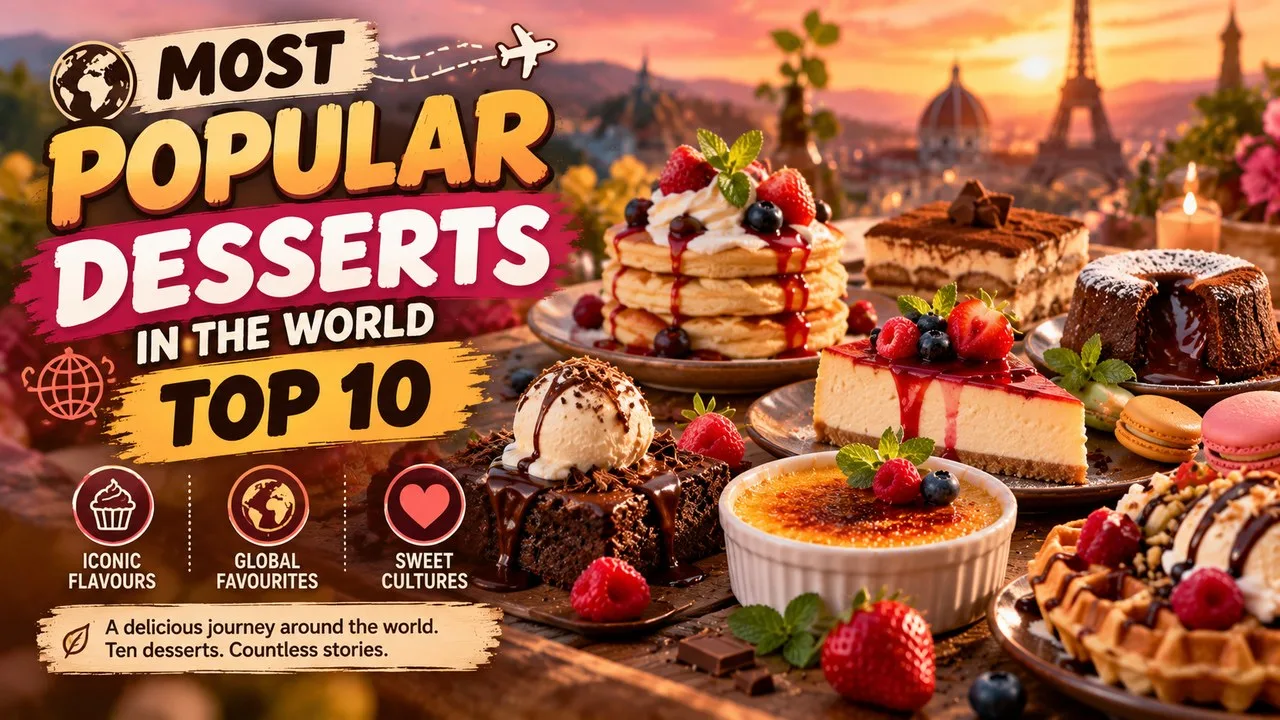
The most popular desserts in the world, led by baklava, mochi and the mooncake, are sweets whose fame rests on centuries of written history and ritual.
A dessert becomes world famous for more than taste. The sweets that travel furthest usually carry a story with them: a palace kitchen, a festival, a teenage apprentice, a disputed recipe or a ritual repeated every year for a thousand years. Those stories keep a pastry on menus long after fashions change.
This Finepedia listicle, written as of October 2026, ranks ten of the best-known desserts on Earth with a published scorecard instead of personal taste. Each entry explains where the dessert really comes from, what makes it distinctive, why it matters to the culture that made it, and which popular stories about it are true, doubtful or plainly legend.
How We Ranked the Most Popular Desserts in the World
Popularity is hard to measure directly, because there is no global sales table for homemade sweets. Finepedia therefore combined one measurable signal of worldwide recognition with three judgements that can be checked against the historical record. Each dessert was scored out of 25.
- Global recognition (up to 10 points): the number of Wikipedia language editions with an article on the dessert, read from Wikidata in October 2026, divided by eight and rounded; a dessert covered in 80 languages scores 10
- Documented history (up to 5 points): the age of the earliest reliable written record of the dessert or its direct ancestor; 5 for before 1500, 4 for 1500 to 1799, 3 for the 19th century, 2 for 1900 to 1949, and 1 for 1950 onwards
- Cultural standing (up to 5 points): 5 for a formal designation such as a protected name, a legal food standard or a starring role in a public holiday; 4 for a dessert widely treated as a national symbol without formal status; 3 for a celebrated national or regional classic
- Signature technique (up to 5 points): an editorial score for how distinctive the method is, from hand-stretched pastry to pounded rice and torched sugar
- Entry rule: at least 30 Wikipedia language editions, and an origin story that could be checked in at least two serious sources
- Tiebreaks: first the language-edition count, then the older written record
Fifteen candidates were scored. They included classics often named in world-dessert roundups, such as pavlova, the Nanaimo bar, the Indonesian dadar gulung and the Austrian Kardinalschnitte, plus every specific dessert covered in 50 or more languages. Broad families such as ice cream, cake, halva and doughnuts were left out as categories rather than single desserts.
Most Popular Desserts in the World at a Glance
| # | Dessert | Associated with | Earliest firm record | Score (of 25) |
|---|---|---|---|---|
| 1 | Baklava | Ottoman, Levantine, Balkan and Caucasian kitchens | 15th century | 25 |
| 2 | Mochi | Japan | Late 8th century | 22 |
| 3 | Mooncake | China and East Asia | Song dynasty (960 to 1279) | 20 |
| 4 | Jalebi | South Asia, Iran and the Arab world | 10th century (as zalabiya) | 19 |
| 5 | Sachertorte | Vienna, Austria | 1832 (traditional date) | 19 |
| 6 | Tiramisu | Northeastern Italy | 1959 | 18 |
| 7 | Cheesecake | Ancient Greece and Rome, later England and the US | 2nd century BC | 18 |
| 8 | Gulab jamun | India, Pakistan, Bangladesh and Nepal | Mughal era (traditional dating) | 18 |
| 9 | Apple pie | England, later the United States | About 1390 | 18 |
| 10 | Crème brûlée | France and England | 1691 | 18 |
Readers interested in the wider world of food may also enjoy Biggest Fast Food Chains in the World: Top 10, Most Unhealthy Foods: Top 10 to Limit and Better Swaps and Why We Love Coffee: 10 Reasons Behind the World&.
1. Baklava
| Attribute | Details |
|---|---|
| Type | Layered filo pastry with chopped nuts, soaked in syrup or honey |
| Associated regions | Turkey, Greece, the Levant, the Balkans, the Caucasus, Iran and North Africa |
| Earliest firm record | A poem by the 15th-century mystic Kaygusuz Abdal |
| Key ingredients | Filo sheets, butter, walnuts or pistachios, sugar syrup or honey |
| Score | 25 of 25: recognition 10 (80 languages), history 5, culture 5, technique 5 |
Origins/History
No single country can fully claim baklava, and that shared ownership is part of its fame. Food historians trace possible ancestors to several places: the honeyed layered cakes of the ancient Greek and Roman world, the Byzantine pastry koptoplakous, nut-filled sweets wrapped in paper-thin dough in medieval Arabic cookbooks, and the layered breads of Central Asian Turkic peoples. The oldest known use of the name itself comes from a poem by the 15th-century mystic Kaygusuz Abdal, and the word reached English in 1650 through Ottoman Turkish.
The version most people know today was refined in the Ottoman imperial kitchens of Topkapı Palace in Istanbul. Palace tradition included a ceremony known as the Baklava Alayı, in which trays of baklava were sent to the Janissary troops in the middle of Ramadan. From the Ottoman world the pastry spread, or was shared, across a huge area, and Greeks, Armenians, Arabs, Azerbaijanis and Persians all developed their own styles.
Key Features
- Thirty to forty sheets of filo are typical, according to Britannica, each brushed with melted butter
- Fillings are usually walnuts or pistachios, with almonds or hazelnuts in some regions
- The tray is cut into diamonds or squares before baking, then soaked in syrup while hot
- Syrups may be flavoured with lemon, rosewater, orange blossom water, cinnamon or cardamom
Significance
Baklava sits at the centre of celebrations across a dozen cuisines, from Eid and Nowruz tables to Christmas and Easter in Greek and Armenian homes. In Greece and Armenia some cooks link the number of layers to Christian symbolism, such as 33 sheets for the years of Christ's life. It is also one of the few desserts with formal legal protection: in December 2013 the European Commission registered Antep Baklavası, or Gaziantep Baklavası, as a Protected Geographical Indication, the first Turkish product to receive that status. Gaziantep, the heart of Turkish pistachio growing, has been famous for baklava since the 1870s.
Interesting Facts
- The Turkish word for pistachio, antep fıstığı, borrows the name of Gaziantep, the city most associated with baklava
- Azerbaijan, Armenia, Syria and Algeria each have distinctive versions, from saffron-glazed layers to almond fillings and different doughs
- The tradition of making pakhlava in the Armenian town of Gavar is listed as national intangible cultural heritage in Armenia
2. Mochi
| Attribute | Details |
|---|---|
| Type | Rice cake made from pounded glutinous rice |
| Origin | Japan |
| Earliest firm record | A legend in the Bungo no kuni fudoki, compiled in the late 8th century |
| Key ingredients | Mochigome (short-grain glutinous rice), water; sugar and fillings in sweet versions |
| Score | 22 of 25: recognition 7 (53 languages), history 5, culture 5, technique 5 |
Origins/History
Mochi is far older than most desserts on this list, and for most of its history it was not sweet at all. Archaeology suggests home production grew from the 6th century, when earthenware steamers spread through Japanese households. A legend recorded in the Bungo no kuni fudoki, a provincial gazetteer of the late 8th century, tells of a rich man who shot an arrow at a round rice cake, which turned into a white bird and flew away, leaving his fields barren. The story shows that white mochi was already treated as something with spiritual power.
During the Heian period (794 to 1185) mochi appeared at Shinto rites for births and weddings, and the earliest accounts of mochi at New Year come from the same era. Samurai households later began the custom of kagami mochi, two stacked rounds topped with a bitter orange. Sweet mochi spread only from the 17th century onward, after contact with Portuguese confectionery raised the status of sugar, and it reached ordinary families once Japanese sugar production grew in the 18th and 19th centuries.
Key Features
- Made from mochigome, a glutinous rice very low in amylose, which gives the elastic chew
- Traditionally pounded with wooden mallets in a large mortar by two people working in rhythm
- Modern cooks often use sweet rice flour, cooked on the stove or in a microwave
- Sweet versions include daifuku filled with red bean paste and seasonal sakura mochi wrapped in a cherry leaf
Significance
Mochi is inseparable from the Japanese New Year. Families place kagami mochi on household altars at the end of December and break it open in the kagami biraki ceremony, traditionally on 11 January, while zōni soup with mochi is eaten on New Year's Day. Community mochitsuki pounding events still take place at shrines, temples and in rural areas. Outside Japan, mochi became an international dessert through mochi ice cream, popularised in the United States by the Japanese-American businesswoman Frances Hashimoto.
Interesting Facts
- Daifuku means "great luck", a pun on an older name meaning "big belly"
- Hishi mochi in red, white and green layers is offered for Girls' Day on 3 March
- Britannica notes that choking cases linked to New Year mochi are reported in Japan nearly every year, so small bites are advised for the elderly and children
3. Mooncake
| Attribute | Details |
|---|---|
| Type | Round or square pastry with a dense sweet filling |
| Origin | China, now eaten across East and Southeast Asia |
| Earliest firm record | Linked to the Mid-Autumn Festival from the Song dynasty (960 to 1279) |
| Key ingredients | Thin pastry, lotus seed or red bean paste, often salted duck egg yolk |
| Score | 20 of 25: recognition 6 (50 languages), history 5, culture 5, technique 4 |
Origins/History
The mooncake is the edible symbol of the Mid-Autumn Festival, held on the 15th day of the eighth month of the Chinese lunisolar calendar, when the harvest moon is at its fullest. Moon worship in autumn is very old in China, and the festival itself grew popular during the Tang dynasty. Folklore credits a Tang emperor with first sharing round cakes under the moon, but historians place the firm link between mooncakes and the festival in the Song dynasty.
A more famous story claims that rebels hid secret messages inside mooncakes to coordinate an uprising against the Mongol-led Yuan dynasty in the 14th century, helping to found the Ming. Britannica describes this role as alleged, and it is best read as a much-loved legend rather than documented history. What is certain is that mooncakes have been exchanged as gifts between families, friends and business partners for centuries.
Key Features
- A thin crust, about 2 to 3 millimetres thick in the Cantonese style, wrapped around a thick filling
- Lotus seed paste is the classic luxury filling; red bean, jujube and mixed nut fillings are also traditional
- A whole salted duck egg yolk in the centre represents the full moon; deluxe versions contain four
- Wooden or plastic moulds press decorative characters for longevity or harmony into the top
Significance
The Mid-Autumn Festival ranks among the most important dates in the Chinese calendar and is an official public holiday in mainland China and Taiwan, while Hong Kong and Macau take the following day off. Many people simply call it the Mooncake Festival. Boxes of mooncakes are the standard seasonal gift, which has turned the trade into a major annual business for bakeries and luxury hotels from Beijing to Singapore. Regional styles include Cantonese, Suzhou, Beijing, Shanghai and Yunnan versions, each with its own crust.
Interesting Facts
- Snow skin mooncakes, a Hong Kong invention, use a chilled glutinous rice wrapper instead of baked pastry
- Modern fillings range from durian and taro to chocolate and ice cream with a mango sorbet "yolk"
- Flaky Suzhou-style crusts are made by rolling oily dough and flour together in layers
4. Jalebi
| Attribute | Details |
|---|---|
| Type | Fried batter spirals soaked in sugar syrup |
| Associated regions | India, Pakistan, Bangladesh, Nepal, Afghanistan, Iran and the Arab world |
| Earliest firm record | Zalabiya recipes in the 10th-century Arabic cookbook Kitab al-Tabikh |
| Key ingredients | Fermented flour batter, oil or ghee, sugar syrup, saffron or rosewater |
| Score | 19 of 25: recognition 7 (57 languages), history 5, culture 3, technique 4 |
Origins/History
Jalebi has one of the best-documented histories of any street sweet. Its ancestor, zalabiya, appears in the Kitab al-Tabikh, a 10th-century Arabic cookbook compiled by Ibn Sayyar al-Warraq, which describes latticed fritters dipped in honey scented with rosewater. Another recipe appears in the 13th-century cookbook of Muhammad bin Hasan al-Baghdadi. According to the Hobson-Jobson dictionary of 1903, the Indian name comes from the Arabic zulabiya or the Persian zolbiya.
The sweet was established in India by the 15th century. A Jain text by the author Jinasura, written around 1450, mentions jalebi at a dinner given by a wealthy merchant, and the Sanskrit work Gunyagunabodhini, dated before 1600, lists ingredients that match the modern recipe. Over the following centuries it became one of the most common sweets of the subcontinent, while related forms survived in Iran as zoolbia and in North Africa and the Levant as zalabia.
Key Features
- Batter is piped freehand into hot oil in pretzel-like loops and spirals
- The hot coils are plunged into warm syrup so they turn crisp outside and juicy inside
- Indian jalebi is often bright orange or yellow; Afghan jalebi is usually thinner and uncoloured
- In North India it is eaten with rabri (thickened sweet milk) or yoghurt
Significance
Jalebi is a staple of weddings, festivals and breakfast stalls across South Asia. In Iran, zoolbia is a classic Ramadan sweet for breaking the fast, and in Azerbaijan the city of Ganja traditionally prepared it for Novruz, where its round shape echoed the equinox. The dessert scores 3 for cultural standing on Finepedia's scorecard because, despite its huge popularity, it has no formal national or legal designation. It is also a reminder of how far recipes travelled along medieval trade and pilgrimage routes.
Interesting Facts
- In Nepal the sweet is called jeri, a name popularly linked to the Mughal emperor Jahangir
- A khoya-based jalebi is credited to Harprasad Badkul of Jabalpur in 1889
- Some writers suggest the American funnel cake is a distant relative, carried by German emigrants
- In Pakistan, jalebi came second in the government's January 2019 Twitter poll for a national sweet
5. Sachertorte
| Attribute | Details |
|---|---|
| Type | Chocolate sponge cake with apricot jam and chocolate glaze |
| Origin | Vienna, Austria |
| Creator | Franz Sacher, traditionally dated to 1832 |
| Key ingredients | Butter, dark chocolate, eggs, sugar, flour, apricot jam |
| Score | 19 of 25: recognition 7 (55 languages), history 3, culture 5, technique 4 |
Origins/History
According to the Hotel Sacher, the story begins in 1832, when Prince Metternich's household asked for a special dessert and the head cook was ill. The 16-year-old apprentice Franz Sacher stepped in and produced the chocolate cake that now carries his name. The 1832 date rests mainly on statements made later by his son Eduard. In a 1906 newspaper interview Franz himself placed the invention in the 1840s, when he ran a business in Pressburg, now Bratislava, so food historians treat the exact year as uncertain.
The cake's reputation grew quickly. The cookbook writer Katharina Prato published an early recipe around 1867 or 1870, and Sachertorte was on the menu when Eduard opened the Hotel Sacher in 1876. By the late 1880s cakes were being sent to Paris, Berlin and London. In 1894 the dessert was defined in the Austrian food codex, which still sets the basic recipe today.
Key Features
- A dense chocolate sponge made with whipped egg whites folded in for lift
- A thin layer of apricot jam under the glaze, and between the layers in two-layer versions
- A glossy chocolate glaze poured over the top that sets to a fudge-like coat
- Served in Vienna with unsweetened whipped cream on the side
Significance
Few cakes have been fought over in court. After the Hotel Sacher ran into financial trouble in the 1930s, Eduard Sacher's son sold a version of the recipe to the Demel pastry shop, which began selling an "Eduard Sacher-Torte" in 1934. A long legal dispute over which cake was the original ended in 1963, and the hotel kept the right to the name "Original Sacher-Torte", while Demel sells "Demel's Sacher-Torte". The cake is now one of Vienna's most popular edible souvenirs, and the Original Sacher Torte Manufactory, opened in 1999, was producing about 360,000 cakes a year by 2007.
Interesting Facts
- The Hotel Sacher finishes its cake with a round chocolate seal, while Demel uses a triangular one
- Under the Austrian codex, a cake sold as Sachertorte must contain at least 15 percent chocolate by weight
- Its high butter content means a whole cake keeps well at room temperature
- Versions made with strawberry or raspberry jam exist in Vienna, but they cannot be sold as Sachertorte
6. Tiramisu
| Attribute | Details |
|---|---|
| Type | Chilled layered dessert of coffee-soaked biscuits and mascarpone cream |
| Origin | Northeastern Italy (Veneto and Friuli-Venezia Giulia) |
| Earliest firm record | A 1959 recipe from Tolmezzo in Friuli, according to Britannica |
| Key ingredients | Savoiardi (ladyfingers), espresso, egg yolks, sugar, mascarpone, cocoa |
| Score | 18 of 25: recognition 9 (70 languages), history 1, culture 5, technique 3 |
Origins/History
Tiramisu is the youngest dessert in this top ten, yet it is covered in more languages than any entry except baklava. Its name comes from the Italian tirami su, "pick me up", and it does not appear in cookbooks before the 1960s. Most food writers agree it grew out of sbatudin, a northeastern Italian treat of egg yolks beaten with sugar and served with biscuits.
Two regions claim the modern recipe. Accounts from the Le Beccherie restaurant in Treviso, in the Veneto, credit its pastry chef Roberto Linguanotto and Alba di Pillo, wife of the owner Ado Campeol, with creating it in 1969, and it joined the menu in 1972. Friuli-Venezia Giulia points to earlier evidence, including a 1959 recipe linked to Norma Pielli of Tolmezzo. Stories that the dish was a 19th-century Treviso brothel restorative or a 17th-century creation for a Tuscan grand duke are generally dismissed.
Key Features
- Savoiardi biscuits dipped briefly in strong coffee, sometimes with Marsala or liqueur
- A cream of egg yolks, sugar and mascarpone, often lightened with whipped egg white
- Layers repeated in a dish and chilled until set, then dusted with bitter cocoa
- The original Le Beccherie version was round; most modern versions are made in square pans
Significance
Tiramisu spread worldwide in the 1980s, helped by Italian restaurants abroad. A 1978 Sydney Morning Herald restaurant column already mentioned it, and the word entered an Italian dictionary in 1980 and English in 1982. In July 2017 Italy's agriculture ministry added tiramisu to the national list of traditional agri-food products for Friuli-Venezia Giulia, a decision officials in the Veneto rejected. It has become the standard Italian dessert on menus from Tokyo to Toronto, and countless versions now swap the coffee for fruit, chocolate or tea.
Interesting Facts
- In Venetian dialect the name is tireme sù
- Mascarpone in its modern form only became widely available in the early 20th century
- Ado Campeol and Alba di Pillo both died in 2021, and Roberto Linguanotto died in 2024
- In 2013 the president of the Veneto sought EU protection based on the original ingredients
7. Cheesecake
| Attribute | Details |
|---|---|
| Type | Baked or chilled dessert with a soft cheese filling over a crust |
| Associated regions | Ancient Greece and Rome, medieval England, today the US and Europe |
| Earliest firm record | Cato the Elder's recipes for libum and placenta, 2nd century BC |
| Key ingredients | Soft cheese (cream cheese, ricotta, quark), eggs, sugar, biscuit or pastry base |
| Score | 18 of 25: recognition 7 (52 languages), history 5, culture 3, technique 3 |
Origins/History
Cheese-filled cakes are among the oldest sweets in written history. Ancient Greek writers praised plakous, a layered cake made with cheese, flour and honey, and the scholar Athenaeus listed many cheese cakes in his Deipnosophistae, even noting four lost books on the art of making them. A popular claim that cheesecake was served to athletes at the first Olympic Games in 776 BC is often repeated, but it rests on tradition rather than surviving evidence. In Rome, Cato the Elder wrote down recipes for libum and placenta, cheese-and-flour cakes used both as food and as offerings to the gods.
Medieval England kept the idea alive. The Forme of Cury, compiled by the cooks of Richard II around 1390, includes cheese tarts such as tart de Bry, and the English word cheesecake appears in the 15th century. Over the 18th century cooks dropped yeast in favour of beaten eggs, moving the dessert towards its modern texture. The great modern leap came in the United States, where cream cheese, developed in 1872 by the dairyman William Lawrence of Chester, New York, became the base of the dense New York style.
Key Features
- The filling can be cream cheese, ricotta, quark, cottage cheese or mascarpone
- Baked versions set slowly in the oven; unbaked versions are set in the refrigerator
- Bases range from graham cracker or digestive biscuit crumbs to pastry or sponge
- Toppings include fruit sauces, sour cream, caramel, chocolate and fresh berries
Significance
Cheesecake has no single homeland, and that is its strength. Italy bakes ricotta cheesecakes, Germany and Poland use quark or twaróg, Japan has its famously light, soufflé-like cotton cheesecake, and the United States made New York cheesecake a diner and restaurant institution. The dessert scores 3 for cultural standing because no country holds it as a formal national symbol, but its global spread makes it one of the most recognisable desserts on any menu.
Interesting Facts
- The Roman libum was baked on bay leaves and offered at household shrines
- Some 17th-century English "cheesecakes", such as lemon versions, contained no cheese at all
- Hannah Woolley published a cheesecake recipe with currants and rosewater in 1664
8. Gulab Jamun
| Attribute | Details |
|---|---|
| Type | Fried milk-solid dumplings soaked in fragrant syrup |
| Associated regions | India, Pakistan, Bangladesh, Nepal and Myanmar |
| Earliest firm record | Traditionally dated to the Mughal era; no single founding text |
| Key ingredients | Khoya (reduced milk solids), flour, ghee, sugar syrup with cardamom and rosewater |
| Score | 18 of 25: recognition 6 (49 languages), history 4, culture 4, technique 4 |
Origins/History
Gulab jamun is usually traced to medieval India during the Mughal Empire, when Persian and Central Asian court cooking blended with local dairy traditions. Its name tells that story. Gulab comes from the Persian gul, flower, and ab, water, a reference to the rose-scented syrup, while jamun is the Hindustani name of the Java plum, a dark fruit of similar size and shape. Food writers often compare it with the medieval Arab fritter luqmat al-qadi, which was also soaked in rosewater syrup, although the batter is quite different.
Because there is no early cookbook entry that pins down a first recipe, Finepedia scores its documented history at 4 on the basis of this accepted Mughal-era dating. By the 19th century local variants were already well established. In Kolkata, the confectioner Bhim Chandra Nag created the related ledikeni, named in honour of Lady Canning, wife of the Governor-General of India from 1856 to 1862.
Key Features
- Khoya is made by simmering milk slowly until most of the water has evaporated
- The dough balls are fried gently in ghee or oil at a low temperature so the centre cooks through
- The browned balls are soaked in sugar syrup scented with cardamom, rosewater, kewra or saffron
- Kala jamun is a darker version in which sugar in the dough caramelises during frying
Significance
Gulab jamun is one of the most common sweets at Indian and Pakistani weddings, birthdays and festivals such as Diwali and Eid. In January 2019 the Government of Pakistan ran a poll on its official Twitter account asking for a national sweet, and gulab jamun won with 47 percent of about 15,000 votes, ahead of jalebi and barfi. The result is informal, which is why the dessert scores 4 rather than 5 for cultural standing. In Nepal the same sweet is called lal mohan and sells strongly during Tihar and Dashain.
Interesting Facts
- Warm gulab jamun is often served with vanilla ice cream or kulfi
- Many modern home recipes use milk powder instead of khoya
- In Bengal the related pantua and kalo jam are local favourites
- Rajasthan even has a savoury gulab jamun curry, cooked in a spiced tomato gravy
9. Apple Pie
| Attribute | Details |
|---|---|
| Type | Fruit pie with an apple filling in pastry |
| Origin | England; later a national symbol in the United States |
| Earliest firm record | A recipe in The Forme of Cury, about 1390 |
| Key ingredients | Apples, shortcrust pastry, sugar, cinnamon or nutmeg, butter |
| Score | 18 of 25: recognition 6 (44 languages), history 5, culture 4, technique 3 |
Origins/History
Apple pie is famous as an American icon, but its recorded history begins in England. The Forme of Cury, the late 14th-century recipe collection of Richard II's court, gives a pie of good apples, spices, figs, raisins and pears in a pastry case called a coffin, coloured with saffron. Many early recipes leaned on honey and dried fruit because sugar was expensive. A Dutch cookbook printed in Brussels in 1514 includes an appeltaerte, showing how widespread the idea already was in northern Europe.
European settlers carried apple pie to North America in the 17th and 18th centuries, although they first had to plant European apple trees, because the only native apples were small, sour crabapples. Two apple pie recipes appear in American Cookery by Amelia Simmons, published in 1796 and regarded as the first American cookbook. Over the next two centuries the pie became shorthand for home, comfort and national pride.
Key Features
- Sliced apples, often tart cooking varieties such as Bramley or Granny Smith, sweetened and spiced
- A shortcrust top and bottom, with the lid either solid or woven into a lattice
- Lattice tops were already in use in the 17th century
- Served with custard in Britain and à la mode, with ice cream, in the US
Significance
The phrase "as American as apple pie" turned a dish of English origin into a symbol of American identity. In the 19th and 20th centuries "mom and apple pie" became shorthand for Americana, and soldiers in both world wars were associated with the dessert in popular culture. Other countries keep strong apple pie traditions of their own, from Dutch appeltaart and Polish szarlotka to the French tarte Tatin, which is baked upside down.
Interesting Facts
- Serving apple pie with a slice of sharp cheddar is an old English habit that survives in New England
- The community of Pie Town in New Mexico takes its name from apple pie
- A 2016 US survey found that 19 percent of Americans preferred apple pie over all others
- Canada recorded a cheese-topped apple pie recipe in 1920 and has its own apple maple pie
10. Crème Brûlée
| Attribute | Details |
|---|---|
| Type | Baked custard with a hard layer of caramelised sugar |
| Associated regions | France and England; closely related to Spain's crema catalana |
| Earliest firm record | François Massialot's cookbook Le Cuisinier roïal et bourgeois, 1691 |
| Key ingredients | Egg yolks, cream or milk, sugar, vanilla |
| Score | 18 of 25: recognition 6 (44 languages), history 4, culture 3, technique 5 |
Origins/History
The earliest known recipe under the name crème brûlée appears in 1691 in Le Cuisinier roïal et bourgeois by François Massialot, a cook who served Philippe I, Duke of Orléans, brother of Louis XIV, and other leading nobles. Massialot's custard was made with egg yolks, milk and a little flour, then sugared on top and scorched with a red-hot fire shovel until it turned gold. The same book is also credited with the first appearance of meringues under that name.
The dessert's nationality has been debated ever since. An English translation of 1702 called it burnt cream, and a 1740 edition of Massialot labelled a similar dish English cream. Trinity College, Cambridge, served it from 1879 as Trinity cream, branding the college arms into the sugar with a hot iron. Spain's crema catalana is almost identical. After a long quiet period, crème brûlée became a restaurant sensation in the 1980s, helped by Sirio Maccioni's New York restaurant Le Cirque.
Key Features
- A rich custard of egg yolks and cream, usually flavoured with vanilla
- Baked gently in individual ramekins set in a water bath, then chilled
- Sugar sprinkled on top and melted with a blowtorch or a hot iron called a salamander
- The contrast of a cold, silky custard and a warm, glassy crust that cracks under the spoon
Significance
Crème brûlée is a fixture of French bistro menus and of fine dining worldwide, and its cracking sugar lid has become one of the most recognisable moments in dessert service. Its history also shows how recipes crossed the Channel and the Pyrenees, with France, England and Catalonia each holding a reasonable claim to a version of it. Finepedia scores its cultural standing at 3, as a celebrated classic without formal designation, and its technique at the maximum of 5.
Interesting Facts
- The name means "burnt cream" in French
- Earlier, the French cook La Varenne browned custards with a hot iron in 1651, but without a hard caramel layer
- Crème brûlée was rare in French and English cookbooks of the 19th and 20th centuries
- Restaurant kitchens often caramelise the top just before serving so the custard stays cool
The Top 10 Desserts Compared
| Dessert | Main technique | Served | Best-known occasion | Formal status |
|---|---|---|---|---|
| Baklava | Layered filo, baked then soaked | Room temperature | Eid, Nowruz, Christmas, weddings | EU PGI for Antep Baklavası (2013) |
| Mochi | Steamed rice pounded to a paste | Fresh, grilled or in soup | Japanese New Year | Central food of a national holiday |
| Mooncake | Pastry moulded around dense filling | Room temperature, in wedges | Mid-Autumn Festival | Central food of a public holiday |
| Jalebi | Batter piped into hot oil, soaked | Hot or warm | Weddings, Diwali, Ramadan | None |
| Sachertorte | Chocolate sponge, jam and poured glaze | Room temperature with cream | Viennese café culture | Austrian food codex since 1894 |
| Tiramisu | Layered and chilled, no baking | Cold | Restaurant dessert | Italian PAT listing (2017) |
| Cheesecake | Baked or chilled cheese filling | Cold | Everyday dessert worldwide | None |
| Gulab jamun | Milk dough fried, then soaked | Warm | Diwali, Eid, weddings | Informal Pakistan poll (2019) |
| Apple pie | Fruit baked in pastry | Warm or cold | US holidays and Sunday dinners | None |
| Crème brûlée | Baked custard, torched sugar | Chilled custard, warm top | Restaurant dessert | None |
Honourable Mentions
| Dessert | Origin | Score (of 25) | Why it missed the top ten |
|---|---|---|---|
| Churros | Spain and Portugal | 16 | Covered in 50 languages, but the modern churro has no firm early record |
| Pavlova | New Zealand and Australia | 15 | Fewer languages (36) and a 20th-century record |
| Nanaimo bar | Nanaimo, British Columbia, Canada | 10 | Below the 30-language entry rule (13) |
| Kardinalschnitte | Vienna, Austria | 10 | Below the 30-language entry rule (5) |
| Dadar gulung | Indonesia, especially Java | 8 | Below the entry rule (7); no datable origin record found |
Pavlova
Pavlova, a crisp-shelled meringue with a soft, marshmallow-like centre, topped with cream and fruit, was named after the Russian ballerina Anna Pavlova, who toured Australia and New Zealand in the 1920s. Both countries claim it. The culinary anthropologist Helen Leach of the University of Otago found a New Zealand recipe for pavlova cake from 1929 and at least 21 New Zealand pavlova recipes in cookbooks by 1940, while Australia points to the chef Bert Sachse at the Esplanade Hotel in Perth, who is said to have created it in 1935. Other researchers trace the idea further back to Central European meringue tortes, and many historians now think the dessert evolved gradually in both countries.
Nanaimo Bar, Kardinalschnitte and Dadar Gulung
The Nanaimo bar, a no-bake layered square of crumb base, custard icing and chocolate, takes its name from the city of Nanaimo on Vancouver Island. The earliest confirmed printed recipe under that name appeared in 1953, although near-identical chocolate squares were printed in a Nanaimo hospital auxiliary cookbook in 1952. The Viennese Kardinalschnitte, made of alternating stripes of meringue and sponge, is usually said to echo the white and gold colours of the Catholic Church and is commonly attributed to the Heiner pastry house in 1933, in honour of Cardinal Theodor Innitzer. Dadar gulung is a green pandan pancake rolled around coconut and palm sugar, sold in markets across Indonesia, Malaysia and Brunei.
Dessert Trends to Watch as of October 2026
Classic desserts keep changing as they travel. Mochi ice cream, filled matcha or fruit mochi, and Hong Kong snow skin mooncakes show how old East Asian sweets are being reshaped for global freezer aisles and cafés. Pistachio, the defining nut of Gaziantep baklava, has also become a fashionable flavour in pastry worldwide. At the same time, protected names such as Antep Baklavası and official standards such as the Austrian codex for Sachertorte show that many communities want to keep the traditional versions clearly labelled.
For readers watching their sugar intake, most desserts on this list are rich in sugar and fat and are best enjoyed as an occasional treat. Finepedia's guide to Most Unhealthy Foods: Top 10 to Limit and Better Swaps offers practical ideas, and Healthy Foods for Senior Citizens: Top 10 covers balanced eating in later life. Those who follow a plant-based diet may find useful background in Vegan Facts: 10 Things Worth Knowing About Veganism, since several classics, such as tiramisu and gulab jamun, rely heavily on eggs or dairy.
Frequently Asked Questions
What is the most popular dessert in the world?
On Finepedia's scorecard, baklava ranks first with a perfect 25 out of 25. It has articles in about 80 Wikipedia languages, a written history reaching back to at least the 15th century, an EU-protected regional version, and an exacting layered technique. Mochi and the mooncake follow in second and third place.
Which dessert has the oldest history on this list?
Cheesecake has the oldest written record, with Roman recipes for cheese cakes by Cato the Elder from the 2nd century BC and earlier Greek references. Mochi has a legend recorded in the late 8th century, and jalebi's ancestor zalabiya appears in a 10th-century Arabic cookbook.
Is baklava Turkish or Greek?
Both, and more. Baklava as it is known today was refined in the Ottoman palace kitchens of Istanbul, and its name is Turkish. Its probable ancestors include Greek and Byzantine layered honey cakes and medieval Arab pastries, and Greek, Armenian, Arab, Persian and Balkan cooks all have their own long-established versions.
Who invented crème brûlée?
No single inventor is known. The earliest surviving recipe under the name appears in François Massialot's French cookbook of 1691, but England's burnt cream and Spain's crema catalana are closely related. Trinity College, Cambridge, popularised a branded version in 1879, and the dessert became a global restaurant favourite in the 1980s.
Why is pavlova not in the top ten?
Pavlova is well known in Australia and New Zealand, but it has articles in fewer Wikipedia languages (36) than the top ten, and its earliest recipes date only from the 1920s. It scored 15 out of 25, so it appears in the Honourable Mentions with a summary of the long-running origin debate.
What is the difference between gulab jamun and jalebi?
Both are fried and soaked in syrup, but they are made differently. Gulab jamun is a soft ball of milk solids, or khoya, fried slowly and soaked in rose and cardamom syrup. Jalebi is a fermented flour batter piped into spirals, fried crisp and dipped in syrup, giving a crunchier, chewier bite.
Conclusion
The most popular desserts in the world are more than sugar and technique. Baklava carries the memory of Ottoman palace kitchens and many older traditions, mochi and mooncakes mark the turning of the year and the harvest moon, and Sachertorte, tiramisu and crème brûlée each come with disputes that would fill a courtroom. What links all ten is a history that can still be traced on the page, from Cato's cheese cakes to a 1959 recipe in the Italian Alps. Whether you bake one at home or seek out the original in its city of birth, each slice is a small piece of that history.
- Britannica, baklava, tiramisu, mochi, mooncake, cheesecake and crème brûlée entries (accessed October 2026): https://www.britannica.com/topic/baklava
- Hotel Sacher, The Original Sacher-Torte (history page): https://www.sacher.com/en/original-sacher-torte/
- European Union, Commission Implementing Regulation (EU) No 1399/2013, Antep Baklavası or Gaziantep Baklavası (PGI): https://eur-lex.europa.eu/legal-content/EN/TXT/HTML/?uri=CELEX%3A52013XC0808%2805%29
- The News (Pakistan), report on the January 2019 national sweet poll: https://www.thenews.com.pk/latest/414280-gulab-jamun-jalebi-or-barfi-which-one-is-the-national-sweet-of-pakistan
- Wikidata, Wikipedia language-edition counts for each dessert (read 15 October 2026): https://www.wikidata.org/
- Wikipedia, articles on baklava, mochi, mooncake, jalebi, Sachertorte, tiramisu, cheesecake, gulab jamun, apple pie, crème brûlée and pavlova (cross-checked dates): https://en.wikipedia.org/wiki/List_of_desserts
- Reference topic prompt: https://10mosttoday.com/10-most-popular-desserts-in-the-world-with-a-fascinating-history/

















Log in with