




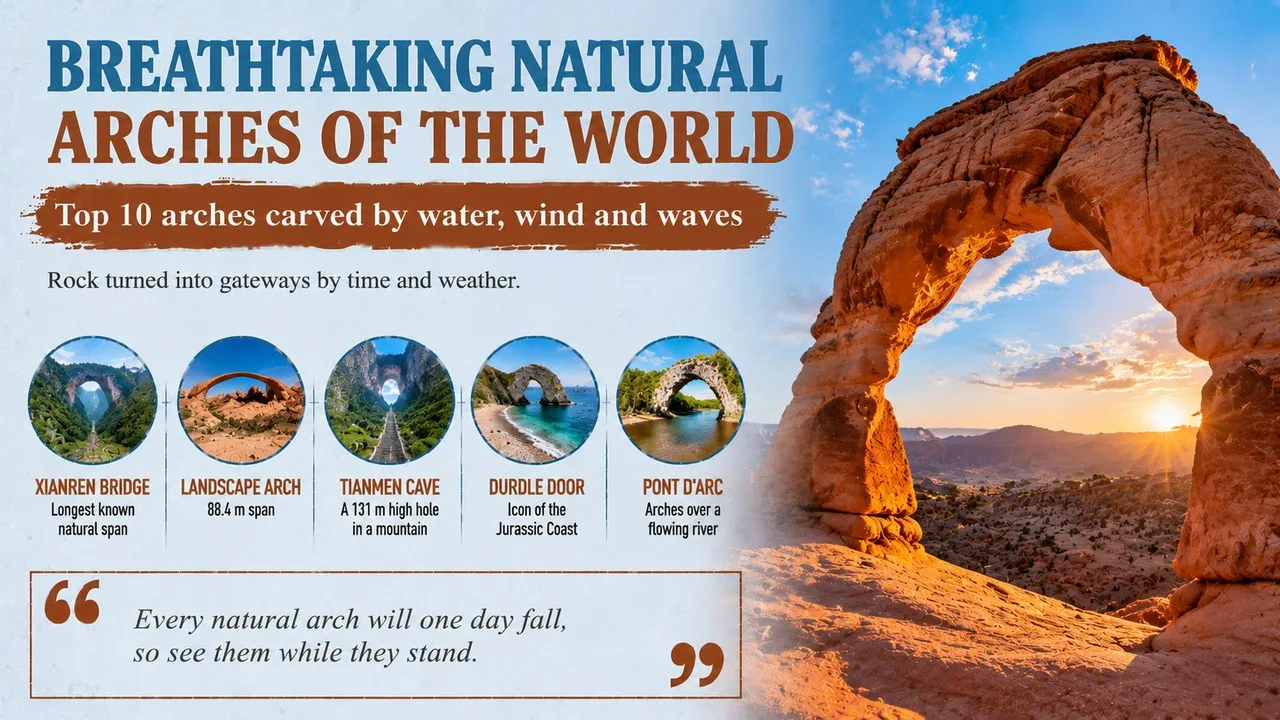
Breathtaking natural arches of the world include a limestone span in China longer than a football pitch and sea arches carved slowly by waves and storms.
This Finepedia guide, written in October 2026, explores 10 stunning natural arches on three continents, from desert sandstone spans to chalk sea arches and huge holes through mountains. We checked each one against national park bodies, arch survey groups and reference works. Surveyors measure arches by differing methods, so the numbers here are the best published ones as of October 2026. For more rocky wonders, see the Finepedia guides Rarest Rock Formations in the World: Top 10 Wonders and Most Famous Man-Made Arches in the World: Top 10.
How We Chose These
A natural arch is a rock formation with an opening worn right through it, usually by water, wind, frost or the sea. Our ten were chosen for size, beauty or a good story, spread across Asia, Europe and North America. We left out Delicate Arch and Percé Rock, which feature in our rock formations guide, and we cover the lost Azure Window of Malta in the questions at the end. Every entry has a short profile, four key facts and a further note.
The 10 Natural Arches at a Glance
| No. | Arch | Country | Rock | Standout fact |
|---|---|---|---|---|
| 1 | Xianren Bridge | China | limestone | longest known natural span |
| 2 | Landscape Arch | United States | sandstone | longest span in North America's arch capital |
| 3 | Rainbow Bridge | United States | sandstone | sacred to Navajo people |
| 4 | Tianmen Cave | China | limestone | a 131 m high hole in a mountain |
| 5 | Pont d'Arc | France | limestone | arches over a flowing river |
| 6 | Étretat arches | France | chalk | painted by Claude Monet |
| 7 | Durdle Door | United Kingdom | limestone | icon of the Jurassic Coast |
| 8 | Green Bridge of Wales | United Kingdom | limestone | battered by Storm Ophelia |
| 9 | El Arco | Mexico | granite | marks Land's End in Baja California |
| 10 | Moon Hill | China | limestone | a half-moon hole through a hill |
1. Xianren Bridge Holds the Record for the Longest Span
Xianren Bridge, whose name means Fairy Bridge, crosses the Buliu River in a remote corner of Guangxi in southern China. It was carved from limestone by flowing water and is so hard to reach, needing a rafting trip of about three hours, that the wider world only learned of it in 2009.
Key Facts
- Location: Buliu River, Guangxi Zhuang Autonomous Region, China
- Span: about 122 m, give or take about 5 m
- Measured: October 2010, by NABS, an arch survey group
- Rock: karst limestone
Why It Matters
Until Xianren Bridge was measured, Landscape Arch in Utah was often called the world's longest natural arch. The 2010 survey showed the Chinese span to be roughly 30 m longer, and several other Chinese arches have since been found to beat the American record too. It shows that some of the world's great natural wonders remained hidden until surprisingly recently.
2. Landscape Arch Is a Thin Ribbon of Stone
Landscape Arch stands in the Devils Garden area of Arches National Park, near Moab in eastern Utah. Its long, slender span of red sandstone looks almost too thin to stay up. The park as a whole holds over 2,000 sandstone arches, the greatest concentration of arches on Earth.
Key Facts
- Location: Arches National Park, eastern Utah, USA
- Span: 88.4 m, measured in 2004
- Height: about 23.6 m
- Rank: fifth-longest natural arch known, after four in China
Did You Know?
Large slabs of rock fell from Landscape Arch in 1991 and again in 1995, and the path that once passed underneath it was closed for safety. Visitors can still view the span from a nearby trail. The area became a national monument in 1929 and was made a national park in 1971.
3. Rainbow Bridge Is a Sacred Stone Rainbow
Rainbow Bridge rises in a remote canyon at the foot of Navajo Mountain in southern Utah, close to Lake Powell. It is one of the tallest natural bridges in the world, with a top that is about 13 m thick. Ancient Pueblo people, and later Paiute and Navajo groups, have known and honoured it for centuries.
Key Facts
- Location: southern Utah, United States
- Span: about 84 m
- Height: about 88 m
- Protected: as a national monument since 1910
Why It Matters
The Navajo name for the arch is often translated as rainbow turned to stone, and several Native American nations still regard it as sacred. The National Park Service lists it as a Traditional Cultural Property and asks visitors not to walk beneath or climb the bridge, out of respect. Outsiders did not hear of it until 1909, when Paiute guides led an expedition to the site.
4. Tianmen Cave Is Heaven's Gate in a Mountain
Tianmen Mountain, in Zhangjiajie in north-west Hunan Province, China, has a huge natural arch through its cliffs known as Tianmen Cave, or Heaven's Gate. The opening is about 131 m high. Visitors reach it by a winding road with 99 bends and then a long flight of 999 steps called the Stairway to Heaven.
Key Facts
- Location: Tianmen Mountain National Park, Hunan, China
- Height of opening: about 131.5 m
- Access: Tongtian Avenue, an 11 km road with 99 bends
- Cable car: one of the longest mountain cableways, about 7.5 km
Did You Know?
The giant hole has drawn daring stunts, including wingsuit pilots who have flown through it during world championship events held at the mountain. At the top, visitors can walk along paths fixed to the cliff face, some with glass floors that look straight down into the valley.
5. Pont d'Arc Spans a Living River
The Pont d'Arc is a large natural bridge over the Ardèche in the south of France, a short drive of about 5 km from Vallon-Pont-d'Arc. It formed when the river broke through a narrow ridge of limestone in the neck of a meander and then changed course to flow through the gap.
Key Facts
- Location: Gorges de l'Ardèche, France
- Width: about 59 m
- Height: about 34 m to the top of the gap
- Age: formed roughly 124,000 years ago
Why It Matters
The Pont d'Arc is widely claimed as the sole rock arch with a working river running under it, and it is known as the gateway to the Ardèche gorges. It has been a protected natural site since 1931. Canoeists and kayakers paddle under it in their thousands, and the famous Chauvet Cave, with some of the oldest known cave paintings, lies nearby.
6. The Arches of Étretat Inspired Great Painters
Étretat is a small seaside town in Normandy, northern France, framed by tall white chalk cliffs. The cliffs hold three natural arches, the Manneporte, which is the biggest, and the Porte d'Aval and Porte d'Amont, along with a tall, pointed sea stack known as the Needle, or L'Aiguille in French.
Key Facts
- Location: Seine-Maritime, Normandy, France
- Rock: chalk
- Cliffs: up to about 90 m high
- The Needle: rises about 70 m above the sea
Did You Know?
Étretat drew many artists in the 1800s, including Claude Monet, Gustave Courbet and Eugène Boudin; Monet painted the arches again and again in different light. The cliffs also play a starring role in The Hollow Needle, a 1909 Arsène Lupin mystery by Maurice Leblanc.
7. Durdle Door Frames the Jurassic Coast
Durdle Door is a limestone arch near Lulworth in Dorset, southern England. It sits on the Jurassic Coast, a stretch of shoreline added to UNESCO's World Heritage List in 2001 for its rocks and fossils. The arch belongs to the Weld family as part of their Lulworth Estate, yet anyone may visit.
Key Facts
- Location: near Lulworth, Dorset, England
- Rock: Portland limestone
- Status: part of the Jurassic Coast World Heritage Site
- Owner: the Lulworth Estate
Why It Matters
Durdle Door is a classic example in geography lessons of how the sea shapes coasts. Here, a strip of hard limestone runs parallel to the shore with softer rocks behind. Waves broke through the hard band and wore an opening through the headland, leaving the arch. One day it will collapse, leaving a stack.
8. The Green Bridge of Wales Stands Against the Atlantic
Known in Welsh as Pont Werdd Cymru, this Pembrokeshire landmark is an arch of Carboniferous limestone on the Pembrokeshire coast in south-west Wales. It formed as the sea dug caves into a narrow headland from each side until they met. The arch stands inside a military training area, but the public can usually visit it from a nearby viewpoint.
Key Facts
- Location: Pembrokeshire Coast National Park, Wales
- Height: about 24 m
- Span: more than 20 m
- Damage: lost a large chunk of rock in Storm Ophelia, October 2017
Did You Know?
NABS, the arch survey group, rates it as perhaps the finest arch anywhere in Britain. Its top is covered in grass and plants, which gives it its name. Nearby are the Elegug Stacks, tall pillars of rock that are popular with seabirds such as guillemots.
9. El Arco Marks Land's End in Mexico
El Arco, meaning the arch, stands at the very end of Cabo San Lucas, the tip of Mexico's long Baja California peninsula. Here the Pacific Ocean meets the Gulf of California. The arch is carved from granite, and sea lions often rest on the rocks around it.
Key Facts
- Location: Los Cabos, at the tip of Baja California Sur
- Rock: granite, formed about 115 million years ago
- Nickname: Land's End
- Nearby: Lovers Beach and Divorce Beach
Why It Matters
El Arco is the signature image of Los Cabos and appears on postcards and hotel adverts. Most visitors see it from a boat. The two beaches beside it face different seas: Lovers Beach faces the calm Gulf, while Divorce Beach faces the rougher Pacific, where swimming is dangerous.
10. Moon Hill Has a Half-Moon Through Its Heart
Moon Hill is a limestone hill a few kilometres outside Yangshuo, in Guangxi in southern China. A wide, half-moon-shaped opening runs right through it, the remains of an ancient cave. It stands among the knobbly karst peaks that make the Guilin and Yangshuo area famous.
Key Facts
- Location: near Yangshuo, Guangxi, China
- Height: about 230 m above the surrounding land
- Climb: about 1,000 steps, roughly 20 minutes to the arch
- Rock: karst limestone
Did You Know?
Moon Hill is popular with rock climbers, and American climber Todd Skinner opened many of its routes during the 1990s. The view from the arch takes in rice fields and dozens of steep karst hills stretching to the horizon.
Frequently Asked Questions
How do natural arches form?
Most form through erosion. Water, ice, wind or waves slowly wear away weaker rock, leaving a band of harder rock with a hole beneath it. Sea arches often start as caves dug into a headland from both sides, while desert arches form as rain and frost break apart thin walls of sandstone.
Do natural arches ever collapse?
Yes, all arches eventually fall. Malta's famous Azure Window, on the island of Gozo, collapsed into the sea during a storm on 8 March 2017. Wall Arch in Arches National Park fell in 2008, and many coastal arches lose rock every winter.
Conclusion
From the record-breaking Xianren Bridge to the chalk arches of Étretat, these ten natural arches show how water, wind and time can turn solid rock into graceful shapes. Because every arch will one day fall, they are worth seeing while they stand. For more rocky wonders, read the Finepedia guides Rarest Rock Formations in the World: Top 10 Wonders and Most Famous Man-Made Arches in the World: Top 10.
- NABS (Natural Arch and Bridge Society), arch measurements and the List of longest natural arches.
- US National Park Service, Arches National Park and Rainbow Bridge National Monument pages.
- UNESCO World Heritage Centre, Dorset and East Devon Coast, whc.unesco.org/en/list/1029.
- Wikipedia (accessed October 2026), articles on Natural arch, Xianren Bridge, Landscape Arch, Arches National Park, Rainbow Bridge National Monument, Tianmen Mountain, Pont d'Arc, Étretat, Durdle Door, Green Bridge of Wales, El Arco de Cabo San Lucas, Moon Hill and Azure Window.
- 10 Most Today, 10 Most Beautiful Natural Arches in the World, 10mosttoday.com (topic reference).















Log in with