










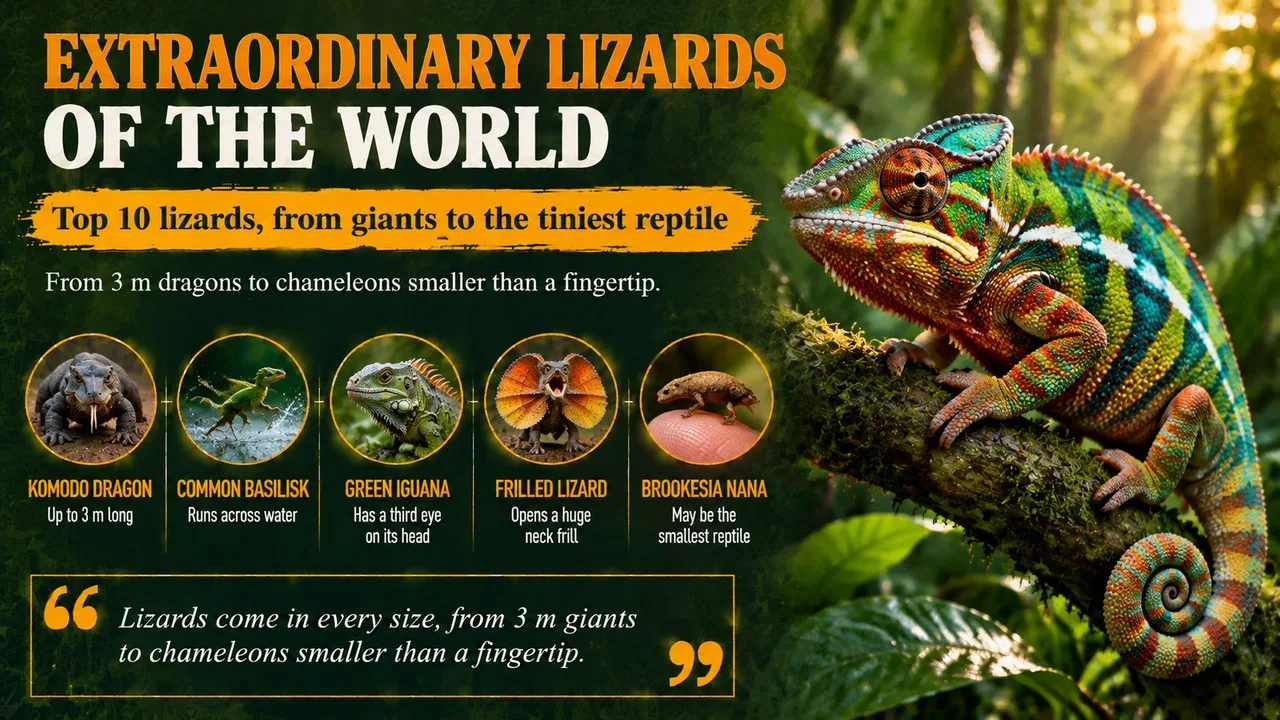
Extraordinary lizards of the world range from the Komodo dragon, which can grow to 3 m long, to a tiny chameleon from Madagascar barely 2 cm long.
This Finepedia guide, written in October 2026, looks at 10 remarkable lizards, from island giants and colour-changing chameleons to a lizard that sprints across water. We checked each entry against wildlife groups, research papers and reference works. Measurements differ from one source to another, so the figures here are typical values as of October 2026, flagged where they are maxima or estimates. For more unusual creatures, you may also like the Finepedia guides Remarkable Spiny Animals of the World: Top 10 and Colourful Parrots of the World: Top 10.
How We Chose These
There are thousands of lizard species, found on every continent except Antarctica. We chose ten that are memorable for their size, colours, defences or habits, from five continents. We left out the thorny devil and other spiny lizards, which feature in our spiny animals guide, and the slow-moving Gila monster, which appears in our slowest animals guide. They appear in rough order of size, biggest first. Every entry gets a short profile, four key facts and one more note on why it matters or a surprising detail.
The 10 Lizards at a Glance
| No. | Lizard | Home | Size | Standout fact |
|---|---|---|---|---|
| 1 | Komodo dragon | Indonesia | up to 3 m | largest living lizard |
| 2 | Green iguana | Central and South America | up to about 1.5 m | has a third eye on its head |
| 3 | Galápagos land iguana | Galápagos Islands | up to 1.5 m | eats spiny cactus |
| 4 | Frilled lizard | northern Australia and New Guinea | up to 90 cm | opens a huge neck frill |
| 5 | Common basilisk | Central and South America | up to 76 cm | runs across water |
| 6 | Panther chameleon | Madagascar | 40 to 51 cm | brilliant colour changes |
| 7 | Tokay gecko | South and Southeast Asia | 25 to 40 cm | named after its loud call |
| 8 | Jackson's chameleon | East Africa | about 30 cm | three horns and live young |
| 9 | Common agama | sub-Saharan Africa | 13 to 30 cm | colourful breeding males |
| 10 | Brookesia nana | Madagascar | about 2 to 3 cm | may be the smallest reptile |
1. The Komodo Dragon Is the World's Largest Lizard
The Komodo dragon is a giant monitor lizard found only on a few islands in eastern Indonesia, including Komodo, Rinca and Flores. Males can grow up to 3 m long, and wild adults usually weigh about 70 kg. It is the top predator in its home, hunting deer, wild pigs and sometimes even water buffalo.
Key Facts
- Species: Varanus komodoensis
- Size: up to 3 m long
- Status: endangered, according to the IUCN
- Protection: Komodo National Park, founded in 1980
Why It Matters
It was once widely believed that the Komodo dragon killed its prey with harmful bacteria in its mouth, but scientists now know it has venom glands. Its bite delivers a toxic venom and saliva that stops blood from clotting. Western scientists first recorded the species in 1910. Female Komodo dragons can sometimes lay eggs that hatch without any male, a process called parthenogenesis, which has been seen in zoos.
2. The Green Iguana Has a Third Eye
The green iguana is a big tree-dwelling lizard native to a wide area of Central and South America and the Caribbean islands, and it is mainly a plant eater, feeding on leaves, flowers and fruit. Adults can reach about 1.5 m from head to tail and have a row of spines down the back and a large flap of skin under the chin, called a dewlap.
Key Facts
- Species: Iguana iguana
- Length: up to about 1.5 m including the tail
- Diet: mostly leaves, flowers and fruit
- Introduced to: Florida, Puerto Rico, Hawaii and many islands
Did You Know?
On top of its head, the green iguana has a pale spot called a parietal eye, sometimes called a third eye. It cannot form pictures but can sense light and shadow, helping the iguana spot birds of prey from above. Green iguanas are also tough climbers, able to fall up to 15 m from a tree and land unhurt. In 1995, a group of iguanas reached the island of Anguilla after drifting on debris following a hurricane.
3. The Galápagos Land Iguana Eats Cactus
The Galápagos land iguana is a large, yellow and brown lizard that lives in the dry lowlands of several Galápagos islands, off the coast of Ecuador. Fresh water is scarce there, so it relies on the prickly pear cactus for most of its water, eating the pads, fruit, flowers and even the spines.
Key Facts
- Species: Conolophus subcristatus
- Size: roughly 1 to 1.5 m long, up to about 13 kg
- Population: an estimated 5,000 to 10,000
- Lifespan: about 60 years or more
Why It Matters
When Charles Darwin visited the islands in 1835, land iguanas were so common on Santiago that he struggled to find room for his tent between their burrows. Later, introduced animals such as goats, rats and cats took a heavy toll, and the iguana died out on Baltra Island by 1954. Animals saved from nearby islands were later bred and returned, and the species now lives on Baltra again.
4. The Frilled Lizard Opens a Startling Cape
The frilled lizard lives in the woodlands of southern New Guinea and the north of Australia. Most of the time, a large fold of skin lies flat around its neck. When it feels threatened, it suddenly opens this frill, which can be red, orange, yellow or white, opens its mouth wide and hisses to look bigger and scarier.
Key Facts
- Species: Chlamydosaurus kingii, the sole species in its genus
- Length: up to about 90 cm including the tail
- Home: mostly in trees in northern Australia and New Guinea
- Status: rated least concern on the IUCN Red List
Did You Know?
The frilled lizard often runs on its two back legs, leaning its head back for balance, when it chases insects or flees from danger. Its frill display is thought to have inspired the neck frill given to the dinosaur Dilophosaurus in the 1993 film Jurassic Park. The lizard has also appeared on Australian coins.
5. The Common Basilisk Can Run on Water
The common basilisk is a slim, brown lizard with tall crests along its back, head and tail, living near rivers and streams in the rainforests of Central and South America. It is famous as the Jesus Christ lizard, because it can run across the surface of water for short distances to escape danger.
Key Facts
- Species: Basiliscus basiliscus
- Length: up to about 76 cm, mostly tail
- Hatchlings: weigh only about 2 g
- Skills: climbs, swims and can hold its breath underwater for around 30 minutes
Why It Matters
To run on water, the basilisk rises onto its back legs and sprints. Its long back toes carry fringes of scales that open out against the water, giving each foot more surface to push against. Slapping its feet down fast traps pockets of air, so it can stay up for a short dash before sinking and swimming. Young, lighter basilisks can run farther than adults.
6. The Panther Chameleon Is a Living Colour Chart
The panther chameleon comes from the forests of northern and eastern Madagascar and has been introduced to Réunion, Mauritius and Florida. Males are larger and far more colourful than females, and their colours vary from place to place, so keepers name the different forms after the areas where they come from.
Key Facts
- Species: Furcifer pardalis
- Length: about 40 to 51 cm
- Tongue: sometimes longer than its body
- Name: pardalis means spotted like a panther
Did You Know?
A 2015 study of panther chameleons showed how they change colour. Instead of only moving pigments around, they adjust a layer of tiny crystals in their skin. Packing the crystals closer together or spreading them out changes the way light reflects, shifting the colour from green to yellow, orange or red when a male is excited or ready to fight.
7. The Tokay Gecko Calls Out Its Own Name
The tokay gecko is a hefty, blue-grey gecko with orange or red spots, found from north-east India and Bangladesh across Southeast Asia to western New Guinea. In rainforests it climbs trees and rock faces, but it also hunts insects on the walls and ceilings of houses at night.
Key Facts
- Species: Gekko gecko
- Length: usually 25 to 30 cm, sometimes 40 cm
- Rank: thought to be the third-largest gecko species
- Behaviour: territorial, with a strong bite
Did You Know?
The male's loud mating call sounds like to-kay, which gave the lizard its name. In fact the word gecko itself comes from this species, through a Malay word that copies the sound of its call. Tokay geckos are common in the pet trade, but their strong bite makes them a poor choice for beginners.
8. Jackson's Chameleon Has Three Horns
Jackson's chameleon is a bright green chameleon from the cool mountain forests of northern Tanzania and the south-centre of Kenya. Males have three long horns, a single horn on the snout plus a pair over the eyes, which they use in shoving contests with rival males. People have also released it in Hawaii, California and Florida.
Key Facts
- Species: Trioceros jacksonii
- Size: about 30 cm long
- Home: mountain forests between roughly 1,600 m and 2,400 m
- First described: in 1896, named after the explorer Frederick John Jackson
Why It Matters
Most chameleons lay eggs, but Jackson's chameleon gives birth to live young, which helps in cold mountain habitats where eggs could struggle to develop. After about five to six months, a female produces about 8 to 30 babies at a time. In Hawaii, where it was introduced, it eats native snails and insects, which worries conservationists.
9. The Common Agama Puts on Bright Breeding Colours
The common agama, also called the red-headed rock agama, is one of the most familiar lizards in much of sub-Saharan Africa. It is often seen basking on rocks and walls under the hot midday sun, even in towns. Females and young males are mostly brown and olive, but a dominant male has a vivid blue body and an orange-red head.
Key Facts
- Species: Agama agama
- Length: about 13 to 30 cm
- Home: much of sub-Saharan Africa, and introduced to Florida
- Diet: mainly insects
Did You Know?
The common agama's eggs do not have their sex fixed at the start. Instead, it depends on the temperature of the nest: warmer eggs, at around 29 °C, produce males, while cooler eggs, at around 26 to 27 °C, produce females. When rival males meet, they bob their heads and change colour to show who is in charge.
10. Brookesia nana May Be the Smallest Reptile on Earth
Brookesia nana, nicknamed the nano-chameleon, was described by scientists in 2021 from rainforest on the Sorata mountains of far northern Madagascar. Adult males are only about 22 mm long, including the tail, and females about 29 mm. It is so small that it could sit on a fingertip with room to spare.
Key Facts
- Species: Brookesia nana
- Size: males about 22 mm, females about 29 mm
- Home: a single forest area in northern Madagascar
- Behaviour: lives on the forest floor rather than in trees
Why It Matters
Brookesia nana may be the smallest reptile known, rivalling other tiny Brookesia chameleons. Unlike many chameleons, it does not change colour, and it hunts tiny insects among the leaf litter. Because it is known from only one location and its forest is threatened, scientists think it is likely to be endangered.
Frequently Asked Questions
Which lizard is the biggest?
The Komodo dragon of Indonesia, which can grow up to 3 m long. Wild adults usually weigh about 70 kg, and large males can weigh much more.
Can all lizards change colour?
No. Chameleons are the best known for it, and many other lizards, such as agamas, change colour to some degree. But some, including the tiny Brookesia nana, do not change colour at all.
Conclusion
From the giant Komodo dragon to a chameleon smaller than a fingertip, these ten lizards show the huge range of shapes, colours and skills in this group of reptiles. Several face threats from habitat loss, which makes protecting their islands and forests important. For more remarkable animals, read the Finepedia guides Remarkable Spiny Animals of the World: Top 10 and Colourful Parrots of the World: Top 10.
- IUCN Red List of Threatened Species, assessments for the Komodo dragon and frilled lizard.
- Teyssier, J. and others, Photonic crystals cause active colour change in chameleons, Nature Communications, 2015.
- Glaw, F. and others, Extreme miniaturization of a new amniote vertebrate and insights into the evolution of genital size in chameleons, Scientific Reports, 2021.
- Darwin, C., The Voyage of the Beagle, 1839.
- Wikipedia (accessed October 2026), articles on Lizard, Komodo dragon, Green iguana, Galápagos land iguana, Frilled lizard, Common basilisk, Panther chameleon, Tokay gecko, Jackson's chameleon, Agama agama and Brookesia nana.
- 10 Most Today, 10 Coolest Lizards in the World, 10mosttoday.com (topic reference).



















Log in with