



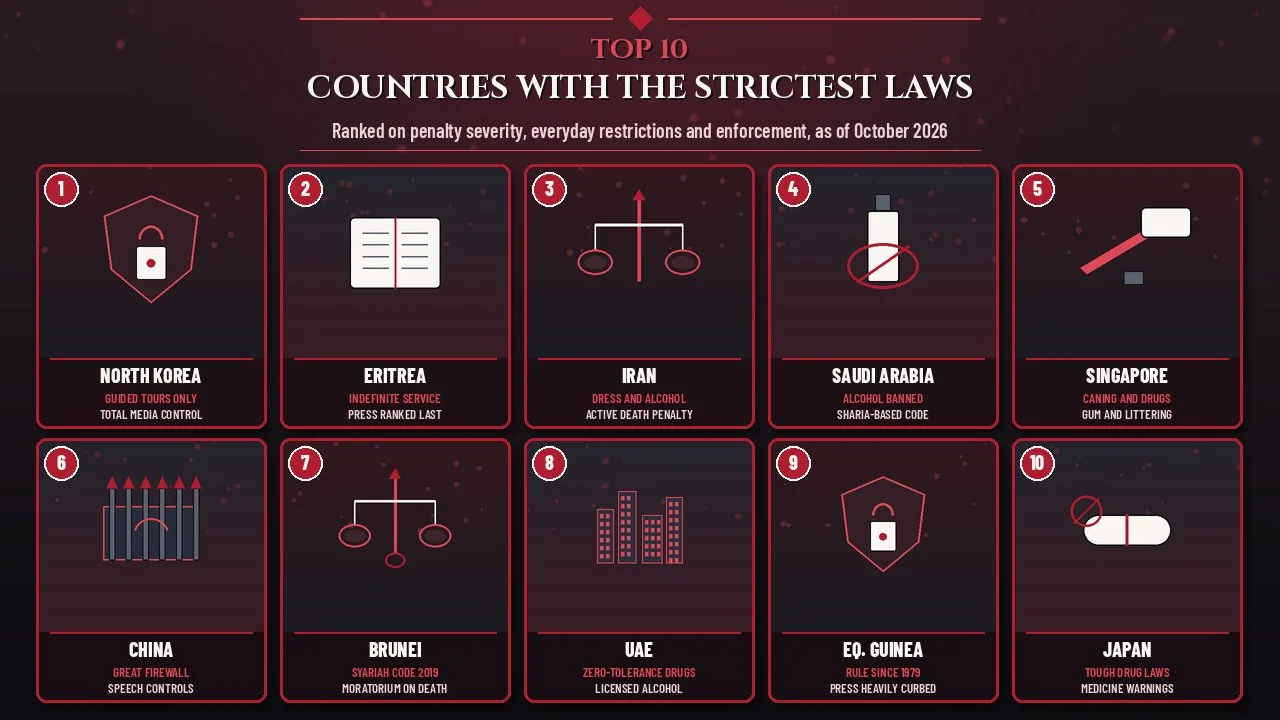
These countries with the strictest laws lean on harsh penalties, broad everyday bans and firm enforcement that visitors and residents feel daily.
Every legal system draws lines around what people may say, wear, drink, buy or photograph. In most places those lines sit in the background of daily life. In a smaller group of countries they sit in the foreground: a missed dress code, a social-media post, a tablet of the wrong cold medicine or a stick of chewing gum can trigger a fine, detention, caning or worse.
This Finepedia ranking looks at that smaller group as of October 2026. It is not a league table of "worst" countries, a travel ban list or legal advice. It scores how severe the written penalties are, how many ordinary habits those penalties reach, and how firmly the rules are enforced in practice. Laws change, and readers should check official government travel advisories and local statutes before any trip.
Syria is deliberately not on this list. The Assad government fell in December 2024, and describing that era's rules as current would be inaccurate. Cuba, which often appears on older "strict laws" round-ups, is covered briefly under Honourable Mentions rather than the top ten, because visitor rules there are milder than the systems ranked below even though political speech remains tightly controlled.
How We Ranked Countries with the Strictest Laws
Three equally weighted criteria, each scored from 1 to 5, produce a total out of 15. Scores are Finepedia's editorial judgement, applied with the same definitions to every country and checked against Freedom House Freedom in the World 2025 scores, Reporters Without Borders World Press Freedom Index 2025 ranks, Amnesty International and Harm Reduction International reporting on the death penalty, U.S. State Department and UK Foreign Office travel advice patterns, and well-documented encyclopedic facts about each legal system.
- Penalty severity (1 to 5): 5 when the law retains capital or judicial corporal punishment for non-violent or drug-related offences and those penalties are still used or remain fully on the statute book; 4 when capital or corporal punishment exists mainly for violent crime or is retained with a clear moratorium; 3 when maximum penalties are long prison terms without routine capital or corporal punishment for everyday offences.
- Everyday restrictions (1 to 5): how far the criminal or administrative code reaches into dress, alcohol, drugs, speech, religion, littering, gum, photography or movement for ordinary residents and visitors.
- Enforcement strength (1 to 5): how consistently rules are applied, how closed independent media and courts are, and how strongly foreign ministries warn travellers. A country with severe laws that are rarely used scores lower here than one that applies milder rules every day.
When totals tie, the higher Penalty score ranks first, then Everyday restrictions, then Enforcement. Shortlisted countries that miss the top ten appear in Honourable Mentions.
The Scorecard
| Rank | Country | Penalty | Everyday | Enforcement | Total |
|---|---|---|---|---|---|
| 1 | North Korea | 5 | 5 | 5 | 15 |
| 2 | Eritrea | 4 | 5 | 5 | 14 |
| 3 | Iran | 5 | 5 | 4 | 14 |
| 4 | Saudi Arabia | 5 | 5 | 4 | 14 |
| 5 | Singapore | 5 | 4 | 5 | 14 |
| 6 | China | 4 | 5 | 4 | 13 |
| 7 | Brunei | 5 | 4 | 3 | 12 |
| 8 | United Arab Emirates | 4 | 4 | 4 | 12 |
| 9 | Equatorial Guinea | 3 | 4 | 4 | 11 |
| 10 | Japan | 4 | 3 | 3 | 10 |
Japan scores 10: its drug penalties are severe, but everyday life outside narcotics law is far freer than in the Gulf or Brunei, so Enforcement is capped at 3 relative to states that police dress, speech and alcohol every day. Equatorial Guinea's 11 therefore places ninth, with Japan tenth as a focused traveller warning on medicines and drugs.
Countries with the Strictest Laws at a Glance
| Rank | Country | Freedom House 2025 | Stand-out rule for visitors | Region |
|---|---|---|---|---|
| 1 | North Korea | 3 / 100 (Not Free) | Guided tours only; photography and speech tightly limited | East Asia |
| 2 | Eritrea | 3 / 100 (Not Free) | Exit visas and indefinite national service shape daily life | Horn of Africa |
| 3 | Iran | 11 / 100 (Not Free) | Public dress code; alcohol ban; strict speech rules | Middle East |
| 4 | Saudi Arabia | 9 / 100 (Not Free) | Alcohol banned; conservative dress still expected | Middle East |
| 5 | Singapore | 48 / 100 (Partly Free) | Caning, drug death penalty, gum and littering rules | Southeast Asia |
| 6 | China | 9 / 100 (Not Free) | Great Firewall; sensitive speech offline and online | East Asia |
| 7 | Brunei | 27 / 100 (Not Free) | Syariah Penal Code Order fully in force since 2019 | Southeast Asia |
| 8 | United Arab Emirates | 18 / 100 (Not Free) | Zero-tolerance drug and medicine rules for travellers | Middle East |
| 9 | Equatorial Guinea | 5 / 100 (Not Free) | Long-running personal rule; press and opposition curbed | Central Africa |
| 10 | Japan | 96 / 100 (Free) | Among the world's toughest personal drug and medicine laws | East Asia |
Freedom House scores are political-rights and civil-liberties aggregates, not crime rankings. Japan shows why this list is about legal strictness, not only authoritarianism: a Free country can still punish small drug offences far more harshly than many Not Free states punish littering.
1. North Korea
| Attribute | Details |
|---|---|
| Capital | Pyongyang |
| Legal system | Socialist civil-law system under the Workers' Party of Korea and the Kim family leadership |
| Freedom House 2025 | 3 / 100 (Not Free) |
| Press Freedom Index 2025 | 179th of 180 (Reporters Without Borders) |
| Visitor reality | Foreign visits run as guided group itineraries; independent travel is not available |
North Korea tops the scorecard because every criterion sits at the maximum. Written criminal law reaches into speech, media, religion and movement; enforcement is total for residents; and visitors never move without state minders. Amnesty International lists the country among the ten states known to have carried out executions every year in the last five years, though exact numbers stay secret.
Origins and History
The Democratic People's Republic of Korea was founded in 1948 after the division of the Korean peninsula. From the outset the legal and security system was built to protect the ruling party and, later, a hereditary leadership. Criminal and administrative rules developed alongside mass organisations, neighbourhood watch structures and a state monopoly on publishing and broadcasting.
After the Korean War armistice of 1953, the country stayed closed to almost all foreign contact. That isolation still shapes the law: unauthorised contact with the outside world, foreign media and unsanctioned religion are treated as security matters, not private choices.
Key Features
- Independent journalism does not exist; state media is the only legal domestic news system
- Ordinary citizens need permission to travel internally between provinces, and leaving the country without authorisation is a serious crime
- Foreign tourists must book through approved operators and remain with their minders; freelancing around the itinerary is not allowed
- Photography of military sites, construction and some ordinary street scenes is restricted
- Capital punishment remains in law for a wide range of political and economic offences, according to defector testimony and UN reporting summarised by human-rights monitors
Significance
North Korea matters on any strict-laws list because the gap between resident life and visitor life is so wide. A tourist on a tightly scripted tour may see monuments and performances, yet the same state that hosts that tour treats private speech, private worship and private media as threats. No other country on this list combines that level of closure with that level of criminalisation of everyday information.
Interesting Facts
- Reporters Without Borders ranked North Korea 179th of 180 in its 2025 World Press Freedom Index, just above last-placed Eritrea.
- Almost all mobile and internet services available to ordinary citizens are domestic intranets, not the global web.
- Visitors are typically asked to surrender mobile phones or use them only under guide rules, depending on the tour operator and current policy.
- International organisations repeatedly report that the death penalty is used, but the state does not publish reliable execution statistics.
2. Eritrea
| Attribute | Details |
|---|---|
| Capital | Asmara |
| Legal system | Mixed civil-law tradition under a highly centralised presidential system; no functioning constitutionally elected legislature since the early 2000s |
| Freedom House 2025 | 3 / 100 (Not Free) |
| Press Freedom Index 2025 | 180th of 180 (last) |
| Signature duty | National service that is 18 months in law but indefinite in practice for many people |
Eritrea matches North Korea on Freedom House's aggregate score and finishes last on the 2025 press-freedom index. Its total of 14 sits just behind North Korea because capital punishment is retained but less publicly documented as a routine tool for ordinary drug or speech cases than in Iran or Saudi Arabia.
Origins and History
Eritrea won de facto independence from Ethiopia in 1991 and formal independence in 1993 after a long liberation war. Isaias Afwerki has led the country since independence. A ratified constitution was never fully implemented, and national elections have not been held.
In September 2001 the government shut independent newspapers and detained journalists and politicians. Human Rights Watch and Reporters Without Borders report that several of those journalists, including Swedish-Eritrean Dawit Isaak, remain detained without trial decades later. That episode still defines the media law in practice: only state outlets operate.
Key Features
- Independent media banned since 2001; RSF calls the country an "information desert"
- National service is legally 18 months but has been open-ended for many conscripts since the late 1990s emergency period
- Exit from the country often requires hard-to-get permission, which is why large numbers of young Eritreans leave irregularly
- Opposition parties and independent civic groups are not allowed to operate freely
- Arbitrary detention without charge or trial is repeatedly documented by the UN Special Rapporteur on Eritrea
Significance
Eritrea shows that "strict laws" are not only about tourist fines. The national-service system reaches into education, labour and family life for years at a time. For outsiders, the practical lesson is that reporting, research and even ordinary visits sit inside an information environment that monitors rank among the most closed on Earth.
Interesting Facts
- RSF ranked Eritrea last (180th) in the 2025 World Press Freedom Index.
- UN and Human Rights Watch reporting in 2025 continued to describe national service as indefinite in practice and linked it to forced labour concerns.
- Nongovernmental gatherings are tightly restricted; civic space is described as closed by major monitors.
- Asmara's modernist architecture is UNESCO-listed, a reminder that cultural heritage and political closure can coexist.
3. Iran
| Attribute | Details |
|---|---|
| Capital | Tehran |
| Legal system | Islamic Republic combining Shia Islamic criminal law with civil-law structures under a Supreme Leader |
| Freedom House 2025 | 11 / 100 (Not Free) |
| Death penalty | Among the world's most active, including for drug offences |
| Visitor flashpoints | Mandatory hijab rules for women in public, alcohol ban, sensitive political speech |
Iran ranks third because penalty severity and everyday restrictions both score a five. Amnesty International's 2025/2026 death-penalty reporting again placed Iran among the states driving a global surge in recorded executions, with a large share linked to drug offences.
Origins and History
The 1979 revolution replaced the Pahlavi monarchy with an Islamic Republic. The constitution gives the Supreme Leader overarching authority and requires legislation to stay compatible with Islamic criteria. Criminal provisions on alcohol, adultery, blasphemy and some security offences draw on Islamic jurisprudence as interpreted by state institutions.
Periodic protest waves, including the nationwide demonstrations that followed Mahsa Amini's death in custody in 2022, have been met with arrests and further enforcement of public-conduct rules. Dress and speech laws therefore sit at the centre of both domestic politics and visitor advice.
Key Features
- Women are required to observe hijab in public; enforcement intensity has varied by period and place but the legal duty remains
- Alcohol production, trade and consumption are prohibited for Muslims under national law
- Many foreign social-media and news sites are blocked or throttled
- Criticism of Islamic or political authorities can be charged under broad national-security and speech offences
- Drug trafficking and some other non-homicide offences remain death-eligible; Amnesty recorded hundreds of drug-related executions in its latest annual tally
Significance
Iran is one of the clearest examples of a legal system where personal conduct, religious rules and state security are braided together. Travellers feel that mainly through dress, alcohol and online behaviour. Residents feel it through the wider criminalisation of dissent and the scale of capital punishment.
Interesting Facts
- Freedom House scored Iran 11 / 100 in Freedom in the World 2025 (Not Free).
- Amnesty's global survey for 2025 found drug-related cases made up a large share of recorded executions worldwide, with Iran the main recorded driver outside China.
- Pre-revolution nightlife and alcohol culture in major cities was replaced by a formal ban after 1979.
- Dual nationals have faced heightened risk in several well-publicised detention cases, which is why several foreign ministries publish special warnings for them.
4. Saudi Arabia
| Attribute | Details |
|---|---|
| Capital | Riyadh |
| Legal system | Islamic monarchy applying Sharia-based criminal and personal-status rules alongside royal decrees |
| Freedom House 2025 | 9 / 100 (Not Free) |
| Alcohol | Banned nationwide |
| Recent change | Women have been allowed to drive since June 2018 under Vision 2030 social reforms |
Saudi Arabia shares Iran's top marks on penalties and everyday restrictions. Enforcement scores a four rather than a five only because Vision 2030 reforms have visibly eased some social rules (driving, some entertainment licensing) even while drug and speech cases remain severe.
Origins and History
Modern Saudi Arabia was unified in 1932 under the Al Saud family. The Basic Law identifies the Quran and the Sunnah as the constitution. Religious police historically played a visible street-enforcement role; their powers were curtailed in 2016 as part of a wider restructuring, but the underlying criminal prohibitions on alcohol, extramarital relations and blasphemy-type offences did not disappear.
Crown Prince Mohammed bin Salman's Vision 2030 programme has opened cinemas, concerts and tourism visas. That opening sits beside continued use of the death penalty, including a sharp rise in drug-related executions reported by Harm Reduction International and Amnesty for 2024–2025.
Key Features
- Alcohol is illegal to produce, import or consume
- Modest dress remains the social and practical expectation in public, even as some fashion rules have loosened in major cities
- Public practice of non-Muslim religions is restricted; private worship rules are detailed in foreign-ministry advice
- Drug trafficking can carry the death penalty; monitors recorded 240 drug-related executions in Saudi Arabia in 2025 in Amnesty's global count
- Online speech critical of the royal family or religion can lead to long prison terms under cybercrime and counter-terrorism provisions
Significance
Saudi Arabia is the country many travellers now meet as a tourism and business destination with new visas and entertainment, yet its criminal red lines on alcohol, drugs and political-religious speech remain among the world's hardest. The mix of reform headlines and capital punishment is exactly why a neutral ranking has to separate marketing from the statute book.
Interesting Facts
- Women obtained the right to drive in June 2018, ending a long-standing ban.
- The kingdom opened a broader tourist visa regime in 2019, expanding visitor numbers.
- Ramadan public-conduct rules, including limits on eating and drinking in view of others during fasting hours, still appear in official visitor guidance.
- Freedom House's 2025 score of 9 / 100 places Saudi Arabia among the lowest-rated Middle Eastern states for political rights and civil liberties.
5. Singapore
| Attribute | Details |
|---|---|
| Capital | Singapore (city-state) |
| Legal system | Common-law heritage with extensive statutory offences and mandatory minimums |
| Freedom House 2025 | 48 / 100 (Partly Free) |
| Corporal punishment | Judicial caning for many male offenders under 50 |
| Drugs | Trafficking above set quantities can carry the mandatory death penalty |
Singapore is the traveller's textbook case of strict laws inside a wealthy, low-crime city. It scores 14 overall: five for penalties (caning plus capital drug trafficking), four for everyday restrictions (gum, littering, vandalism, public cleanliness rules) and five for enforcement that is famously consistent.
Origins and History
British colonial criminal law, including caning, arrived in the nineteenth century and stayed after independence in 1965. Parliament later widened the list of caning offences and kept capital punishment for murder and for trafficking controlled drugs above threshold amounts.
The 1994 caning of American teenager Michael Fay for vandalism fixed Singapore's reputation in global media. Domestic politics across parties has generally supported the deterrent model. Separately, commercial sale of chewing gum was tightly restricted from 1992 to protect Mass Rapid Transit cleanliness; therapeutic nicotine gum later returned under licence, but unlicensed gum imports remain controlled.
Key Features
- Judicial caning (up to 24 strokes in a single trial for adult men under 50) can be ordered for dozens of offences, always with imprisonment
- Drug trafficking above statutory weights can mean the death penalty; Singapore carried out 15 drug-related executions in 2025 according to Amnesty's global survey
- Littering can bring fines and, for repeat offenders, Corrective Work Order cleaning duties in high-visibility vests
- Importing chewing gum without the proper authorisation is an offence; it is not punished by caning
- Vandalism, overstaying immigration limits and some sexual offences also attract caning in defined cases
Significance
Singapore proves that strict everyday enforcement and strong commercial success can coexist. For visitors the practical message is simple: read the Immigration and Checkpoints Authority and Central Narcotics Bureau warnings, declare medicines, and treat littering and public-order rules as seriously as the death-penalty posters at the airport suggest.
Interesting Facts
- Freedom House rates Singapore Partly Free (48 / 100), far above every fully authoritarian entry on this list.
- The same city-state ranks among the most peaceful countries in the 2026 Global Peace Index, showing that "strict" and "peaceful" are not opposites.
- School caning of boys remains lawful under Education Ministry rules, separate from judicial caning.
- Official statistics published via U.S. State Department human-rights reports show caning sentences numbered in the thousands in peak years of the 2000s and lower but still substantial figures in the 2010s.
6. China
| Attribute | Details |
|---|---|
| Capital | Beijing |
| Legal system | Socialist legal system with Chinese characteristics; Communist Party leadership is constitutionally affirmed |
| Freedom House 2025 | 9 / 100 (Not Free) |
| Information control | Great Firewall blocks many foreign news, social and search services |
| Death penalty | Retained; Amnesty believes China remains the world's leading executioner, with figures a state secret |
China ranks sixth with 13 points. Everyday restrictions on information score a five; penalty severity scores a four because capital punishment is heavily used yet opaque; enforcement scores a four because national law is applied through a vast police and platform-censorship machinery, with regional variation.
Origins and History
After 1949 the People's Republic built a party-centred legal order. The reform era from 1978 rebuilt courts and codes for a market economy while keeping speech, association and publishing under political control. Internet regulation from the 1990s onward created the filtering system popularly called the Great Firewall.
National-security, counter-espionage and public-order legislation tightened again in the 2010s and early 2020s. For visitors, the visible result is that familiar apps simply fail to load without technical workarounds that may themselves raise compliance questions.
Key Features
- Major foreign platforms (for example Google search, Facebook, Instagram and many news sites) are routinely unreachable on mainland networks
- Publishing, filmmaking and online platforms operate under licensing and real-name rules
- Public protest without approval is illegal; sensitive anniversaries and topics are heavily policed online
- The death penalty applies to serious violent and some economic or drug crimes; national totals are not released
- Public-security and immigration rules give officers wide discretion at borders and in Tibet, Xinjiang and other sensitive areas
Significance
China's strictness is less about caning or alcohol bans and more about the scale of information control. A visitor can eat and dress much as in any big city, then discover that a normal social-media habit from home is impossible. That is why China scores so high on Everyday restrictions even when street-level tourist life looks relaxed.
Interesting Facts
- Freedom House scored China 9 / 100 in 2025, matching Saudi Arabia's aggregate and far below Singapore.
- RSF ranked China 178th of 180 in the 2025 press-freedom index.
- Hong Kong retains a separate legal system, but national-security legislation since 2020 has narrowed the gap with mainland speech rules.
- VPN use sits in a grey zone: commercial VPNs are restricted, and visitors should read current local rules rather than assume a workaround is lawful.
7. Brunei
| Attribute | Details |
|---|---|
| Capital | Bandar Seri Begawan |
| Legal system | Dual track: English common-law style Penal Code plus Syariah Penal Code Order 2013 |
| Freedom House 2025 | 27 / 100 (Not Free) |
| SPCO full force | Third phase from 3 April 2019 |
| Death penalty | Retained in law; Sultan announced a de facto moratorium covering SPCO cases in May 2019 |
Brunei enters this list in place of older round-ups' focus on Syria. The sultanate's Syariah Penal Code Order, fully in force since April 2019, writes capital and corporal punishments into statute for a range of offences even though a moratorium on executions was publicly extended the same year.
Origins and History
Brunei is an absolute monarchy on the island of Borneo. Sultan Hassanal Bolkiah has ruled since 1967. Islamic criminal provisions existed before 2013, but the Syariah Penal Code Order created a much wider parallel code. It rolled out in phases from 2014 and reached full implementation in April 2019.
International criticism was intense. In May 2019 the Sultan said the long-standing de facto moratorium on the death penalty would also cover SPCO cases and spoke about respect for personal privacy. Amnesty International and other monitors note that the moratorium does not remove the penalties from the text of the law, and that corporal punishments remain a separate concern.
Key Features
- SPCO penalties in the statute book include whipping, amputation and, for some offences, death by stoning, subject to high evidentiary thresholds under the code's own rules
- Muslims face penalties for drinking alcohol; non-Muslims can be punished for drinking in public
- Friday prayers are a legal obligation for Muslim men under the code's religious-observance sections
- Proselytising to Muslims is restricted; blasphemy and apostasy provisions are severe on paper
- Common-law style courts continue to handle many ordinary criminal cases beside syariah courts
Significance
Brunei is small and wealthy, with low street crime, yet its dual criminal codes are among the most textually severe in Southeast Asia. For a ranking dated 2026, the accurate statement is that the harsh penalties remain law, the execution moratorium remains political practice, and visitors should follow alcohol and religious-conduct rules carefully.
Interesting Facts
- Freedom House scored Brunei 27 / 100 (Not Free) in 2025.
- The last known execution in Brunei was in 1957, before full independence, which is why monitors call it abolitionist in practice despite the statute book.
- Therapeutic and research debates about the SPCO continue at the UN Human Rights Council's Universal Periodic Review.
- Non-Muslims are exempt from some worship and dietary sections but not from all public-order and morality offences.
8. United Arab Emirates
| Attribute | Details |
|---|---|
| Capital | Abu Dhabi |
| Legal system | Federal civil-law inspired codes mixed with Sharia principles; each emirate adds local rules |
| Freedom House 2025 | 18 / 100 (Not Free) |
| Visitor flashpoint | Controlled drugs and some prescription medicines; speech about rulers |
| Alcohol | Sold and served under licence in several emirates; public drunkenness and unlicensed drinking remain offences |
The UAE replaces Cuba on this refreshed list because its traveller-facing criminal exposure on drugs, medicines and online speech is better documented in current advisories than Cuba's mainly political restrictions. Total score 12.
Origins and History
The federation formed in 1971. Rapid growth in Dubai and Abu Dhabi built a tourism and finance economy that markets openness, while federal criminal law kept strict lines on narcotics, extramarital sex (reformed in parts in recent years), and criticism of state symbols.
Federal Decree-Laws in the early 2020s adjusted some morality and alcohol provisions, allowing licensed drinking for non-Muslims in more settings. Those reforms did not create leniency on illegal drugs: foreign ministries still warn that traces of banned substances, and some common foreign medicines, can lead to arrest at the airport.
Key Features
- Zero-tolerance messaging on illegal drugs; possession of even small amounts can mean long prison terms
- Some opioid, psychotropic and codeine-based medicines that are routine elsewhere need prior permission or are banned — travellers must check the Ministry of Health lists
- Social-media posts deemed insulting to the state, rulers or friendly countries have led to prosecutions
- Alcohol is legal in licensed venues and for eligible residents in several emirates, but rules differ by emirate and public intoxication is punished
- Expatriates make up most of the population, so enforcement often appears through immigration and workplace discipline as well as criminal court
Significance
The UAE is where many first-time Gulf visitors meet "strict laws" in practice: a polished airport, a hotel bar that serves wine, and a customs channel that will still detain someone for a mislabelled painkiller. Ranking it here keeps the list useful for travellers without pretending the Emirates are as closed as Eritrea or North Korea.
Interesting Facts
- Freedom House scored the UAE 18 / 100 (Not Free) in 2025; internet freedom was scored 28 / 100.
- Dubai and Abu Dhabi publish visitor codes of conduct covering dress in public spaces and respectful behaviour during Ramadan.
- Co-habitation rules were eased in federal reforms around 2020–2021, showing that morality law here is not static.
- The death penalty is retained; Amnesty noted the UAE among states that carried out executions in its recent global surveys, though not at Iran or Saudi volumes.
9. Equatorial Guinea
| Attribute | Details |
|---|---|
| Capital | Malabo (administrative capital also associated with Oyala / Ciudad de la Paz projects) |
| Legal system | Civil-law system under a presidential republic dominated by one family since 1979 |
| Freedom House 2025 | 5 / 100 (Not Free) |
| Leadership | President Teodoro Obiang Nguema Mbasogo in power since 1979 |
| Media | Independent journalism is extremely limited |
Equatorial Guinea scores 11. Penalty severity is lower than the caning-and-capital states above, but everyday political restrictions and enforcement against dissent remain severe enough for a top-ten place, and they explain why older lists put the country first.
Origins and History
The former Spanish colony became independent in 1968. After a brutal first presidency, Obiang took power in a 1979 coup and has remained president ever since — one of the longest-ruling leaders still in office worldwide. Oil wealth from the 1990s transformed state revenues without creating open politics.
Opposition parties exist on paper but face harassment, and elections are not judged free and fair by major monitors. That political closure is the core of the country's "strict laws" reputation: the red lines are about power and speech more than chewing gum or alcohol.
Key Features
- Freedom House's 5 / 100 score reflects near-absent political rights
- Security forces and courts are widely described by human-rights groups as tools against opponents
- Independent media and NGOs operate under heavy pressure; self-censorship is the norm
- Corruption and opaque public finances are recurring themes in U.S. Senate and NGO investigations into elite assets abroad
- Ordinary criminal law is not famous for tourist caning regimes; the strictness sits in political and press control
Significance
Equatorial Guinea warns readers not to confuse "laws tourists bump into" with "laws that structure a whole society." Few casual travellers go there, so it scores lower on visitor flashpoints than Singapore or Japan, yet residents live inside one of Africa's most closed civic spaces.
Interesting Facts
- Obiang's 1979–present tenure makes him the longest-serving non-royal head of state still in power as of 2026.
- Spanish remains an official language beside French and Portuguese, a colonial legacy unique in its neighbourhood.
- The government has poured oil money into the planned inland city often called Oyala or Ciudad de la Paz.
- Freedom House and Amnesty reporting consistently flag torture and arbitrary detention concerns.
10. Japan
| Attribute | Details |
|---|---|
| Capital | Tokyo |
| Legal system | Civil-law system with a postwar constitution that strongly protects political freedoms |
| Freedom House 2025 | 96 / 100 (Free) |
| Drug stance | Among the strictest personal-possession regimes in the developed world |
| Medicines | Some common foreign cold and allergy tablets containing stimulants are banned or controlled |
Japan closes the list with a narrow but intense form of strictness. It is a Free country on Freedom House's scale and a top-ten peaceful state on the Global Peace Index, yet its Stimulant Control Law and cannabis rules routinely surprise travellers.
Origins and History
Post-1945 Japan rebuilt under a constitution that guarantees speech, assembly and religion. Parallel to that liberal order, lawmakers kept and later tightened narcotics and stimulant controls, shaped by postwar public-health campaigns and a low social tolerance for recreational drugs.
Customs and police enforce those rules actively at airports. High-profile arrests of foreign celebrities for small amounts of cannabis periodically remind visitors that "small" is not a defence.
Key Features
- Cannabis, cocaine, methamphetamine and MDMA possession can mean multi-year sentences and deportation for foreigners
- Some over-the-counter cold medicines sold freely in North America or Europe contain pseudoephedrine or related stimulants that Japan restricts
- Soft-drink cans and vending-machine beer are normal; alcohol law is not the strict part
- Criminal procedure allows long pre-trial detention by international standards, which rights groups criticise even while overall crime stays low
- Death penalty remains in law for murder and is still used, though that is not the main traveller issue
Significance
Japan is on this list as a consumer warning, not as an authoritarian twin of North Korea. If the ranking only measured political freedom it would not appear. Because the ranking measures how harshly ordinary personal-conduct rules can land on a visitor, Japan's drug and medicine regime earns tenth place.
Interesting Facts
- Freedom House's 96 / 100 score is the highest on this list by a wide margin.
- Japan also appears in Finepedia's most-peaceful-countries ranking based on the 2026 Global Peace Index.
- Customs leaflets and embassy pages repeatedly tell travellers to check every prescription and cold tablet before flying.
- Unlike Singapore, Japan does not use judicial caning; imprisonment and entry bans are the main tools.
Honourable Mentions
Several countries missed the top ten but illustrate the same themes.
| Country | Why it was shortlisted | Why it missed the top 10 |
|---|---|---|
| Cuba | One-party state; independent journalism restricted; speech red lines | Everyday tourist life is comparatively relaxed; less corporal/capital exposure for visitors than Singapore or Saudi Arabia |
| Malaysia | Judicial caning; death penalty retained for some drug trafficking (mandatory death removed in 2023 reforms) | 2023 discretion reforms and a more open media scene than Brunei lowered the combined score |
| Turkmenistan | Extremely closed information space; personality-centred politics | Less reliably documented traveller-facing penalty detail than the states ranked above |
| Qatar | Alcohol tightly controlled; speech and blasphemy red lines | Slightly narrower everyday code and different enforcement profile than the UAE for this scorecard |
| Syria (pre-December 2024 context only) | Decades of emergency-style security law under Assad | Government change in December 2024; current rules are too fluid for a static 2026 "strict laws" rank |
Frequently Asked Questions
Which country has the strictest laws in the world?
On Finepedia's 2026 scorecard, North Korea ranks first with 15 of 15. It combines maximum scores for penalty severity, everyday restrictions and enforcement. Other indexes that measure only democracy or press freedom also place it at or near the bottom, alongside Eritrea.
Is Singapore's chewing-gum ban a caning offence?
No. Unlicensed import and sale of chewing gum are controlled and can bring fines, but caning is attached to other offences such as vandalism, certain violent and sexual crimes, and some immigration breaches. The gum rules are still a real compliance point for travellers and shopkeepers.
Are Saudi Arabia's laws still strict after Vision 2030 reforms?
Social life in major Saudi cities is more open than a decade ago: women can drive, cinemas operate and tourist visas exist. Alcohol remains banned, political and religious speech stays tightly policed, and monitors recorded a large number of drug-related executions in 2025. Reforms and strict red lines coexist.
Why is Japan on a strict-laws list if it is a free democracy?
Because this ranking measures legal severity and enforcement on personal conduct, especially drugs and medicines, not only authoritarianism. Japan's political system scores as Free; its stimulant and cannabis rules remain some of the toughest travellers will meet in a high-income democracy.
What changed about Syria after December 2024?
The Assad government fell in December 2024. Older articles that describe Syria's laws under that government as if they were current are out of date. Finepedia therefore excludes Syria from the ranked ten until a stable, well-documented legal order can be scored with the same method used for the other states.
Is this list the same as the most dangerous countries for tourists?
No. Danger from conflict, crime or infrastructure is a different question. Several countries here, notably Singapore and Japan, are statistically very safe from street violence while remaining legally unforgiving on specific offences. For conflict-zone risk see Finepedia's separate ranking of dangerous tourist destinations.
How should travellers prepare for a trip to any of these countries?
Read your own government's latest travel advisory, check customs rules on medicines and devices, assume that online speech can be read by local authorities, and follow dress and alcohol rules even when hotel staff seem relaxed. This article is general information, not legal advice, and statutes change.
Conclusion
Countries with the strictest laws are not all closed dictatorships, and not all closed dictatorships advertise their rules in the same way. North Korea and Eritrea police information and movement as total systems. Iran, Saudi Arabia and Brunei write religious-criminal codes that reach dress, alcohol and belief. Singapore and Japan show how a rich, orderly society can still greet visitors with caning statutes or airport drug arrests. China and the UAE police speech and data as much as street behaviour. Equatorial Guinea's strictness sits in long-running personal rule.
If you are comparing destinations, pair this article with Finepedia's guides to the most peaceful countries in the world, the most powerful countries, and the most dangerous tourist destinations. Laws change, enforcement shifts with politics, and the only safe final check is an official advisory on the week you travel.
- Reference overview (Oct 2019, outdated on Syria): https://10mosttoday.com/10-most-known-countries-with-the-strictest-laws/
- Freedom House, Freedom in the World 2025 country scores: https://freedomhouse.org/country/scores
- Reporters Without Borders, World Press Freedom Index 2025
- Amnesty International, death-penalty report covering 2025 executions (published 2026)
- Harm Reduction International, death penalty for drug offences reporting 2024–2025
- Human Rights Watch World Report 2025, Eritrea chapter
- USCIRF and U.S. State Department reporting on Brunei's Syariah Penal Code Order
- Singapore Statutes Online, Criminal Procedure Code provisions on caning; historical reporting on gum controls and Michael Fay case
- Institute for Economics and Peace, Global Peace Index 2026 (context for Singapore and Japan)
- Finepedia internal: https://finepedia.com/post/most-peaceful-countries-in-the-world-top-10
- Finepedia internal: https://finepedia.com/post/most-dangerous-tourist-destinations-in-the-world-top-10
- Finepedia internal: https://finepedia.com/post/most-powerful-countries-in-the-world-top-10
- Finepedia internal: https://finepedia.com/post/top-10-richest-countries-in-the-world-2026-gdp-rankings-explained


















Log in with