






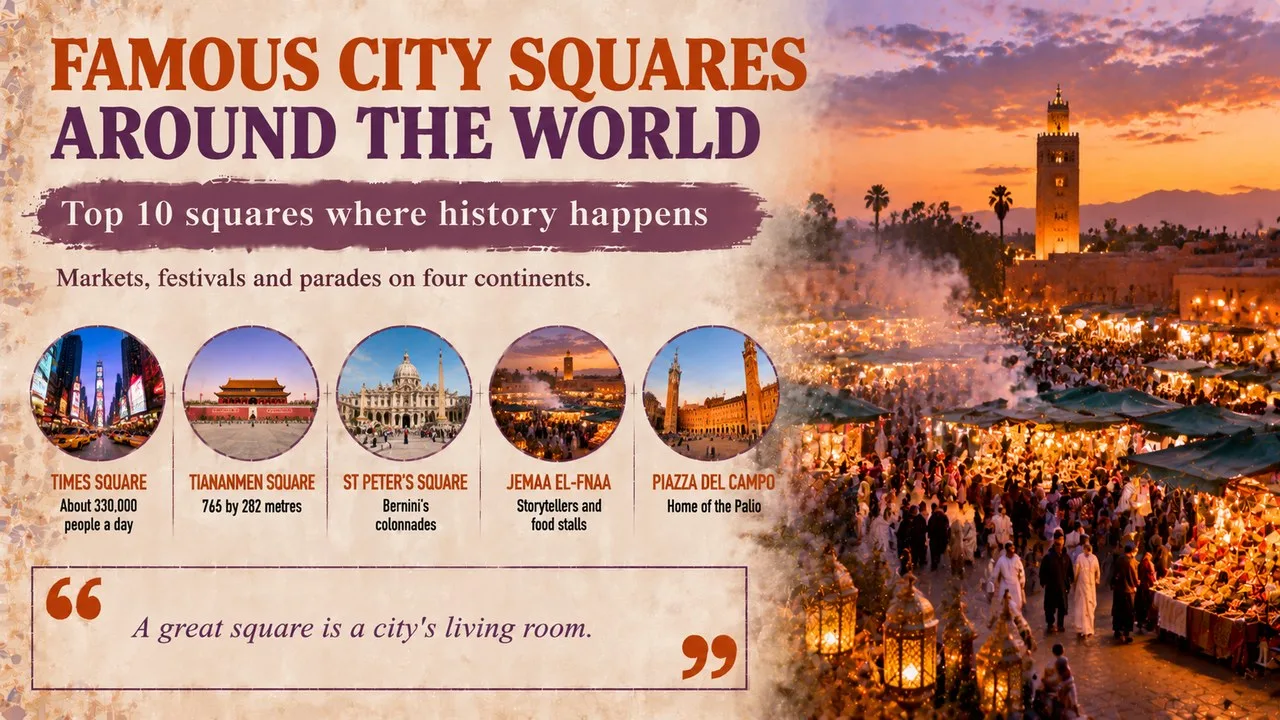
Famous city squares around the world range from Beijing's vast Tiananmen Square to the fan-shaped Piazza del Campo in Siena, each a stage for history.
This Finepedia guide, written in October 2026, profiles 10 of the best-known public squares on four continents, from Times Square in New York to the Zócalo in Mexico City. For each one we explain where it is, how it grew and what still happens there today. For more on great places to explore on foot, see the Finepedia guides Famous Clock Towers Around the World: Top 10 and Best-Preserved Medieval Towns in Europe: Top 10.
How We Chose These
We looked for squares that are famous far beyond their own country, that have shaped national history and that still draw large crowds. Size alone was not enough: a small square with centuries of festivals can matter as much as a huge parade ground. Red Square in Moscow and Old Town Square in Prague are left out here because their landmark towers already feature in our clock towers guide, so we added Isfahan's Naqsh-e Jahan Square and the Grand-Place in Brussels instead. Sizes and dates come from Wikipedia and UNESCO, checked against official city and tourism sources. The order is a guide, not a scientific ranking.
The 10 Famous City Squares at a Glance
| Rank | Square | City | Known for |
|---|---|---|---|
| 1 | Times Square | New York, USA | bright billboards and New Year's Eve |
| 2 | Tiananmen Square | Beijing, China | huge size and national ceremonies |
| 3 | St Peter's Square | Vatican City | Bernini's colonnades and papal blessings |
| 4 | Trafalgar Square | London, UK | Nelson's Column and the fourth plinth |
| 5 | Jemaa el-Fnaa | Marrakesh, Morocco | storytellers, musicians and food stalls |
| 6 | Zócalo | Mexico City, Mexico | Aztec roots and national celebrations |
| 7 | Piazza del Campo | Siena | the Palio horse race |
| 8 | Naqsh-e Jahan Square | Isfahan, Iran | Safavid mosques and palace |
| 9 | Grand-Place | Brussels, Belgium | guildhalls and the flower carpet |
| 10 | Plaza de Mayo | Buenos Aires | the Casa Rosada and the Mothers' marches |
1. Times Square Never Goes Dark
Times Square sits where Broadway crosses Seventh Avenue at 42nd Street in Midtown Manhattan. Giant digital screens light it up day and night, and it anchors the Theater District, home to the bulk of Broadway's stages. Together with Duffy Square it forms a bowtie-shaped plaza that runs for five blocks.
Key Facts
- Former name: Longacre Square, renamed in 1904
- Daily foot traffic: roughly 330,000 people
- Yearly visitors: an estimated 50 million
- Famous tradition: the New Year's Eve ball, first lowered on 31 December 1907
Did You Know?
The square took its name from The New York Times, which moved into a new tower there in 1904. That building, now One Times Square, is where the famous ball still descends at midnight each New Year's Eve, watched by around a million people in person.
2. Tiananmen Square Is a Vast National Stage
Tiananmen Square lies in central Beijing, just south of the Gate of Heavenly Peace that leads to the Forbidden City. Around it stand the Great Hall of the People, Mao's mausoleum, an obelisk honouring revolutionary heroes and the country's national museum.
Key Facts
- Size: about 765 by 282 metres, or roughly 21.6 hectares
- First laid out: 1651, then made four times larger in the 1950s
- Key date: Mao Zedong proclaimed the new communist state here on 1 October 1949
- Daily ritual: the national flag is raised at sunrise and lowered at sunset
Why It Matters
The square has seen many turning points in modern Chinese history, from the May Fourth Movement of 1919 to the 1976 Tiananmen incident. Abroad it is best remembered for the 1989 protests, which were crushed by the army and remain heavily censored inside China.
3. St Peter's Square Embraces the Faithful
St Peter's Square spreads before the great basilica of the Vatican, the world's smallest independent state. Gian Lorenzo Bernini reshaped it in the 17th century for Pope Alexander VII, so that huge crowds could watch the pontiff bless them.
Key Facts
- Designer: Gian Lorenzo Bernini
- Colonnades: Tuscan columns arranged four deep in two great curving arms
- Centrepiece: an ancient Egyptian obelisk, moved to the spot in 1586
- Fountains: one by Carlo Maderno (1613) and a matching one by Bernini (1675)
Did You Know?
Bernini described his sweeping colonnades as the open arms of the Church welcoming visitors. On big feast days and at papal events the oval space fills with tens of thousands of pilgrims from around the world.
4. Trafalgar Square Honours Nelson
Trafalgar Square in Westminster, central London, is named after the 1805 naval battle in which Britain's fleet defeated France and Spain. Nelson's Column rises from its centre, and the National Gallery lines its northern edge.
Key Facts
- Opened: 1844, after plans by John Nash were finished by others
- Nelson's Column: about 52 metres tall
- Fourth plinth: has shown changing modern artworks since 1999
- Christmas tree: a gift from Norway every year since 1947
Why It Matters
For centuries, road distances from London have been measured from Charing Cross, just south of the square. Trafalgar Square has hosted rallies, protests and celebrations, from anti-war marches to New Year's Eve crowds.
5. Jemaa el-Fnaa Comes Alive at Night
Jemaa el-Fnaa is the main square of the old walled medina in Marrakesh, Morocco. By day it is busy with orange juice sellers, water carriers and snake charmers; as evening falls, rows of open-air food stalls appear and storytellers and musicians draw circles of listeners.
Key Facts
- Location: the medina of Marrakesh
- UNESCO honour: proclaimed a masterpiece of oral and intangible heritage in 2001
- Name: its meaning is unclear and may refer to a ruined or unfinished mosque
- Highlight: evening food stalls and live performers
Did You Know?
Worries that traditional storytellers here were vanishing helped inspire UNESCO's whole programme for protecting living traditions. The square was among the very first places honoured when that list began in 2001.
6. The Zócalo Stands on Aztec Ground
The Zócalo is the main square of Mexico City, built over the ceremonial heart of the Aztec capital Tenochtitlan. Officially it is called Plaza de la Constitución, and it is lined by the Metropolitan Cathedral and the National Palace.
Key Facts
- Size: about 240 by 240 metres, or 57,600 square metres
- Official name: Plaza de la Constitución
- Nearby ruin: the Templo Mayor, one block away
- Use: national celebrations, concerts and protests
Did You Know?
The word zócalo means plinth. A monument to independence was planned for the square, but only its base was ever built, and the nickname stuck. Many other Mexican towns now call their own main squares a zócalo too.
7. Piazza del Campo Hosts the Palio
Piazza del Campo is the central square of Siena in Tuscany, shaped like an open fan and sloping gently down towards the Palazzo Pubblico and its tall Torre del Mangia. It is often called one of the finest medieval squares in Europe.
Key Facts
- Shape: a fan divided into nine sections
- Main building: the Palazzo Pubblico, Siena's town hall
- Fountain: the Fonte Gaia, first built in 1419
- World Heritage: inside Siena's UNESCO-listed old centre (1995)
Why It Matters
Twice every summer, on 2 July and 16 August, riders from Siena's districts race bareback around the edge of the square in the Palio. The race lasts little more than a minute, yet locals spend the whole year preparing for it.
8. Naqsh-e Jahan Square Shows Off Safavid Isfahan
Naqsh-e Jahan Square, whose name means Image of the World, lies at the centre of Isfahan in Iran. Shah Abbas the Great built it after moving his capital to the city, and grand Safavid buildings frame all four sides.
Key Facts
- Built: between 1598 and 1629
- Size: about 160 by 560 metres, or 89,600 square metres
- Landmarks: the Shah Mosque, Sheikh Lotfollah Mosque, Ali Qapu Palace and the entrance to the Grand Bazaar
- Status: a UNESCO World Heritage Site
Did You Know?
The square appears on the back of Iran's 20,000 rial banknote. In Safavid times the open ground served as a polo field, and the shahs watched matches and horse races from the upper galleries of the Ali Qapu Palace.
9. The Grand-Place Is Brussels' Golden Heart
The Grand-Place is the historic hub of Brussels, surrounded by richly decorated guildhalls, the Gothic Town Hall and the King's House, home of the Brussels City Museum. It is the city's most visited landmark.
Key Facts
- Size: about 68 by 110 metres, fully paved
- Destroyed: largely flattened by French cannon fire in 1695
- World Heritage: listed by UNESCO in 1998
- Festival: a giant carpet of flowers covers the centre every other August
Why It Matters
When French guns pounded the city in 1695, the Town Hall's tower and front survived, partly because the gunners used it as a target. The guilds rebuilt their halls within a few years, giving the square the ornate look visitors admire today.
10. Plaza de Mayo Is Argentina's Political Heart
Plaza de Mayo is the chief public space of Buenos Aires, facing the Casa Rosada, the office of Argentina's president. It took its present form in 1884, when two older plazas were joined, and it is named after the May Revolution of 1810.
Key Facts
- Formed: 1884
- Monument: the May Pyramid, put up in 1811 as the city's first national monument
- Neighbours: the Casa Rosada, the Cabildo and the Metropolitan Cathedral
- Famous protest: the Mothers' marches, which began in 1977
Why It Matters
During the military dictatorship, mothers whose children had been taken by the regime began walking around the square with photos of the missing. Their weekly vigil turned the plaza into a worldwide symbol of the fight for human rights.
Frequently Asked Questions
Which city square is the biggest?
Tiananmen Square in Beijing is often named as one of the largest city squares on Earth, covering more than 21 hectares. Some newer plazas elsewhere claim a bigger area, so the title depends on how a square is defined.
Which square has the most visitors?
Times Square in New York is among the most visited places on the planet, with an estimated 50 million visitors a year and about 330,000 people passing through on a typical day.
Conclusion
From neon-lit Manhattan to the storytellers of Marrakesh, these ten squares show how open public spaces bring cities to life. Each one has been a market, a stage and a meeting place, and most still are. For more on great places to explore on foot, read the Finepedia guides Famous Clock Towers Around the World: Top 10 and Best-Preserved Medieval Towns in Europe: Top 10.
- UNESCO World Heritage Centre: Meidan Emam, Esfahan; Grand-Place, Brussels; Historic Centre of Siena.
- UNESCO Intangible Cultural Heritage: Cultural space of Jemaa el-Fna Square.
- Times Square Alliance, pedestrian counts and history.
- Royal Parks and Greater London Authority, Trafalgar Square history.
- Wikipedia (accessed October 2026): Times Square, Tiananmen Square, St. Peter's Square, Trafalgar Square, Jemaa el-Fnaa, Zócalo, Piazza del Campo, Naqsh-e Jahan Square, Grand-Place and Plaza de Mayo.
- 10 Most Today, 10 Most Famous City Squares in the World, 10mosttoday.com (topic reference).














Log in with