












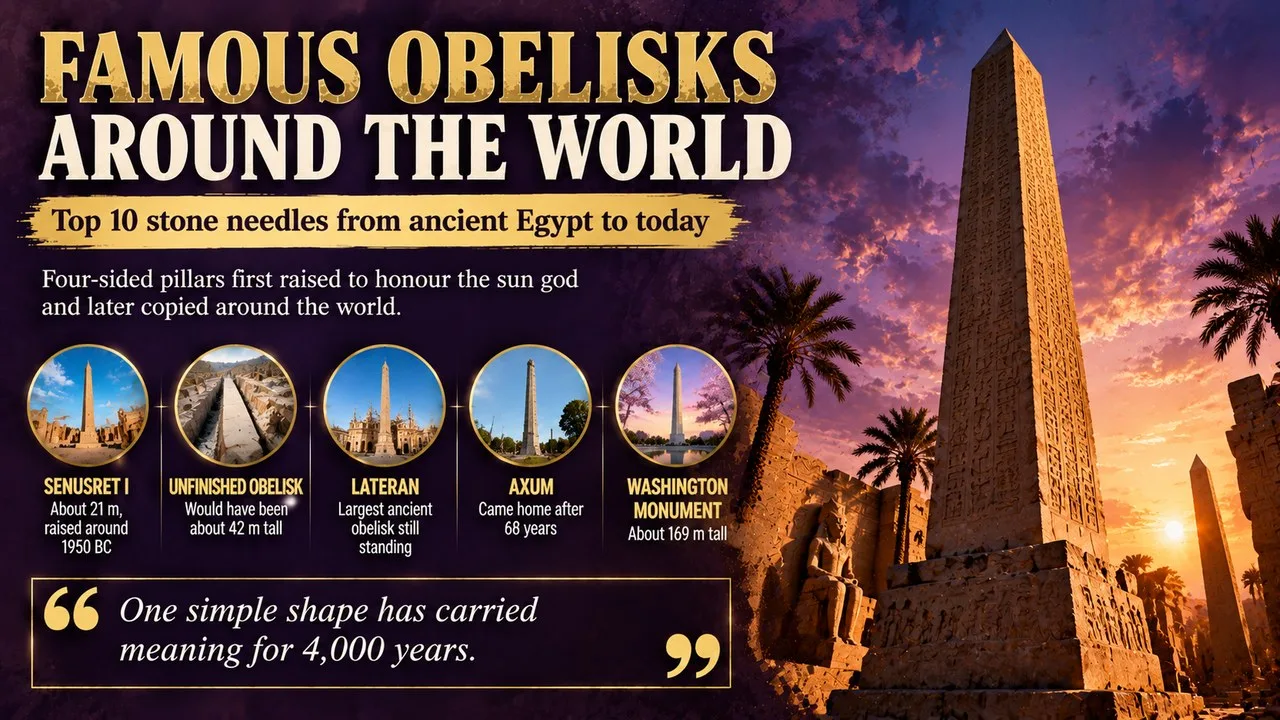
Famous obelisks are tall, four-sided stone pillars with pointed tops, first raised in Egypt to honour the sun god and later copied around the world.
This Finepedia guide, written in October 2026, looks at 10 of the most famous obelisks on Earth, from a 4,000-year-old pillar in Cairo to a modern landmark in Buenos Aires. Many of the ancient ones have travelled far from home, and their journeys are part of their story. The facts come from museum and heritage records, encyclopaedias and archaeological studies, and where dates or weights are estimates we say so. If you are drawn to the ancient world, you may also enjoy Finepedia's guides to the entire history of Egypt and famous tombs and mausoleums.
How We Chose These
An obelisk is a tall, narrow pillar with four sides that taper to a small pyramid at the top, called a pyramidion. The ancient Egyptians usually carved each one from a single block of granite and set them in pairs at temple gates. We chose ten that stand out for their age, size, journey or symbolism, including one ancient stele that is famous as an obelisk. They are in rough chronological order, by when each was made. For each one you will find a short story, four key facts and a closer look at why it matters.
The 10 Obelisks at a Glance
| No. | Obelisk | Where it stands now | Made | Height |
|---|---|---|---|---|
| 1 | Obelisk of Senusret I | Cairo, Egypt | about 1950 BC | about 21 m |
| 2 | Hatshepsut's obelisk | Karnak, Luxor, Egypt | about 1450s BC | about 29 m |
| 3 | Unfinished Obelisk | Aswan, Egypt | about 1450s BC | about 42 m if finished |
| 4 | Lateran Obelisk | Rome, Italy | about 1400 BC | about 32 m |
| 5 | Cleopatra's Needles | London and New York | about 1450 BC | about 21 m |
| 6 | Luxor Obelisk | Paris, France | about 1250 BC | 23 m |
| 7 | Vatican Obelisk | Vatican City | unknown, ancient Egypt | 25.3 m |
| 8 | Obelisk of Axum | Axum, Ethiopia | 4th century AD | 24 m |
| 9 | Washington Monument | Washington, D.C., USA | 1848 to 1884 | 169 m |
| 10 | Obelisco de Buenos Aires | Argentina | 1936 | 67.5 m |
1. The Obelisk of Senusret I Is the Oldest Still Standing
This red granite obelisk stands where the great sun-temple city of Heliopolis once was, now buried under the suburbs of north-east Cairo. Senusret I, a pharaoh of the Middle Kingdom, raised it, along with a twin that has since been lost, at the temple of Ra-Atum around 1950 BC. It is about 21 metres tall and weighs about 120 tonnes.
Key Facts
- Location: Al-Matariyyah, Cairo, Egypt
- Raised by: Senusret I, Middle Kingdom
- Height: about 21 m
- Weight: about 120 tonnes
Why It Matters
It is thought to be the oldest obelisk in the world still standing in its original place. Heliopolis was the main centre of sun worship in Egypt, and obelisks were closely linked to the sun god, so it is fitting that the oldest survivor stands here. Most of the ancient city now lies many metres below the modern streets, and archaeologists are still finding statues and temple remains there.
2. Hatshepsut Raised the Tallest Obelisks of Her Age
Hatshepsut, one of the few women to rule Egypt as pharaoh, set up a pair of obelisks at the temple of Amun at Karnak, in today's Luxor, in the 15th century BC. No obelisks anywhere were taller when they went up. One still stands, at about 29 metres second only to the Lateran Obelisk among ancient obelisks still upright, while its twin has fallen and broken in two.
Key Facts
- Location: Karnak Temple, Luxor, Egypt
- Built for: Pharaoh Hatshepsut
- Height of the standing obelisk: about 29 m
- Overseer: the high steward Amenhotep
Did You Know?
After Hatshepsut's death, her stepson Thutmose III had walls built around the base of her obelisks, hiding the lower parts from view. The walls actually helped protect the carvings, which is one reason the standing obelisk is so well preserved. Its official in charge was Amenhotep, a high steward of the queen, and scenes at her temple at Deir el-Bahari show the giant stones being carried down the Nile on barges.
3. The Unfinished Obelisk Shows How They Were Made
In the granite quarries of Aswan, in southern Egypt, lies the largest ancient obelisk ever attempted. It was probably ordered under Hatshepsut. If it had been finished, it would have stood about 42 metres tall and weighed close to 1,090 tonnes, nearly a third larger than any obelisk the Egyptians ever raised. But cracks appeared in the stone as the workers cut it out, and the project was abandoned. Its underside never came free of the rock beneath it.
Key Facts
- Location: northern quarries, Aswan, Egypt
- Planned height: about 42 m
- Planned weight: about 1,090 tonnes
- Studied in detail: 1922, by Reginald Engelbach
Why It Matters
Because it was never finished, it gives a rare view of how obelisks were made. Tool marks and red ochre lines left by the workers can still be seen. The quarry is part of the Nubian Monuments UNESCO World Heritage Site and is open to visitors as an outdoor museum.
4. The Lateran Obelisk Is the Largest Ancient Obelisk Still Standing
The Lateran Obelisk was carved at Karnak around 1400 BC. Thutmose III began it, but it lay unfinished for decades until his grandson Thutmose IV completed and raised it, and at about 32 metres it was then the tallest obelisk in Egypt. In the 4th century AD the Roman emperors moved it first to Alexandria and then, in 357, to Rome, where it was set up in the Circus Maximus.
Key Facts
- Made: about 1400 BC, at Karnak
- Brought to Rome: AD 357, by Constantius II
- Re-erected: 1588, by Domenico Fontana
- Weight today: about 300 tonnes
Why It Matters
After the Circus Maximus fell out of use, the obelisk toppled, broke and was buried. In the 1580s Pope Sixtus V had it dug up, repaired and raised near the Archbasilica of St John Lateran, topped with a cross. It once weighed about 413 tonnes. It is now about 4 metres shorter than it once was, but it is still the largest ancient Egyptian obelisk standing anywhere.
5. Cleopatra's Needles Were Split Between London and New York
Cleopatra's Needles are a pair of obelisks first raised at Heliopolis and carved with inscriptions of Thutmose III and, later, Ramesses II. In 13 or 12 BC the Romans moved them to Alexandria, where they stood for almost 2,000 years. Despite the name, Cleopatra played no part in their story; she lived more than 1,000 years after they were made. The nickname came from European travellers.
Key Facts
- Made: around 1450 BC, at Heliopolis
- London needle: re-erected 1878, Victoria Embankment
- New York needle: re-erected 1881, Central Park
- Height: about 21 m each
Did You Know?
The London needle was towed across the sea inside a specially built iron cylinder. During a storm in the Bay of Biscay in 1877 it had to be cut loose, and six sailors died trying to help. The cylinder was later found drifting and recovered, and the obelisk finally reached London the next year. In New York the second needle stands in Central Park, just behind the Metropolitan Museum of Art.
6. The Luxor Obelisk Was a Gift to France
Two obelisks once stood at the gate of Luxor Temple, carved for Ramesses II around 1250 BC. In the 1830s Egypt gave one of them to France, and the French scholar Jean-François Champollion, who had cracked the code of hieroglyphs, urged the government to choose these. The 23 metre obelisk reached the French capital in 1833 and was raised in the great Paris square called the Concorde in 1836, while its twin still stands in Luxor.
Key Facts
- Made: about 1250 BC, for Ramesses II
- Height: 23 m
- Raised in Paris: 1836, Place de la Concorde
- Idea first raised: by French officers under Napoleon, 1799
Did You Know?
The east and west faces of the two Luxor obelisks are slightly curved outward, which is not known on any other ancient obelisk, and nobody is sure why. A gold-leaf cap was placed on its tip in 1998, replacing one that is thought to have been lost in ancient times. In return for the gift, France sent Egypt a mechanical clock, which still sits in the Citadel of Cairo.
7. The Vatican Obelisk Has Never Fallen
The Vatican Obelisk is a plain red granite pillar, 25.3 metres tall, with no hieroglyphs at all. According to the Roman writer Pliny, it came from Heliopolis. Around AD 40 the emperor Caligula brought it across the sea and placed it in a racing circus later linked with Nero. Of all the ancient obelisks in Rome, it alone has stood without ever falling.
Key Facts
- Location: St Peter's Square, Vatican City
- Height: 25.3 m, almost 40 m with base and cross
- Brought to Rome: about AD 40, by Caligula
- Moved: 10 September 1586
Why It Matters
In 1586 Pope Sixtus V had it moved about 260 metres to the front of St Peter's. The engineer Domenico Fontana spent 13 months preparing, then used some 800 workers, 160 horses and dozens of winches to shift it in a single day. No ancient obelisk in Rome had been moved since antiquity, and the feat made Fontana famous.
8. The Obelisk of Axum Came Home After 68 Years
The Obelisk of Axum is a 24 metre stone stele, weighing about 160 tonnes, carved in the 4th century AD by people of the Kingdom of Aksum in what is now northern Ethiopia. Strictly speaking it is a stele, a grave marker, not an Egyptian-style obelisk. It is decorated with false doors and windows, like a tall carved tower house, and ends in a rounded top. Hundreds of smaller stelae stand in fields around the city, and the largest of all, the Great Stele, about 33 metres long, probably fell soon after it was put up.
Key Facts
- Location: Axum, Ethiopia
- Made: 4th century AD
- Height: 24 m
- Weight: about 160 tonnes
Why It Matters
In 1937, during the Italian occupation of Ethiopia, the stele was taken to Rome as war loot and set up there. After decades of campaigning, its pieces were flown back to Ethiopia in April 2005, and it was later reassembled in Axum. Its return became a powerful symbol of the return of cultural treasures.
9. The Washington Monument Is the Giant of Obelisks
Built to honour George Washington, the first US president, the Washington Monument rises over the grassy Mall at the heart of the capital and stands about 169 metres tall. Work began in 1848 but stopped in 1854, when money ran out, and did not restart until 1877 because of political quarrels and then the Civil War. The stone shaft was finished in 1884.
Key Facts
- Location: National Mall, Washington, D.C.
- Height: about 169 m (555 ft)
- Built: 1848 to 1884, with a long pause
- Materials: marble facing over granite
Did You Know?
Look closely and you can see that the bottom third is a slightly different shade from the rest, because the marble used after the pause came from different quarries. When it was completed, it was the tallest structure in the world, until the Eiffel Tower overtook it in 1889.
10. The Obelisco de Buenos Aires Was Built in 31 Days
The Obelisco stands where Avenida Corrientes crosses the very wide Avenida 9 de Julio, two of the city's main roads. It was put up in 1936 to mark 400 years since the city's first founding, and it was designed by the architect Alberto Prebisch. Made of reinforced concrete faced with white stone, it is 67.5 metres tall, and 157 workers completed it in just 31 days.
Key Facts
- Location: Plaza de la República, Buenos Aires
- Built: 1936, in 31 days
- Height: 67.5 m
- Inside: a single staircase of 206 steps
Why It Matters
At first many people disliked it, and in 1939 the city council even voted to pull it down, but the decision was overturned. Today it is the best-known symbol of Buenos Aires and the place where crowds gather to celebrate football victories and other big events.
Frequently Asked Questions
What were obelisks used for?
In ancient Egypt, obelisks were linked to the sun god Ra and were usually set in pairs at temple entrances. Their inscriptions praised the gods and the pharaoh who raised them. Later, people around the world copied the shape for monuments and memorials.
Why are so many Egyptian obelisks outside Egypt?
Roman emperors shipped many to Rome as symbols of power, and in the 19th century others were given or taken to cities such as Paris, London and New York. As a result, Rome is often said to have more ancient obelisks than any other city in the world.
Conclusion
From the 4,000-year-old pillar of Senusret I to the concrete Obelisco of Buenos Aires, these ten obelisks show how one simple shape has carried meaning for thousands of years. Some, like the Lateran and Luxor obelisks, travelled across seas, while the Obelisk of Axum's journey home became a story of justice. For more ancient history, read Finepedia's guides to the entire history of Egypt and famous tombs and mausoleums.
- Habachi, Labib (1977), The Obelisks of Egypt: Skyscrapers of the Past, Charles Scribner's Sons, New York.
- Curran, Brian and others (2009), Obelisk: A History, Burndy Library, Cambridge, Massachusetts.
- UNESCO World Heritage Centre, Nubian Monuments from Abu Simbel to Philae (list no. 88) and Aksum (list no. 15).
- US National Park Service, Washington Monument history.
- Encyclopaedia Britannica, entries on obelisks, Cleopatra's Needle and the Washington Monument.
- Wikipedia (accessed October 2026), articles on Heliopolis, Hatshepsut, the Unfinished Obelisk, the Lateran Obelisk, Cleopatra's Needle, the Luxor Obelisks, the Vatican Obelisk, the Obelisk of Axum, the Washington Monument and the Obelisco de Buenos Aires.
- 10 Most Today, 10 Awesome Obelisks From Around the World, 10mosttoday.com (topic reference).


















Log in with