



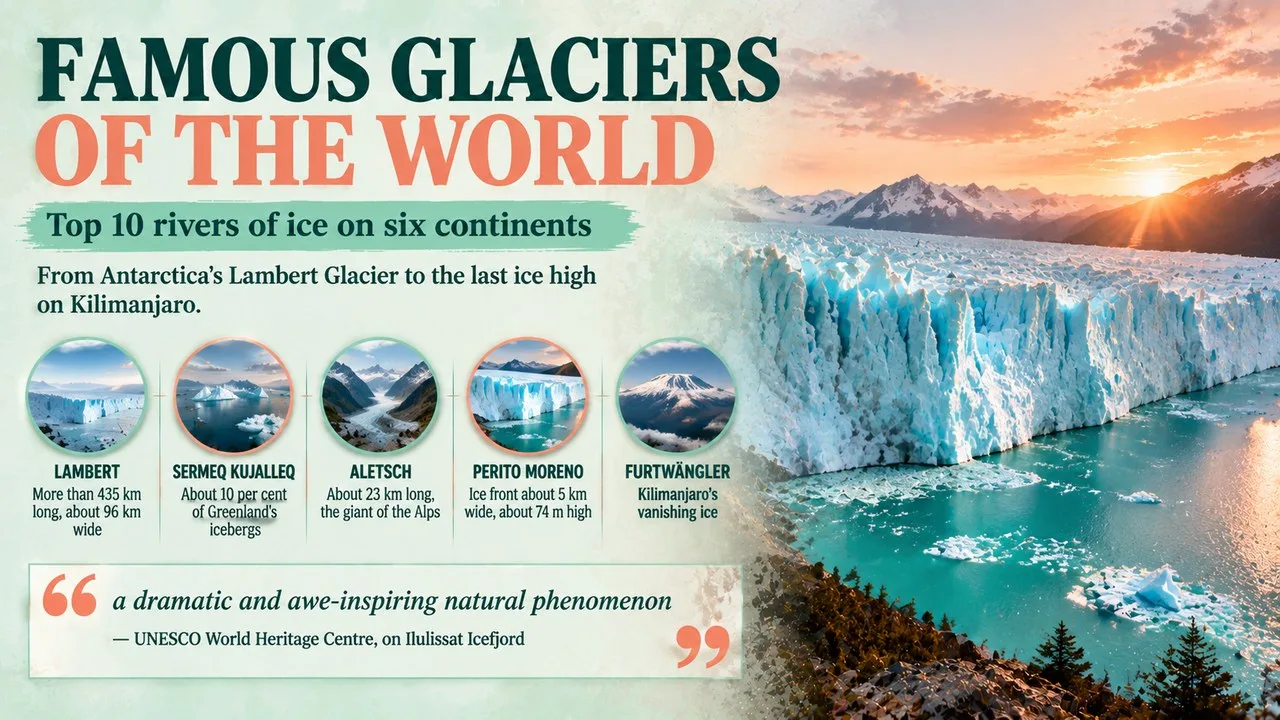
Famous glaciers are vast rivers of ice that carve valleys and feed rivers, from Antarctica's Lambert Glacier to the last shrinking ice high on Kilimanjaro.
This Finepedia guide, written in October 2026, looks at 10 of the world's most remarkable glaciers on six continents. The facts come from glaciology studies, national parks, UNESCO and encyclopaedias, and because glaciers change every year, we give the date of a measurement where it matters. If you enjoy the wild corners of our planet, you may also like Finepedia's guides to Lake Vostok, the largest lake hidden under Antarctic ice, and Mount Everest.
How We Chose These
A glacier is a mass of ice, built up from snow over many years, that moves slowly under its own weight. We chose ten that stand out for their size, their speed, their beauty, or what they tell scientists about a warming climate. We have tried to cover very different kinds of ice, from a giant Antarctic ice stream to small tropical ice fields. They are grouped roughly from the poles towards the equator. For each one you will find a short profile, four key facts and a closer look at why it matters.
The 10 Glaciers at a Glance
| No. | Glacier | Country or region | Type | Known for |
|---|---|---|---|---|
| 1 | Lambert Glacier | East Antarctica | ice stream | largest glacier on Earth |
| 2 | Sermeq Kujalleq | Greenland | outlet glacier | one of the fastest glaciers |
| 3 | Vatnajökull | Iceland | ice cap | volcanoes beneath the ice |
| 4 | Hubbard Glacier | Alaska and Yukon | tidewater glacier | advancing, not retreating |
| 5 | Aletsch Glacier | Switzerland | valley glacier | largest glacier in the Alps |
| 6 | Mer de Glace | France | valley glacier | the Sea of Ice above Chamonix |
| 7 | Baltoro Glacier | Pakistan | valley glacier | gateway to K2 |
| 8 | Perito Moreno Glacier | Argentina | lake-ending glacier | dramatic ice-dam collapses |
| 9 | Franz Josef Glacier | New Zealand | temperate glacier | ice close to a rainforest |
| 10 | Furtwängler Glacier | Tanzania | summit ice field | vanishing ice on Kilimanjaro |
1. Lambert Glacier Is the Largest Glacier on Earth
Lambert Glacier flows through East Antarctica towards the Amery Ice Shelf and the sea at Prydz Bay. It is about 96 km wide, more than 435 km long and around 2,500 metres deep, which makes it the largest glacier in the world. On its own it drains about 8 per cent of the Antarctic ice sheet.
Key Facts
- Location: East Antarctica
- Length: more than 435 km
- Width: about 96 km
- Named for: Bruce Lambert, Australia's Director of National Mapping
Did You Know?
American aerial photographs taken in 1946 and 1947 first revealed the glacier, and a US geographer called it Baker Three Glacier after the code name of the aircraft. The name Lambert Glacier, chosen by Australia after its own mapping in 1956, is the one that stuck. The glacier flows along a deep valley in the rock beneath the ice and feeds the Amery Ice Shelf, one of the largest floating ice shelves in East Antarctica.
2. Sermeq Kujalleq Sends Icebergs Into the Atlantic
Sermeq Kujalleq, also known as the Jakobshavn or Ilulissat Glacier, flows out of the Greenland ice sheet near the town of Ilulissat on the west coast. It drains about 6.5 per cent of the ice sheet and produces around a tenth of all Greenland's icebergs, some of them so tall that they scrape the bottom of the fjord and stay stuck for years.
Key Facts
- Location: Ilulissat, West Greenland
- Share of Greenland icebergs: about 10 per cent
- Speed: over 45 m a day on average at its front (2012 to 2013)
- UNESCO: Ilulissat Icefjord listed in 2004
Why It Matters
Scientists have studied this glacier for more than 250 years, and it is among the fastest-moving and fastest-shrinking glaciers on Earth. Icebergs from it are thought to have added about 4 per cent of the rise in world sea level during the 20th century, which is one reason UNESCO protected its fjord. Danish geologist Hinrich Rink described it in scientific writing as early as 1853, and its speed roughly tripled between the 1990s and 2012.
3. Vatnajökull Hides Volcanoes Under the Ice
Vatnajökull, whose name means glacier of lakes, covers about 7,700 square kilometres in south-east Iceland, roughly 8 per cent of the country. It is Iceland's largest ice cap and holds about 3,000 cubic kilometres of ice, with an average thickness of 380 metres and up to 950 metres in places. Iceland's highest peak, Hvannadalshnjúkur, rises on its southern edge.
Key Facts
- Location: south-east Iceland
- Area: about 7,700 square km
- Maximum ice thickness: about 950 m
- Protection: part of Vatnajökull National Park since 2008
Why It Matters
Vatnajökull sits on top of active volcanoes, including Grímsvötn. When they erupt under the ice, they melt huge pockets of water that can burst out in sudden floods called jökulhlaups. A flood of this kind from Grímsvötn in 1996 swept across the plain to the south and washed away parts of the coastal road. A much bigger flood in 1934 released around 15 cubic kilometres of water over several days.
4. Hubbard Glacier Is Growing, Not Shrinking
Hubbard Glacier flows from the high peaks on the border of Alaska and Canada's Yukon down to Disenchantment Bay, a journey of about 122 km from its farthest source. While most glaciers around the world are retreating, Hubbard has been slowly advancing for about a century. Its towering ice front regularly breaks off in huge chunks, a process called calving.
Key Facts
- Location: Alaska, USA, and Yukon, Canada
- Longest source: about 122 km from its front
- Behaviour: advancing for about a century
- Named after: Gardiner Hubbard
Did You Know?
In May 1986 the glacier surged forward and blocked the mouth of Russell Fjord, turning it into a lake. Over the summer the water rose about 25 metres, until the ice dam burst in October. In one day roughly 5.3 cubic kilometres of water rushed out, one of the largest floods from a glacial lake ever recorded.
5. Aletsch Is the Giant of the Alps
No glacier in the Alps is bigger than the Great Aletsch, which lies in the Swiss region of Valais. In 2014 it was about 23 km long, and four smaller glaciers meet at a broad basin called Konkordiaplatz, where the ice has been measured at up to about 905 metres thick. The glacier and the mountains around it, including the Jungfrau, form a UNESCO World Heritage Site.
Key Facts
- Location: Valais, Switzerland
- Length: about 23 km (2014)
- Greatest thickness: about 905 m, at Konkordiaplatz
- UNESCO: Jungfrau-Aletsch listed in 2001
Why It Matters
Like most glaciers today, Aletsch is shrinking. Since 1870 its front has pulled back by about 3.2 km, and it has lost more than 300 metres of thickness, making it a clear measure of climate change in the Alps. Its meltwater feeds the Massa river, which flows on into the Rhône valley.
6. The Mer de Glace Is the Sea of Ice Above Chamonix
The Mer de Glace, or Sea of Ice, pours down the north side of Mont Blanc, high above the valley of Chamonix. On its own it is about 7.5 km long, but if the glaciers that feed it are counted too, no glacier in France is bigger, and only Aletsch is longer anywhere in the Alps. Visitors have come to see it since the 18th century, and a rack railway has carried them up to the viewpoint at Montenvers since 1908.
Key Facts
- Location: Mont Blanc massif, France
- Length: about 7.5 km, or 12 km with its feeders
- Depth: about 200 m
- Thinning: about 30 cm a year from 1939 to 2001
Did You Know?
Mary Shelley set two meetings between Victor Frankenstein and his creature on the Mer de Glace in her 1818 novel Frankenstein. The glacier has been thinning for decades, so the stairs that lead visitors down to the ice grow longer as the surface sinks.
7. The Baltoro Glacier Leads to K2
The Baltoro Glacier lies in the Karakoram mountains of Gilgit-Baltistan in northern Pakistan, one of the longest glaciers outside the polar regions. Around it rise some of the highest mountains on Earth, including K2, the world's second-highest peak at 8,611 metres, with three more peaks above 8,000 metres within 20 km.
Key Facts
- Location: Karakoram, Gilgit-Baltistan, Pakistan
- Highest neighbour: K2, 8,611 m
- Key junction: Concordia, at about 4,600 m
- Meltwater: feeds the Braldo River, part of the Indus basin
Why It Matters
Concordia, where the Baltoro meets the Godwin-Austen Glacier, is one of the most famous trekking spots in the world, with views of several giant peaks. Studies between 2001 and 2011 found that the Baltoro is not simply retreating but surging and shifting, part of a wider puzzle known as the Karakoram anomaly.
8. Perito Moreno Puts On a Show of Falling Ice
The Perito Moreno Glacier in Los Glaciares National Park, Argentina, draws its ice from the huge Southern Patagonian Ice Field shared with Chile. It covers about 250 square kilometres and is about 30 km long, ending in a wall of ice about 5 km wide that rises around 74 metres above the water of Lake Argentino. Walkways let visitors watch huge blocks of ice crash into the lake.
Key Facts
- Location: Santa Cruz Province, Argentina
- Area: about 250 square km
- Ice front: about 5 km wide, about 74 m high
- Name: honours the 19th-century explorer Francisco Moreno
Did You Know?
From time to time the glacier pushes across the lake and cuts off one arm of it. Water then builds up behind the ice until it bursts through in a spectacular rupture. This first happened in 1917 and has happened many times since. For decades the glacier was unusually stable, but since 2020 its northern edge has started to pull back.
9. Franz Josef Glacier Comes Down Close to a Rainforest
On the wet western side of the South Island, the 12 km Franz Josef Glacier pours out of the high Southern Alps inside a national park named Westland Tai Poutini. It and its neighbour, Fox Glacier, reach down below 300 metres above the sea, where the ice ends among lush temperate rainforest. The area is part of the Te Wāhipounamu World Heritage Site.
Key Facts
- Location: West Coast, South Island, New Zealand
- Length: about 12 km
- Lowest point: under 300 m above sea level
- Named: in 1865, in honour of the Austrian emperor
Did You Know?
Its Māori name, Kā Roimata o Hine Hukatere, means the tears of Hine Hukatere. In the legend, her lover was swept to his death by an avalanche, and her tears flowed down the mountain until the sky father froze them into ice. Since 1998 the glacier has officially carried both names. Like Fox Glacier, it advances and retreats in cycles, depending on how much snow falls high on the mountain compared with how much ice melts at the bottom.
10. Furtwängler Glacier Is Kilimanjaro's Vanishing Ice
Furtwängler Glacier clings to the top of Kilimanjaro, Africa's highest mountain, just a few hundred kilometres south of the equator. It is a small leftover of the ice cap that once covered the mountain's top, and it takes its name from Walter Furtwängler, a German climber who reached the summit in 1912. About 85 per cent of Kilimanjaro's ice cover disappeared between 1912 and 2011.
Key Facts
- Location: summit of Kilimanjaro, Tanzania
- Area in 1976: about 113,000 square m
- Area in 2018: about 11,000 square m
- Outlook: most of Kilimanjaro's ice may be gone by about 2040
Why It Matters
In 2006 scientists found a hole that went right through the glacier's remaining 6 metres of ice, and by 2007 it had split the glacier in two. Its rapid loss has made it one of the best-known symbols of shrinking tropical glaciers. Researchers think the ice on Kilimanjaro is disappearing mainly because the air at the summit has become drier and less snow falls, so sunlight wears the ice away faster than it can be replaced.
Frequently Asked Questions
Which glacier is the biggest in the world?
Lambert Glacier in East Antarctica is generally named as the largest, at about 96 km wide and over 435 km long. The Antarctic and Greenland ice sheets are far bigger, but they are counted as ice sheets rather than single glaciers.
Are all glaciers shrinking?
Nearly all glaciers on Earth are losing ice as the climate warms, but not all. A few, such as Hubbard in Alaska, are advancing for local reasons, and some in the Karakoram have been stable or surging.
Conclusion
From the giant Lambert Glacier to the last ice on Kilimanjaro, these ten glaciers show both the power of moving ice and how quickly it can disappear. Some, like Perito Moreno and the Mer de Glace, draw visitors from around the world, while others, like Sermeq Kujalleq and Furtwängler, help scientists measure a changing climate. For more of Earth's wild places, read Finepedia's guides to Lake Vostok and Mount Everest.
- World Glacier Monitoring Service, global glacier change reports.
- UNESCO World Heritage Centre, Ilulissat Icefjord (list no. 1149) and Swiss Alps Jungfrau-Aletsch (list no. 1037).
- US Geological Survey, Hubbard Glacier and the 1986 Russell Fjord flood.
- Thompson, L. G. and others (2009), Glacier loss on Kilimanjaro continues unabated, Proceedings of the National Academy of Sciences, vol. 106.
- Vatnajökull National Park, official information.
- Encyclopaedia Britannica, entries on Lambert Glacier, Vatnajökull, Aletsch Glacier and the Baltoro Glacier.
- Wikipedia (accessed October 2026), articles on Lambert Glacier, Sermeq Kujalleq, Vatnajökull, Hubbard Glacier, Aletsch Glacier, Mer de Glace, Baltoro Glacier, Perito Moreno Glacier, Franz Josef Glacier and Furtwängler Glacier.
- 10 Most Today, 10 Most Amazing Glaciers in the World, 10mosttoday.com (topic reference).















Log in with