






 By
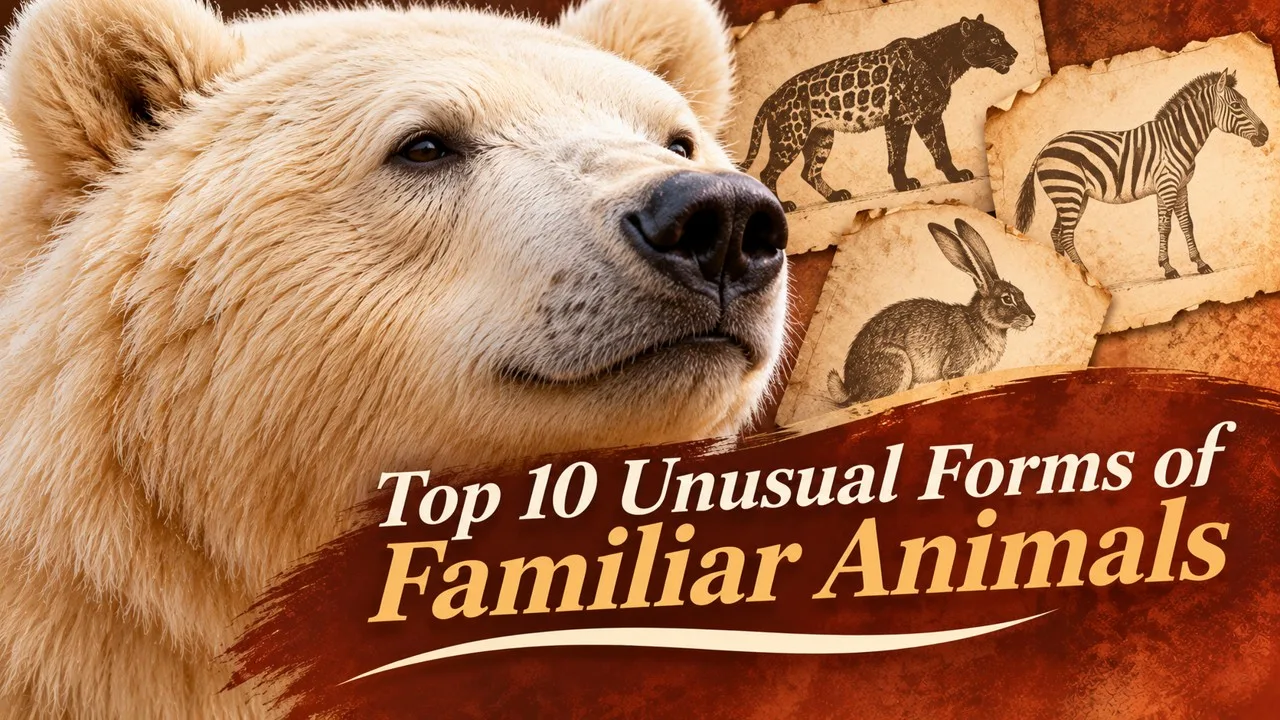
Familiar animal groups include some rare or odd forms, from a cream-colored bear morph to a sand-swimming golden mole.
A "version" of a familiar animal can be a separate endangered species, a debated canid, or, in one case, a color morph of a species everyone already knows. The ten entries below are a hirola, a mouse-tailed dormouse, the Siamese crocodile, the Javan rhinoceros, a finless porpoise, the silky sifaka, the spoon-billed sandpiper, the red wolf, the Kermode or spirit bear, and De Winton's golden mole, treated here as a body plan, not as a rediscovery headline. This article does not invent hunting scenes, and it does not borrow faces from films.
Key Facts
| Item | What is unusual | What to keep cautious |
|---|---|---|
| 1 | The hirola is a distinct, critically endangered antelope of the Kenya–Somalia borderlands, with a characteristic face and horns | It is not a color morph of a common safari antelope |
| 2 | Roach's mouse-tailed dormouse is a rare European and Turkish dormouse with a slim, mouse-like tail | A scarce woodland rodent, not a novelty pet |
| 3 | The Siamese crocodile is a critically endangered freshwater species of Southeast Asia | It is not "the closest living dinosaur," and birds are living dinosaurs |
| 4 | The Javan rhinoceros is a one-horned species now restricted to a single park | A tiny remaining population, not a zoo staple |
| 5 | Finless porpoises lack a dorsal fin and include a critically endangered Yangtze form | A true porpoise, not a small dolphin with the fin removed |
| 6 | The silky sifaka is a white, critically endangered lemur of northeastern Madagascar | No film character is a source, or a likeness, here |
| 7 | The spoon-billed sandpiper has a spatulate bill and a very small global population | A breeding and stopover conservation story, not a curiosity of the bill alone |
| 8 | The red wolf is a canid of the southeastern United States whose species status is still debated | Taxonomy is open; the conservation problem is not |
| 9 | The spirit, or Kermode, bear is a cream-colored morph of the American black bear | A genetic color form, not a separate white-bear species |
| 10 | De Winton's golden mole is a sand-swimming, nearly eyeless animal with an iridescent coat | This section is about the body plan; a recent confirmation that it still lives is a different story |
1. An Antelope That Is Its Own Line
The hirola, Beatragus hunteri, lives in a narrow range on the Kenya–Somalia border and is often called one of the world's most endangered antelopes [1]. It is not a rare paint job on an impala or a hartebeest. It is placed in its own genus, with lyre-shaped horns and a face whose dark markings and preorbital glands give it a look that field guides try, and usually fail, to reduce to a more familiar species [1].
The unexpected fact is how easy it is, in a general "antelope" category, to miss that some forms are not versions at all. They are last remaining populations of a separate line [1]. This article will not stage a chase, and it will not treat a conservation crisis as a safari postcard. The careful fact is a distinct, critically endangered antelope, a small remaining range, and a reminder that "unusual form" can mean "almost gone." Habitat loss, hunting pressure, and the shrinking of a borderland grassland are the usual pressures named in the literature.
A hirola is not a common antelope in a new coat. It is a scarce animal with its own name, which is the whole point of listing it.
2. A Dormouse With a Slim Tail
Roach's mouse-tailed dormouse, Myomimus roachi, is a rare rodent of southeastern Europe and western Turkey [2]. Unlike the familiar hazel dormouse, with its brushed tail, this species has a slimmer, more mouse-like tail, which is why it sits oddly in the popular idea of a dormouse. It is nocturnal, hard to census, and of conservation concern across a fragmented range of woodland and scrub [2].
The unexpected fact is that "dormouse" is already a mixed group, and the mouse-tailed forms are a reminder that the fluffy-tailed storybook animal is not the whole family [2]. This article will not treat the species as a cute mascot, and it will not offer a keeping guide. The careful fact is a scarce European dormouse with a distinctive tail, a thin observational record, and a habitat problem that is more important than the tail. A rarity in a familiar family is still a rarity.
A tail can be the field mark. The conservation status is the reason the field mark matters.
3. A Freshwater Crocodile, Not a Dinosaur Label
The Siamese crocodile, Crocodylus siamensis, is a freshwater species of Southeast Asia that has disappeared from most of its historical range and is now critically endangered in the wild [3]. It is smaller than the better-known saltwater crocodile, and it has been reduced by habitat loss and by hunting, including for farms. Remaining wild animals are the conservation story, not a nightmare poster [3].
Related: Top 10 Extraordinary Lizards of the World
The unexpected fact, on a list of "unusual versions," is how often crocodiles are still introduced as leftover dinosaurs. Crocodilians are archosaurs, and they have a deep fossil history, but the living animals that are dinosaurs are birds [3]. This article will not use a dinosaur slogan as a substitute for a species account, and it will not describe an attack. The careful fact is a critically endangered freshwater crocodile, a collapsed wild range, and a body plan that is distinctive without being mythical. Captive populations exist; they do not automatically restore a river.
A crocodile can be rare and still be a crocodile. The decent correction is to drop the dinosaur shorthand and keep the endangered river.
4. A One-Horned Rhinoceros With Almost No Range Left
The Javan rhinoceros, Rhinoceros sondaicus, is a one-horned species that once ranged more widely in Southeast Asia and now survives in a single stronghold, Ujung Kulon National Park, in Java [4]. It is related to, and not the same as, the greater one-horned rhinoceros of the Indian subcontinent. The remaining wild population is counted in the tens, which makes it one of the rarest large mammals on the planet [4].
The unexpected fact is how easily a zoo-goer's idea of "the rhinoceros" erases this species. Most people who can picture a rhinoceros are picturing an African or a greater one-horned animal, not a Javan one in a Javan park [4]. This article will not describe poaching in graphic terms, and it will not treat a horn as a prize. The careful fact is a distinct species, a single remaining site, and a conservation program that has to protect that site as if there were no other. An unusual form, in this case, is almost a last form.
A rhinoceros can be famous as a shape and almost unknown as a species. The Javan animal is the second of those facts.
5. A Porpoise That Has No Fin to Spot
Finless porpoises, in the genus Neophocaena, are small toothed whales that lack the dorsal fin that most people use, at a glance, to recognize a porpoise or a dolphin [5]. They are true porpoises, with the spade-shaped teeth of the group, not dolphins with a missing part. Coastal and river forms exist in Asia, and the Yangtze finless porpoise is critically endangered, a freshwater population under the same kind of pressure that already erased the baiji as a living river cetacean [5].
The unexpected fact is that a missing fin is both a field character and a conservation problem: an animal that is harder to see, in a river that is harder to live in [5]. This article will not confuse the porpoise with a dolphin, and it will not treat the Yangtze form as a cute mascot. The careful fact is an unusual, well-named body plan and a river population that official assessments treat as a crisis. A familiar marine group can have a freshwater edge that is almost gone.
Related: Top 10 Wild Members of the Dog Family
A porpoise without a fin is still a porpoise. The unusual outline is the easy part; the river is the hard part.
6. A White Sifaka, and No Film Stand-In
The silky sifaka, Propithecus candidus, is a large lemur of the humid forests of northeastern Madagascar, with a creamy or white coat that makes it look, from a distance, unlike the ring-tailed lemur that dominates popular images of the group [6]. It is critically endangered. Logging, hunting, and a small remaining range are the usual pressures in the conservation literature [6].
The unexpected fact is how completely a single movie lemur can stand in, for many viewers, for more than a hundred lemur species, including this one [6]. This article will not use a film character, and it will not treat a white coat as a fantasy animal. The careful fact is a distinct, critically endangered sifaka, a narrow forest range, and a reminder that "unusual form of a familiar animal" can mean "the familiar animal was already a stand-in." Madagascar's primate fauna is older and more various than a popular silhouette.
A white lemur is not a costume. It is a species with a remaining forest, which is the only setting this list needs.
7. A Bill Shaped Like a Spoon, and a Tiny Population
The spoon-billed sandpiper, Calidris pygmaea, is a small wader whose bill broadens into a spoon or spatula, a shape unlike the fine bills of most sandpipers [7]. It breeds in a remote Arctic range in Russia and migrates to coasts in South and Southeast Asia. The global population is very small, and the species is critically endangered, with habitat loss on the staging and wintering grounds among the main threats [7].
The unexpected fact is that the bill, which is why the bird makes lists of odd forms, is not the reason it is almost gone. Coastal development along the migration route is [7]. This article will not treat the bill as a cartoon, and it will not offer a site as a destination. The careful fact is a distinctive, well-documented bill, a counted and declining population, and a conservation story that now includes head-starting and habitat protection. An unusual form can be a flag for a flyway, not only for a field guide.
Related: Top 10 Animals Once Thought Extinct That Turned Up Alive
A spoon at the end of a bill is a feeding tool. The emergency is the path between the breeding ground and the winter coast.
8. A Canid Whose Name Is Still Argued
The red wolf, Canis rufus, is a canid historically associated with the southeastern United States and now present in the wild mainly through a reintroduction in North Carolina and through intense management [8]. Its status as a distinct species, as a lineage close to the grey wolf, or as a historical mix with coyotes, has been argued for decades in genetic and morphological papers. That argument is real, and it is not settled in a single popular sentence [8].
The unexpected fact is that a taxonomic debate can be misused as if the animals themselves were a fiction. They are not [8]. A managed population can need a name and a legal status even while the papers continue. This article will not pretend the species question is closed, and it will not treat hybridization as a scandal scene. The careful fact is a conservation-dependent canid, an open taxonomic file, and a southeastern history that is more than a zoo label. Unusual, here, includes the possibility that the familiar words "wolf" and "coyote" do not carve the animal up cleanly.
A red wolf can be debated as a species and still be an animal that official programs are trying to keep on the ground.
9. A Cream Coat on a Black Bear
The spirit bear, or Kermode bear, of coastal British Columbia is a cream or white color morph of the American black bear, Ursus americanus, not a separate species and not, in the usual case, an albino [9]. A recessive genetic variant, in some island and coastal populations, produces the pale coat. The animal has deep importance for some Indigenous communities of the region, and it has become a symbol of the Great Bear Rainforest [9].
The unexpected fact, for a list of unusual forms, is that this is the one entry that really is a version of a familiar species, in the strict sense [9]. A pale coat can look like a different bear at a distance and still be a black bear at the museum label. This article will not treat the bear as a mythical creature, and it will not use a person's likeness or a territorial flag. The careful fact is a well-studied color morph, a coastal population, and a cultural significance that a natural-history list can name without turning the bear into a mascot. Salmon, forest, and isolation are part of the ecological story often told around the morph.
Related: Top 10 Species That Survived Against the Odds
A white bear in that forest is usually a black bear in a cream coat. The coat is rare. The species is not.
10. A Sand-Swimming Mole, Listed Here for Its Body
De Winton's golden mole, Cryptochloris wintoni, is a tiny, nearly eyeless mammal of coastal sands in South Africa, with the dense, iridescent coat and sand-swimming habits of the golden-mole family [10]. Golden moles are not true moles; they are afrotherian mammals, more closely related, at a distance, to animals such as elephant shrews than to the talpid moles of the Northern Hemisphere. The eyes are covered, the ears are hidden, and the animal moves through sand in a way that makes a "mole" comparison both useful and misleading [10].
The unexpected fact, on this particular list, is that the same species has also been discussed as a rediscovery, after years with no confirmed sighting. That is a different article's emphasis [10]. This section is about the body plan: a glittering coat, a lack of external ears and functional exposed eyes, and a life in sand. This article will not treat the animal as a grotesque, and it will not retell a search as a miracle. The careful fact is an unusual afrotherian body, a narrow coastal habitat, and a reminder that "familiar animal" was already the wrong family name.
A golden mole can look like a mole and belong to another branch of mammals. The unusual form is the anatomy, which is enough.
Conclusion
The ten forms above are a distinct endangered antelope, a rare mouse-tailed dormouse, a freshwater crocodile that is not a dinosaur slogan, a Javan rhinoceros with one remaining park, a finless porpoise, a white sifaka, a spoon-billed sandpiper, a debated red wolf, a cream morph of the black bear, and a sand-swimming golden mole listed here for its body, not for a rediscovery headline. Unusual, in this list, is sometimes a species, sometimes a morph, and sometimes a mistaken familiar name.
A fair list of odd forms keeps the taxonomy honest, leaves film faces and hunts off the page, and does not confuse a coat color with a new animal, or a new animal with a coat color.
- ^ [1] Conservation and zoological accounts of the hirola, Beatragus hunteri, as a distinct, critically endangered antelope of the Kenya–Somalia borderlands. Britannica: antelope IUCN Red List
- ^ [2] Zoological accounts of Roach's mouse-tailed dormouse, Myomimus roachi, as a rare dormouse of southeastern Europe and western Turkey. Britannica: dormouse IUCN Red List
- ^ [3] Species and conservation accounts of the Siamese crocodile, with the dinosaur shorthand rejected in favor of a standard archosaur placement. Britannica: crocodile IUCN Red List
- ^ [4] Conservation accounts of the Javan rhinoceros as a distinct one-horned species now restricted largely to Ujung Kulon. Britannica: rhinoceros IUCN Red List
- ^ [5] Zoological and conservation accounts of finless porpoises, including the critically endangered Yangtze form, as true porpoises without a dorsal fin. Britannica: porpoise IUCN Red List
- ^ [6] Conservation accounts of the silky sifaka as a critically endangered lemur of northeastern Madagascar, without film likenesses. Britannica: sifaka IUCN Red List
- ^ [7] Species accounts of the spoon-billed sandpiper, including its spatulate bill, Arctic breeding range, and critically low global population. Britannica: sandpiper IUCN Red List
- ^ [8] Scientific and official discussions of the red wolf, Canis rufus, including an ongoing taxonomy debate and a conservation-dependent southeastern population. Britannica: red wolf U.S. Fish and Wildlife Service: red wolf
- ^ [9] Biological accounts of the Kermode or spirit bear as a cream-colored morph of the American black bear in coastal British Columbia, not as a separate species. Britannica: black bear Wikipedia: Kermode bear
- ^ [10] Biological accounts of De Winton's golden mole and of golden moles as sand-swimming afrotherians, with this entry focused on anatomy rather than on a rediscovery narrative. Britannica: golden mole Wikipedia: De Winton's golden mole




















Discussion
Log in with