





Top 10 Mass Wildlife Die-Offs Science Has Tried to Explain
 By Dhiraj Sharma · Published
Share Post
Loading…
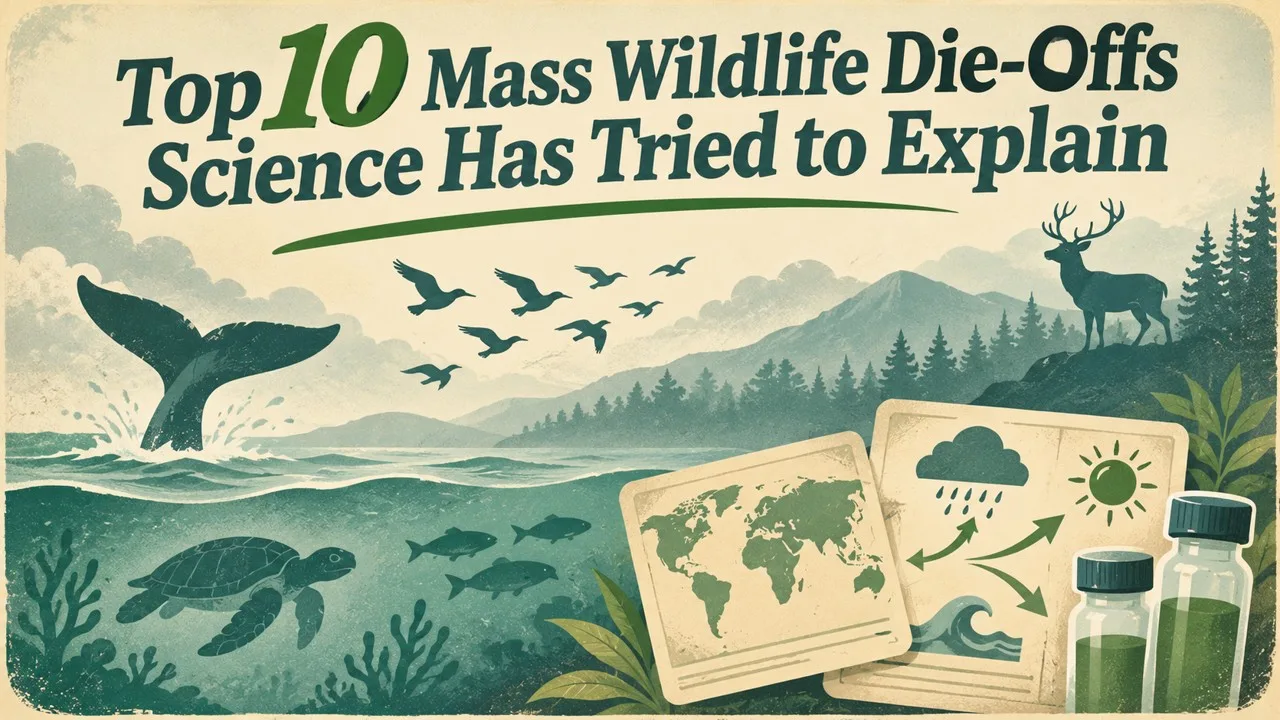
Science has explained some mass wildlife die-offs and left others in honest debate; neither result needs an end-of-days plot.
A large number of dead animals in one place is a scientific problem, not a prophecy. The ten events below have been examined by wildlife agencies, veterinarians, or published research. Some now have a leading mechanism, such as a marine heat wave, a harmful algal bloom, or a well-studied fungus. Others still have competing official accounts. This article does not describe carcasses in detail, and it does not treat a pathogen as a recipe. Where a number is an estimate, it is labeled as one.
Key Facts
| Item | Leading account | What remains cautious |
|---|---|---|
| 1 | Beebe, Arkansas, 31 December 2010: thousands of red-winged blackbirds died of trauma after being startled at night | A nearby fish kill was bundled into the same headlines and was not explained the same way |
| 2 | Common murres, 2014–2016, northeastern Pacific: mass starvation during the marine heat wave nicknamed the Blob | Beach counts are a lower bound; a widely cited estimate is about a million birds |
| 3 | Caspian seals, Dagestan, December 2022: thousands of carcasses were counted | Official accounts later split among infection, gas, and still-open inquiry |
| 4 | Sea-star wasting, from 2013, Pacific coast of North America | A syndrome with early viral leads, later bacterial and warming work, not a single closed story |
| 5 | Southern Chile, 2016: harmful algal blooms hit farmed salmon and, later, other coastal life | Tonnage figures are industry and official estimates, not a single census of the sea |
| 6 | Okavango area, Botswana, 2020: hundreds of elephants died; authorities pointed to cyanobacterial toxins in pans | The finding is the official leading explanation, not a laboratory lesson |
| 7 | Kazakhstan, May 2015: around 200,000 saiga antelope died in weeks | Research points to pasteurellosis in unusual heat and humidity, described here only in outline |
| 8 | Gulf of Penas, Chile, 2015: hundreds of sei whales; a harmful bloom is the leading hypothesis | The count is from surveys, and the toxin path is inferred, not filmed |
| 9 | The chytrid fungus Batrachochytrium dendrobatidis and global amphibian declines | A decades-long panzootic, not a single week's mystery, and not a culture protocol |
| 10 | Highly pathogenic H5 avian influenza in wild birds and poultry since 2020 | A continuing panzootic described at a high level, without methods or enhancement talk |
1. A Night of Startled Birds, Not a Prophecy
On the night of 31 December 2010, in and around Beebe, Arkansas, several thousand red-winged blackbirds died over a small area [1]. Wildlife investigators found trauma consistent with birds that had been flushed from a roost in the dark and had struck trees, houses, and other objects. New Year fireworks were widely discussed as the startle, and later radar work supported a sudden night-time departure from a roost [1]. A poison rumor did not hold up in the official account of the birds.
The unexpected fact is how quickly a local trauma event was bundled, in headlines, with a separate fish kill on the Arkansas River, where tens of thousands of freshwater drum were reported dead around the same season [1]. The fish were not explained by the same collision story, and their cause was left more open. This article will not describe internal injuries, and it will not treat two winter wildlife events as a single omen. The careful fact is a documented night-time startle and collision, a confirmed trauma finding for the birds, and a nearby fish kill that should not be forced into the same sentence as a miracle or a curse.
A town can have a shocking morning after fireworks. The decent explanation is ordinary and local, which is less exciting than an end-of-days plot and much closer to the evidence.
2. Murres, Warm Water, and Empty Foraging
Between 2014 and 2016 a large patch of unusually warm water, nicknamed the Blob, sat over much of the northeastern Pacific [2]. Common murres, which need energy-rich prey, washed up emaciated along coasts from California to Alaska. Researchers counted tens of thousands of carcasses on beaches and estimated that the true toll was far higher, on the order of a million birds, making it one of the largest murre die-offs on record [2].
The unexpected fact is how slowly a heat wave becomes a bird disaster. Warm water can shift or shrink forage fish, and a diving bird that looks healthy one month can starve when the prey field fails [2]. This article will not treat a nickname as a monster, and it will not linger on strandings. The careful fact is a marine heat wave, a well-studied seabird, and a published starvation account. The Blob is a physical oceanographic event with a wildlife consequence, not a riddle from outside science.
A warm patch of ocean is not a metaphor. For a murre, it can be an empty pantry at a continental scale.
3. A Caspian Count, and Competing Official Stories
In early December 2022, unusually large numbers of dead Caspian seals were reported along the Dagestan coast of the Caspian Sea, with later tallies in official and news accounts rising toward about 2,500 animals [3]. The Caspian seal is already a threatened species, so a mass stranding of that size is a conservation emergency as well as a forensic one. Early inspections did not show an obvious single wound pattern that would settle the case at a glance [3].
Related: Top 10 Bioluminescent Sea Animals That Use Light to Survive
The unexpected fact is that the official story did not close cleanly. Russia's veterinary service reported that tests on its samples did not confirm influenza or a list of other infections; a university group discussed avian influenza as a preliminary idea; a prosecutor's office later described a burst of natural gas, and oxygen loss, as a working hypothesis [3]. This article will not pretend those statements are the same finding, and it will not turn a virus name into a method. The careful fact is a large, documented mortality, a threatened endemic seal, and an investigation whose leading accounts still disagreed in public. A later debate is not a failure of science. It is what an incomplete file looks like.
A count of carcasses is a starting point. The honest sentence, for now, is that the 2022 Caspian event remains a case with more than one official explanation.
4. A Wasting Syndrome, Not a Spell
From 2013, divers and intertidal observers along the Pacific coast of North America began recording sea stars with lesions, collapsed bodies, and rapid death, in a die-off that eventually involved many species from Mexico to Alaska [4]. Sunflower stars and other well-known species declined sharply in large parts of their range. Researchers described a wasting syndrome rather than a single, instantly identified poison [4].
The unexpected fact is how the leading mechanism has shifted as papers have accumulated. An early line of work associated a densovirus with diseased stars; later studies have emphasized warming, microbial change, and, in at least one 2025 study, a bacterium as a cause for a particular species [4]. This article will not use "melting" as a spectacle, and it will not offer a culture protocol. The careful fact is a geographically huge, multi-species outbreak, a genuine conservation loss, and a mechanism that is still being refined. A syndrome can be real while the last word on the agent is not yet in.
A sea star that falls apart is a pathology, and a pathology is a research problem. It is not a curse on a coastline.
5. Red Tide, Farms, and a Wider Bloom Year
In early 2016, southern Chile, especially the Los Lagos salmon-farming region, suffered a severe harmful algal bloom that killed a large tonnage of farmed salmon, with industry and official figures often cited around 40,000 tons [5]. Later that season, further blooms and mass deaths of other marine animals, and a bitter social crisis on Chiloé over closed fisheries, made the year more than a single farm accident. Warm conditions associated with a strong El Niño were widely discussed as a background factor [5].
The unexpected fact is that "red tide" is a popular name for several kinds of bloom, not one pigment with one toxin, and that farm losses and wild die-offs should not be collapsed into a single number [5]. This article will not list toxins as a recipe, and it will not treat a protest as a footnote to a spectacle. The careful fact is a documented bloom year, a serious blow to a major farmed-salmon industry, and a coastal community that felt the effects in closed beds and lost work. The sea did not end. A production system and a set of wild populations were hit hard in a warm year.
Related: Top 10 Unusual Octopus Species
A bloom can be measured in tons and in closed seasons. Those are calmer units than a graveyard metaphor, and they are the ones the record actually supports.
6. Water Pans, and a Cyanobacteria Finding
In 2020, between March and June, Botswana's wildlife authorities recorded around 330 to 350 elephant deaths in the Seronga area, near the Okavango Delta [6]. Poaching was an early suspicion, but tusks were left and the pattern did not fit a hunting story. In September 2020 the Department of Wildlife and National Parks said the leading explanation was neurotoxins from cyanobacteria, sometimes called blue-green algae, in seasonal water pans. Officials also said the deaths eased as pans dried [6].
The unexpected fact is how local the mechanism is, if the official account holds: a drinking source, a bloom in still water, and a species that must drink [6]. This article will not describe neurological signs in a clinical list, and it will not explain how a toxin is isolated. Anthrax and deliberate poisoning were discussed and, in official statements, set aside. The careful fact is a well-reported mortality, a government finding that points to contaminated pans, and a remaining duty to treat that finding as a leading explanation, not as a closed book for every individual animal.
An elephant die-off can look like a riddle from a distance. Up close, in this case, it was investigated as a water problem, which is already a serious enough sentence.
7. A Steppe Die-Off With a Named Bacterium
In May 2015, on the steppes of Kazakhstan, around 200,000 saiga antelope died in about three weeks, a loss on the order of 60 percent of the world population at the time [7]. Observers described animals that had appeared healthy and then collapsed in large groups near calving aggregations. A later research paper in Science Advances pointed to hemorrhagic septicemia associated with Pasteurella, in a herd already carrying the bacterium, under an unusual combination of heat and humidity [7].
The unexpected fact is that a familiar bacterium, rather than a new plague from nowhere, can become a catastrophe when weather and dense calving coincide [7]. This article will not describe a septic process as a guide, and it will not treat the event as a rehearsal for human disease. The careful fact is a quantified mass mortality, a published leading mechanism, and a species that has since been the subject of intensive conservation work. The 2015 die-off is one of the best-documented terrestrial wildlife catastrophes of the century, which is a reason to cite the paper, not a reason to dramatize it.
Related: Top 10 Species That Survived Against the Odds
A saiga is a cold-adapted antelope on an open steppe. The 2015 deaths are a scientific event with a weather trigger and a named agent, told here only in outline.
8. A Fjord of Sei Whales, and a Bloom Hypothesis
In 2015, aerial and field surveys in the Gulf of Penas, in Chilean Patagonia, recorded hundreds of dead sei whales, with published counts of more than 300 animals, among the largest baleen-whale mass mortalities on record [8]. The site is remote, so the event was found after the fact, from the air and from later visits, rather than watched in real time. Researchers have pointed to a harmful algal bloom as the leading hypothesis, based on the setting, the timing, and supporting environmental evidence [8].
The unexpected fact is that a "graveyard" headline can hide a fairly ordinary scientific inference: a dense group of whales, a productive but risky bloom, and a toxin path that is better supported than a mysterious stranding cult [8]. This article will not inventory bodies, and it will not claim a toxin assay that the papers do not claim. The careful fact is a surveyed mortality of sei whales, a published bloom hypothesis, and an event that is large without being supernatural. Later years have seen further attention to harmful blooms in high-latitude waters, which is context, not a prediction.
A remote fjord can hold a tragic count. The decent account is a survey and a hypothesis, not an apocalypse in a tourist sentence.
9. A Fungus, a Skin, and a Long Panzootic
For decades, the chytrid fungus Batrachochytrium dendrobatidis, often abbreviated Bd, has been central to a global decline of frogs, toads, and their relatives [9]. The fungus infects the skin, and amphibians depend on the skin for water and salt balance. A major synthesis has estimated that the disease is implicated in the decline of hundreds of species and in the presumed extinction of dozens, a scale that makes this a panzootic rather than a local oddity [9].
The unexpected fact, on a list of sudden die-offs, is that this one is not a single week and not a single river. It is a long, geographically scattered emergency, with different species and regions hit at different times, and with climate, trade in amphibians, and local conditions all discussed as parts of the spread [9]. This article will not explain how the fungus is grown or moved, and it will not offer a treatment as medical or veterinary advice. The careful fact is a named pathogen, a documented conservation disaster, and a research literature that is still working on why some species collapse and others persist.
Related: Top 10 Lasting Traces of Nuclear Testing
A fungus on a skin can empty a mountain stream of its frogs. That sentence is already grave enough without a timetable for the end of the world.
10. A Continuing Bird-Flu Panzootic, Told in Outline
Since 2020, a highly pathogenic H5 avian influenza lineage, often discussed as clade 2.3.4.4b, has spread through wild birds across large parts of the world and has caused enormous losses in poultry [10]. It reached North America in late 2021 after severe outbreaks in Europe, and it has continued to circulate, with further die-offs in wild birds and, in some places, infections in mammals. Officials and researchers have used the word panzootic for the scale of the wildlife event [10].
The unexpected fact is not that influenza viruses move in birds. It is that this lineage has remained in wild populations in a way earlier high-pathogenic outbreaks often did not, which is why the story did not end with one winter [10]. This article will not discuss laboratory work, enhancement, or any method of handling a virus. It will not give farm or household advice. The careful fact is a documented, multi-year circulation, a severe cost to poultry and to some wild species, and a public-health watch that belongs to official agencies. The list can name the event without pretending to be a manual.
A panzootic is a wildlife and agricultural fact. The calm way to put it on a list is to cite the official picture, keep the mechanism at a high level, and stop.
Conclusion
The ten events above are a New Year bird trauma in Arkansas, a murre starvation during a Pacific heat wave, a Caspian seal count with competing official stories, a sea-star wasting syndrome still under study, a Chilean bloom year, an elephant mortality tied by authorities to toxic pans, a saiga die-off with a published bacterial trigger, a sei-whale survey in Patagonia, a decades-long amphibian chytrid panzootic, and a continuing H5 influenza event in birds. Some of those sentences now have a leading mechanism. Some do not.
A mass die-off is a reason to read the investigation. It is not a reason to announce the end of the world, and it is not a reason to explain how a pathogen is made or moved.
- ^ [1] Official and scientific accounts of the 31 December 2010 red-winged blackbird mortality at Beebe, Arkansas, including trauma after a night-time startle, and of a nearby, less settled fish kill. Smithsonian: blackbird deaths explained NPR: bird deaths mostly solved
- ^ [2] Research on common-murre mortality during the 2014–2016 northeastern Pacific marine heat wave, including beach counts and a larger estimated toll from starvation. USGS: seabird die-off and warming ocean Wikipedia: the Blob
- ^ [3] Reporting and official statements on the December 2022 Caspian seal mortality in Dagestan, including disagreed veterinary, university, and prosecutorial accounts of infection or gas. TASS: gas bursts as a working hypothesis Frontiers review of pinnipeds and avian influenza
- ^ [4] Scientific overviews of sea-star wasting along the Pacific coast of North America from 2013, including early viral associations, later warming and microbial work, and continuing research on agents. Britannica: sea star Wikipedia: sea star wasting disease
- ^ [5] Accounts of the 2016 harmful algal blooms in southern Chile, including losses of farmed salmon in Los Lagos and later coastal effects, with tonnage treated as an official or industry estimate. Britannica: harmful algal bloom Wikipedia: 2016 Chilean algal bloom
- ^ [6] Official Botswana statements and contemporary reporting on the 2020 elephant deaths near Seronga and the leading explanation of cyanobacterial toxins in water pans. BBC: elephant deaths and cyanobacteria Reuters: toxins in water
- ^ [7] Published research and conservation accounts of the May 2015 saiga mass mortality in Kazakhstan, including a leading pasteurellosis mechanism under unusual heat and humidity. Science Advances: saiga mass mortality Britannica: saiga
- ^ [8] Survey publications and summaries of the 2015 sei-whale mortality in the Gulf of Penas, Chilean Patagonia, with a harmful algal bloom as the leading hypothesis. Wikipedia: sei whale Britannica: harmful algal bloom
- ^ [9] Scientific syntheses of amphibian declines associated with Batrachochytrium dendrobatidis, treated as a long panzootic and not as a laboratory method. Britannica: chytridiomycosis Science: amphibian chytrid panzootic
- ^ [10] Official and scientific overviews of highly pathogenic H5 avian influenza in wild birds and poultry since 2020, described at a high level without methods. World Organisation for Animal Health: avian influenza CDC: avian influenza situation




















Discussion
Log in with