







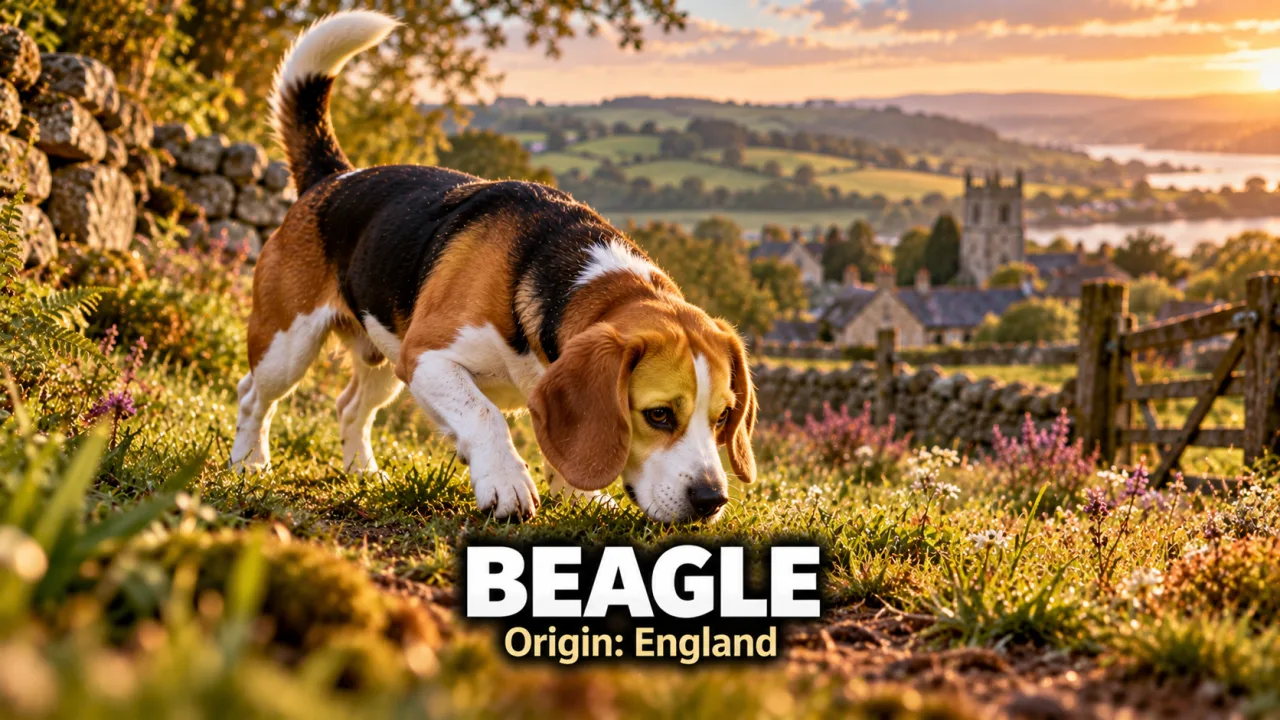
The Beagle is a British breed of scent hound, built like a smaller version of the Foxhound. It was bred mainly to hunt rabbit and hare, a sport known as beagling, and the modern breed took shape in Great Britain around the 1830s from older hounds that probably included the Talbot Hound, the North Country Beagle, the Southern Hound and possibly the Harrier.[1]
Beagles are compact, sturdy, short-coated dogs with long, soft ears, a white-tipped tail and one of the keenest noses of any breed. That sense of smell makes them useful as detection dogs at airports and borders, where they search luggage for banned food and farm products. Their gentle, sociable nature has also made them one of the most popular family dogs in North America.[1][6][7]
The breed is recognised by the Federation Cynologique Internationale (FCI) as standard No. 161 and by the American Kennel Club (AKC) in two size varieties. In 2025 it ranked seventh among AKC-registered breeds.[2][3]
This profile is part of Finepedia's Dog Breeds of the World guide, which covers every major dog family from ancient times to today.
Key Facts
| Attribute | Details |
|---|---|
| Origin | Great Britain |
| Original purpose | Hunting hare and rabbit in packs (beagling) |
| FCI classification | Group 6 (Scent hounds and related breeds), Section 1.3 Small-sized hounds, with working trial; standard No. 161 |
| FCI definitive acceptance | 26 April 1955 |
| AKC group | Hound Group |
| Height (AKC) | Two varieties: under 13 in (33 cm), and 13 to 15 in (33 to 38 cm) |
| Height (Kennel Club and FCI) | 33 to 41 cm (13 to 16 in) |
| Weight | Generally 8.2 to 15.9 kg (18 to 35 lb) |
| Coat | Short, smooth, hard and dense |
| Colours | Most often tricolour; also tan and white, lemon, red, liver, and ticked or mottled patterns |
| Median lifespan | 12.5 years (UK, 2024 study) |
| Temperament | Merry, even-tempered, gentle, sociable |
| Popularity | No. 7 in the US (AKC, 2025) |
History
Early small hounds
The exact origin of the Beagle is uncertain. In the eleventh century, William the Conqueror is said to have brought the St. Hubert Hound and the Talbot Hound to Britain, and both strains were later crossed with Greyhounds to give them more speed and stamina for deer hunting.[1]
From the Middle Ages onward, "beagle" was used as a general word for smaller hounds, although these dogs differed considerably from the modern breed. Edward II and Henry VII both kept packs of "Glove Beagles", dogs small enough to sit on a gloved hand. Elizabeth I kept a variety known as the Pocket Beagle, which stood only 20 to 23 cm (8 to 9 in) at the shoulder. Pocket Beagles were small enough to ride in a saddlebag. Once the larger hounds had run the quarry to ground, the hunters released the small dogs to continue the chase through the undergrowth. Elizabeth called them her "singing beagles" and is said to have let them wander among the plates and cups at her table to amuse her guests.[1]
The seventeenth-century writer Gervase Markham, quoted by George Jesse in 1866, described the "little small mitten-beagle", which could run "as cunningly as any hound" although its voice was "very small like reeds".[1]
The first known use of the word "beagle" in English literature dates from about 1475, in The Squire of Low Degree. Where the word came from is unclear. One suggestion is the French "begueule", meaning "gaping throat", which may refer to the hound's voice.[1]
Southern Hound and North Country Beagle
By the eighteenth century, two types of hound had been developed for hunting hare and rabbit. The Southern Hound was a tall, heavy dog with a square head and long, soft ears. It was common south of the River Trent and was probably closely related to the Talbot Hound. It was slow, but it had great stamina and an excellent nose. The North Country Beagle, or Northern Hound, was bred mainly in Yorkshire. It was smaller and lighter, with a more pointed muzzle, and it was faster than the Southern Hound, though its scenting ability was weaker.[1]
Honeywood's pack and the modern breed
In the 1830s the Reverend Phillip Honeywood established a pack of Beagles in Essex, and this pack is believed to be the foundation of the modern breed. The pack's ancestry was not recorded, but North Country Beagles and Southern Hounds were probably strongly represented. William Youatt suspected that Harriers made up much of the bloodline. According to John Mills, writing in The Sportsman's Library in 1845, Honeywood's dogs stood only about 25 cm (10 in) at the shoulder and were pure white.[1]
Prince Albert and Lord Winterton also kept packs at the time, and royal interest helped revive the breed. Honeywood bred mainly for hunting ability. It was Thomas Johnson who refined the breeding to produce dogs that were both attractive and capable in the field. Two coat types were developed, rough and smooth. The rough-coated Beagle survived into the early twentieth century and was recorded at a dog show as late as 1969, but it is now extinct and was probably absorbed into the main bloodline.[1]
In 1856 John Henry Walsh, writing as "Stonehenge" in the Manual of British Rural Sports, still divided beagles into four varieties: the medium beagle, the dwarf or lapdog beagle, the fox beagle and the rough-coated or terrier beagle. He described them as measuring "from 10 inches, or even less, to 15".[1]
Breed clubs and standards
By 1887 the risk of extinction was receding, and there were 18 Beagle packs in England. The Beagle Club was founded in 1890 and drew up the first breed standard the same year. The Association of Masters of Harriers and Beagles followed in 1891 and took over a regular show at Peterborough that had begun in 1889. The Beagle Club held its first show in 1896. By 1902 the number of packs had risen to 44.[1]
Shows were suspended during the First World War, and afterwards the breed again struggled in Britain. The last Pocket Beagles were probably lost during this period, and registrations fell to an all-time low. A few breeders, notably Reynalton Kennels, revived interest, and by the Second World War the breed was doing well again.[1]
The UK Kennel Club drew up a standard for the Pocket Beagle in 1901. The original lines are now extinct, and although dogs are sometimes sold as "pocket beagles", no kennel club recognises the variety today.[1]
Arrival in North America
Beagles were in the United States by the 1840s at the latest. These early imports were kept strictly for hunting, were of uneven quality and were described as looking like straight-legged Dachshunds with weak heads. Serious breeding began in the early 1870s, when General Richard Rowett of Illinois imported dogs from England. Rowett's hounds are believed to have been the model for the first American standard, written by Rowett, L. H. Twadell and Norman Ellmore in 1887. The National Beagle Club of America was formed in 1888, and by 1901 a Beagle had won a Best in Show title.[1]
Description
Size and build
The Beagle looks like a miniature Foxhound, but its head is broader, its muzzle shorter and its legs shorter in proportion to its body. Most Beagles stand between 33 and 40 cm (13 and 16 in) at the withers and weigh between 8.2 and 15.9 kg (18 and 35 lb). Females are on average slightly smaller than males.[1]
Size limits differ between registries:
| Registry | Height rule |
|---|---|
| American Kennel Club | Two varieties: 13-inch (under 33 cm) and 15-inch (33 to 38 cm) |
| Canadian Kennel Club | One type, not exceeding 38 cm (15 in) |
| The Kennel Club (UK) and FCI | One type, 33 to 41 cm (13 to 16 in) |
People sometimes speak of "English" and "American" Beagles, but no kennel club officially recognises that split. Dogs bred to the AKC standard, which disqualifies hounds over 15 inches, are simply smaller on average than dogs bred to the Kennel Club standard.[1][2]
Head and body
The skull is smooth and slightly domed, with a medium-length, square-cut muzzle and a black, or occasionally liver, "gumdrop" nose. The jaw is strong, with a scissor bite. The eyes are large and hazel or brown, with a mild, pleading expression typical of hounds. The long, soft ears are set low and rounded at the tips.[1]
The neck is strong and long enough for the dog to drop its nose easily to the ground. The chest is broad and the body tapers to the waist. The tail, called the "stern", is long, slightly curved and tipped with white. This white tip, known as the flag, was deliberately bred for so that hunters could still see the tail when the dog's head was down on a scent. The tail is carried upright when the dog is active but does not curl over the back.[1]
Coat and colours
The coat is short, smooth and hard. The most common colouring is tricolour, white with large black areas and light brown shading. Tricolours range from the "classic tri" with a jet-black saddle to "dark" and "faded" tris, and some have a broken or pied pattern that is mostly white with patches of black and brown. Tricolour puppies are almost always born black and white. The white areas are usually set by eight weeks, but the black can fade to brown as the dog matures, a change that may take one to two years.[1]
Two-colour Beagles always have a white base. Tan and white is the most common, and other colours include lemon (very light tan), red, liver and black. Liver is uncommon and not allowed by some standards. There are also ticked or mottled varieties, such as the blue-mottled or "bluetick" Beagle. Saddle-patterned dogs that carry the ancient domino gene are called hare-pied and have a smaller, faded saddle.[1]
Sense of smell
Along with the Bloodhound and the Basset Hound, the Beagle has one of the best-developed senses of smell of any dog. In the 1950s, John Paul Scott and John Fuller began a 13-year study of dog behaviour. In one test they released a mouse into a one-acre field and timed how long different breeds took to find it. The Beagles found it in under a minute. Fox Terriers took 15 minutes, and Scottish Terriers failed to find it at all. The breed's long ears and large lips probably help trap scent close to the nose.[1]
Temperament
Breed standards often describe the Beagle as "merry". It has an even temper and a gentle nature and is usually neither aggressive nor timid. Beagles enjoy company. They may hold back with strangers at first but are easily won over, which makes them poor guard dogs. Their habit of barking or howling at anything unfamiliar does make them good watchdogs.[1]
A 1985 study by Ben and Lynette Hart gave the Beagle the highest excitability rating, alongside several terrier breeds. Stanley Coren ranked the Beagle 72nd in The Intelligence of Dogs, placing it in the group with the lowest working and obedience intelligence. Coren's scale does not measure understanding, independence or creativity, however. Beagles were bred to follow a scent on their own initiative, and that independence can make them seem stubborn in obedience training.[1]
Beagles are generally excellent with children, which is one reason they are popular family pets, and they usually get along well with other dogs and with cats. As pack animals, they are prone to separation anxiety and may become destructive when left alone. Not every Beagle howls, but most bark when faced with something strange, and many "bay", also called "giving tongue" or "opening", when they pick up the scent of quarry.[1]
Uses
Hunting
Beagles were developed mainly to hunt hare. They were seen as ideal hunting companions for older people who could follow on horseback without effort, for young hunters on ponies and for poorer hunters who could not keep a stable of good horses. Before foxhunting became fashionable in the nineteenth century, a hunt was an all-day event enjoyed for the chase rather than the kill. Beagles suited this style well: unlike Harriers they would not end a hunt quickly, but their scenting skill and stamina meant they were almost certain to catch the hare eventually. The packs ran so closely together that they were said to be coverable "with a sheet".[1]
When faster hunts came into fashion, the Beagle fell out of favour for hare but was still used for rabbits. In the United States, Beagles appear to have been used mainly for rabbit hunting from the earliest imports. Hunting hare with Beagles became popular again in Britain in the mid-nineteenth century. It continued until it was banned in Scotland by the Protection of Wild Mammals (Scotland) Act 2002 and in England and Wales by the Hunting Act 2004. Beagles may still pursue rabbits with the landowner's permission, and drag hunting, which follows an artificial scent, has become popular where live quarry is not allowed.[1]
A traditional foot pack has up to 40 Beagles. A Huntsman directs the pack, helped by whippers-in who return stray hounds, and a Master of the Hunt is in overall charge. Several British schools and universities have kept packs, including Eton, Marlborough, Radley, the Royal Agricultural University and Christ Church, Oxford. Beagles have also been used, often in pairs, as gun dogs to flush a wide range of game, from cottontail rabbits and game birds to deer and wild boar.[1]
Detection
Beagles are best known today as detection dogs. In the United States, the Beagle Brigade began in 1984 at Los Angeles International Airport with a single Beagle, as part of a joint effort between the Department of Agriculture and border agencies. Labrador Retrievers were added in 2000, and US Customs and Border Protection now fields more than 180 agriculture canine teams. Its dogs train for 10 to 13 weeks.[7]
The USDA's National Detector Dog Training Center in Newnan, Georgia, also started in 1984 with one dog. It now has 17 acres, 8 buildings and 100 kennels. Training lasts up to 13 weeks, about 75 percent of the dogs complete it, and the Beagles learn to find fruits, vegetables and meats that could carry pests and diseases.[6] In 2018 a Beagle named Hardy at Atlanta's airport found a roasted pig's head in a passenger's luggage. The USDA highlighted the find as an example of how the dogs help keep African swine fever out of the country.[8]
The breed was chosen after trials of several breeds because it is small and unthreatening to people nervous of dogs, easy to care for and keen to work for food rewards. Beagles do similar work for agriculture and quarantine services in New Zealand, Australia, Canada, Japan and China. Larger breeds are usually preferred for explosives detection, which can involve climbing over luggage and conveyor belts.[1]
Other roles
Beagles have been used to detect termites in Australia and bedbugs in New York City, although some experts doubt how reliable dogs are at bedbug work. Their gentle nature and modest size also make them common therapy dogs in hospitals and care homes. In 2006 a trained Beagle assistance dog was credited with saving its owner's life by using her mobile phone to call an emergency number. After the 2010 Haiti earthquake, a Beagle working with a Colombian rescue team was credited with finding the owner of the Hotel Montana, who was rescued after about 100 hours under the rubble.[1]
Use in research
Beagles are among the breeds most often used in animal testing, because of their size, temperament and long history in laboratories. Of the 8,018 dogs used in scientific procedures in the UK in 2004, 7,799, or 97.3 percent, were Beagles. Testing cosmetics on animals is banned in the European Union. In the United States, the Beagle Freedom Project has campaigned for laboratory Beagles to be adopted, and in 2014 Minnesota became the first state to pass a law allowing research dogs and cats to be adopted once their studies end.[1]
Health and lifespan
Lifespan
A 2024 study of 584,734 dogs in the UK, led by the Dogs Trust and published in Scientific Reports, gave the Beagle a median lifespan of 12.5 years, based on 4,678 dogs. That figure sits close to the overall average for purebred dogs.[4][5]
| Group | Median lifespan (UK, 2024) |
|---|---|
| Beagle | 12.5 years |
| All purebred dogs | 12.7 years |
| Crossbred dogs | 12.0 years |
| All dogs in the study | 12.5 years |
A 2024 Italian study found a life expectancy of 11 years for Beagles, compared with 10 years for dogs overall.[1]
Inherited and common conditions
| Condition | Notes |
|---|---|
| Epilepsy | Seen in the breed; can often be controlled with medication |
| Musladin-Lueke syndrome (MLS) | Specific to the breed; slanted eyes and underdeveloped outer toes, with otherwise normal development |
| Neonatal cerebellar cortical degeneration | Rare; affected puppies have poor co-ordination; estimated 5% carriers and 0.1% affected; DNA test available |
| Primary open-angle glaucoma | Caused by an autosomal recessive mutation in the ADAMTS10 gene |
| Juvenile polyarteritis ("beagle pain syndrome") | Inflammation of small arteries causing repeated fever and neck pain over 3 to 7 days |
| Intervertebral disc disease | Beagles are a chondrodystrophic breed and prone to disc problems |
| Hypothyroidism and dwarfism | Several types reported |
| Eye conditions | Corneal dystrophy, cherry eye, distichiasis and retinal atrophy |
| Ear infections | Long ears can trap moist air |
Hip dysplasia, which is common in Harriers and in many larger breeds, is rarely considered a problem in Beagles. Beagles also commonly "reverse sneeze", making a sound as if they are choking. It looks alarming but is harmless.[1]
Care, grooming and exercise
Grooming
The short, hard coat needs little more than regular brushing. The long ears need more attention, because poor air flow can lead to infections. Field dogs can pick up cuts, sprains, fleas, ticks, harvest mites and tapeworms, and grass seeds can lodge in their eyes, ears or paws, so it is wise to check them after walks.[1]
Exercise and weight
Beagles have great stamina and do not tire easily, but they do not need to be run to exhaustion before they will rest. Regular exercise helps prevent weight gain. Obesity is a common problem, because Beagles will eat whenever food is available and rely on their owners to control their portions.[1]
Training and containment
A Beagle that catches a scent tends to follow it, so off-lead walking needs a reliable recall and a secure area. Owners who want to channel the hound's nose without hunting live animals can take up drag hunting or scent work. Because Beagles are prone to separation anxiety, they are best suited to homes where they are not left alone for long.[1]
Popularity
United States
Beagles have always been more popular as pedigree dogs in North America than in Britain. The breed was the AKC's most registered breed every year from 1953 to 1959 and has been among the American top ten for more than 30 years. It ranked fifth in 2005 and 2006, fourth in 2012 and 2013, and seventh in 2025.[1][3]
Westminster
A Beagle won several prizes at the Westminster Kennel Club show in 1928. In 1939, Champion Meadowlark Draughtsman was the top-winning American-bred dog of the year.[1] On 12 February 2008, a 15-inch Beagle registered as K-Run's Park Me In First and known as Uno became the first Beagle to win Best in Show at Westminster.[9] Another Beagle, Miss P, won Best in Show in 2015.[10]
United Kingdom
In the UK the breed is less prominent, ranking 28th and 30th in Kennel Club registrations in 2005 and 2006 respectively.[1]
Notable dogs
- Uno (K-Run's Park Me In First), the first Beagle to win Best in Show at Westminster, in 2008.[9]
- Miss P, Westminster Best in Show winner in 2015.[10]
- Hardy, a USDA detector Beagle at Atlanta who found a roasted pig's head in luggage in 2018.[8]
- Champion Meadowlark Draughtsman, the top-winning American-bred show dog of 1939.[1]
Crossbreeds and related types
In the 1850s Stonehenge recommended crossing a Beagle with a Scottish terrier to make a small retriever. He found the cross a good, quiet and obedient worker, but it was too small to carry a hare easily. More recently, the best-known Beagle cross has been the puggle, a Beagle and Pug mix. Some puggles are calmer than Beagles, but many are just as excitable and need vigorous exercise.[1]
A strain called Patch Hounds was developed by Willet Randall and his family from 1896 for rabbit hunting. It traces back to Field Champion Patch, though the dogs do not necessarily have patchy markings. The Kerry Beagle of Ireland, despite its name, is a much taller black-and-tan hound of 56 to 61 cm.[1]
See also
- Dog Breeds of the World: Ancient to Modern Guide
- Harrier
- English Foxhound
- Basset Hound
- Bloodhound
- Detection dog
- ^ [1] "Beagle". Wikipedia. https://en.wikipedia.org/wiki/Beagle
- ^ [2] "Beagle (161)". FCI Breeds Nomenclature, Federation Cynologique Internationale. https://www.fci.be/en/nomenclature/BEAGLE-161.html
- ^ [3] "The Most Popular Dog Breeds of 2025". American Kennel Club. https://www.akc.org/expert-advice/dog-breeds/most-popular-dog-breeds-2025/
- ^ [4] McMillan K. M. et al. "Longevity of companion dog breeds: those at risk from early death". Scientific Reports, 2024. https://www.nature.com/articles/s41598-023-50458-w
- ^ [5] "Life expectancy of breeds table, 2024". Dogs Trust. https://www.dogstrust.org.uk/downloads/life-expectancy-breeds-table-2024.pdf
- ^ [6] "Detector Dogs: Protecting American Agriculture". USDA Animal and Plant Health Inspection Service. https://www.aphis.usda.gov/plant-protection-quarantine/detector-dogs
- ^ [7] "Agriculture Canine". U.S. Customs and Border Protection. https://www.cbp.gov/border-security/canine-program/agriculture-canine
- ^ [8] "USDA's Beagle Brigade Helping Prevent African Swine Fever from Entering the U.S.". U.S. Department of Agriculture, 22 October 2018. https://www.usda.gov/about-usda/news/press-releases/2018/10/22/usdas-beagle-brigade-helping-prevent-african-swine-fever-entering-us
- ^ [9] "Beagle, a Breed Long Unsung, Wins Best in Show". The New York Times, 13 February 2008. https://www.nytimes.com/2008/02/13/sports/othersports/13westminster.html
- ^ [10] "Best in Show Winners". The Westminster Kennel Club. https://www.westminsterkennelclub.org/conformation-records/best-in-show-winners/



























Discussion
Log in with