






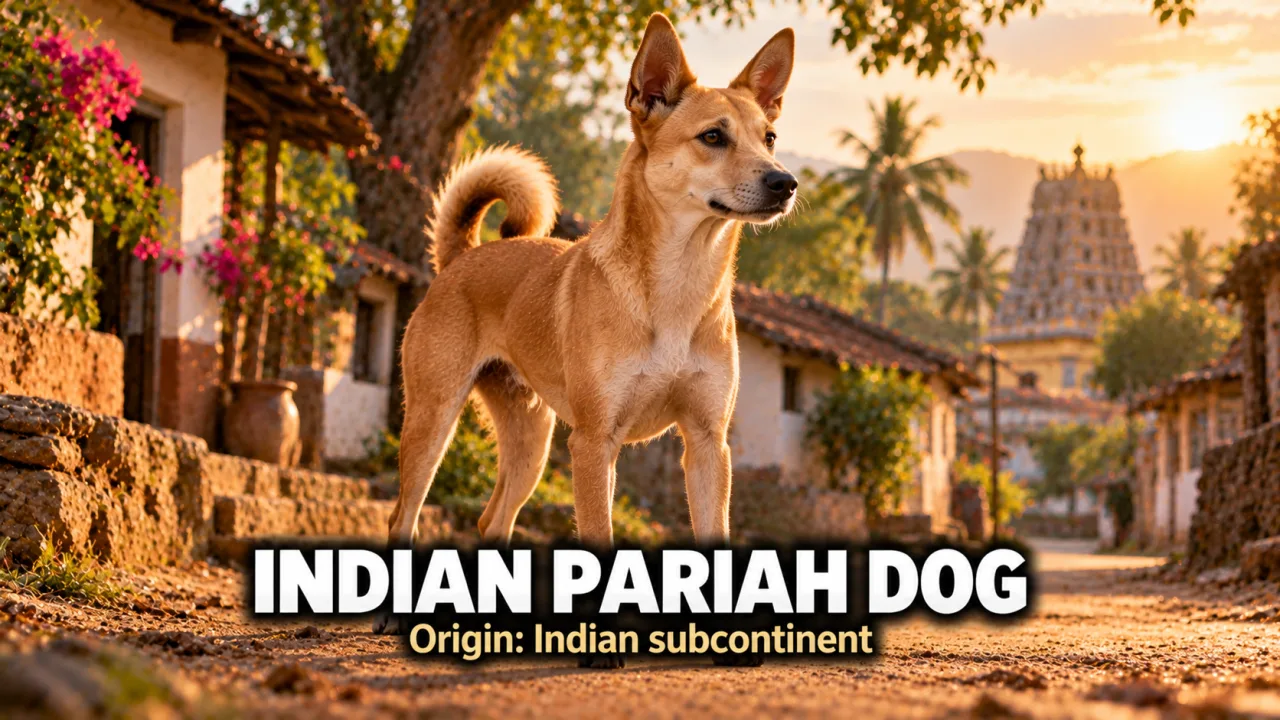
The Indian pariah dog, also called the South Asian pariah dog, Desi Kutta, Indie dog or INDog, is a landrace of dog native to the Indian subcontinent.[1][2] It has erect ears, a wedge-shaped head and a curved tail, and it is easily trained and often used as a guard dog and police dog.[1] It belongs to an ancient group of dogs known as pye-dogs, and archaeological evidence suggests dogs of this type lived in Indian villages as early as 4,500 years ago.[1][2]
The INDog Project describes it as "the original and predominant domestic dog type in the plains and lower-altitude hill ranges of the subcontinent", shaped entirely by natural selection rather than deliberate breeding.[2] Many street dogs in South Asia are pariah dogs, but not all free-ranging dogs are. Some are mixed with European breeds, especially in cities and around former colonial settlements.[1][2]
This profile is part of Finepedia's Dog Breeds of the World guide, which covers every major dog family from ancient times to today.
Key Facts
| Attribute | Details |
|---|---|
| Other names | South Asian pariah dog; pye-dog; Desi Kutta; Desi Dog; Indie dog; INDog (Indian Native Dog) |
| Origin | Indian subcontinent |
| Type | Landrace; primitive and aboriginal dog |
| Build | Medium-sized; square to slightly rectangular |
| Coat | Short double coat: coarse outer coat, soft undercoat |
| Common colours | Browns from dark to reddish-brown, with or without white markings |
| Uses | Guard dog, police dog, livestock guardian, companion |
| Recognition | Breed standard published in the Indian Kennel Gazette (2015); recognised by the Primitive and Aboriginal Dogs Society |
| FCI or AKC recognition | Not recognised |
Names
The name "pariah" was given during the British Raj, after the Pariah tribe of the Madras Presidency.[1] The alternative "pye-dog" (also spelt pie or pi) comes from the Anglo-Indian word pye or paë and the Hindi pāhī, meaning "outsider".[1] Rudyard Kipling called it the "yellow pariah dog".[1]
Regional names
The popular name Desi Kutta comes from the Hindi-Urdu desi, "native", and kutta, "dog".[1] Regional names are as follows:
- nadan patti
- nedi kukur
- deshi kukur
- deshiya naayi
- deshi kutra
- theruvu naai
- veedhi kukka
- deshi kutro.[1]
INDog
The name INDog, short for "Indian Native Dog", was coined by Col. Gautam Das. The INDog Project prefers it because "pariah" has long been misused and carries negative social connotations, and because India has no pan-Indian word for "native". The Hindi desi is used only in North India.[2] The project calls INDog mixes "Indies".[2]
Many kennel clubs use the term "primitive dog" for South Asian pariah-type dogs, reflecting their resemblance to early domestic dogs.[1]
History
Ancient origins
The pariah dog is an ancient landrace found across India, Pakistan, Bangladesh, Afghanistan, Nepal and Sri Lanka, and beyond South Asia.[1] Evidence of its antiquity includes:
- a pariah-like dog skull from the Harappan city of Mohenjo-daro;
- prehistoric rock art of a similar dog in the Bhimbetka rock shelters.[1]
In 1931 Colonel R. B. Seymour Sewell and Dr B. S. Guha compared the Mohenjo-daro skull with ancient dog remains elsewhere. They concluded that the Mohenjo-daro dogs, the Australian dingo and the Indian pariah probably "possessed a common ancestry".[2]
The INDog Project cautions that the antiquity of today's INDog will remain "a hypothesis, albeit a reasonable one" until ancient dog DNA is analysed. It considers it "a distinct possibility" that modern INDogs directly descend from the primitive dogs of settlements 4,500 years ago, noting there is no evidence of any countrywide extermination that could have broken that line.[2]
Colonial era
The pye-dog reached the Andaman Islands with the British penal colony there. Dogs had previously been unknown to the native Andamanese.[1] Although the dog is intelligent and easily trained, merchants who wanted to sell foreign breeds in India deliberately played it down during the Raj.[1]
Some British observers praised the dog. In 1903 Lieutenant General W. Osborn wrote in the Journal of the Bombay Natural History Society on behalf of "the unjustly despised Pariah... the true Indian Pariah Dog, mostly red in colour", calling it "a faithful companion, good watchdog, and excellent assistant in many field sports".[2] J. L. Kipling's Beast and Man in India (1891) noted that "even the pariah dog enjoys some popular respect as a watch-dog".[2]
M. Krishnan's description
The naturalist M. Krishnan wrote in 1944 that the pariah is "tractable, clever, even sagacious, self-reliant and absolutely incorruptible". He added that it has "an extremely hardy constitution and costs next to nothing to feed", and that "there is no better house-dog".[2]
Modern recognition
- 2002: the INDog Project began as the "Indian Pariah Dog Club", later renamed the INDog Club.[2]
- 2003: the National Geographic Channel documentary Search for the First Dog featured the dog alongside the Canaan Dog and the Australian dingo.[1][2]
- July 2015: the Kennel Club of India's journal, the Kennel Gazette, published its first article on INDogs. Wikipedia describes this as a breed standard.[1][2]
The Primitive and Aboriginal Dogs Society (PADS) also recognises the dog.[1] The Kennel Club of India has expressed support for efforts to standardise and register it.[2] Popularity in the West has led to hundreds of dogs being exported from the subcontinent.[1]
Genetics
The INDog Project collaborated on a landmark study of village dogs by Shannon, Boyko and colleagues, published in PNAS in 2015 under the title "Genetic structure in village dogs reveals a Central Asian domestication origin".[2][3] Dogs from India were sampled between 2009 and 2015. According to the project:
- village dogs in remote rural areas, including many villages in Odisha, were indigenous;
- urban free-ranging dogs from metro cities showed European ancestry.[2]
The project argues that village dogs in remote parts of India have "minimal or no genetic admixture" and are less mixed than many modern European breeds, most of which were created in the last 200 years.[2] The geneticists Adam and Ryan Boyko have cited the INDog as an example of forming a recognised breed from an indigenous village population to help conserve dog genetic diversity.[2]
Appearance
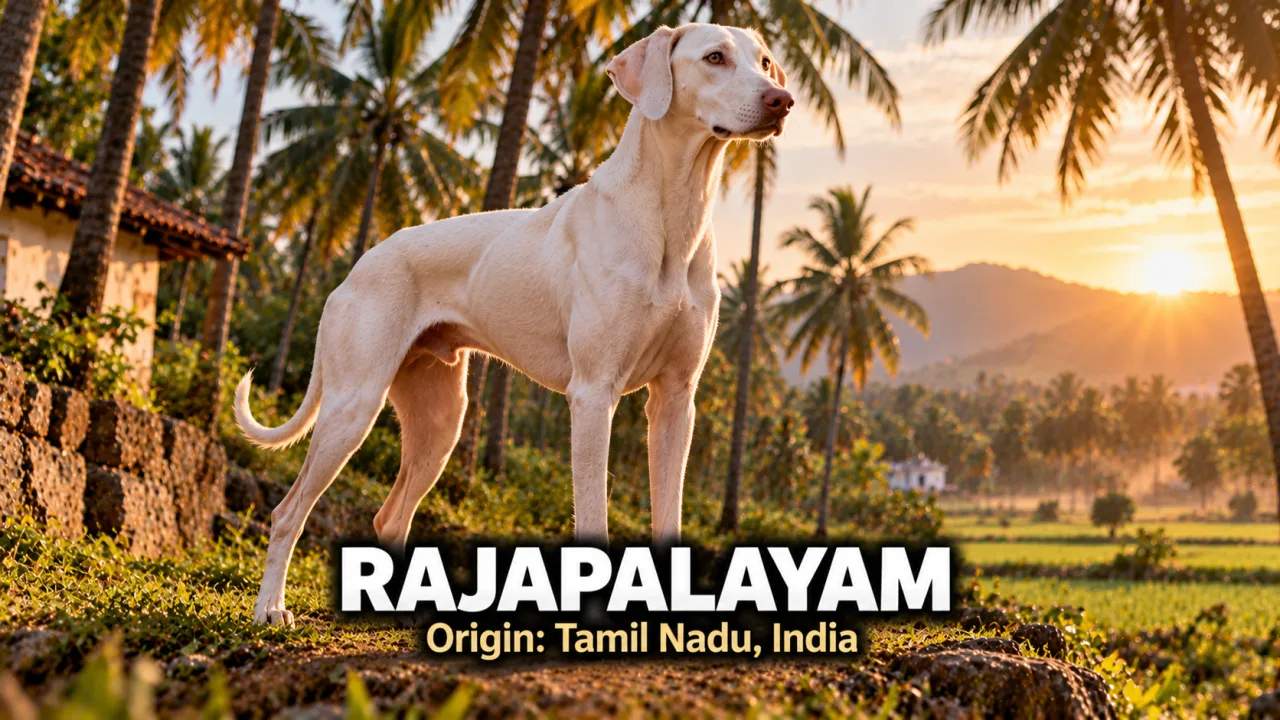
The Indian pariah dog is medium-sized, with a square to slightly rectangular build and a short double coat. The outer coat is coarse and the undercoat soft.[1]
Head and tail
The head is medium-sized and wedge-shaped. The muzzle is pointed and equal to or slightly longer than the skull.[1] The eyes are almond-shaped and dark brown. The ears are erect and pointed, with a broad base.[1] The tail is curled and held high when the dog is excited, and the trot is short.[1]
Colour
| Frequency | Colours |
|---|---|
| Most common | Browns, from dark to reddish-brown, with or without white markings |
| Uncommon | Solid black (rare); pied |
| Never seen in pure populations | Shaded coats, brindle, solid white, dalmatian-type spotting |
Source: Wikipedia.[1] Such colours, along with fully dropped ears and long coats, are seen in cities and other places where non-native dogs have been introduced and may indicate mixing.[1][2]
Temperament
Indian pariah dogs are very alert and social. They are very territorial and defensive, which suits them to work as guard dogs and police dogs.[1] They need good socialisation as puppies, and with it they do well with families and children.[1]
They are highly intelligent and easily trained. The veterinarian Premlata Choudhary has said that "desi dogs are much more intelligent and hardy than most pedigreed dogs that people spend so much money on."[1]
The INDog Project notes that, unlike India's "man-made" breeds, the INDog has never been selected for a specific job such as hunting or guarding. It therefore has no inherited traits that make it unsuited to being an urban family pet, provided it gets enough outdoor exercise.[2] Gond villagers in Central India traditionally used the dogs for hunting and still keep them as livestock guardians, property guardians and companions.[2]
Health
As a naturally evolved landrace, the Indian pariah dog has very few health concerns and thrives with little maintenance in suitable climates.[1] Its coat needs very little grooming, and the dog is relatively clean with little body odour.[1] Inherited problems such as hip dysplasia are extremely rare.[1]
Most deaths among free-ranging pariah dogs are caused by:
- road and railway accidents
- starvation
- polluted water
- tumours
- snakebites
- harm from humans.[1]
Free-ranging dogs and public health
Some people in India see the growing free-ranging dog population as a menace, citing constant barking and bites. The numbers of dog bites and deaths from dog attacks rise every year, and because most free-ranging dogs are unvaccinated they often carry rabies.[1] Only a few Indian island territories, such as the Andaman and Nicobar Islands, are rabies-free even though they have pariah dog populations.[1]
The INDog Project stresses that the dog's ancestry has "no bearing on the management of street dog populations". Urban free-ranging dogs live hazardous lives, and the project endorses high-reach vaccination and neutering programmes.[2]
Threats
The INDog Project sees genetic swamping by non-native breeds as the biggest threat to the landrace. In poorer countries, owning European breeds is a common way to display status, and such pets are often left to roam and breed. Development of rural areas through tourism, plantations or weekend homes has introduced mixing even in the countryside.[2]
Related types
The INDog belongs to a broad group of primitive and aboriginal dogs that also includes the Australian dingo, the Canaan Dog of Israel, the New Guinea singing dog and the Central African village dog, ancestor of the Basenji.[2]
See also
- ^ [1] "Indian pariah dog". Wikipedia. https://en.wikipedia.org/wiki/Indian_pariah_dog
- ^ [2] "INDog – the indigenous village dog of the Indian Subcontinent". The INDog Project. http://indog.co.in/
- ^ [3] Shannon L. M. et al. "Genetic structure in village dogs reveals a Central Asian domestication origin". Proceedings of the National Academy of Sciences, 2015. https://doi.org/10.1073/pnas.1516215112


























Discussion
Log in with