






Top 10 Most Dangerous Amphibians in the World
 By Dhiraj Sharma · Published
· Updated
Share Post
Loading…
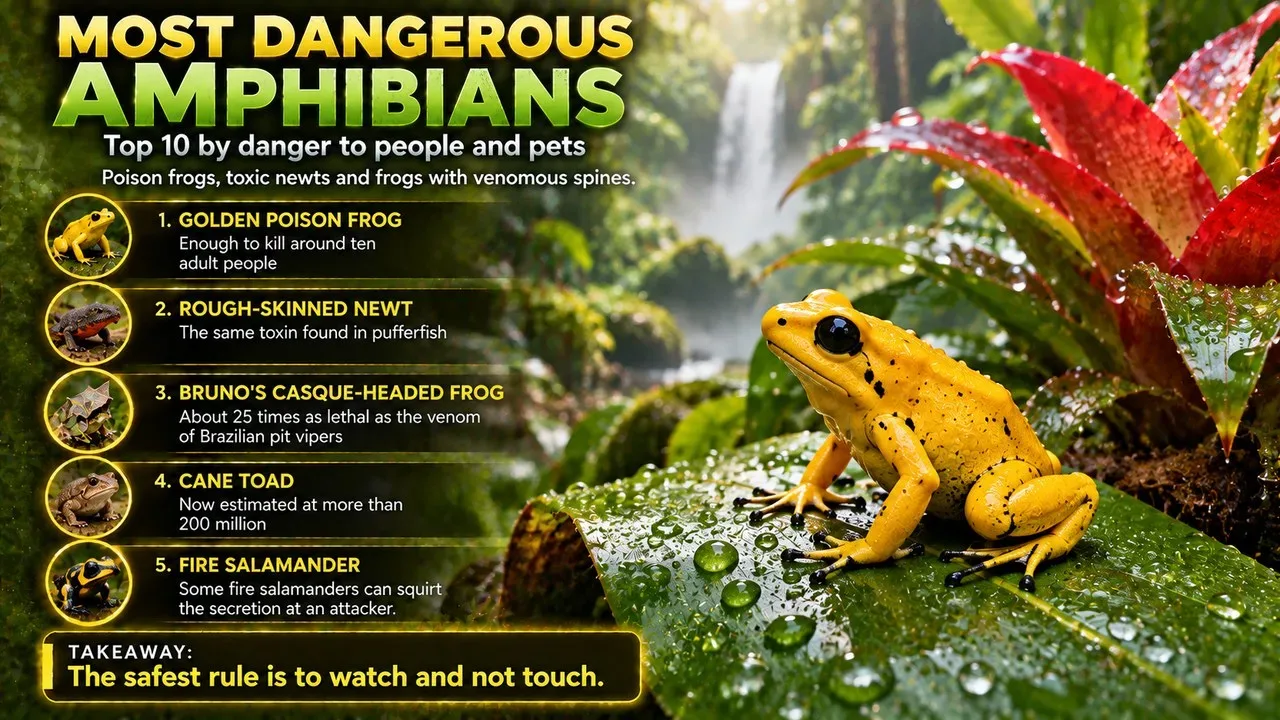
Amphibians, the group that includes frogs, toads, salamanders, newts and caecilians, are mostly small and harmless-looking, yet a few of them carry some of the strongest natural poisons known.[1] Most amphibians have granular glands in their skin that release distasteful or poisonous substances, and brightly coloured skin is usually a warning to predators that a species is toxic.[1] In a handful of species these chemicals are strong enough to kill a person.
This Finepedia list, updated in October 2026, ranks the top 10 most dangerous amphibians in the world. The ranking is based on how strong their toxins are and how much risk they pose to people and pets. It covers the poison dart frogs of Colombia and Ecuador, a newt from the Pacific Northwest, two toads, and Europe's fire salamander, and it explains how each of these animals gets its poison. Note that nearly all of these animals are poisonous, not venomous. They are dangerous only if touched, licked or eaten, and they do not bite or sting to deliver their toxins. The list ends with two rare Brazilian frogs that really are venomous.
Key Facts
The table below sums up the ten amphibians on this list, with the main toxin of each and where it lives.
The 10 Amphibians at a Glance
| Rank | Amphibian | Main toxin | Where it lives |
|---|---|---|---|
| 1 | Golden poison frog | Batrachotoxin | Pacific coast of Colombia[3] |
| 2 | Black-legged dart frog | Batrachotoxin | Chocó region, Colombia[5] |
| 3 | Kokoe poison dart frog | Batrachotoxin | Pacific coast of Colombia[6] |
| 4 | Phantasmal poison frog | Epibatidine | Bolívar Province, Ecuador[7] |
| 5 | Rough-skinned newt | Tetrodotoxin | Pacific Northwest of North America[11] |
| 6 | Cane toad | Bufotoxin | Native to the Americas; introduced to Australia and elsewhere[13] |
| 7 | Colorado River toad | 5-MeO-DMT and bufotenin | Southwestern United States and northwestern Mexico[14] |
| 8 | Fire salamander | Samandarin | Europe[15] |
| 9 | Strawberry poison frog | Pumiliotoxin 251D | Nicaragua, Costa Rica and Panama[10] |
| 10 | Dyeing dart frog | Alkaloids including histrionicotoxins | Guiana Shield[9] |
How Amphibians Become Poisonous
There are about 8,000 known species of amphibian, and nearly 90 per cent of them are frogs.[1] The main poison-producing glands are called parotoids. They make the neurotoxin bufotoxin and sit behind the ears of toads, along the backs of frogs, behind the eyes of salamanders and on the upper surface of caecilians.[1]
Poison dart frogs, the family Dendrobatidae, are the best-known poisonous amphibians. Most are brightly coloured, which warns predators away.[2] The most toxic species get their chemicals from a diet of ants, mites and termites. Species that eat a wider range of prey tend to have dull colours and much less toxin.[2] This is why frogs bred in captivity on a normal diet are usually not poisonous. The golden poison frog, Kokoe poison dart frog and phantasmal poison frog all lose their toxicity when raised without their wild food.[3][6][8]
Of more than 170 species of poison dart frog, only four are known to have been used by people to poison darts, and all of them belong to the genus Phyllobates.[2] Curare plants are more often used for South American hunting darts.[2]
1. Golden Poison Frog
The golden poison frog (Phyllobates terribilis) is found only in the rainforests of Colombia's Pacific coast. Despite its small size, it is considered the most poisonous animal species alive today.[3] Its species name, terribilis, refers to the deadly toxins in its skin. It was formally described in 1978 by Charles W. Myers, John W. Daly and Borys Malkin.[3] It is the largest member of the poison dart frog family, reaching about 6 centimetres in length and almost 30 grams in weight.[3]
The average wild golden poison frog is estimated to carry about one milligram of poison, enough to kill 10 to 20 people.[3] The lethal dose for a human has been estimated at between 2.0 and 7.5 micrograms.[3] A predator usually has to try to eat the frog to be poisoned, but touching its skin is also dangerous.[3]
The poison is batrachotoxin, a steroidal alkaloid that attacks both the nerves and the heart. It binds to the sodium channels of nerve cells and holds them open so they cannot close, which causes paralysis and death. No antidote is known.[4] Batrachotoxin has been found in only three frogs, all Colombian members of Phyllobates, along with a few birds from Papua New Guinea and some Papuan beetles.[3]
Related: Top 10 Remarkable Frogs of the World
The Emberá people have long used the frog to tip their hunting darts. They expose the frog to the heat of a fire so that it releases small amounts of poison, then soak dart and arrow tips in the fluid, which stays deadly for two years or more.[3] The species is endangered because its small range, less than 5,000 square kilometres, is being destroyed.[3]
2. Black-Legged Dart Frog
The black-legged poison dart frog (Phyllobates bicolor) is described as the world's second most toxic dart frog. It looks so much like the golden poison frog that the two are often confused.[5] It can be recognised by its yellow or orange body and its black or dark blue legs.[5] Adults are about 45 to 55 millimetres long from snout to vent, and females are slightly larger than males.[5]
Between 2 and 200 micrograms of its batrachotoxin is reported to be enough to kill a person.[5] Batrachotoxin was first isolated from this species. In 1963 Fritz Märki and Bernhard Witkop extracted its toxic alkaloids and worked out their chemical properties.[4] The Chocó people of western Colombia rub dart tips against the skin of live frogs or extract the poison from them for hunting.[5] The IUCN Red List classes the black-legged dart frog as endangered, mainly because of deforestation, habitat loss and pollution.[5]
3. Kokoe Poison Dart Frog
Phyllobates aurotaenia, the Kokoe poison dart frog, is known as the third most poisonous frog in the world. It is also the smallest member of the genus Phyllobates.[6] It was first described by George Albert Boulenger in 1913 and lives in the wet forests of western Colombia, in the Atrato and San Juan river basins.[6]
Wild Kokoe frogs store batrachotoxin in glands in their skin, and a dose as small as 100 micrograms can kill a person.[6] The frogs release the poison only under stress. Chocóan hunters coat their darts by rubbing them across the frogs' backs.[6] The frogs avoid poisoning themselves because their sodium channels are modified so that batrachotoxin cannot bind to them.[6] Its numbers are falling because of habitat loss, but the IUCN currently lists it as Least Concern.[6]
4. Phantasmal Poison Frog
The phantasmal poison frog (Epipedobates tricolor) lives only on the Andean slopes of Bolívar Province in central Ecuador, at heights of about 319 to 1,769 metres.[7] It is tiny, with a snout-to-vent length of about 22.6 millimetres, and has bright orange, yellow or pale green stripes running along a dark body.[7]
It is described as one of the most poisonous animals on Earth. Its skin secretes epibatidine, a toxin studied as being hundreds of times stronger than morphine.[7] Epibatidine interferes with acetylcholine receptors in the nervous system. It causes numbness throughout the body that can quickly turn into paralysis, and doses are lethal when the paralysis stops breathing.[8] Scientists once hoped it could replace morphine as a painkiller because it did not appear to be addictive. However, the dose that relieves pain is too close to the dose that poisons, so it is no longer being researched for medical use.[8] The frog is listed as vulnerable because its habitat is being destroyed, and the IUCN has warned that collecting it for medical research could also threaten the species.[7]
5. Rough-Skinned Newt
The rough-skinned newt (Taricha granulosa) is a stocky North American newt, brown on top and orange to yellow underneath, known for the strong toxin in its skin.[11] It is 11 to 18 centimetres long overall and lives across the Pacific Northwest, from Santa Cruz in California north to Alaska.[11]
Related: Top 10 Deadliest Animals in the World
Its toxin is tetrodotoxin, the same poison found in pufferfish and several other sea animals.[11] Taken by mouth, tetrodotoxin is more poisonous than cyanide, and no antidote has been approved for human use.[12] Some rough-skinned newts carry enough toxin to kill several adults.[11] In 1979, a 29-year-old man from Oregon died after swallowing one.[11]
The newt is also a famous example of an evolutionary arms race. Across much of its range, the common garter snake has developed resistance to tetrodotoxin and preys on the newts. In response, the newts are favoured to produce ever stronger toxin.[11] In some places the garter snake now seems to have pulled ahead, with resistance so strong that the newts cannot keep up.[11]
6. Cane Toad
The cane toad (Rhinella marina) is a large toad native to South and mainland Central America. Adults average 10 to 15 centimetres in length, and the largest on record measured 24 centimetres from snout to vent.[13] Because it eats so much, it was introduced to many islands in the Pacific and the Caribbean to control farm pests, and in August 1935 Queensland's sugar scientists released it into Australian cane fields.[13] The toads spread rapidly across Queensland and into the Northern Territory and New South Wales, and in 2010 one was found as far west as Broome in Western Australia.[13]
The cane toad's skin carries bufotoxin, which is toxic to many animals, and people have died after eating cane toads.[13] Its toxic skin can kill wild and domestic animals, and it is especially dangerous to dogs, which may be poisoned by licking or biting a toad.[13] The toad releases small amounts of bufotenin and much larger amounts of other toxins, so licking one can cause serious illness or death.[13] It also breeds very quickly. A female can lay 8,000 to 25,000 eggs at a time.[13]
7. Colorado River Toad
The Colorado River toad (Incilius alvarius), also called the Sonoran Desert toad, lives in northwestern Mexico and the southwestern United States.[14] It grows to about 190 millimetres and is the largest toad in the United States apart from the introduced cane toad.[14]
Glands behind its eyes produce 5-MeO-DMT and bufotenin, both powerful hallucinogenic chemicals.[14] Its toxin is famous for these psychoactive effects, and smoking the dried secretion has become a recreational and ceremonial practice. Toad toxins have caused several reported poisonings in people, some of them fatal.[14] In Spain, the death of a photographer at a "toad" ceremony in July 2019 led to arrests on suspicion of involuntary manslaughter.[14] Collecting the toads for "milking" is also thought to stress them, and synthetic versions of the drug are fairly easy to make.[14] Raccoons have learned to avoid the poison by flipping the toad over and eating it from the belly, well away from the poison glands.[14]
8. Fire Salamander
The fire salamander (Salamandra salamandra) is one of Europe's best-known amphibians. It is black with yellow spots or stripes, and its bright colours honestly warn predators that it is toxic.[15] Its poison glands are concentrated around the head and along its back. Its main alkaloid toxin, samandarin, causes strong muscle convulsions, high blood pressure and hyperventilation in all vertebrates.[15]
Related: Top 10 Unexpected Abilities Found in Animals
Fire salamanders can live a very long time. One lived for more than 50 years at the Museum Koenig in Germany.[15] Today the species is itself in danger. In 2013 scientists identified a new chytrid fungus, Batrachochytrium salamandrivorans, probably brought to Europe from East Asia with captive amphibians, as the cause of sharp declines.[15] In 2023 the IUCN moved the fire salamander from Least Concern to Vulnerable.[15]
9. Strawberry Poison Frog
The strawberry poison frog (Oophaga pumilio), also called the blue jeans poison frog, is a small poison dart frog found from eastern Nicaragua through Costa Rica to northwestern Panama.[10] It is famous for its range of colours, with about 15 to 30 colour forms.[10] It is not the most poisonous dart frog, but it is the most toxic member of its genus.[10]
The frog's toxicity comes from its diet, especially certain mites and ants. Its specialised toxin, pumiliotoxin 251D, disrupts the heart and the ion channels inside cells.[10] Females typically carry about 53 per cent more alkaloids than adult males.[10] Both parents care for the young.[10]
10. Dyeing Dart Frog
The dyeing poison dart frog (Dendrobates tinctorius) is one of the largest and most variably coloured poison dart frogs, with more than 30 recognised colour forms. It typically reaches about 50 millimetres in length.[9] It lives in the eastern Guiana Shield, in parts of French Guiana, Guyana, Suriname and Brazil.[9] Its name, tinctorius, comes from a legend that local people used its poison to change the colour of green parrot feathers.[9]
Like its relatives, the dyeing dart frog takes noxious alkaloids from a diet of ants and mites. Its chemicals include indolizidines, decahydroquinolines and histrionicotoxins.[9] It can be highly toxic if eaten, and predators are thought to link its bright colours with an unpleasant taste and pain.[9]
Honourable Mentions: Venomous Frogs and a Biting Giant
Two Brazilian tree frogs break the rule that amphibians are poisonous but not venomous. Greening's frog (Corythomantis greeningi) has bony spines on its skull that can inject venom into other animals, or into a human hand, when it headbutts.[16] Bruno's casque-headed frog (Nyctimantis brunoi) uses the same tactic, and its venom is estimated to be 25 times as toxic as that of the local fer-de-lance pit vipers.[17]
The African bullfrog (Pyxicephalus adspersus) is not poisonous, but it is one of the largest frogs on Earth. Males are highly protective and will pounce on and bite anything they see as a threat.[18]
Related: Top 10 Most Dangerous Sea Creatures
The Threat to Amphibians
Many of the world's most dangerous amphibians are now endangered themselves. The fungal disease chytridiomycosis has been linked to dramatic population declines or extinctions of amphibians in western North America, Central and South America, eastern Australia, East Africa and the Caribbean.[19] Recent research links the spread of the disease to the international trade in amphibians.[19] Habitat loss threatens the golden and black-legged poison frogs.[3][5] The fire salamander is also suffering from a newly introduced chytrid fungus.[15]
Key Figures
- Known amphibian species: about 8,000, of which nearly 90% are frogs [1]
- Poison dart frog species: more than 170 [2]
- Poison carried by one wild golden poison frog: about 1 milligram, enough to kill 10 to 20 people [3]
- Estimated lethal batrachotoxin dose for a human: 2.0 to 7.5 micrograms [3]
- Range of the golden poison frog: under 5,000 square kilometres [3]
- Year cane toads were released in Australia: 1935 [13]
- Eggs laid by a female cane toad at one time: 8,000 to 25,000 [13]
- Recorded lifespan of a captive fire salamander: more than 50 years [15]
Frequently Asked Questions
What is the most poisonous amphibian in the world?
The golden poison frog of Colombia. It is considered the most poisonous animal alive, and one wild frog carries enough batrachotoxin to kill 10 to 20 people.[3]
Can you die from touching a poison dart frog?
Touching the skin of a wild golden poison frog is dangerous, although a predator usually has to try to eat it to be poisoned.[3] Frogs raised in captivity without their natural diet are generally not toxic.[3][6]
Are cane toads dangerous to dogs?
Yes. The cane toad's toxic skin is especially dangerous to dogs, which can be poisoned by licking or biting a toad.[13]
Are any frogs venomous?
Yes. Greening's frog and Bruno's casque-headed frog from Brazil have skull spines that can inject venom by headbutting.[16][17]
Why are poisonous amphibians brightly coloured?
Bright colours warn predators that the animal is toxic, a strategy called aposematism.[1][2]
See also
- General Knowledge Facts About Elephants
- General Knowledge Facts About Dogs
- Interesting Facts About Antarctica
- ^ [1] "Amphibian". Wikipedia. Wikipedia
- ^ [2] "Poison dart frog". Wikipedia. Wikipedia
- ^ [3] "Golden poison frog". Wikipedia. Wikipedia
- ^ [4] "Batrachotoxin". Wikipedia. Wikipedia
- ^ [5] "Phyllobates bicolor". Wikipedia. Wikipedia
- ^ [6] "Phyllobates aurotaenia". Wikipedia. Wikipedia
- ^ [7] "Phantasmal poison frog". Wikipedia. Wikipedia
- ^ [8] "Epibatidine". Wikipedia. Wikipedia
- ^ [9] "Dyeing dart frog". Wikipedia. Wikipedia
- ^ [10] "Strawberry poison-dart frog". Wikipedia. Wikipedia
- ^ [11] "Rough-skinned newt". Wikipedia. Wikipedia
- ^ [12] "Tetrodotoxin". Wikipedia. Wikipedia
- ^ [13] "Cane toad". Wikipedia. Wikipedia
- ^ [14] "Colorado River toad". Wikipedia. Wikipedia
- ^ [15] "Fire salamander". Wikipedia. Wikipedia
- ^ [16] "Corythomantis greeningi". Wikipedia. Wikipedia
- ^ [17] "Nyctimantis brunoi". Wikipedia. Wikipedia
- ^ [18] "African bullfrog". Wikipedia. Wikipedia
- ^ [19] "Chytridiomycosis". Wikipedia. Wikipedia




















Discussion
Log in with