





 By
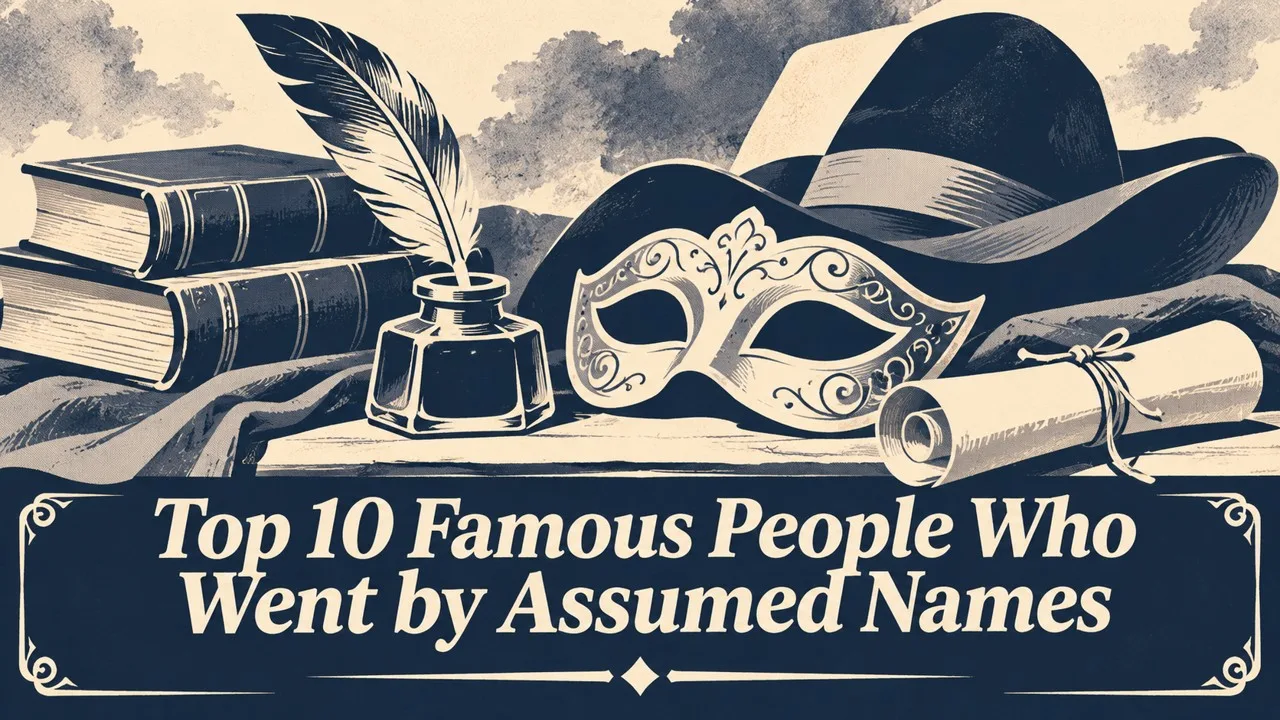
Many famous names were invented, from Voltaire and George Eliot to Mark Twain, George Orwell, Cary Grant, Marilyn Monroe and Freddie Mercury. Some of the most recognizable names in history were not given at birth. Writers adopted pen names to protect their privacy, avoid prejudice or create a new identity. Actors and musicians chose stage names that were easier to remember or better suited to a public image. Political revolutionaries used pseudonyms to escape the police and later kept them as symbols.
An assumed name is not the same as deception. In most of the cases below, the people involved were open about their real names, and many later adopted their chosen names legally. The new names became part of who they were.
The ten people below are Voltaire, Molière, George Eliot, Mark Twain, Lewis Carroll, Lenin, George Orwell, Cary Grant, Marilyn Monroe and Freddie Mercury. Each name has its own story, and in several cases the exact origin is still debated.
The practice is very old. Writers in ancient and medieval times sometimes published under the names of earlier authorities, and in the eighteenth and nineteenth centuries anonymous and pseudonymous publishing was common. In the twentieth century, film studios routinely gave actors new names, often to make them sound more glamorous or to hide immigrant or working-class origins. Each of those traditions is represented in the list.
Key Facts
| # | Assumed name | Birth name | Why the name was chosen |
|---|---|---|---|
| 1 | Voltaire | François-Marie Arouet | Adopted around 1718, origin debated |
| 2 | Molière | Jean-Baptiste Poquelin | Adopted in 1644 when he began acting |
| 3 | George Eliot | Mary Ann Evans | Used to be taken seriously and protect her privacy |
| 4 | Mark Twain | Samuel Langhorne Clemens | A riverboat term meaning two fathoms |
| 5 | Lewis Carroll | Charles Lutwidge Dodgson | Created by translating and reversing his names |
| 6 | Lenin | Vladimir Ilyich Ulyanov | Used to evade police and later a political symbol |
| 7 | George Orwell | Eric Arthur Blair | Chosen for his first book in 1933 |
| 8 | Cary Grant | Archibald Alec Leach | Name chosen when he signed a film contract |
| 9 | Marilyn Monroe | Norma Jeane Mortenson | Name chosen when she signed with 20th Century Fox |
| 10 | Freddie Mercury | Farrokh Bulsara | Adopted around the time Queen was formed |
1. A Philosopher's New Identity
François-Marie Arouet was born in Paris in 1694. As a young writer, he was imprisoned in the Bastille for verses that offended the authorities. Around 1718, after his release, he began using the name Voltaire [1].
The origin of the name is uncertain. One common theory is that it is an anagram of a Latinized form of his surname, Arouet, with the initials l.j., meaning the younger. Other suggestions link it to a place name connected with his family or to a word suggesting quickness [1].
Under his new name, Voltaire became one of the most famous writers of the Enlightenment, known for works such as Candide and for his defense of freedom of thought and religious tolerance. The name is so closely tied to his ideas that few people remember his birth name.
2. A Playwright Who Spared His Family
Jean-Baptiste Poquelin was born in Paris in 1622, the son of an upholsterer who served the royal household. Instead of following his father's trade, he joined a theater company, and in 1644 he began using the name Molière [2].
He never explained why he chose the name, and its origin remains unknown. Historians often suggest that he wanted to spare his respectable family the embarrassment of having an actor in the family, since actors had low social status in France at the time [2].
Related: Top 10 Writers Who Helped Coin Everyday Words
Molière became the greatest comic playwright in French literature, writing plays such as Tartuffe and The Misanthrope. French is sometimes called the language of Molière, just as English is called the language of Shakespeare.
3. A Woman Writing as a Man
Mary Ann Evans was born in England in 1819. She worked as a translator, editor and critic before publishing her first fiction in the late 1850s under the name George Eliot [3].
She chose a male pen name partly because women writers were often assumed to write light romances, and she wanted her work to be judged seriously. She also wished to protect her private life, since she lived openly with the writer George Henry Lewes, who was married to another woman [3].
Her identity became known after the success of her first novel, Adam Bede, in 1859. She went on to write Middlemarch, often considered one of the greatest novels in English. The name George Eliot remains the name under which her books are published.
4. A Name From the River
Samuel Langhorne Clemens was born in Missouri in 1835 and grew up beside the Mississippi River. As a young man, he trained and worked as a steamboat pilot until the Civil War stopped river traffic [4].
The phrase mark twain was a call used on riverboats to report that the water was two fathoms deep, about twelve feet, which was safe for a steamboat. Clemens first used the pen name in 1863 while working as a journalist in Nevada [4].
As Mark Twain, he wrote The Adventures of Tom Sawyer and Adventures of Huckleberry Finn and became one of America's best-known writers and speakers. He enjoyed the playful contrast between his literary persona and his private identity, and he signed letters with both names.
5. A Mathematician's Alter Ego
Charles Lutwidge Dodgson was born in 1832 and became a mathematics lecturer at Christ Church, Oxford. He published mathematical works under his real name, but for his imaginative writing he used the name Lewis Carroll [5].
Related: Top 10 Most Bizarre Phobias: Strange Fears That Exist
The pen name was created by translating his first two names into Latin, as Carolus Ludovicus, reversing them and turning them back into English forms. He first used it in 1856 for a poem published in a magazine [5].
As Lewis Carroll, he wrote Alice's Adventures in Wonderland in 1865 and Through the Looking-Glass in 1871. He kept his two identities separate and was reported to be reluctant to accept letters addressed to Lewis Carroll at his Oxford college.
6. A Revolutionary's Pseudonym
Vladimir Ilyich Ulyanov was born in Russia in 1870. As a revolutionary opposed to the tsarist government, he used many pseudonyms to avoid police attention, as was common among underground activists [6].
Around 1901, he began using the name Lenin, which became his best-known pseudonym. Its origin is uncertain. A common theory links it to the Lena River in Siberia, but other explanations have been suggested, and he never clearly explained it [6].
As Lenin, he led the Bolshevik seizure of power in 1917 and became the first leader of Soviet Russia. After his death, cities and institutions were named after him, including Leningrad, now Saint Petersburg. The pseudonym became one of the most widely known names of the twentieth century.
7. A Name Taken From an English River
Eric Arthur Blair was born in 1903 in India, where his father worked in the colonial civil service. He was educated in England and served in the police in Burma before becoming a writer [7].
When his first book, Down and Out in Paris and London, was published in 1933, he used the name George Orwell. He reportedly wanted to avoid embarrassing his family with the book's account of poverty. Orwell is the name of a river in Suffolk, a county he knew well, and George was a typically English first name [7].
Related: Top 10 Oldest Buildings in the World
As George Orwell, he wrote Animal Farm and Nineteen Eighty-Four, two of the most influential books of the twentieth century. Words such as Orwellian, Big Brother and doublethink, from his writing, have entered everyday language.
8. From Bristol to Hollywood
Archibald Alec Leach was born in Bristol, England, in 1904. He joined a troupe of performers as a teenager and traveled to the United States, where he worked in vaudeville and on Broadway [8].
In 1931, he signed a contract with Paramount Pictures, and the studio asked him to adopt a new name. He chose Cary Grant, combining a character name from a play he had appeared in with a surname from a list suggested by the studio. He legally changed his name in 1941 [8].
As Cary Grant, he became one of Hollywood's greatest stars, known for films such as North by Northwest. He once joked that everyone wanted to be Cary Grant, including himself. His career shows how studios carefully shaped the identities of their stars.
9. A Star Created by a Studio
Norma Jeane Mortenson was born in Los Angeles in 1926 and was baptized Norma Jeane Baker. She had a difficult childhood, spending time in foster homes. During the Second World War, she worked in a factory, where a photographer took pictures that helped launch her modeling career [9].
In 1946, she signed a contract with 20th Century Fox. Her new first name was suggested by a studio executive, and Monroe was her mother's maiden name. She legally changed her name to Marilyn Monroe in 1956 [9].
Marilyn Monroe became one of the most famous film stars in history, appearing in films such as Some Like It Hot. Her image remains one of the most recognizable in popular culture, and her story is often used to discuss the pressures of fame and the studio system.
Related: 10 Sikh Gurus: The Pillars of Sikhism Who Shaped Faith, Equality, Courage, and Humanity
10. A Singer Who Reinvented Himself
Farrokh Bulsara was born in 1946 in Zanzibar, then a British protectorate, to a Parsi family of Indian origin. He went to school in India, where friends called him Freddie, and later moved with his family to England [10].
Around 1970, as he formed the band Queen with Brian May and Roger Taylor, he adopted the surname Mercury, after the messenger of the Roman gods. He later changed his name legally [10].
As Freddie Mercury, he became one of the most celebrated rock singers in history, known for songs such as Bohemian Rhapsody and his powerful live performances. His story became widely known again through the 2018 film Bohemian Rhapsody.
Conclusion
The ten people above chose new names for many reasons. Writers such as George Eliot, Mark Twain and George Orwell used pen names to shape how readers saw their work. Molière and Orwell considered their families. Lenin's pseudonym began as protection from the police. Cary Grant, Marilyn Monroe and Freddie Mercury adopted names that fitted the public personas they built.
In every case, the chosen name became the one remembered by history. Their stories show that identity can be partly created, and that a name can carry meaning that the person who adopts it helps to define.
Today, pen names and stage names remain common, from novelists who write in different genres under different names to musicians who perform under a single word. The stories of these ten famous figures show that the practice has a long and rich history.
- ^ [1] Accounts of Voltaire and the origin of his name. Wikipedia: Voltaire Wikipedia: pen name
- ^ [2] Accounts of Molière's life and name. Wikipedia: Molière Wikipedia: Tartuffe
- ^ [3] Accounts of George Eliot and her pen name. Wikipedia: George Eliot Wikipedia: Adam Bede
- ^ [4] Accounts of Mark Twain and the origin of his name. Wikipedia: Mark Twain Wikipedia: fathom
- ^ [5] Accounts of Lewis Carroll and his pen name. Wikipedia: Lewis Carroll Wikipedia: Alice's Adventures in Wonderland
- ^ [6] Accounts of Lenin's pseudonyms. Wikipedia: Vladimir Lenin Wikipedia: Lena River
- ^ [7] Accounts of George Orwell and his pen name. Wikipedia: George Orwell Wikipedia: River Orwell
- ^ [8] Accounts of Cary Grant's early life and name change. Wikipedia: Cary Grant Wikipedia: stage name
- ^ [9] Accounts of Marilyn Monroe's early life and name. Wikipedia: Marilyn Monroe Wikipedia: 20th Century Studios
- ^ [10] Accounts of Freddie Mercury's early life and name. Wikipedia: Freddie Mercury Wikipedia: Queen





















Discussion
Log in with