






Top 10 Tiny Creatures That Live On or In the Human Body
 By Dhiraj Sharma · Published
Share Post
Loading…
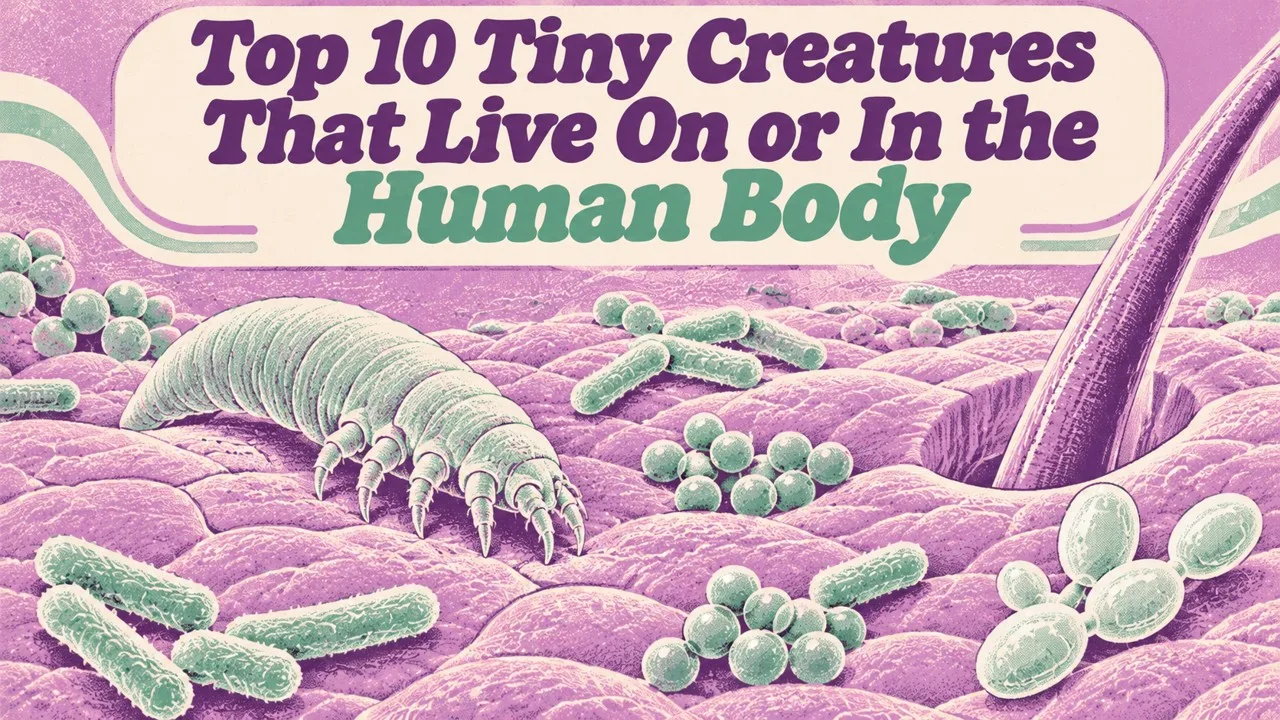
Your body is home to a crowd of tiny residents, from mites living in your eyelash follicles to stomach bacteria, gut microbes and viruses that hunt bacteria. A human body is not just a single organism. It is also a habitat for enormous numbers of microbes and a few small animals. Scientists estimate that the number of bacterial cells in and on the body is roughly similar to the number of human cells, and the variety of species is huge. Together, these organisms are known as the human microbiome.
Most of these residents are harmless, and many are helpful. They digest food we cannot break down ourselves, train the immune system and protect us from harmful germs by taking up space and resources. A few can cause disease, especially if they get into the wrong part of the body or if the immune system is weakened.
The ten creatures below are face mites, skin staphylococci, acne bacteria, skin yeasts, tooth-decay bacteria, stomach bacteria, gut Bacteroides, methane-producing archaea, bacteriophages and head lice. Some live with almost everyone, while others are found only in some people. Learning about them has changed how scientists think about health.
Key Facts
| # | Creature | Where it lives | What it does |
|---|---|---|---|
| 1 | Demodex mites | Hair follicles and oil glands, especially on the face | Feed on skin oils and are mostly harmless |
| 2 | Staphylococcus epidermidis | Skin surface | Helps protect against harmful microbes |
| 3 | Cutibacterium acnes | Hair follicles and oil glands | Usually harmless, but linked to acne |
| 4 | Malassezia | Skin and scalp | Common fungi linked to dandruff |
| 5 | Streptococcus mutans | Mouth, on teeth | Contributes to cavities |
| 6 | Helicobacter pylori | Stomach lining | Can cause ulcers and is linked to stomach cancer |
| 7 | Bacteroides | Large intestine | Break down complex carbohydrates |
| 8 | Methanobrevibacter smithii | Large intestine | An archaeon that consumes hydrogen |
| 9 | Bacteriophages | Gut, skin, mouth and elsewhere | Infect bacteria, not human cells |
| 10 | Head lice | Scalp hair | Feed on blood and spread by head-to-head contact |
1. Mites That Live in Your Face
Demodex mites are tiny eight-legged animals, related to spiders and ticks, that live in human hair follicles and oil glands. Two species live on humans: Demodex folliculorum, which lives in hair follicles, and Demodex brevis, which lives deeper in oil glands. They are less than half a millimeter long [1].
The mites are found on most adults, especially on the face, around the nose, eyebrows and eyelashes. They feed on oils and dead skin cells and are most active at night, when they crawl slowly across the skin to mate before returning to the follicles [1].
In most people, Demodex mites cause no problems. In large numbers, they have been linked to some skin and eyelid conditions, such as certain forms of rosacea and blepharitis. Studies of their DNA suggest that the mites have lived with humans for a very long time and have evolved along with us.
2. The Skin's Most Common Bacterium
Staphylococcus epidermidis is one of the most common bacteria on human skin. It lives on almost everyone and is usually harmless. It is a close relative of Staphylococcus aureus, a bacterium that can cause serious infections [2].
Research suggests that S. epidermidis helps protect the skin. It can produce substances that inhibit the growth of harmful bacteria and help stimulate the skin's immune defenses. By occupying space on the skin, it also makes it harder for dangerous microbes to establish themselves [2].
However, S. epidermidis can cause problems when it gets inside the body, especially through medical devices such as catheters and artificial joints. It forms sticky layers called biofilms on these devices, which can be hard to treat with antibiotics. It is a leading cause of infections associated with medical devices.
Related: Top 10 Best Foods to Relieve Constipation
3. Bacteria in Oily Skin
Cutibacterium acnes, formerly known as Propionibacterium acnes, lives deep in hair follicles and oil glands, especially on the face, chest and back. It feeds on the oily substance called sebum produced by these glands [3].
The bacterium is found on almost all adults and is usually harmless. It may even help keep the skin healthy by breaking down sebum into fatty acids that make the skin less hospitable to other microbes [3].
When follicles become blocked with sebum and dead skin cells, C. acnes can multiply and contribute to inflammation, which plays a role in acne. However, people with and without acne carry similar amounts of the bacterium. Researchers now believe that particular strains and the balance of the skin microbiome are more important than the bacterium's presence alone.
4. Yeasts on the Skin
Malassezia is a group of yeasts, a type of fungus, that live on the skin of most people, especially in oily areas such as the scalp, face and upper body. They are the most common fungi on human skin [4].
Malassezia yeasts need fats to grow, so they feed on oils produced by the skin. They are usually harmless, but they have been linked to common conditions such as dandruff and seborrheic dermatitis, as well as some skin rashes [4].
Many anti-dandruff shampoos contain ingredients that reduce the growth of Malassezia. Recent studies have also found Malassezia in other parts of the body, including the gut, and scientists are studying whether it plays a role in other health conditions. The yeast is a reminder that fungi are part of the microbiome too.
5. The Tooth Decay Bacterium
The mouth is home to hundreds of species of bacteria. One of the best known is Streptococcus mutans, which lives in dental plaque, the sticky film that forms on teeth [5].
S. mutans feeds on sugars from food and drink and produces acid as a by-product. The acid can dissolve tooth enamel, leading to cavities. The bacterium also helps form plaque by producing sticky substances that allow it and other bacteria to attach to teeth [5].
Related: Top 10 Best Anti-Aging Foods for Younger-Looking Skin
Brushing, flossing, fluoride and limiting sugary foods help control S. mutans and reduce tooth decay. The bacterium is often passed from parents to children early in life. Researchers have studied ways to replace it with less harmful strains, but good oral hygiene remains the main defense.
6. A Bacterium That Survives Stomach Acid
For a long time, doctors believed that no bacteria could survive in the acidic environment of the stomach. In the early 1980s, the Australian scientists Barry Marshall and Robin Warren showed that a bacterium called Helicobacter pylori lives in the stomach lining [6].
They proposed that H. pylori causes many stomach ulcers, which were then thought to be caused mainly by stress and diet. To prove the point, Marshall drank a culture of the bacteria in 1984 and developed stomach inflammation. Marshall and Warren received the Nobel Prize in Physiology or Medicine in 2005 [6].
H. pylori infects a large share of the world's population, though most infected people have no symptoms. It can be treated with antibiotics. It is also linked to an increased risk of stomach cancer, and its discovery changed the treatment of ulcers worldwide.
7. The Gut's Fiber Specialists
The large intestine contains the densest population of microbes in the human body. Bacteroides is one of the most common groups of bacteria in the gut of many people, especially those who eat a Western diet [7].
Bacteroides species are experts at breaking down complex carbohydrates, such as those found in plants, that human enzymes cannot digest. They produce substances called short-chain fatty acids, which provide energy for the cells lining the colon and help regulate the immune system [7].
Related: Top 10 Common Misconceptions About the Human Body
Bacteroides are usually beneficial, but some species can cause infections if they escape the gut, for example after surgery or injury. The balance of Bacteroides and other gut bacteria varies between people and is influenced by diet, and scientists are studying how it relates to health and disease.
8. A Gut Resident That Makes Methane
Not all microbes in the gut are bacteria. Methanobrevibacter smithii belongs to a separate group of single-celled organisms called archaea. It is the most common archaeon in the human gut [8].
M. smithii uses hydrogen and carbon dioxide produced by bacteria during digestion and turns them into methane. By removing hydrogen, it may help bacteria ferment food more efficiently, increasing the energy extracted from the diet [8].
The amount of M. smithii varies widely between people. Some studies have linked it to constipation and to differences in body weight, though the evidence is not settled. Its presence shows that the gut microbiome includes members from all major branches of life, not just bacteria.
9. Viruses That Hunt Bacteria
Bacteriophages, or phages, are viruses that infect bacteria. They are the most abundant biological entities on Earth, and the human body contains enormous numbers of them, especially in the gut. Together, they are sometimes called the virome [9].
Phages do not infect human cells. Instead, they attack specific bacteria, sometimes killing them and sometimes inserting their genes into the bacteria. By doing so, they help shape the composition of the microbiome [9].
Scientists are studying phages as a possible treatment for infections caused by antibiotic-resistant bacteria, an approach known as phage therapy. It has been used for many decades in some countries, such as Georgia, and is being tested in clinical trials elsewhere. Phages show that viruses in the body are not always harmful to us.
Related: Top 10 Most Bizarre Phobias: Strange Fears That Exist
10. Insects That Live in Hair
Head lice are small, wingless insects that live on the human scalp. They feed on small amounts of blood several times a day and lay eggs, called nits, which they glue to hair shafts near the scalp [10].
Head lice are common, especially among schoolchildren, and spread mainly through direct head-to-head contact. They do not jump or fly. Despite popular belief, infestation is not a sign of poor hygiene. Head lice do not spread disease, but their bites can cause itching [10].
Humans have lived with lice for a very long time. Lice and nits have been found on ancient Egyptian mummies and in prehistoric sites. Genetic studies of lice have even been used to estimate when humans began wearing clothing, since body lice evolved from head lice to live in clothes.
Conclusion
The ten creatures above show that the human body is a crowded ecosystem. Mites, bacteria, yeasts, archaea, viruses and insects all find homes on our skin, in our mouths and in our guts. Most are harmless or helpful, and some are essential to health.
Research on the microbiome is changing medicine, from new treatments for infections to a better understanding of diet and disease. Far from being alone, each of us is a walking community of life, much of it invisible but all of it part of who we are.
If the idea of sharing your body with so many organisms feels unsettling, it may help to remember that the relationship is ancient. Humans evolved alongside these microbes and small animals, and many of them depend on us as much as we depend on them.
- ^ [1] Accounts of Demodex mites on human skin. Wikipedia: Demodex folliculorum Wikipedia: Demodex
- ^ [2] Accounts of Staphylococcus epidermidis. Wikipedia: Staphylococcus epidermidis Wikipedia: skin flora
- ^ [3] Accounts of Cutibacterium acnes and acne. Wikipedia: Cutibacterium acnes Wikipedia: acne
- ^ [4] Accounts of Malassezia yeasts. Wikipedia: Malassezia Wikipedia: dandruff
- ^ [5] Accounts of Streptococcus mutans and tooth decay. Wikipedia: Streptococcus mutans Wikipedia: tooth decay
- ^ [6] Accounts of Helicobacter pylori and its discovery. Wikipedia: Helicobacter pylori Wikipedia: Barry Marshall
- ^ [7] Accounts of Bacteroides in the gut. Wikipedia: Bacteroides Wikipedia: gut microbiota
- ^ [8] Accounts of Methanobrevibacter smithii. Wikipedia: Methanobrevibacter smithii Wikipedia: archaea
- ^ [9] Accounts of bacteriophages and phage therapy. Wikipedia: bacteriophage Wikipedia: phage therapy
- ^ [10] Accounts of head lice. Wikipedia: head louse Wikipedia: human microbiome






















Discussion
Log in with