






Top 10 Expensive Infrastructure Projects That Failed
 By Dhiraj Sharma · Published
Share Post
Loading…
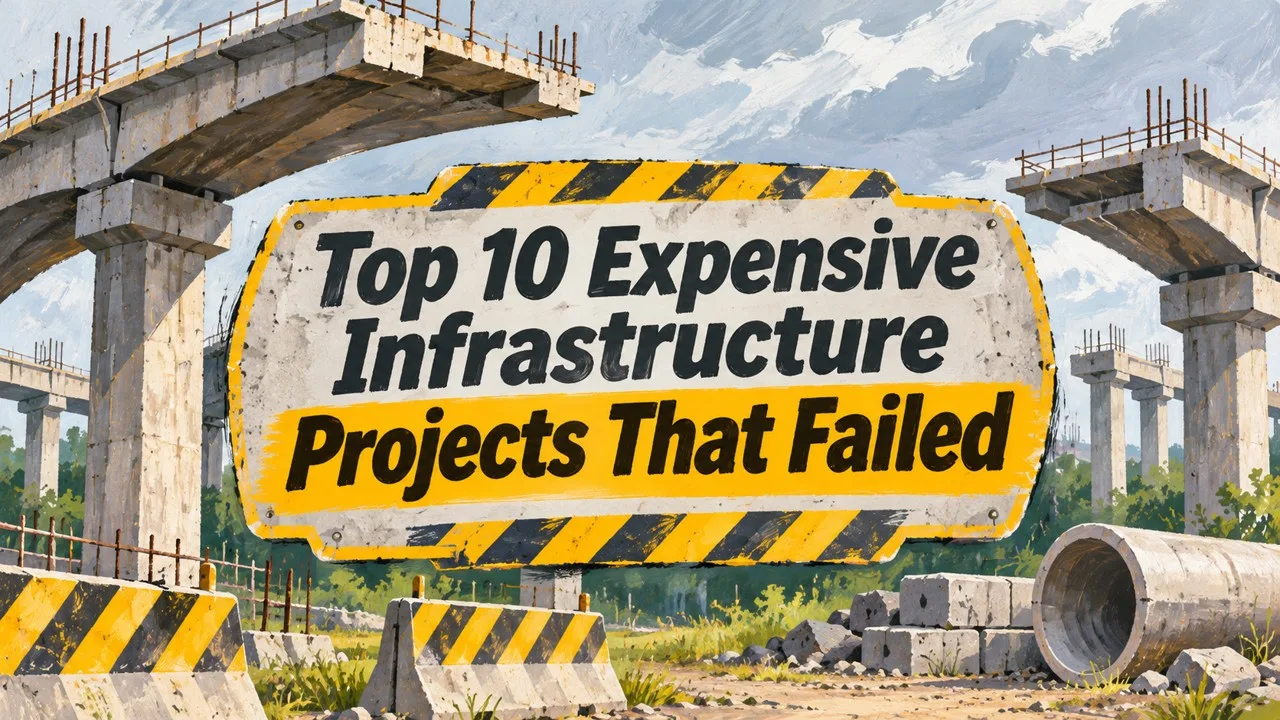
Some of the costliest projects ever built barely worked or never worked at all, from empty airports to nuclear plants that never produced power. Large infrastructure projects are among the most ambitious things societies build. Airports, power plants, stadiums and scientific facilities can take decades to plan and complete, and they often cost billions. When they succeed, they shape economies for generations. When they fail, the costs can burden taxpayers for decades.
Researchers who study megaprojects have found that most go over budget, and many deliver fewer benefits than promised. Optimistic forecasts, political pressure, changing technology and public opposition are common causes. Some projects are finished but barely used, while others are abandoned after huge sums have already been spent.
The ten projects below are Montreal's Mirabel Airport, Spain's Ciudad Real Central Airport, Sri Lanka's Mattala airport, the Shoreham nuclear plant in New York, Austria's Zwentendorf nuclear plant, Germany's Kalkar fast breeder reactor, the Superconducting Super Collider in Texas, Montreal's Olympic Stadium, North Korea's Ryugyong Hotel and Berlin's Brandenburg Airport. Each became a lesson in the risks of building big.
The Danish planning scholar Bent Flyvbjerg, who has collected data on thousands of megaprojects, has argued that the typical project is over budget, over time and under benefits, again and again. He links this pattern to optimism bias and to the incentives that encourage planners to underestimate costs in order to win approval.
Key Facts
| # | Project | Place and years | What went wrong |
|---|---|---|---|
| 1 | Montréal–Mirabel International Airport | Quebec, Canada, 1975 to 2004 | Passenger flights left after three decades |
| 2 | Ciudad Real Central Airport | Spain, 2008 to 2012 | Closed after a few years |
| 3 | Mattala Rajapaksa International Airport | Sri Lanka, from 2013 | Very few flights after opening |
| 4 | Shoreham Nuclear Power Plant | Long Island, New York, 1973 to 1989 | Completed but never commercially operated |
| 5 | Zwentendorf Nuclear Power Plant | Austria, completed 1978 | Never operated after a referendum |
| 6 | Kalkar fast breeder reactor | Germany, 1970s to 1991 | Completed but never started |
| 7 | Superconducting Super Collider | Texas, 1987 to 1993 | Cancelled after billions were spent |
| 8 | Montreal Olympic Stadium | Montreal, 1976 to 2006 | Debts took 30 years to pay off |
| 9 | Ryugyong Hotel | Pyongyang, North Korea, from 1987 | Unfinished for decades |
| 10 | Berlin Brandenburg Airport | Berlin, 2006 to 2020 | Opened years late and far over budget |
1. An Airport Too Far From the City
Mirabel Airport opened in 1975, intended to become Montreal's main international airport and one of the largest airports in the world. The government expropriated a huge area of farmland, displacing thousands of residents, far more land than the airport ever used [1].
The airport was located far from downtown Montreal, and planned rail and highway connections were never fully built. Airlines and passengers preferred the older Dorval airport, which was closer to the city. International traffic also shifted toward Toronto [1].
In 2004, scheduled passenger flights moved back to Dorval, now called Montréal–Trudeau International Airport. Mirabel continued as a cargo and industrial site, and its passenger terminal was demolished in 2016. Much of the expropriated land was eventually returned to farmers.
2. An Airport Sold for a Tiny Bid
Ciudad Real Central Airport in central Spain was built by a private company during the Spanish construction boom of the 2000s, at a cost often reported at around one billion euros. It was planned as an alternative airport for Madrid, although it was about 200 kilometers away [2].
The airport opened in 2008 and 2009 but attracted very few flights. Airlines saw little reason to fly to a remote airport when Madrid already had a large airport. The operating company went bankrupt, and the airport closed in 2012 [2].
Related: Top 10 Most Expensive Megaprojects in History
In 2015, the airport was put up for auction, and a widely reported bid of 10,000 euros made headlines around the world. It was later sold to new owners, who have tried to revive it for cargo and aircraft storage. It became a symbol of the excesses of Spain's property bubble.
3. The World's Emptiest Airport
Mattala Rajapaksa International Airport opened in 2013 in southern Sri Lanka, as part of a plan to develop the region along with a new port at Hambantota. It was largely financed with loans from China [3].
The airport attracted very few airlines, and at times it had almost no scheduled flights. International media described it as the world's emptiest airport. At one point, the airport was used to store rice, and staff had to deal with wildlife such as elephants near the runway [3].
The Sri Lankan government has explored partnerships to revive the airport, and it has been used for training and diverted flights. Its difficulties, along with those of the Hambantota port, became part of a wider debate about debt and infrastructure planning in Sri Lanka.
4. A Nuclear Plant That Never Ran
The Shoreham Nuclear Power Plant on Long Island was planned in the 1960s. Construction took many years longer than expected, and its cost rose to about six billion dollars, far above early estimates [4].
After the Three Mile Island accident in 1979, public concern about nuclear safety grew. Local and state officials argued that Long Island could not be safely evacuated in an emergency, and they refused to approve evacuation plans. The plant carried out only low-power testing [4].
In 1989, the utility agreed to close the plant without it ever entering commercial operation. Much of the cost was passed on to electricity customers on Long Island, contributing to some of the highest electricity rates in the United States. The plant was later decommissioned.
5. A Plant Rejected by Voters
Zwentendorf was Austria's first nuclear power plant, built on the Danube River west of Vienna. Construction was completed in 1978, at great expense [5].
Related: Top 10 Planned Cities That Were Never Built
Before it could start operating, the government held a national referendum in November 1978. By a very narrow majority, about 50.5 percent, voters rejected nuclear power. Austria later passed a law banning nuclear power plants [5].
The plant was never used to generate electricity. It has since been used for training nuclear workers from other countries, as a film location and for events. In recent years, solar panels were installed on the site. Zwentendorf is often called the world's safest nuclear power plant, because it never operated.
6. A Reactor Turned Into an Amusement Park
The SNR-300 at Kalkar, in western Germany, was a fast breeder reactor, designed to produce more nuclear fuel than it consumed. Construction began in the 1970s, but it faced strong protests, legal challenges and safety debates [6].
The plant was largely completed, but political opposition in the state of North Rhine-Westphalia prevented it from receiving permission to start. In 1991, the federal government cancelled the project. Its cost was several billion Deutschmarks [6].
In 1995, a Dutch investor bought the site and turned it into an amusement park and hotel complex, now known as Wunderland Kalkar. The reactor's cooling tower was painted with a mountain scene and fitted with a climbing wall and a swing ride. The site is one of the most unusual reuses of a failed project.
7. A Particle Collider Abandoned Underground
The Superconducting Super Collider was planned as the world's largest particle accelerator, with a ring about 87 kilometers in circumference under the Texas countryside near Waxahachie. It was intended to search for new particles, including the Higgs boson [7].
Construction began in the early 1990s, and more than 20 kilometers of tunnel were dug. Costs rose sharply from early estimates, and the project faced political opposition. In 1993, Congress voted to cancel it, after about two billion dollars had been spent [7].
Related: Top 10 Buildings Famous for Being Widely Disliked
The Higgs boson was eventually discovered in 2012 at the Large Hadron Collider in Europe. The cancellation of the Super Collider is often seen as a turning point that shifted leadership in particle physics from the United States to Europe. Parts of the site have been sold and reused.
8. A Stadium Called the Big Owe
Montreal's Olympic Stadium was built for the 1976 Summer Olympics. Its striking design included a tall inclined tower intended to hold a retractable roof. Construction faced delays, labor disputes and rising costs, and the tower and roof were not completed in time for the Games [8].
The stadium's costs left Quebec with a huge debt, which was finally paid off in 2006, about 30 years later. The stadium earned the nickname the Big Owe. The retractable roof, installed in the 1980s, never worked well and was replaced with a fixed roof that also suffered damage [8].
The stadium was home to the Montreal Expos baseball team until 2004 but has struggled to find a permanent tenant since. The tower is a tourist attraction. Plans have been made to replace the roof again, and the stadium remains a symbol of Olympic cost overruns.
9. A Hotel That Never Opened
The Ryugyong Hotel is a 105-story pyramid-shaped building in Pyongyang. Construction began in 1987, and it was intended to be the tallest hotel in the world [9].
Work stopped in 1992, during North Korea's economic crisis, leaving a bare concrete shell that dominated the city's skyline. For years, it was omitted from official photographs. Construction resumed in 2008, and the exterior was covered with glass panels by 2011 [9].
Despite occasional reports of an opening, the hotel has never opened to guests. It has been used for light shows on its facade. The building, about 330 meters tall, is often called one of the largest unoccupied buildings in the world.
Related: Top 10 Construction Projects That Almost Bankrupted Nations
10. An Airport Delayed for Nine Years
Berlin Brandenburg Airport was planned to replace Berlin's older airports. Construction began in 2006, and the airport was scheduled to open in 2011, later moved to June 2012 [10].
Weeks before the planned opening in 2012, it was postponed because of serious problems with the fire safety system. Further investigations uncovered thousands of construction defects, and the opening was delayed again and again. Management changes and legal disputes followed [10].
The airport finally opened on 31 October 2020, during the COVID-19 pandemic, when air travel had collapsed. Its total cost was several times the original budget. The airport now operates normally, but its delays became a symbol of planning failure in Germany and a source of jokes about German efficiency.
Conclusion
The ten projects above failed in different ways. Some, like Mirabel and Ciudad Real, were built in the wrong place. Others, like Shoreham, Zwentendorf and Kalkar, were completed but rejected by the public. The Super Collider was abandoned halfway, the Ryugyong Hotel was never finished and Berlin's airport was delayed for years.
Together, they show the importance of realistic forecasts, public consent and careful management. Large projects can transform societies, but when they go wrong, the costs are borne by taxpayers and communities for decades.
Some failed projects later found new uses, as an amusement park, a cargo airport or a training center, showing that even mistakes can sometimes be turned to advantage with imagination.
- ^ [1] Accounts of Mirabel Airport and its decline. Wikipedia: Mirabel International Airport Wikipedia: Montréal–Trudeau Airport
- ^ [2] Accounts of Ciudad Real Central Airport. Wikipedia: Ciudad Real Central Airport Wikipedia: Spanish property bubble
- ^ [3] Accounts of Mattala airport. Wikipedia: Mattala Rajapaksa International Airport Wikipedia: Hambantota International Port
- ^ [4] Accounts of the Shoreham plant. Wikipedia: Shoreham Nuclear Power Plant Wikipedia: Three Mile Island accident
- ^ [5] Accounts of Zwentendorf and the 1978 referendum. Wikipedia: Zwentendorf Nuclear Power Plant Wikipedia: nuclear power in Austria
- ^ [6] Accounts of the Kalkar reactor and Wunderland Kalkar. Wikipedia: SNR-300 Wikipedia: Wunderland Kalkar
- ^ [7] Accounts of the Superconducting Super Collider. Wikipedia: Superconducting Super Collider Wikipedia: Large Hadron Collider
- ^ [8] Accounts of Montreal's Olympic Stadium. Wikipedia: Olympic Stadium (Montreal) Wikipedia: 1976 Summer Olympics
- ^ [9] Accounts of the Ryugyong Hotel. Wikipedia: Ryugyong Hotel Wikipedia: Pyongyang
- ^ [10] Accounts of Berlin Brandenburg Airport. Wikipedia: Berlin Brandenburg Airport Wikipedia: megaproject





















Discussion
Log in with