








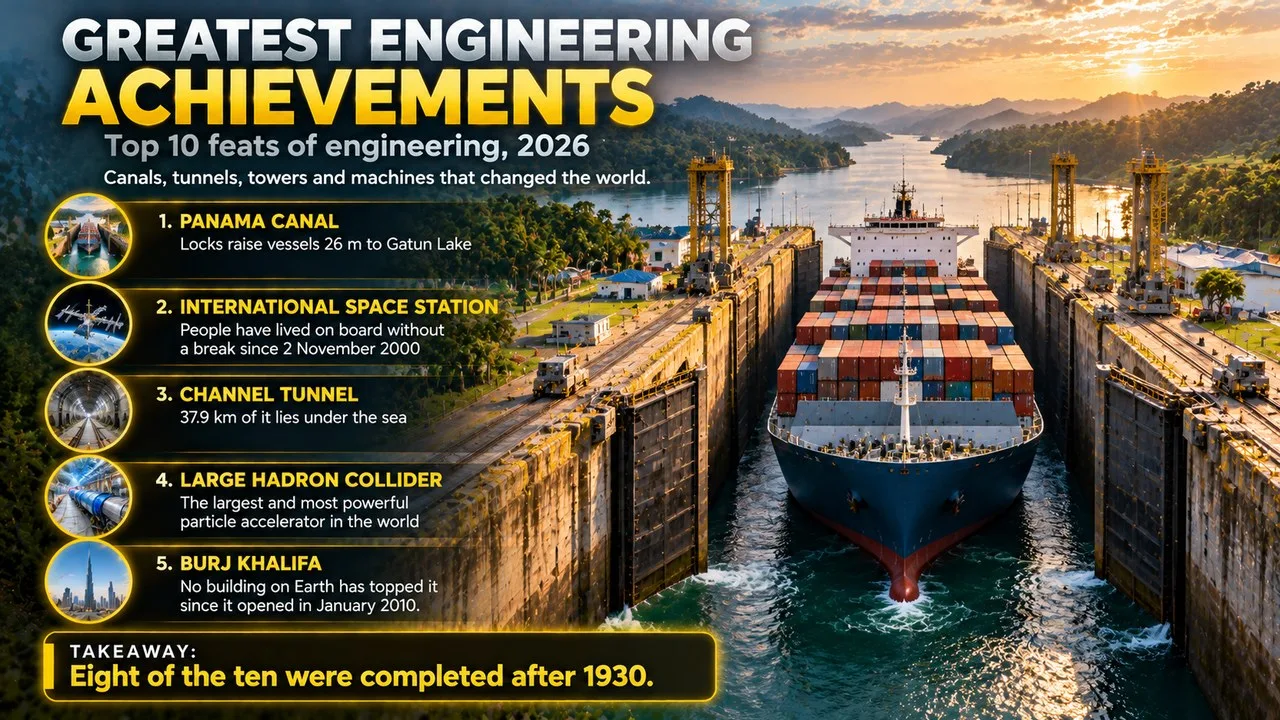
The greatest engineering achievements range from the Panama Canal, which joined two oceans in 1914, to the International Space Station orbiting 400 km up.
This Finepedia guide, written in October 2026, looks at ten works of engineering that solved problems once thought impossible. They include canals and tunnels that changed world trade, barriers that hold back the sea, a machine that found a new particle and a home for astronauts in orbit. Each one pushed the limits of the materials, tools and knowledge of its time. For more on how engineers learn from success and failure, see the Finepedia guides Engineering Disasters That Changed the Rules: Top 10 and Top 10 Tallest Buildings in the World.
How We Chose These
We weighed each project on its scale, the difficulty of the problems it overcame and its lasting effect on how people live, travel or learn. Five of our picks also feature among the seven modern wonders named in 1994 by ASCE, the leading US body for civil engineers. Dates and figures were checked against the operators, ASCE, NASA, CERN, UNESCO and Wikipedia, as of October 2026. Ancient pyramids, great walls and the largest dams are covered in other Finepedia guides, so we focused on different feats here. Eight of the ten were completed after 1930.
The 10 Greatest Engineering Achievements at a Glance
| Rank | Achievement | Location | Completed | Key figure |
|---|---|---|---|---|
| 1 | Panama Canal | Panama | 1914 | 82 km between two oceans |
| 2 | International Space Station | Low Earth orbit | Crewed since 2000 | About 109 m across |
| 3 | Channel Tunnel | United Kingdom and France | 1994 | 37.9 km under the sea |
| 4 | Delta Works | Netherlands | 1997 | Storm barriers along the coast |
| 5 | Large Hadron Collider | France and Switzerland | 2008 | 27 km ring |
| 6 | Golden Gate Bridge | United States | 1937 | 1,280 m main span |
| 7 | Burj Khalifa | United Arab Emirates | 2010 | 828 m tall |
| 8 | Hong Kong–Zhuhai–Macau Bridge | China | 2018 | 55 km sea crossing |
| 9 | Empire State Building | United States | 1931 | Built in about 13 months |
| 10 | Pont du Gard | France | 1st century CE | 48.8 m high aqueduct bridge |
1. The Panama Canal Joined Two Oceans
The Panama Canal cuts 82 km across the Isthmus of Panama, saving ships a long and stormy voyage around the tip of South America. Locks raise vessels 26 m to Gatun Lake, a reservoir created when engineers dammed the Chagres River, and then lower them on the far side. France began the work in 1881 but gave up in 1889; the United States took over in 1904, and the first official transit came on 15 August 1914.
Key Facts
- Length: 82 km (51 miles)
- Opened: 15 August 1914
- New, wider locks: in use since June 2016
- Control: handed to Panama in 1999
Did You Know?
The cost in lives was heavy. Disease and accidents killed an estimated 22,000 workers during the French attempt, and more than 5,600 died during the American phase, by official count, before mosquito control helped tame yellow fever and malaria.
2. International Space Station: A Home in Orbit
No human-made object in space is larger than the International Space Station, measuring about 109 m with its solar panels, roughly the size of a football field. Its first module was launched in 1998, and people have lived on board without a break since 2 November 2000. Five space agencies, from the United States, Russia, Europe, Japan and Canada, run it together.
Key Facts
- First module launched: 1998
- Crewed without a break: since 2 November 2000
- Height above Earth: about 400 km
- Orbit time: about 93 minutes, or 15.5 trips around Earth a day
Why It Matters
The station was assembled piece by piece in orbit over more than a decade, using rockets and space shuttles from several nations. It is due to be retired around 2030, when it will be steered back into the atmosphere, although some lawmakers have argued for keeping it in a higher orbit, as of 2026.
3. The Channel Tunnel Links Britain and France
The Channel Tunnel runs 50.46 km between Folkestone in England and Coquelles in northern France, and 37.9 km of it lies under the sea, the longest undersea stretch of any tunnel. It opened in 1994 and is made up of two rail tunnels and a smaller service tunnel between them. Passenger trains, car shuttles and freight trains all use it.
Key Facts
- Total length: 50.46 km
- Undersea section: 37.9 km
- Deepest point: about 75 m below sea level
- Opened: 1994
Did You Know?
Giant boring machines dug from both coasts and met under the Channel in December 1990. ASCE counts the tunnel among its seven modern wonders, along with the Panama Canal and the Golden Gate Bridge.
4. The Delta Works Hold Back the North Sea
The Delta Works are a chain of dams, locks, sluices and storm barriers that protect the low-lying south-west of the Netherlands. They were built between 1954 and 1997 after the great 1953 North Sea flood, which killed more than 1,800 people in the country. By closing off river mouths, the works shortened the coastline that needed strong dykes.
Key Facts
- Built: 1954 to 1997
- Trigger: the 1953 North Sea flood
- Largest part: the Eastern Scheldt barrier, about 9 km long
- Recognition: one of ASCE's seven modern wonders
Why It Matters
The Eastern Scheldt barrier, opened in 1986, was first planned as a solid dam. After protests from fishers and nature groups, engineers instead fitted huge movable gates that stay open most of the time and close only in storms, keeping the estuary tidal and alive.
5. The Large Hadron Collider Found the Higgs Boson
The Large Hadron Collider at CERN is the largest and most powerful particle accelerator in the world. Its ring, 27 km around, lies up to 175 m underground beneath the border of France and Switzerland near Geneva. Built between 1998 and 2008 by thousands of scientists from more than 100 countries, it smashes beams of protons together at nearly the speed of light.
Key Facts
- Ring length: 27 km
- Built: 1998 to 2008
- Magnets: about 1,232 main bending magnets of 35 tonnes each
- Major discovery: the Higgs boson, announced in 2012
Did You Know?
The magnets are cooled with liquid helium to 1.9 degrees above absolute zero, or about minus 271 degrees Celsius. That is colder than the space between the stars.
6. Golden Gate Bridge Spans a Stormy Strait
The Golden Gate Bridge crosses the narrow strait where San Francisco Bay meets the Pacific, a place of strong currents, fog and high winds. When it opened on 27 May 1937, its 1,280 m main span was the longest of any suspension bridge on Earth, a record it held until 1964. Its towers rise 227 m above the water.
Key Facts
- Main span: 1,280 m (4,200 ft)
- Tower height: 227 m (746 ft)
- Opened: 27 May 1937
- Chief engineer: Joseph Strauss
Why It Matters
The bridge showed that long suspension spans could survive harsh coastal weather. Its famous International Orange colour, chosen by the architect Irving Morrow, helps it stand out in fog and has made it a symbol of California.
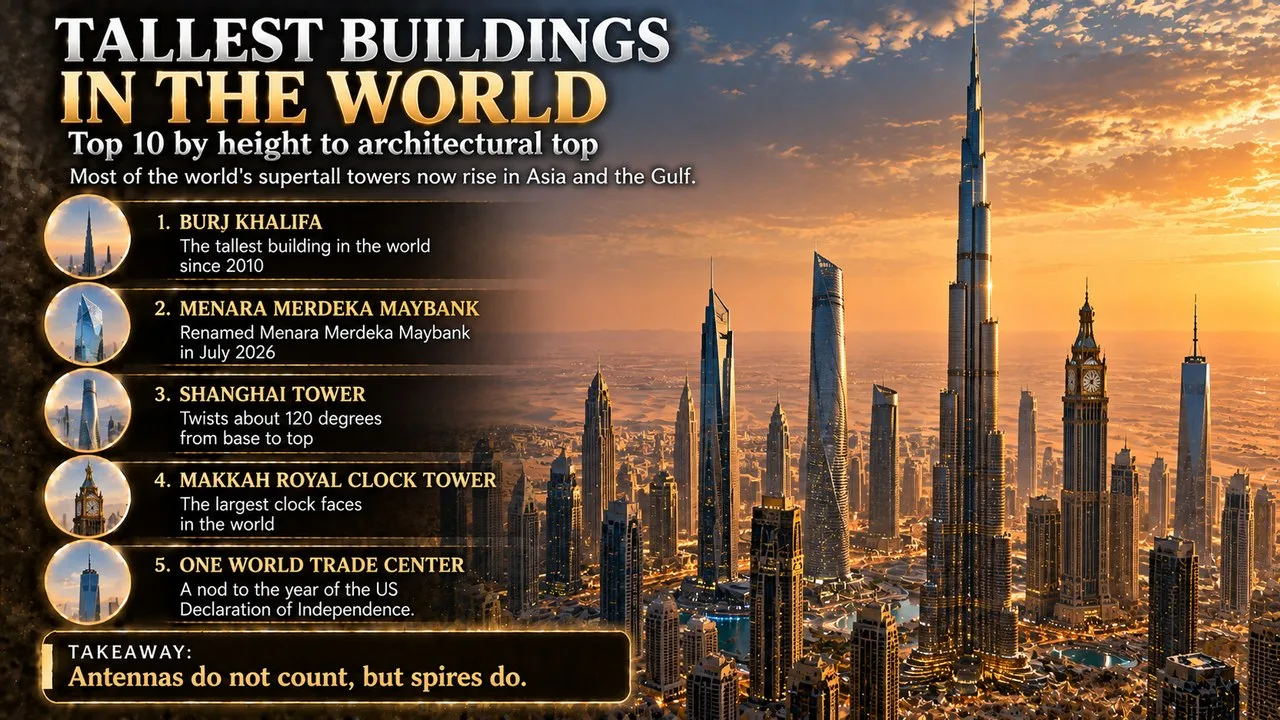
7. Burj Khalifa Reaches 828 Metres
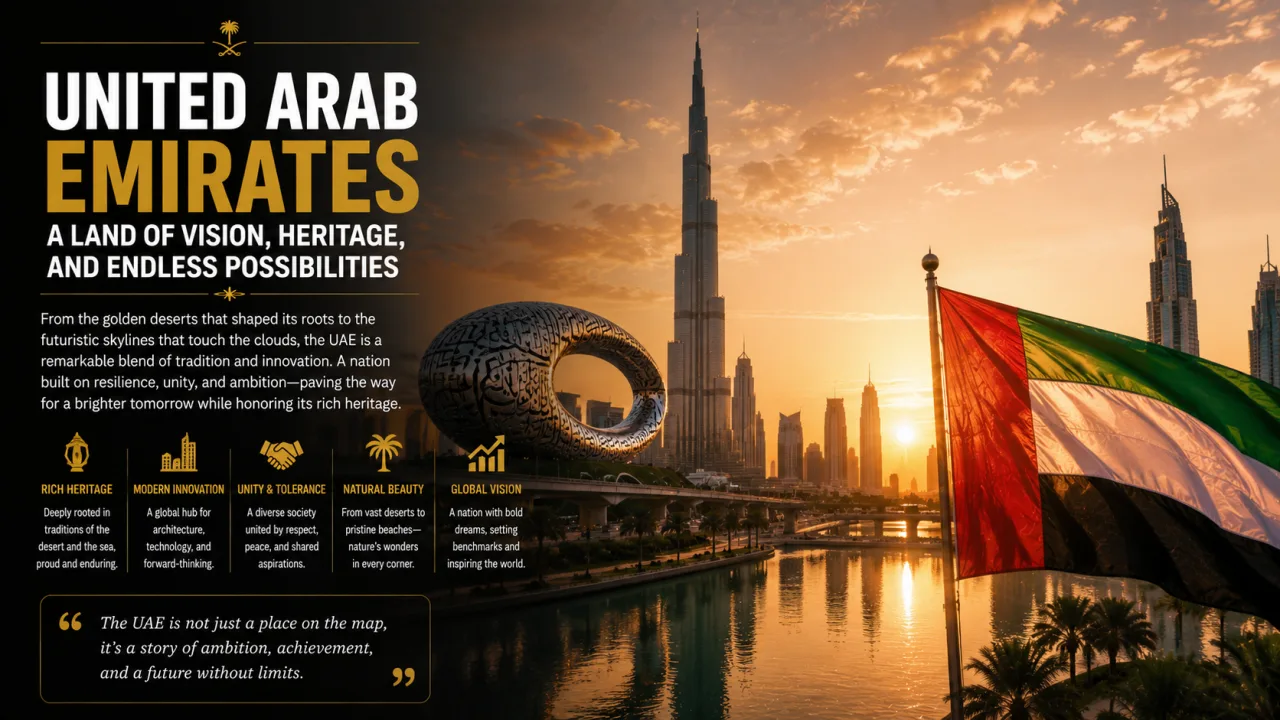
The Burj Khalifa in Dubai rises 828 m, and no building on Earth has topped it since it opened in January 2010. Designed by the firm Skidmore, Owings and Merrill, it has a central core of reinforced concrete with three wings, a Y-shaped plan that helps it resist strong desert winds.
Key Facts
- Height: 828 m (2,717 ft)
- Opened: January 2010
- Construction began: 2004
- Main material: reinforced concrete
Did You Know?
Pumping concrete to such heights was a record-breaking challenge in itself. Workers often poured concrete at night, when it was cooler, and added ice to the mix so it would set properly in the heat.
8. Hong Kong–Zhuhai–Macau Bridge Crosses the Open Sea
Known as the HZMB, this link joins Hong Kong, Macau and the city of Zhuhai across the Pearl River estuary. The 55 km route mixes three cable-stayed bridges with four man-made islands and a tunnel beneath the seabed, making it the longest sea crossing in the world. It opened to the public on 24 October 2018.
Key Facts
- Length: 55 km
- Opened: 24 October 2018
- Parts: three bridges, a tunnel and four artificial islands
- Design life: 120 years
Why It Matters
The tunnel section lets large ships pass through one of the busiest shipping lanes in Asia without needing very tall bridges. The crossing has cut the road journey between Hong Kong and Zhuhai from several hours to under one hour.
9. The Empire State Building Rose in About 13 Months
The Empire State Building in New York City was built at astonishing speed. Work began on 17 March 1930 and the 102-storey tower opened on 1 May 1931, about 13 and a half months later. At 381 m to its roof, no taller building existed anywhere until 1970.
Key Facts
- Floors: 102
- Roof height: 381 m (1,250 ft)
- Built: March 1930 to May 1931
- Style: Art Deco
Did You Know?
At the peak of construction, the steel frame rose by about four floors a week. Careful planning of deliveries and work crews made this pace possible long before computers were used for project planning.
10. The Pont du Gard Shows Roman Precision
The Pont du Gard is a Roman aqueduct bridge in southern France, built in the first century CE to carry water about 50 km to the city of Nîmes. Its three tiers of limestone arches stand 48.8 m high. Remarkably, the water channel falls only about 17 m along its whole route, a gentle slope that kept the water moving steadily.
Key Facts
- Height: 48.8 m
- Built: first century CE
- Water carried: about 40,000 cubic metres a day
- UNESCO World Heritage Site: since 1985
Why It Matters
Built without mortar in its main arches, the bridge has stood for about 2,000 years. It shows that ancient engineers could survey and build with a precision that still impresses experts today.
Frequently Asked Questions
Which modern wonders did civil engineers name?
In 1994 ASCE, the US civil engineering society, picked seven modern wonders: the Channel Tunnel, the CN Tower, the Empire State Building, the Golden Gate Bridge, the Itaipu Dam, the Netherlands' North Sea protection works and the Panama Canal.
What is the largest engineering project in space?
No bigger or costlier project has ever been placed in space than the International Space Station. It was built from dozens of parts launched separately and joined together in orbit.
Conclusion
From a Roman aqueduct to a laboratory in orbit, the greatest engineering achievements show how people have used skill and teamwork to overcome nature's limits. Many of them, such as the Panama Canal and the Delta Works, still shape trade and safety today. For more on the rules and records of engineering, read the Finepedia guides Engineering Disasters That Changed the Rules: Top 10 and Top 10 Tallest Buildings in the World.
- ASCE (American Society of Civil Engineers), modern wonders list, accessed October 2026.
- Panama Canal Authority, history of the canal, accessed October 2026.
- NASA, International Space Station facts and figures, accessed October 2026.
- CERN, the Large Hadron Collider, accessed October 2026.
- Rijkswaterstaat, Delta Works, and UNESCO World Heritage Centre, Pont du Gard, accessed October 2026.
- Wikipedia (accessed October 2026): Panama Canal, International Space Station, Channel Tunnel, Delta Works, Oosterscheldekering, Large Hadron Collider, Golden Gate Bridge, Burj Khalifa, Hong Kong–Zhuhai–Macau Bridge, Empire State Building and Pont du Gard.
- 10 Most Today, 10 Most Amazing Engineering Achievements, 10mosttoday.com (topic reference).

























Discussion
Log in with