











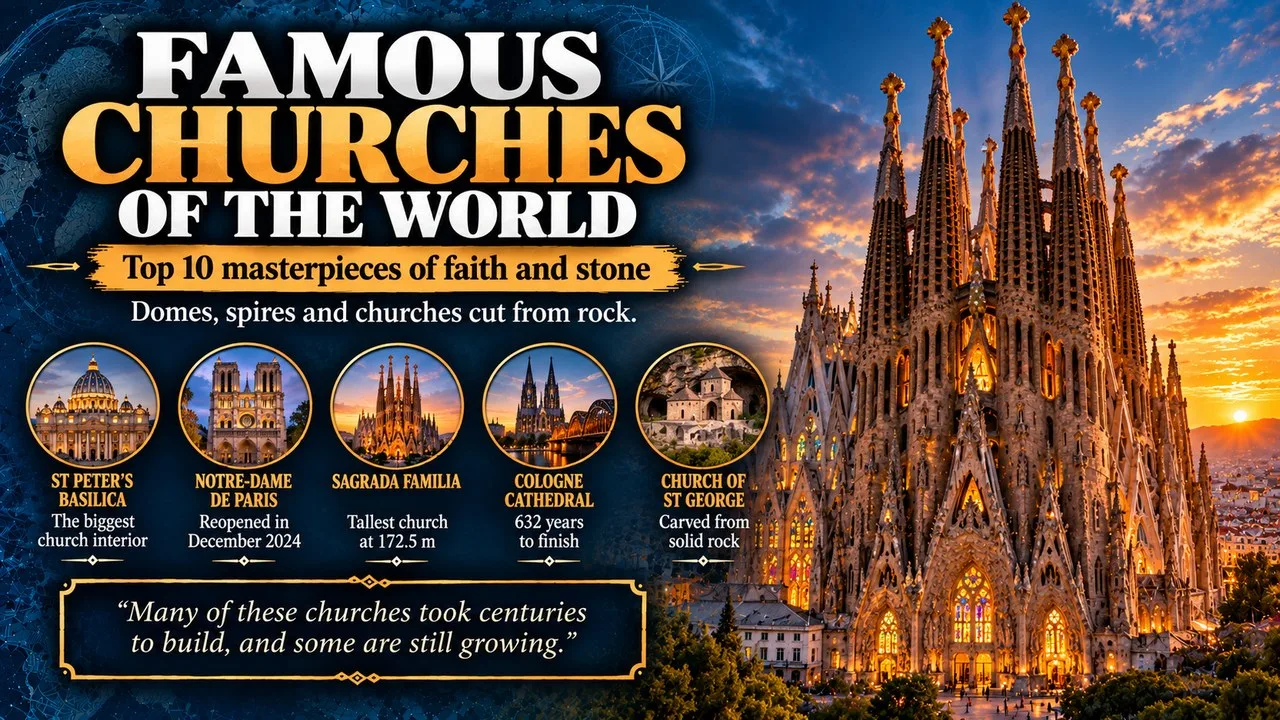
Famous churches of the world range from St Peter's Basilica in Vatican City to Gaudí's Sagrada Família and the rock-cut Church of St George in Ethiopia.
This Finepedia guide, written in October 2026, presents 10 of the best-known churches on Earth, from Renaissance Rome to the highlands of Ethiopia and a canyon in the Andes. Each entry covers when the church was built, what makes its architecture stand out and one story that visitors often miss. For more sacred places, see the Finepedia guides Remarkable Monasteries Around the World: Top 10 and Famous Statues of Jesus Around the World: Top 10.
How We Chose These
We looked for churches that are famous far beyond their own countries, for their architecture, their history or their role as places of pilgrimage. We also wanted a spread of styles, from Gothic and Renaissance to Russian, Ethiopian and modern designs. Hagia Sophia in Istanbul is left out because it has served as a mosque since 2020, and monasteries are covered in a separate Finepedia guide. The order is a guide, not a ranking of importance.
The 10 Famous Churches at a Glance
| Rank | Church | Location | Main building period |
|---|---|---|---|
| 1 | St Peter's Basilica | Rome, Vatican City | 1506–1626 |
| 2 | Notre-Dame de Paris | Paris, France | 1163–1260 |
| 3 | Sagrada Família | Barcelona, Spain | 1882–present |
| 4 | Cologne Cathedral | Cologne, Germany | 1248–1880 |
| 5 | Saint Basil's Cathedral | Moscow, Russia | 1555–1561 |
| 6 | Church of the Holy Sepulchre | Jerusalem | 4th century, rebuilt 1048 |
| 7 | Milan Cathedral | Milan, Italy | 1386–1965 |
| 8 | Florence Cathedral | Florence, Italy | 1296–1436 |
| 9 | Church of St George | Lalibela, Ethiopia | about 1200 |
| 10 | Las Lajas Sanctuary | Ipiales, Colombia | 1916–1949 |
1. St Peter's Basilica Has the Biggest Church Interior
St Peter's Basilica stands in Vatican City, the smallest country in the world, and has the biggest interior of any church. It replaced a fourth-century basilica built under the emperor Constantine, and work on the present building lasted 120 years.
Key Facts
- Built: 18 April 1506 to 18 November 1626
- Main architects: Bramante, Michelangelo and Carlo Maderno
- Square and fittings: Gian Lorenzo Bernini
- Famous artwork: Michelangelo's Pietà, near the entrance
Did You Know?
St Peter's is not the pope's cathedral. That title belongs to St John Lateran, across the city in Rome. Catholic tradition holds that St Peter is buried directly beneath the high altar, which is why the basilica became such an important place of pilgrimage.
2. Notre-Dame de Paris Rose Again After the Fire
Notre-Dame de Paris, on an island in the Seine, shows French Gothic design at its very best. Its flying buttresses, rib vaults and huge rose windows made it a model for cathedrals across Europe.
Key Facts
- Building began: 1163, in the time of Bishop Maurice de Sully
- Largely complete: about 1260
- Major restoration: 1844 to 1864, led by Eugène Viollet-le-Duc
- Fire: April 2019, with reopening in December 2024
Why It Matters
Victor Hugo's 1831 novel, whose English title is The Hunchback of Notre-Dame, revived public interest in the neglected building and led to its 19th-century restoration. After the 2019 fire destroyed the roof and spire, a five-year rebuilding effort restored it using traditional crafts.
3. Sagrada Família Is Now the Tallest Church
Antoni Gaudí's Sagrada Família in Barcelona has been rising slowly since 1882, paid for by private donations and ticket sales. Gaudí blended Gothic ideas with flowing, nature-inspired shapes, and he worked on it until his death in 1926.
Key Facts
- First stone: 19 March 1882
- Gaudí's role: chief architect from 1883 until 1926
- Consecrated: 7 November 2010, by Pope Benedict XVI
- Central tower: the Tower of Jesus Christ, 172.5 m tall
Did You Know?
The central tower reached its full height on 20 February 2026, and the Sagrada Família took the title of tallest church on Earth. Pope Leo XIV blessed the tower on 10 June 2026, during the centenary year of Gaudí's death, though other parts of the basilica are still being built.
4. Cologne Cathedral Took 632 Years to Finish
Cologne Cathedral, beside the Rhine, is a masterpiece of Gothic architecture and Germany's most visited landmark, drawing about 6 million people a year. Work started in 1248, stopped for about three centuries and was only completed to its medieval plans in 1880.
Key Facts
- Height: 157 m, the tallest twin-spired church on Earth
- Façade: the biggest church front anywhere
- Treasure: the golden Shrine of the Three Kings, made around 1190 to 1225
- UNESCO listing: 1996
Why It Matters
The cathedral was built to house relics said to be those of the Three Kings, which made Cologne a major pilgrimage city in the Middle Ages. It came through heavy air raids during the Second World War while much of the city around it was destroyed.
5. Saint Basil's Cathedral Brightens Red Square
Saint Basil's Cathedral, at the edge of Red Square in Moscow, is famous for its colourful onion domes. Ivan the Terrible ordered it to celebrate his conquest of the khanates of Kazan and Astrakhan, and its unusual design has no close parallel in Russian architecture.
Key Facts
- Built: 1555 to 1561
- Official name: the Cathedral of the Intercession on the Moat
- Layout: eight chapels around a central ninth, plus a tenth added in 1588
- Bright colours: completed by 1683
Did You Know?
The popular name comes from Vasily the Blessed, a local holy man buried in the tenth chapel. Since 1928 it has been a branch of the State Historical Museum, though services are sometimes held there again.
6. The Holy Sepulchre Is Shared by Several Communities
Jerusalem's Church of the Holy Sepulchre stands inside the walled Old City, in its Christian Quarter. Christian tradition dating to the fourth century holds that it contains both the place of the crucifixion and the tomb of Jesus, so it has drawn pilgrims for about 1,700 years.
Key Facts
- First church: built under Constantine in the 4th century
- Rebuilt: completed in 1048, after destruction in 1009
- Tomb shrine: the Aedicule, a 19th-century structure
- Shared by: Greek Orthodox, Catholic and Armenian communities, with smaller Coptic, Ethiopian and Syriac roles
Why It Matters
Use of the church is governed by the Status Quo, an arrangement dating to 1757 and confirmed in 1853, under which even small changes need agreement. A wooden ladder has stood under a window on the façade since the 18th century, partly because no one can agree to move it.
7. Milan Cathedral Took Nearly Six Centuries
Milan Cathedral, known locally as the Duomo, is Italy's biggest church and ranks among the biggest anywhere. Its white and pink marble exterior bristles with spires, pinnacles and thousands of statues.
Key Facts
- Building began: 1386, under Archbishop Antonio da Saluzzo
- Last details: the final portal opened on 6 January 1965
- Golden statue: the Madonnina, raised in 1762 at about 108 m
- Rooftop: visitors can walk among the spires on the terraces
Did You Know?
Milan is often foggy, so local people say the weather is good when they can see the gilded Madonnina from a distance. For many years no building in the city was allowed to rise higher than the statue.
8. Florence Cathedral Has a Record-Breaking Dome
Florence Cathedral, also called Santa Maria del Fiore, is the heart of the city's historic centre. Its dome, designed by Filippo Brunelleschi, remains the biggest dome ever built from brick and stone.
Key Facts
- Building began: 1296, to a design by Arnolfo di Cambio
- Dome: built from 1420 to 1436
- Exterior: green, pink and white marble panels
- Neighbours: the Baptistery and Giotto's bell tower
Why It Matters
Brunelleschi built the huge dome without the usual wooden scaffolding from the ground, using two domes, one inside the other, and herringbone brickwork. The feat became a symbol of Renaissance engineering, and visitors can still climb hundreds of steps to the top.
9. The Church of St George Was Carved From Solid Rock
The Church of St George, or Bete Giyorgis, is the best known of 11 rock-hewn churches in Lalibela, in northern Ethiopia. Builders cut it downwards from volcanic rock, so the roof sits at ground level and the whole church stands in a deep pit.
Key Facts
- Date: about 1200, by most estimates
- Commissioned by: King Lalibela, a ruler of the Zagwe dynasty
- Shape: a cross, clearly visible from above
- Status: part of the Rock-Hewn Churches of Lalibela UNESCO site
Did You Know?
Tradition says King Lalibela wanted to create a new Jerusalem, and the churches are grouped around a channel named after the Jordan River. Visitors reach St George through a narrow trench and tunnel, and it is still used for worship by Ethiopian Orthodox Tewahedo believers.
10. Las Lajas Sanctuary Spans a Canyon
Las Lajas Sanctuary in southern Colombia is a neo-Gothic basilica built across the gorge of the Guáitara River, a few kilometres from the border with Ecuador. It rises about 100 m from the canyon floor and is reached by a bridge about 50 m high.
Key Facts
- Built: 1916 to 1949
- Location: near Ipiales, in the Nariño department
- Basilica status: granted in 1954
- Pilgrims: from both Colombia and Ecuador
Why It Matters
Local tradition tells of a woman, María Mueses, and her daughter Rosa, who sheltered from a storm here around 1754 and saw the Virgin Mary appear on the rock. The image is still on the cliff face behind the altar, and the name comes from lajas, the Spanish word for flat stones.
Frequently Asked Questions
What is the largest church in the world?
St Peter's has the biggest interior of any church. Since February 2026 the Sagrada Família has been the tallest, while the huge basilica at Yamoussoukro in Côte d'Ivoire, dedicated to Our Lady of Peace, also appears on lists of the biggest.
What is the difference between a cathedral and a basilica?
A cathedral is the main church of a diocese and holds the bishop's chair, called a cathedra. Basilica is an honorary title given by the pope to important churches, so a church can be both, like Notre-Dame.
Conclusion
From the rock-cut walls of Lalibela to the soaring towers of the Sagrada Família, these famous churches show how faith, art and engineering have shaped cities for more than 1,500 years. Many took centuries to finish, and several are still being restored or built. For more places of worship and reflection, read the Finepedia guides Remarkable Monasteries Around the World: Top 10 and Famous Statues of Jesus Around the World: Top 10.
- UNESCO World Heritage Centre, listings for Cologne Cathedral, Works of Antoni Gaudí, Historic Centre of Florence and Rock-Hewn Churches, Lalibela.
- Official visitor websites of the Sagrada Família and Notre-Dame de Paris (accessed October 2026).
- Wikipedia (accessed October 2026): St. Peter's Basilica, Notre-Dame de Paris, Sagrada Família, Cologne Cathedral, Saint Basil's Cathedral, Church of the Holy Sepulchre, Milan Cathedral, Florence Cathedral, Church of Saint George, Lalibela and Las Lajas Sanctuary.
- 10 Most Today, 10 Most Famous Churches in the World, 10mosttoday.com (topic reference).




























Discussion
Log in with