






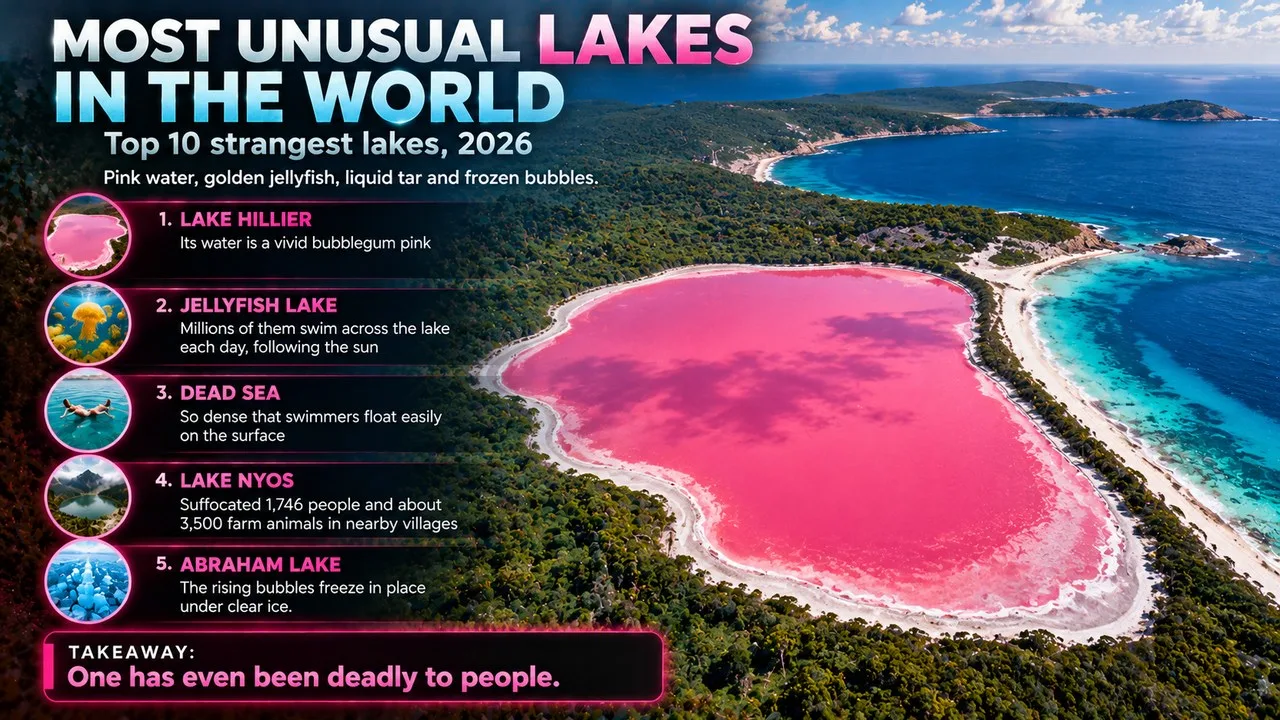
The most unusual lakes in the world include a bubblegum-pink lake in Australia, a lake full of golden jellyfish in Palau and a lake of liquid asphalt.
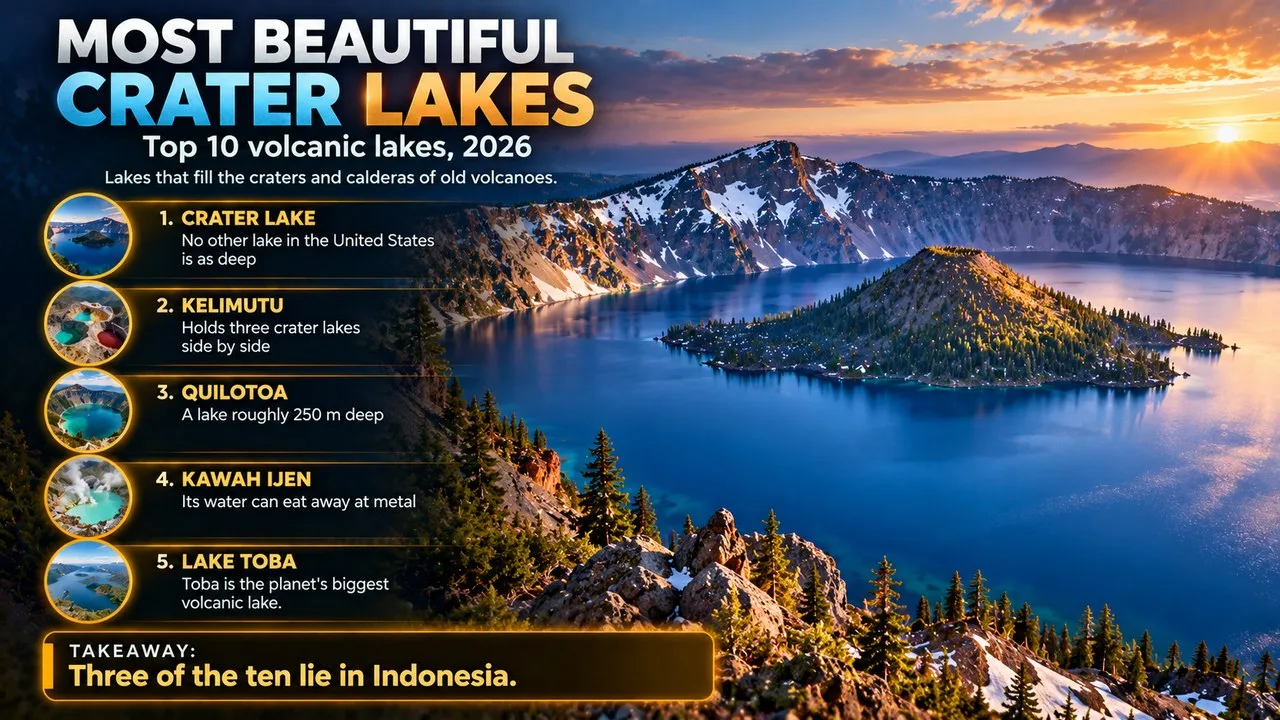
This Finepedia guide, written in October 2026, explores ten lakes that break the usual rules. Some are coloured pink or red by tiny living things, some are so salty that they never freeze, and one is made almost entirely of natural tar. One has even been deadly to people. Volcanic crater lakes chosen mainly for their beauty are covered in a separate Finepedia list, so none of those appear here. For more record-breaking waters and landscapes, see the Finepedia guides Top 10 Deepest Lakes in the World and Amazing Salt Flats of the World: Top 10.
How We Chose These
We looked for lakes with a feature that is rare or unique on Earth, such as an unusual colour, extreme saltiness or heat, strange wildlife or a surprising material. Each lake had to be well studied, with facts that could be checked against scientific papers, park and tourism authorities and Wikipedia, as of October 2026. We ranked them by how unusual their main feature is and how well known they are to travellers. Several of these lakes are protected or sacred, and some can only be seen from a distance.
The 10 Most Unusual Lakes at a Glance
| Rank | Lake | Country | What makes it unusual |
|---|---|---|---|
| 1 | Lake Hillier | Australia | Bright pink water all year |
| 2 | Jellyfish Lake | Palau | Millions of golden jellyfish |
| 3 | Dead Sea | Jordan, Israel and the West Bank | Lowest land on Earth, very salty |
| 4 | Lake Natron | Tanzania and Kenya | Red alkaline water and flamingos |
| 5 | Pitch Lake | Trinidad and Tobago | A lake of natural asphalt |
| 6 | Spotted Lake | Canada | Coloured mineral spots in summer |
| 7 | Don Juan Pond | Antarctica | So salty it rarely freezes |
| 8 | Lake Nyos | Cameroon | Deadly gas cloud in 1986 |
| 9 | Frying Pan Lake | New Zealand | Largest hot spring on Earth |
| 10 | Abraham Lake | Canada | Frozen methane bubbles in winter |
1. Lake Hillier Is Bright Pink
Lake Hillier sits on Middle Island, in the Southern Ocean near Esperance, Western Australia, separated from the ocean by a thin strip of sand and forest. Only about 600 m long, it stands out from the air because its water is a vivid bubblegum pink. The colour stays even when the water is scooped into a bottle.
Key Facts
- Size: about 600 m by 250 m
- Location: Middle Island, Recherche Archipelago, Western Australia
- Cause of colour: salt-loving algae and microbes, mainly Dunaliella salina
- Best view: from scenic flights, as the island is hard to reach
Did You Know?
Scientists who studied its DNA found a mix of salt-loving algae, bacteria and archaea that produce red and pink pigments. Lake Retba in Senegal is another famous pink lake, though its colour can fade after heavy rain.
2. Jellyfish Lake Is Full of Golden Jellyfish
Jellyfish Lake lies on Eil Malk, one of Palau's Rock Islands in the western Pacific. The salt water reaches the lake through cracks in the old limestone reef, yet it is cut off enough that its golden jellyfish have evolved to differ from their cousins in the open lagoon. Millions of them swim across the lake each day, following the sun.
Key Facts
- Location: Eil Malk, Rock Islands, Palau
- Famous resident: the golden jellyfish
- Daily movement: east to west across the lake with the sun
- Lower layer: has no oxygen and contains toxic gas
Why It Matters
The jellyfish sting so weakly that people can snorkel among them, although scuba diving is banned to protect visitors from the poisonous lower water. Jellyfish numbers crashed during a drought in 2016, and the lake was closed to swimmers until the population recovered, reopening in 2019.
3. The Dead Sea Lies at the Lowest Point on Land
The Dead Sea, shared by Jordan, Israel and the West Bank, has a surface about 440 m below sea level, as of 2025, making its shores the lowest dry land on the planet. The water holds roughly nine times as much salt as seawater, so dense that swimmers float easily on the surface. Few living things apart from microbes can survive in it.
Key Facts
- Surface: about 440 m below sea level (2025)
- Maximum depth: about 304 m
- Saltiness: about 34 percent
- Main inflow: the Jordan River
Did You Know?
The Dead Sea has been shrinking since the 1960s, as much of the water that once flowed in from the Jordan River is now used for farms and towns. Its level now falls by about a metre a year, leaving sinkholes along its shores.
4. Lake Natron Turns Animals to Stone
Lake Natron in northern Tanzania is a shallow, hot and highly alkaline lake, with water that can reach a pH above 12, close to that of household ammonia. Microbes that thrive in the salty water turn parts of it deep red and orange. Birds and bats that die in the lake can become coated in salts and preserved, almost like statues.
Key Facts
- Location: northern Tanzania, reaching into Kenya
- Depth: less than 3 m
- Water temperature: often above 40 degrees Celsius
- Alkalinity: pH can exceed 12
Why It Matters
Despite its harsh water, Lake Natron is the main breeding site for East Africa's lesser flamingos, which nest on its salt islands where few predators can reach them. Plans for industry on the lake are closely watched because of how much the birds depend on it.
5. Pitch Lake Is Made of Asphalt
Pitch Lake, at La Brea in south-west Trinidad, holds more natural asphalt than any other site on Earth. It covers about 40 hectares and is said to be about 75 m deep, holding an estimated 10 million tonnes of tar. The surface is firm enough to walk on in many places, but it slowly churns and can swallow objects over time.
Key Facts
- Area: about 40 hectares (100 acres)
- Depth: reported to be about 75 m
- Contents: an estimated 10 million tonnes of natural asphalt
- Use: mined for road surfacing for more than a century
Did You Know?
The English explorer Sir Walter Raleigh visited in 1595 and used the pitch to seal the hull of his ship. Guided tours today lead visitors across the surface, where rainwater collects in warm pools between the folds of tar.
6. Spotted Lake Breaks Into Coloured Spots
Spotted Lake, near Osoyoos in British Columbia, is rich in magnesium sulphate and other minerals. Each summer, most of its water evaporates, leaving hundreds of small pools separated by hard mineral walkways. The pools take on shades of blue, green and yellow, depending on the minerals they hold.
Key Facts
- Location: near Osoyoos, British Columbia, Canada
- Main mineral: magnesium sulphate
- Best time to see: summer, when the water evaporates
- Name in the Syilx language: Kłlil'xʷ (Khiluk)
Why It Matters
The lake is sacred to the Syilx Okanagan people, who have long used its waters for healing. In 2001 the Okanagan Nation Alliance bought the surrounding land to protect it, and visitors can view it only from a roadside fence.
7. Don Juan Pond Almost Never Freezes
Don Juan Pond, in the Wright Valley of Antarctica, is one of the saltiest bodies of water on Earth. Its salt content can be more than 40 percent, mainly calcium chloride, so its water stays liquid at temperatures as low as minus 50 degrees Celsius. The pond is very shallow, often only about 10 cm deep.
Key Facts
- Location: Wright Valley, Victoria Land, Antarctica
- Saltiness: up to about 45 percent
- Liquid down to: about minus 50 degrees Celsius
- Discovered: 1961
Did You Know?
The pond is named after two helicopter pilots, Don Roe and John Hickey, who flew the first team to study it. Scientists study it as a model for salty water that might exist on Mars.
8. Lake Nyos Released a Deadly Gas Cloud
Lake Nyos is a deep crater lake in north-west Cameroon. Carbon dioxide from magma below seeps into its deep water. On 21 August 1986, the lake suddenly released a huge cloud of the gas, which flowed downhill and suffocated 1,746 people and about 3,500 farm animals in nearby villages.
Key Facts
- Location: Northwest Region, Cameroon
- Disaster: 21 August 1986
- Deaths: 1,746 people
- Safety measure: gas-venting pipes installed from 2001
Why It Matters
Scientists know of just two other lakes that store gas in this way: Lake Monoun, a smaller Cameroonian lake, plus Lake Kivu, shared by Rwanda and the DR Congo. Pipes now carry deep water to the surface so the gas can escape slowly and safely.
9. Frying Pan Lake Is the Largest Hot Spring
Frying Pan Lake, in the Waimangu Volcanic Rift Valley near Rotorua in New Zealand, is the biggest hot spring on Earth. Its acidic water stays at about 50 to 60 degrees Celsius, and steam often drifts across its surface. The lake fills a crater formed during the 1886 eruption of Mount Tarawera and grew to its present size after a blast in 1917.
Key Facts
- Area: about 3.8 hectares
- Water temperature: about 50 to 60 degrees Celsius
- Average depth: about 5.5 m
- Formed: in a crater from the 1886 eruption
Did You Know?
Only the Boiling Lake on the Caribbean island of Dominica comes close in size among hot lakes. Its grey-blue water bubbles so fiercely in the centre that its temperature there has never been measured.
10. Abraham Lake Traps Frozen Bubbles
Abraham Lake is a reservoir in the Canadian Rockies of western Alberta, created in 1972 when the Bighorn Dam was built. In winter, rotting plants at the bottom give off methane, and the rising bubbles freeze in place under clear ice. The stacks of white bubbles make a striking sight that draws photographers every year.
Key Facts
- Location: western Alberta, Canada
- Created: 1972, by the Bighorn Dam
- Length: about 32 km
- Best time to see bubbles: January and February
Why It Matters
The lake shows how even a human-made reservoir can produce a natural wonder. Visitors are warned to take care on the ice, as strong winds and open patches can make it dangerous.
Frequently Asked Questions
Why are some lakes pink?
Pink lakes are usually very salty and home to algae such as Dunaliella salina, along with bacteria and archaea, which make red and orange pigments to cope with strong sunlight and salt.
Can you swim in these lakes?
You can float in the Dead Sea and snorkel in Jellyfish Lake, but most of the others are unsafe or off-limits, because of acid, extreme heat, toxic gas, strong alkalis or cultural protection.
Conclusion
The world's most unusual lakes, from pink Lake Hillier and the jellyfish-filled waters of Palau to the asphalt of Pitch Lake and the frozen bubbles of Abraham Lake, show how varied our planet's waters can be. They are reminders that chemistry, geology and life can combine in surprising ways. For more extraordinary places, read the Finepedia guides Top 10 Deepest Lakes in the World and Amazing Salt Flats of the World: Top 10.
- Tourism Western Australia, Lake Hillier, accessed October 2026.
- Coral Reef Research Foundation and Palau tourism authority, Jellyfish Lake, accessed October 2026.
- Ramsar Convention, Lake Natron Basin site information, accessed October 2026.
- US Geological Survey and published studies, Lake Nyos degassing, accessed October 2026.
- Waimangu Volcanic Valley, Frying Pan Lake, accessed October 2026.
- Wikipedia (accessed October 2026): Lake Hillier, Lake Retba, Jellyfish Lake, Dead Sea, Lake Natron, Pitch Lake, Spotted Lake, Don Juan Pond, Lake Nyos, Lake Kivu, Frying Pan Lake, Boiling Lake and Abraham Lake.
- 10 Most Today, 10 Most Unique Lakes in the World, 10mosttoday.com (topic reference).

























Discussion
Log in with