









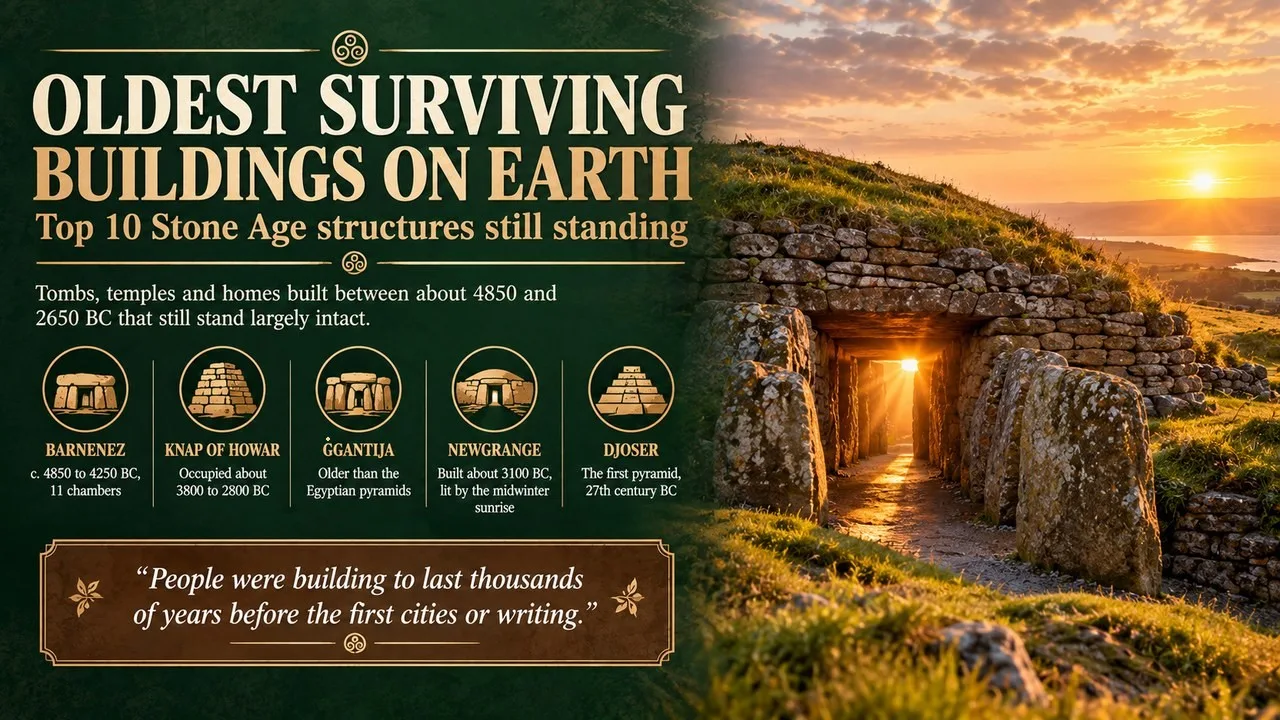
The oldest surviving buildings on Earth are Stone Age tombs, temples and homes, built between about 4850 and 2650 BC, that still stand largely intact.
This Finepedia guide, written in October 2026, gathers 10 of these survivors, from a stepped stone cairn on the Brittany coast to the first pyramid in Egypt. Most dates come from radiocarbon dating and are approximate, so we give ranges where specialists disagree, and we have relied on heritage bodies such as UNESCO, English Heritage and Historic Environment Scotland alongside encyclopaedias and excavation reports. If ancient history is your thing, you may also like Finepedia's guides to the entire history of Egypt and the history of human civilisations from ancient to modern.
How We Chose These
Archaeologists have found older walls and foundations, but many are low ruins. We only included structures that are still clearly recognisable as buildings, stand to a good height, enclose a space you could walk into, and survive for most of their original plan. Stone circles such as Stonehenge are left out because they have no walls or roof. The list runs from oldest to youngest, using the earliest widely accepted construction date for each site.
The 10 Oldest Buildings at a Glance
| No. | Building | Country | Built (approx.) | Type |
|---|---|---|---|---|
| 1 | Cairn of Barnenez | France | c. 4850 to 4250 BC | Passage tombs |
| 2 | Saint-Michel Tumulus | France | 5th millennium BC | Burial mound |
| 3 | Gavrinis | France | c. 4200 to 4000 BC | Passage tomb |
| 4 | La Hougue Bie | Jersey | c. 4000 to 3500 BC | Passage grave |
| 5 | Knap of Howar | Scotland | from c. 3800 BC | Farmhouse |
| 6 | West Kennet Long Barrow | England | c. 3650 BC | Chambered tomb |
| 7 | Ġgantija | Malta | c. 3600 BC | Temple |
| 8 | Skara Brae | Scotland | c. 3180 BC | Village |
| 9 | Newgrange | Ireland | c. 3100 BC | Passage tomb |
| 10 | Pyramid of Djoser | Egypt | 27th century BC | Royal tomb |
1. The Cairn of Barnenez Is Older Than Writing
On a headland above the Bay of Morlaix in northern Brittany stands one of the oldest buildings in the world. Radiocarbon dates show that the first part of the Cairn of Barnenez was raised at some point from 4850 to 4250 BC, with a second section added from about 4450 to 4000 BC. Today it is about 72 metres long, up to 25 metres wide and over 8 metres high, built from some 13,000 to 14,000 tonnes of stone, with 11 separate burial chambers each reached by its own passage.
Key Facts
- Location: Plouezoc'h, Finistère, Brittany
- First phase: 4850 to 4250 BC
- Size: roughly 72 by 25 metres, over 8 m tall
- Chambers: 11, each with its own passage
Saved From the Quarry
For a long time the cairn sat on private land and used as a source of paving stone. Quarrying exposed several chambers, the local community stepped in to protect the site, and archaeologists restored it over the next 14 years, finishing in 1968. Some of its stones carry carved symbols, an early example of megalithic art.
2. The Saint-Michel Tumulus Is a Man-Made Hill
Just east of Carnac, famous for its rows of standing stones, rises the Saint-Michel Tumulus. No burial mound on mainland Europe is bigger. It was built in the fifth millennium BC from earth and stone, about 125 metres long and 10 metres high. Excavators who dug into it in 1862 reached a central chamber holding axes, beads and flint tools, and later digs around 1900 revealed a second chamber and fifteen small stone chests.
Key Facts
- Location: Carnac, Brittany
- Built: 5th millennium BC
- Size: about 125 m long, 10 m high
- Protected: French historic monument since 1889
Did You Know?
The mound has seen more than burials. On 27 June 1795, during the wars of the French Revolution, it was the scene of a clash between French and British forces, known as the Battle of the Saint-Michel Tumulus.
3. Gavrinis Is Covered in Neolithic Carvings
Gavrinis is a small, uninhabited granite island in Brittany's Gulf of Morbihan, reached by boat from Larmor-Baden. Its passage tomb was built around 4200 to 4000 BC, when the island was still joined to the mainland. Almost every stone lining the passage and chamber is covered in swirling carved patterns, which makes it one of the great treasure houses of Neolithic art in Europe. The entrance was sealed around 3000 BC, and the chamber was only rediscovered in 1835.
Key Facts
- Location: Gulf of Morbihan, Brittany
- Built: about 4200 to 4000 BC
- Sealed: around 3000 BC
- First excavated: 1835
Why It Matters
Gavrinis shows that early farming communities could plan and decorate a building with great care. Its style links it to other famous passage tombs, including Newgrange in Ireland and Maeshowe in Orkney, which suggests ideas travelled along Europe's Atlantic coast.
4. La Hougue Bie Has a Medieval Chapel on Its Roof
La Hougue Bie, in the parish of Grouville on Jersey, ranks among the biggest and most complete passage graves anywhere in western Europe. It was in use around 4000 to 3500 BC and consists of a stone passage and chamber about 20 metres long, buried under an earth mound some 12 metres high. Excavated in 1925, it held pottery and the remains of at least eight people, although robbers had entered it long before.
Key Facts
- Location: Grouville, Jersey
- In use: about 4000 to 3500 BC
- Mound height: about 12 m
- Excavated: 1925, by Jersey's Société Jersiaise
Layers of History
Two chapels were built on top of the mound in the Middle Ages, one in the 12th century and one in the 16th. During the German occupation of Jersey in the Second World War, a command bunker was dug into the site; it now holds an exhibition about the forced labourers who built the island's defences. At the spring and autumn equinoxes, sunlight reaches deep into the chamber.
5. The Knap of Howar Is a 5,800-Year-Old Farmhouse
On the small Orkney island of Papa Westray stands a farmhouse often described as the oldest surviving stone home in northern Europe. Carbon dates show people lived at the Knap of Howar for about a thousand years, from roughly 3800 BC, so it was already old when Skara Brae was founded. It has two thick-walled buildings joined by a low passage, with low doorways facing the sea and no windows.
Key Facts
- Location: Papa Westray, Orkney
- Occupied: about 3800 to 2800 BC
- Walls: still up to about 1.6 m high
- Care: Historic Environment Scotland
Life Inside
The roof, probably of wood and turf or thatch, has gone, but a hearth, stone benches, beds, shelves and a cupboard still survive inside. Rubbish heaps around the house show that the family kept cattle, sheep and pigs, grew barley and wheat, gathered shellfish and caught fish from boats.
6. West Kennet Long Barrow Served Many Generations of Dead
West Kennet Long Barrow lies on a chalk ridge near Avebury in Wiltshire, close to Silbury Hill. It was probably built in the 37th century BC by some of Britain's first farmers, using local sarsen stones and limestone brought from the Cotswolds. The first burials in its stone chambers probably took place in the 3660s or 3650s BC, and the tomb was reused for centuries before its entrance was blocked with huge sarsen boulders late in the Neolithic.
Key Facts
- Location: near Avebury, Wiltshire, England
- Built: probably 37th century BC
- Excavated: 1859 and 1955 to 1956
- Care: English Heritage
Did You Know?
The long barrow sits in one of the richest ancient landscapes in Britain. Later monuments, including Avebury's great henge with its stone rings and Silbury Hill, the largest prehistoric artificial mound in Europe, were built around it after it was first used.
7. Ġgantija Is Older Than the Egyptian Pyramids
On the Xagħra plateau of Gozo, Malta's second island, stand the Ġgantija temples, whose name means "place of giants" in Maltese. The larger and older southern temple dates to about 3600 BC and still rises to around 6 metres, making it over five and a half thousand years old. Two temples share a single enclosing wall, with a third begun but never finished, and they face south-east towards the sunrise.
Key Facts
- Location: Xagħra, Gozo, Malta
- Built: from about 3600 BC
- Height: up to about 6 m
- UNESCO: listed 1980, within the Megalithic Temples of Malta site
The Legend of the Giantess
Local folklore says a giantess named Sansuna, who lived on broad beans and honey, built the temples with a child on her shoulder. The real builders were Neolithic farmers, but the size of the stones, some weighing many tonnes, explains why later islanders believed giants were responsible.
8. Skara Brae Is Europe's Most Complete Stone Age Village
Skara Brae, on the Bay of Skaill in Orkney, was home to a farming community from roughly 3180 BC to about 2500 BC. Its stone houses were buried by sand for thousands of years until a great storm in the winter of 1850 stripped away the dunes and exposed them. Today ten structures linked by covered passages can be seen, many with stone beds, hearths and shelved dressers still in place.
Key Facts
- Location: Bay of Skaill, Mainland, Orkney
- Occupied: about 3180 to 2500 BC
- Rediscovered: storm of 1850
- UNESCO: Heart of Neolithic Orkney site, listed 1999
Why It Matters
Because the furniture is made of stone rather than wood, Skara Brae gives a rare view of how a Neolithic family arranged its home. The archaeologist V. Gordon Childe excavated it from 1927. Rising sea levels and storms now put it at serious risk, according to Historic Environment Scotland, and a single severe storm could destroy part of it.
9. Newgrange Catches the Midwinter Sunrise
Newgrange stands on a rise above the River Boyne in County Meath, Ireland, about eight kilometres west of Drogheda. It was built around 3100 BC, before both Stonehenge and the Egyptian pyramids, as a great circular mound with a stone passage leading to a cross-shaped chamber. The front is faced with white quartz, and many of the large kerbstones around it are carved with spirals and other patterns.
Key Facts
- Location: Brú na Bóinne, County Meath, Ireland
- Built: about 3100 BC
- Main excavation: Michael O'Kelly, 1962 to 1975
- UNESCO: part of Brú na Bóinne
The Winter Solstice Light
Above the entrance is a small opening called the roofbox. For a few mornings either side of the shortest day, sunrise light passes through it, along the passage and into the inner chamber. Each year a small number of visitors, chosen by lottery, wait inside to see it, if the December sky is clear. At least one archaeologist has questioned how much of the roofbox is original, since the front of the monument was heavily reconstructed in the 1960s and 1970s.
10. The Pyramid of Djoser Was the First Pyramid
The Step Pyramid of Djoser at Saqqara, near the ancient capital of Memphis, was raised in the 2600s BC for Djoser, a king of Egypt's Third Dynasty. It began as a flat tomb and was enlarged into six stepped levels that originally rose about 62.5 metres, cased in polished white limestone. No earlier building in Egypt was made of stone on such a huge scale, and it became the model for the smooth-sided pyramids that followed, including the Great Pyramid of Giza.
Key Facts
- Location: Saqqara, Egypt
- Built: 27th century BC, Third Dynasty
- Original height: about 62.5 m
- Reopened: March 2020, after a 14-year restoration
Who Built It?
Most Egyptologists credit Djoser's chief minister, Imhotep, with designing the complex. Their view rests on his statue found at the site, his official titles and a much later claim by the Egyptian historian Manetho that Imhotep invented building in stone.
Frequently Asked Questions
Is Göbekli Tepe older than these buildings?
Yes. The stone enclosures at Göbekli Tepe in Turkey were first built between about 9500 and 9000 BC. They are usually described as monuments rather than complete buildings, which is why they are not on this list, but they are far older than anything here.
Why are so many of the oldest buildings tombs?
Neolithic people often built their homes of wood, which has rotted away, but used massive stones for tombs and temples meant to last. Earth mounds then protected many of those chambers for thousands of years.
Conclusion
Almost every building on this list was made for the dead or for the gods, and that is why it survives: Neolithic communities used their biggest stones for tombs and temples, then covered many of them with earth. The two Orkney homes, Knap of Howar and Skara Brae, are rare exceptions, saved by sand and midden heaps. Together these ten structures show that people were building to last thousands of years before the first cities or writing. To continue the story, read Finepedia's history of human civilisations from ancient to modern and the entire history of Egypt.
- UNESCO World Heritage Centre (accessed October 2026), Megalithic Temples of Malta; Heart of Neolithic Orkney; Brú na Bóinne, Archaeological Ensemble of the Bend of the Boyne; Memphis and its Necropolis, whc.unesco.org.
- Historic Environment Scotland, property guides to Skara Brae and the Knap of Howar.
- English Heritage, West Kennet Long Barrow history and research.
- Encyclopaedia Britannica, entries on Newgrange, Skara Brae, Step Pyramid of Djoser and megalith.
- O'Kelly, Michael J. (1982), Newgrange: Archaeology, Art and Legend, Thames and Hudson, London.
- Childe, V. Gordon (1931), Skara Brae: A Pictish Village in Orkney, Kegan Paul, London.
- Joussaume, Roger (1988), Dolmens for the Dead: Megalith-Building Throughout the World, Batsford, London.
- Wikipedia (accessed October 2026), List of oldest extant buildings, and articles on the Cairn of Barnenez, Saint-Michel tumulus, Gavrinis, La Hougue Bie, Knap of Howar, West Kennet Long Barrow, Ġgantija, Skara Brae, Newgrange and Pyramid of Djoser.
- 10 Most Today, 10 Oldest Buildings In The World, 10mosttoday.com (topic reference).

















Log in with